

By early 2026, cryptocurrency is no longer a fringe experiment. It’s part of the financial system - and regulators are treating it that way. Gone are the days of vague warnings and观望 (wait-and-see). Today, governments are enforcing rules with real teeth. If you’re using crypto, trading it, or building on it, you’re now operating inside a tightly woven regulatory web - one that’s changing faster than most people realize.
Europe’s MiCA Framework Is Now Fully Enforced
The European Union’s MiCA is the Markets in Crypto-Assets Regulation, the first comprehensive legal framework for digital assets in the EU, fully operational since January 2026 isn’t just a policy document anymore. It’s active law. Every crypto exchange, wallet provider, and token issuer operating in the EU now needs a license. No exceptions. Supervisors aren’t just checking boxes - they’re auditing operational controls. Can you prove your cold storage is secure? Can you show your KYC checks are real-time? If not, you’re shut down.
The real game-changer? The AMLA the EU AML Authority, established in 2025 to unify anti-money laundering enforcement across member states. It’s now coordinating investigations across borders. Anonymous crypto transfers? Almost impossible. Wallets that don’t verify users? Blocked. Even decentralized platforms that act like centralized ones - like popular DeFi front ends - are being targeted. If you’re a user in Germany, France, or Spain, your transactions are now traceable from start to finish.
The UK’s Tighter Grip on Crypto Promotions
The UK didn’t copy MiCA. It did something smarter: it forced crypto into its existing financial rules. Under the Financial Services and Markets Act (FSMA) the UK’s primary legislation governing financial markets, updated in 2025 to include cryptoasset activities under FCA supervision, every crypto ad must now be approved by the FCA the Financial Conduct Authority, the UK’s financial regulator responsible for overseeing crypto promotions and consumer protection. No more "earn 15% APY" ads without a 30-second risk warning. No more influencers pushing tokens without a cooling-off period.
And it’s not just ads. If you’re offering custody, trading, or token issuance in the UK, you’re regulated. The Digital Securities Sandbox a regulatory testing environment launched by the FCA in 2025 to allow firms to pilot tokenized securities under real supervision is now live. Companies testing tokenized real estate, bonds, or private equity funds are getting real-time feedback from regulators. This isn’t a lab experiment anymore - it’s the future of asset ownership.
The U.S. Finally Got a Stablecoin Law
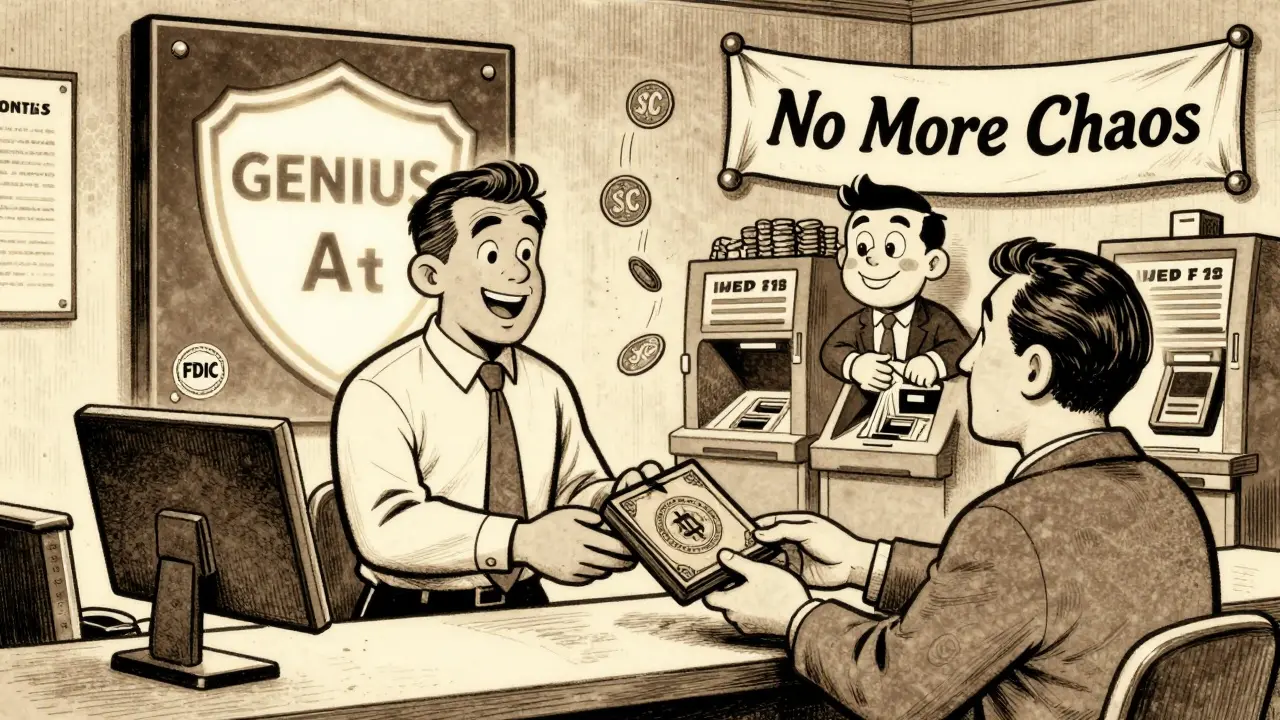
The U.S. didn’t wait for a court battle to decide if crypto was a security or a commodity. In 2025, Congress passed the GENIUS Act the Generating Energy and Nurturing Innovation for Stablecoins Act, a federal law enacted in 2025 that created a new regulatory category for payment stablecoins. It’s simple: if a stablecoin is designed to be used for payments - like USD Coin or USDC - it’s neither a security nor a commodity. It’s its own thing. And it’s regulated by the OCC the Office of the Comptroller of the Currency, a U.S. federal agency responsible for chartering and supervising national banks and federal savings associations, backed by the Fed, FDIC, and Treasury.
This changed everything. Banks can now offer crypto wallets. Payment processors can settle in stablecoins. Retailers can accept them. And because the law requires 100% reserve backing and daily audits, trust is rising. The CLARITY Act a proposed U.S. federal bill expected to pass in 2026 that would clarify the regulatory roles of the SEC and CFTC in digital asset markets is moving through the Senate. If it passes, it will define who regulates what - ending years of jurisdictional chaos between the SEC and CFTC.
Meanwhile, the SEC the U.S. Securities and Exchange Commission, responsible for regulating securities markets and enforcing federal securities laws is still active - but now it’s working with the CFTC. They’ve launched a joint innovation office to help startups navigate compliance. Tokenized bonds? Approved. Tokenized real estate funds? Approved. Even DAOs with clear governance and legal wrappers are getting no-action letters. The message? Innovation is welcome - if you play by the rules.
DeFi Isn’t Immune Anymore
People used to say, "DeFi is decentralized, so regulators can’t touch it." That myth died in 2025. Regulators aren’t trying to shut down Ethereum. They’re going after the people who run the front ends, the developers who control upgrade keys, and the companies that market DeFi protocols as "risk-free yield."
In 2026, if a DeFi protocol has a CEO, a marketing team, or a website that collects user data - it’s regulated. The FATF the Financial Action Task Force, an intergovernmental body that sets standards to combat money laundering and terrorist financing, including for cryptoassets updated its guidance to say: "If you’re controlling the user experience, you’re a VASP." That means even open-source projects with centralized governance are now in scope. The Basel Committee an international body that provides recommendations on banking regulations, now including cryptoasset risk weights in its capital framework even added crypto exposure to bank capital requirements. Banks can’t ignore it anymore.
Tokenized real-world assets - like real estate, commodities, or art - are under the heaviest scrutiny. If a token represents ownership in a building or a share of a fund, it’s treated like a security. No matter how "decentralized" the platform claims to be.
Global Tax Reporting Is Now Real
Remember when crypto was tax-free? That ended in 2025. The CARF the Common Reporting Standard for Crypto-Assets, a global tax information-sharing framework adopted by over 100 jurisdictions in 2025 is now active. Over 100 countries, including the U.S., EU, UK, Singapore, and UAE, are automatically sharing transaction data on crypto users. Exchanges, custodians, and even peer-to-peer platforms with more than 500 users must report: who sent what, when, and to whom.
The IRS now requires crypto brokers to file Form 1099-B for every trade. The EU requires the same under its AML package. Even if you’re in Canada, if you used a U.S.-based exchange, your data is being sent to the CRA. There’s no hiding anymore. And penalties for underreporting? They’re now on par with traditional financial fraud.

Illicit Activity Is Driving the Push
In 2025, illicit crypto transactions hit $158 billion - up 145% from 2024. That’s more than the GDP of 80 countries. It’s not just ransomware. It’s fraud, darknet markets, and state-backed actors. This spike forced regulators to act. No more "we’re still learning." The message from the FSB the Financial Stability Board, an international body that monitors and makes recommendations about the global financial system, including cryptoasset risks was clear: if you can’t control it, you don’t get to operate.
That’s why stablecoin rules are so strict. Why KYC is mandatory. Why even NFT marketplaces now need AML checks. The goal isn’t to kill innovation. It’s to stop criminals from using crypto as a shield.
What’s Next? The Winners Will Be the Compliant
The future of crypto isn’t about being the fastest or the most decentralized. It’s about being the most transparent. Firms that built strong AML programs, kept clear reserves, and worked with regulators are thriving. Those that tried to game the system? They’re gone.
Tokenized assets are the next big wave - but only if they’re issued under license. Cross-border payments using stablecoins? Growing fast - but only if they follow CARF and Travel Rule rules. On-chain identity? Coming. But it won’t be anonymous. It’ll be verified.
If you’re a user, your wallet will soon look more like a bank account - with clear disclosures, mandatory ID checks, and no hidden fees. If you’re a builder, you’ll need legal counsel before launching anything. There’s no such thing as "regulatory arbitrage" anymore. The global system is aligned.
Bottom Line
Crypto regulation in 2026 isn’t about stopping innovation. It’s about integrating it. The days of wild west crypto are over. The new rules are clear, enforceable, and global. The winners? Those who adapt fast. The losers? Those who still think they can fly under the radar.
Is crypto still anonymous in 2026?
No. Anonymous crypto transactions are nearly impossible in 2026. The EU’s AMLA, the FATF’s Travel Rule, and CARF require all major exchanges and wallet providers to verify users and report transactions. Even DeFi front ends that collect user data must comply. If you’re using a regulated service - which most are - your identity and transaction history are recorded and shared across borders.
Can I still use DeFi without getting regulated?
Only if you’re truly using a fully decentralized protocol with no central team, no marketing, and no user-facing website. But even then, if you’re interacting with a protocol that’s promoted on social media or has a centralized governance vote, regulators can and will target the developers or front ends. Most DeFi users today are interacting with platforms that are now classified as VASPs - meaning they’re subject to the same rules as banks.
Do I need to report my crypto trades to the IRS if I’m not in the U.S.?
Yes - if you used a U.S.-regulated exchange or custodian. Under CARF, over 100 countries share crypto transaction data automatically. So even if you live in Canada, Australia, or Brazil, your U.S.-based exchange reports your trades to your home country’s tax authority. Ignorance isn’t a defense anymore.
What’s the difference between MiCA and the GENIUS Act?
MiCA is a broad EU regulation covering all cryptoassets - from Bitcoin to NFTs - with licensing rules for service providers. The GENIUS Act is narrower: it only applies to payment stablecoins in the U.S., giving them a new legal category outside of securities or commodities. MiCA regulates the whole ecosystem. GENIUS focuses on one use case: everyday payments with stablecoins.
Are NFTs regulated now?
It depends. If an NFT is just a digital collectible with no financial rights, it’s mostly unregulated. But if it grants ownership in a company, revenue share, or real-world asset - it’s treated as a security. In the EU and U.S., NFT marketplaces that list these types of tokens must now comply with securities laws, KYC, and disclosure rules. Many platforms have already pulled non-compliant NFTs.
Looking ahead, the next big shift will be in cross-border licensing. If you’re a crypto firm in 2026, you won’t need separate licenses for every country - just one that meets global standards. The era of regulatory fragmentation is ending. The future belongs to those who build with compliance baked in.

Arya Dev
February 22, 2026 AT 11:38Leslie Cox
February 22, 2026 AT 13:29Derek Sasser
February 24, 2026 AT 08:33Nadia Shalaby
February 24, 2026 AT 17:58Fiona Monroe
February 26, 2026 AT 05:55Lucy Simmonds
February 27, 2026 AT 00:51Jessica Carvajal montiel
February 28, 2026 AT 05:12maya keta
March 1, 2026 AT 08:12Sean Logue
March 2, 2026 AT 03:16Carl Gaard
March 2, 2026 AT 06:11bella gonzales
March 3, 2026 AT 19:14Paul Reinhart
March 4, 2026 AT 16:17Samantha Stultz
March 5, 2026 AT 18:05Robert Conmy
March 6, 2026 AT 09:13Lilly Markou
March 7, 2026 AT 11:42Amita Pandey
March 8, 2026 AT 17:19