
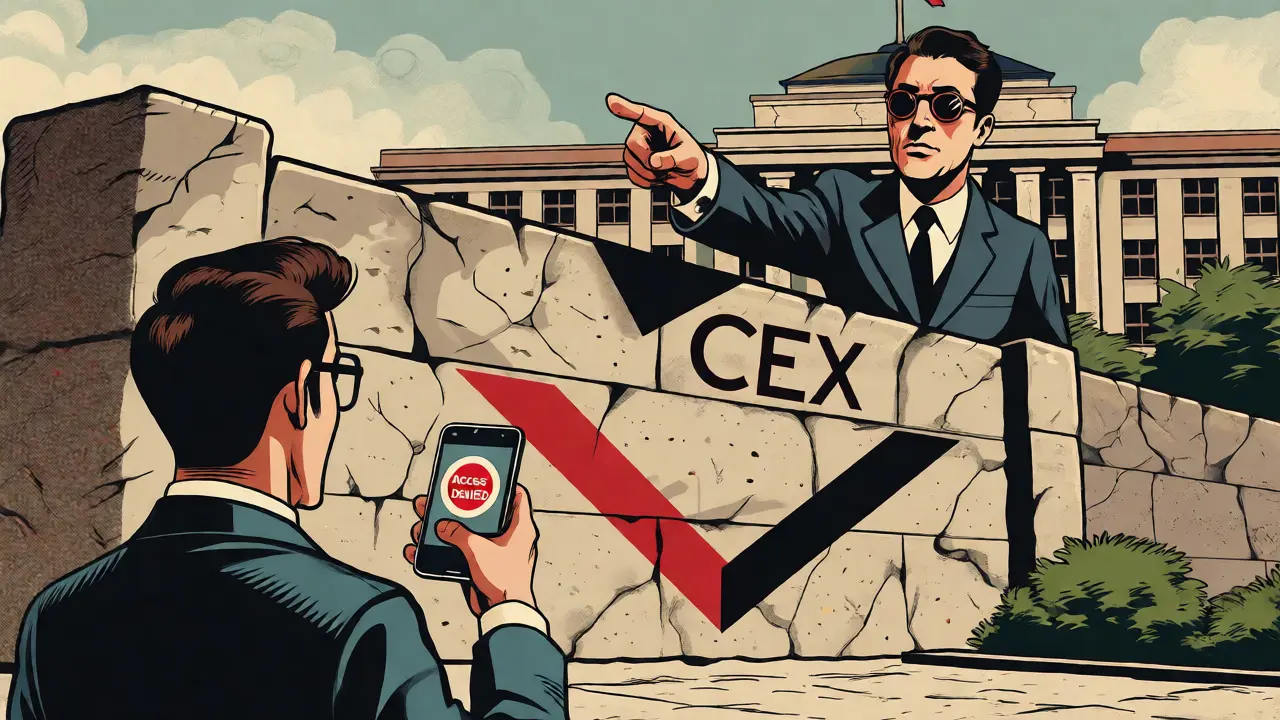
You just bought a new phone, downloaded your favorite trading app, and tried to swap some Bitcoin for Ethereum. But instead of a trade confirmation, you get a cold error message: "Service unavailable in your region." It’s frustrating, especially when you know the blockchain itself doesn’t care where you live. This is the reality of geographic crypto restrictions. The difference between using a Centralized Exchange (CEX) and a Decentralized Exchange (DEX) often comes down to whether a government can point a finger at a specific company headquarters or server location.
If you are trying to figure out which platform will actually let you trade from your current location, you need to understand how these two types of exchanges handle borders. One relies on legal licenses and human verification; the other relies on code that runs on thousands of computers worldwide. Let's break down why your zip code matters more than you think.
The Core Difference: Who Controls Access?
To understand the restrictions, you have to look at who holds the keys. A Centralized Exchange (CEX) is like a traditional bank or brokerage. It is a company with a physical address, employees, and a legal entity registered in a specific country. Because it is a business, it must obey the laws of every place it wants to do business. If Binance operates in Canada, it follows Canadian rules. If Coinbase operates in the US, it follows SEC guidelines. This structure makes them easy targets for regulators. If the US government decides a certain token is a security, they can simply order the CEX to delist it for US users.
In contrast, a Decentralized Exchange (DEX) is not a company. It is a set of smart contracts deployed on a blockchain. There is no CEO to subpoena, no headquarters to raid, and often no single entity that "owns" the protocol. Uniswap, for example, is a protocol on Ethereum. When you trade on Uniswap, you aren't trusting a company to hold your money; you are interacting directly with code. This fundamental architectural difference is why DEXs have historically been harder to block geographically.
How CEXs Enforce Geographic Blocks
CEXs use a layered approach to keep restricted users out. It starts simple and gets invasive quickly.
- IP Address Blocking: This is the first line of defense. When you visit a CEX website, it checks your IP address. If your IP resolves to a sanctioned country or a jurisdiction where the exchange lacks a license (like the US for many offshore exchanges), the site might simply refuse to load or redirect you.
- KYC Verification: This is the real barrier. Almost all major CEXs require Know Your Customer (KYC) checks. You upload a passport or driver's license. The system reads your address and nationality. Even if you spoofed your IP to look like you were in Europe, if your ID says you live in New York, you are blocked from derivatives trading or the entire platform.
- Banking Relationships: To deposit fiat currency (dollars, euros), you need a bank account. Banks are heavily regulated. If a bank sees transactions coming from a non-compliant crypto exchange, they may freeze your funds. This effectively restricts access even if the digital interface works.
These measures make CEXs reliable but rigid. If you move to a new country, you might lose access to features overnight because the local regulator changed their mind about crypto licensing.
Why DEXs Are Harder to Restrict
DEXs operate on a different logic. Since there is no central authority, there is no one to tell the network to stop serving users in China or the United States. The blockchain nodes run globally. However, this doesn't mean DEXs are completely immune to geography.
The primary mechanism for restriction here is the user interface (UI). While the smart contract lives on the blockchain, the website you click on to interact with it is hosted on servers. Some DEX front-ends, like the official Uniswap interface, have implemented geo-blocking for specific countries due to regulatory pressure. But here is the catch: because the underlying protocol is open-source, anyone can build a new front-end. If Uniswap blocks your IP, you can use a third-party interface, connect your wallet, and still execute trades against the same liquidity pools.
Furthermore, DEXs typically do not require KYC. You connect a wallet like MetaMask or Phantom. The protocol doesn't know your name, your address, or your citizenship. It only knows your public key. This anonymity makes it technically difficult to enforce geographic bans without breaking the core functionality of the network.

Regulatory Pressure and the Gray Area
Is the DEX landscape really a free-for-all? Not anymore. Regulators are getting smarter. In 2026, we are seeing a shift toward targeting the developers and the infrastructure providers rather than just the exchanges themselves.
Consider the US Securities and Exchange Commission (SEC). They have argued that certain DeFi protocols act like unregistered securities exchanges. While they cannot easily shut down a smart contract on Ethereum, they can sue the development team behind it. This creates a chilling effect. Developers might choose to restrict access to US IPs voluntarily to avoid lawsuits, even if the technology allows global access.
There is also the issue of Layer 2 solutions. As more trading moves to networks like Arbitrum or Optimism, the data availability layers and sequencers become potential choke points. If a sequencer operator decides to filter transactions based on origin, geographic restrictions creep back into the decentralized world. We are already seeing early examples of this in emerging regulatory frameworks in the EU under MiCA (Markets in Crypto-Assets regulation).
Fiat On-Ramps: The Biggest Bottleneck
Here is a practical problem most beginners overlook. You can trade on a DEX from anywhere, but how do you get crypto onto the DEX in the first place?
Most people start with fiat currency in their bank account. CEXs excel here. You link your bank account, send $1,000, and buy Bitcoin. DEXs generally do not accept fiat. You need crypto to buy crypto. So, if you live in a country where CEXs are banned, you have a chicken-and-egg problem. You need a CEX to get crypto, but the CEX won't let you sign up because of your location.
This forces users in restrictive regions to rely on Peer-to-Peer (P2P) markets or specialized fiat on-ramps like MoonPay or Ramp, which integrate with wallets. These services often have their own geographic restrictions, mirroring those of traditional banks. So, while the DEX itself is borderless, the bridge from your bank account to the blockchain remains heavily gated by geography.
Comparison Table: CEX vs DEX Accessibility
| Feature | Centralized Exchange (CEX) | Decentralized Exchange (DEX) |
|---|---|---|
| Identity Requirement | Mandatory KYC (ID proof required) | None (Wallet connection only) |
| Blocking Method | IP Block + ID Verification + Banking Rules | Front-end IP Block (bypassable via API/Wallet) |
| Fiat Support | High (Direct bank transfers) | Low (Requires external on-ramp) |
| Regulatory Risk | High (Company can be fined/shut down) | Medium (Developers/UI hosts targeted) |
| Global Reach | Patchwork (Depends on local licenses) | Universal (At protocol level) |

Real-World Scenarios: Where Do You Stand?
Let's look at three common situations to see how this plays out.
Scenario 1: The US Trader. You live in California. You want to trade altcoins. On a CEX like Coinbase, you are limited to assets that are clearly not securities. Many popular tokens are missing. On a DEX like Uniswap, you can find almost any ERC-20 token. However, you must be careful. The IRS requires you to report taxes on every trade. Since DEXs don't provide tax forms, you need third-party software to track your activity. Also, if the SEC cracks down on a specific protocol, the UI might block your US IP, forcing you to use a different interface.
Scenario 2: The User in a Restricted Nation. Imagine you live in a country where crypto trading is banned outright. A CEX like Binance won't let you register. You can't use your local bank card. You might turn to a DEX. You can download a wallet and swap tokens. But buying the initial ETH? That's hard. You might use P2P platforms like LocalBitcoins, where you send cash via Western Union to another user, and they release BTC to your wallet. Once you have crypto, the DEX is accessible. The restriction is on entry, not necessarily on movement within the chain.
Scenario 3: The Traveler. You are a digital nomad moving between Thailand, Portugal, and Brazil. With a CEX, your access might fluctuate. Logging in from a Thai IP might trigger a security check requiring additional verification. Some CEXs restrict leverage or futures trading based on your current location. With a DEX, you just connect your wallet. The experience is identical everywhere. The gas fees change, but the ability to trade does not.
The Future of Geographic Filtering
We are entering an era of "compliance-aware DeFi." Projects are building tools that allow users to prove they are not in restricted jurisdictions without revealing their exact identity. Zero-knowledge proofs (ZKPs) could allow you to prove you are over 18 and not in the US, without showing your passport. This would satisfy regulators while preserving privacy.
However, the trend is toward more friction, not less. As institutional money enters DeFi, they demand compliance. Institutions won't touch a pool that has mixed funds from sanctioned entities. This leads to "permissioned" liquidity pools on DEXs, where only verified addresses can participate. The clean binary of "CEX = Restricted, DEX = Free" is blurring. Instead, we are seeing a spectrum of access levels depending on the specific asset, the protocol, and your risk tolerance.
Key Takeaways for Users
- Check Before You Commit: Don't assume a DEX is available in your country. Check the Terms of Service of the front-end you are using.
- Fiat is the Choke Point: Your biggest geographic hurdle is usually getting money into crypto, not swapping it once it's there.
- Tax Implications Vary: CEXs often provide transaction history for taxes. DEXs leave you to do the work. Ensure you have tools to track cross-border transactions.
- Use Hardware Wallets: Regardless of geography, keeping custody of your keys protects you from exchange freezes, which can happen due to regulatory shifts in the exchange's home country.
Understanding these nuances saves you from locked accounts and lost opportunities. The blockchain is global, but the gateways to it are very much local.
Can I use a VPN to bypass CEX geographic restrictions?
Technically, yes, a VPN can mask your IP address. However, most reputable CEXs require KYC verification, which involves uploading a government-issued ID. If your ID shows an address in a restricted country, the exchange will likely reject your application or limit your account features, regardless of your IP address. Additionally, using a VPN might violate the Terms of Service, leading to account suspension.
Are DEXs completely anonymous?
No, DEXs are pseudonymous, not anonymous. While you don't provide personal information like your name, all your transactions are recorded on a public blockchain. Anyone can trace the flow of funds from your wallet address. If you ever interact with a service that requires KYC (like a fiat on-ramp), your wallet address becomes linked to your identity, potentially de-anonymizing your past DEX activity.
Why do some DEX websites block my country?
While the smart contracts run on a decentralized blockchain, the website interface (front-end) is usually hosted on centralized servers. Companies hosting these sites may block traffic from certain countries to comply with local laws or reduce liability. However, because the protocol is open, you can often still trade by connecting your wallet directly to the blockchain node or using an alternative interface built by a different developer.
Do I pay taxes differently on CEXs vs DEXs?
The tax rate is usually determined by your country of residence, not the type of exchange. However, reporting is easier on CEXs because they provide downloadable transaction histories. On DEXs, you must manually track every swap, add, and remove liquidity event across multiple chains. Failure to accurately report DEX transactions is a common audit risk.
What happens if my country bans crypto exchanges?
If your country bans exchanges, you will likely lose access to CEXs. For DEXs, the ban is harder to enforce technically. You can still run a wallet and interact with the blockchain. However, accessing fiat currency becomes difficult. You may need to rely on peer-to-peer cash deals or international bank transfers to acquire crypto, which carries higher counterparty risk.
