
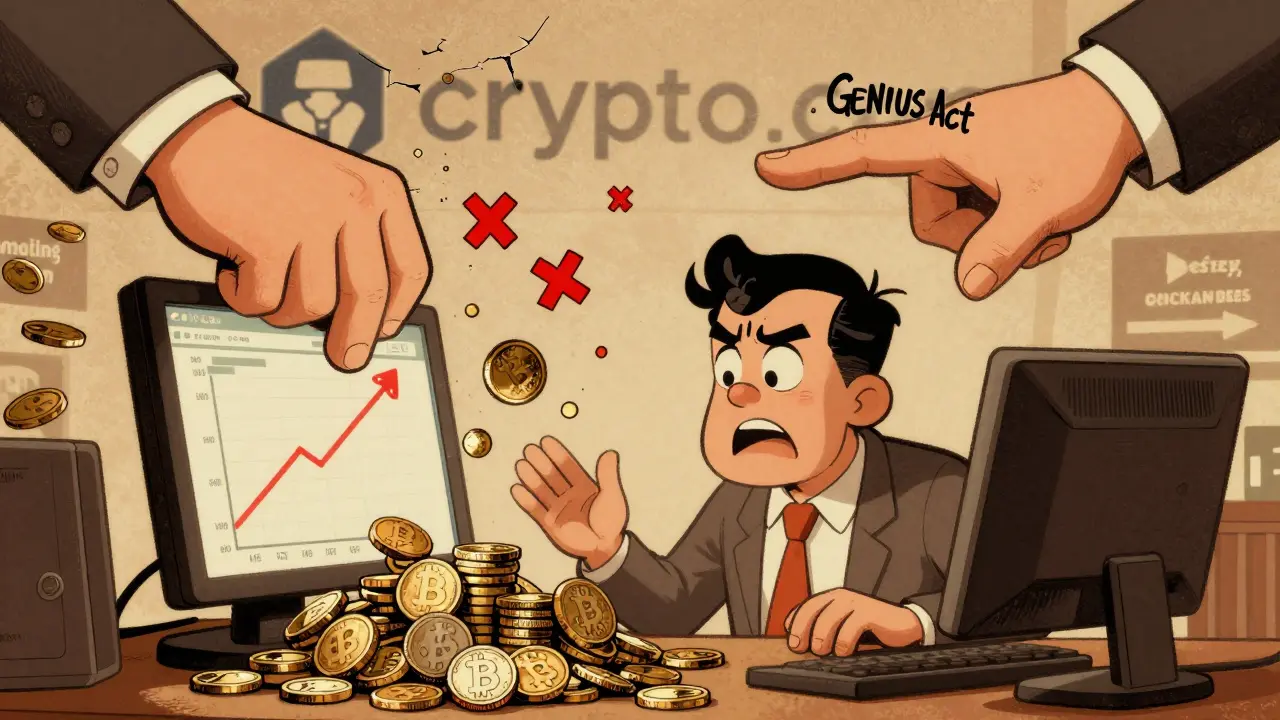
Trading volume in cryptocurrency markets has been falling - not because people stopped caring, but because governments started enforcing rules. In 2025, major exchanges saw spot trading volume drop by nearly 28% quarter-over-quarter, even as Bitcoin hit new all-time highs. That doesn’t make sense unless you understand what’s really happening: regulatory restrictions are reshaping where and how people trade.
What’s Actually Causing the Drop?
It’s not a lack of interest. Bitcoin rose over 30% in Q2 2025. Ethereum held steady. New institutional money poured into crypto ETFs - over $5.95 billion in just one week. But on centralized exchanges like Crypto.com, Binance, and Kraken, trading volume cratered. Why? Because regulators started demanding licenses, KYC checks, and stablecoin backing rules. Exchanges had to choose: comply and lose users, or ignore rules and get shut down. Most picked compliance. And that meant cutting access. Crypto.com’s volume plunged 61.4% in Q2 2025. It didn’t lose customers because the market crashed. It lost them because U.S. regulators required it to delist dozens of tokens that didn’t meet new compliance standards. Suddenly, users couldn’t trade popular altcoins. They left. Others moved to exchanges in Singapore, Switzerland, or the UAE - places with clearer, less aggressive rules.The U.S. GENIUS Act Changed Everything
The biggest turning point came with the GENIUS Act, passed in mid-2025. It forced all stablecoins issued in the U.S. to be backed 1:1 by U.S. dollars held in FDIC-insured banks. No more algorithmic stablecoins. No more Terra-style collapses. Sounds good, right? But here’s the catch: it also required exchanges to verify every single transaction involving U.S. users. That meant blocking access to non-compliant tokens, freezing accounts, and delaying withdrawals. Users reported waiting weeks just to trade USDT. Some exchanges delisted over 80% of their altcoin pairs overnight. The result? U.S.-based trading volume dropped 18.7% in the first quarter after implementation. Reddit threads exploded with complaints: “Why can’t I trade SHIB anymore?” “My account got frozen for no reason.” “I moved to Binance.US and lost access to 12 coins I held.”It’s Not Just the U.S.
Europe’s MiCA regulation, which rolled out fully in 2025, had a different effect. Instead of banning tokens, it created a legal path for compliant ones. That’s why EURC - a euro-backed stablecoin - jumped from $47 million to $7.5 billion in monthly volume in just one year. Institutional investors flocked to it. Exchanges like Bitpanda and Kraken Europe saw only a 12% volume dip - then rebounded as users trusted the system more. India? They slapped a 30% tax on crypto gains and forced exchanges to report every transaction. Trading volume didn’t collapse - it just moved underground. Peer-to-peer trading grew 42% in 2025. People still bought crypto. They just stopped using regulated exchanges. Japan and Switzerland? They gave clear rules, fast approvals, and low fees. Exchanges there saw volume drops of only 7-9%. Users didn’t leave because they knew what was allowed. No surprises. No sudden delistings.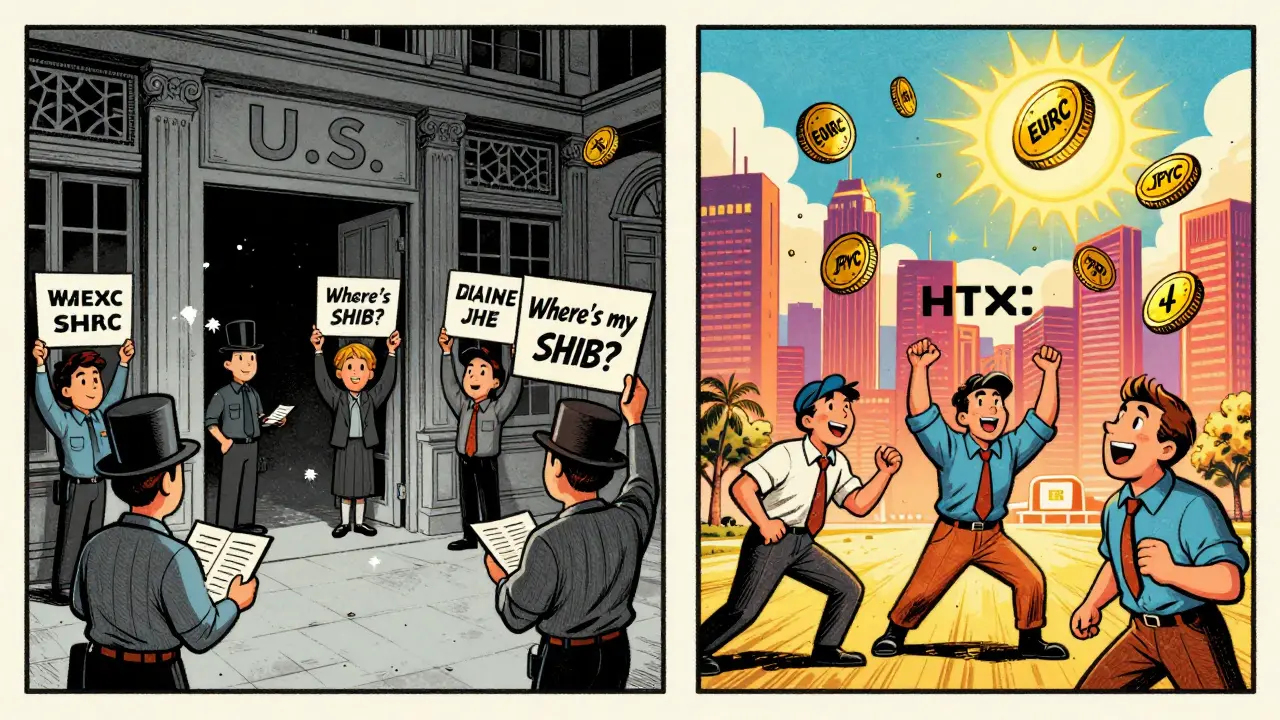
Who’s Gaining? Who’s Losing?
The market isn’t shrinking - it’s splitting. Here’s what happened in Q2 2025:- Big losers: Crypto.com (-61.4%), Binance (U.S. arm down 48%), Kraken (U.S. down 39%)
- Small winners: MEXC (+3.7%), HTX (+5.4%), Bitget (+3.0%) - all moved key operations offshore
- Stablecoin winners: USDT and USDC still dominate, but EURC and JPYC are growing fast in compliant markets
- Institutional winners: Crypto ETFs attracted $5.95 billion in one week - because they’re regulated, not because crypto is dying
Why This Isn’t Just a Temporary Dip
In past bull markets, rising prices meant rising volume. More people bought. More people traded. More people made money. That’s over. Now, price and volume are decoupled. Bitcoin can go up 30% while spot trading volume falls 28%. That’s never happened before. Why? Because the people who used to trade daily - retail speculators, meme coin hunters, DeFi farmers - are being pushed out by regulation. The new buyers? Institutions. They don’t trade on Binance. They buy through regulated ETFs. They don’t need to trade every day. They hold. That’s why volume is down - but market cap is up.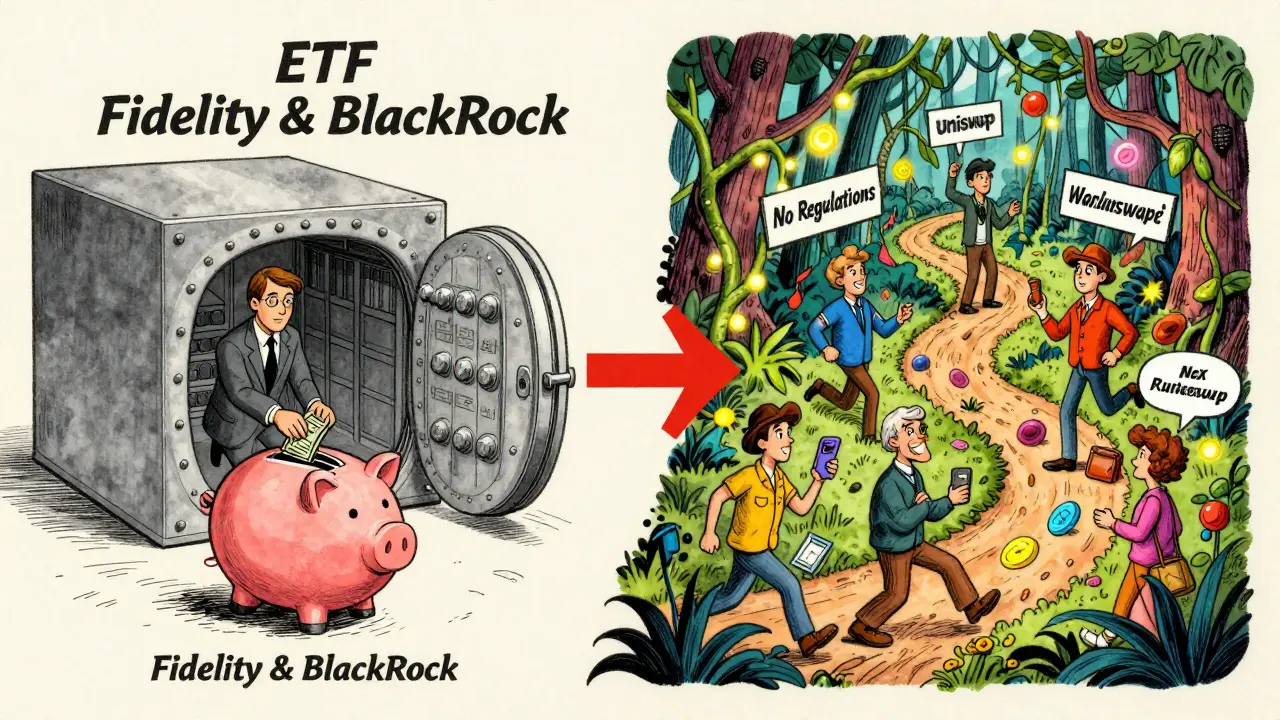
The Dark Side: Illicit Activity Is Down, But So Is Trust
Regulators point to one win: illicit crypto activity dropped 51% from 2023 to 2025. That’s huge. Money laundering, ransomware payments, darknet markets - all shrinking. TRM Labs says it’s the best result in crypto history. But here’s the trade-off: users feel less control. One Reddit user wrote: “I used to trade 5 coins a day. Now I can only trade 2. I don’t even know why some got banned.” Trust isn’t growing because of safety - it’s growing because people have no choice. Trustpilot ratings for major exchanges fell from 4.3 to 2.5 stars in Q1 2025. Complaints about “sudden delistings” and “unexplained account freezes” made up 68% of all user feedback.What’s Next? The Market Is Reorganizing
By late 2025, the worst of the volume collapse is over. Exchanges have restructured. Users have adapted. The real shift isn’t in volume - it’s in structure. - Retail traders are moving to P2P platforms and decentralized exchanges (DEXs) like Uniswap and PancakeSwap. - Institutions are sticking to regulated ETFs and custodians like Fidelity and BlackRock. - Stablecoins are becoming the new backbone - not just for trading, but for global payments. JPMorgan predicts stablecoins will drive $1.4 trillion in new dollar demand by 2027. That’s not a drop. That’s growth. But it’s growth on new terms. The crypto market isn’t dying. It’s growing up. And growing up means losing some freedom. The exchanges that survive won’t be the ones with the most coins. They’ll be the ones with the clearest rules, the most transparent policies, and the fewest surprises.What Should You Do?
If you’re trading crypto in 2025, here’s what actually matters:- Know your jurisdiction’s rules - don’t assume what worked last year still works.
- Use regulated exchanges only if you’re in the U.S., EU, or Japan - they’re safer, even if they offer fewer coins.
- Keep your assets in non-custodial wallets if you want full control - but know you lose buyer protection.
- Focus on Bitcoin and major stablecoins. They’re the least likely to be banned.
- Don’t panic when volume drops. It’s not the market collapsing. It’s the market cleaning house.
Why is trading volume falling even though Bitcoin is going up?
Because regulation is changing who trades and how. Retail traders are being pushed off centralized exchanges due to delistings and compliance rules. Meanwhile, institutional investors are buying through regulated ETFs, which don’t show up in exchange volume data. So while Bitcoin’s price rises, spot trading volume drops because the buyers aren’t using the same platforms.
Did crypto regulations cause the volume drop, or was it just a market correction?
It’s not a market correction. In Q2 2025, Bitcoin rose over 30%, yet top exchanges saw a 27.7% drop in spot volume - the opposite of what normally happens in a bull market. CoinGecko, Chainalysis, and Bitwise all confirmed this disconnect was caused by regulatory actions like the U.S. GENIUS Act and MiCA in Europe, not by investor sentiment or macroeconomic factors.
Which exchanges are still growing despite restrictions?
MEXC, HTX, and Bitget were the only major exchanges to grow QoQ in Q2 2025. They did it by relocating key operations to jurisdictions with lighter regulations - like Singapore and the UAE. They kept listing altcoins that U.S. and EU exchanges had to delist, attracting traders who wanted more freedom.
Are stablecoins still popular after new regulations?
Yes - but only the compliant ones. USDT and USDC remain dominant, processing over $1 trillion monthly. But the real growth is in euro- and yen-backed stablecoins like EURC and JPYC, which are now fully licensed under MiCA and Japan’s new rules. These are becoming the preferred choice for institutions and cross-border payments.
Should I move my crypto to a decentralized exchange (DEX) to avoid restrictions?
If you want to trade tokens that got delisted on centralized exchanges, yes - DEXs like Uniswap and PancakeSwap still let you trade them. But you lose all protections: no customer support, no chargebacks, no insurance. You’re responsible for everything. Only use DEXs if you understand the risks and know how to use wallets securely.
Is crypto trading dead in the U.S.?
No - it’s just different. U.S. users can still trade Bitcoin, Ethereum, and major stablecoins on regulated platforms like Coinbase and Kraken’s U.S. arm. But altcoin trading is severely limited. The market is shifting from speculation to custody. If you’re holding crypto in the U.S., focus on regulated assets and long-term holds, not daily trading.
Will trading volume recover in 2026?
Yes - but not the way it used to. CoinGecko projects volume growth will return in Q1 2026 once exchanges finish adapting to MiCA and the GENIUS Act. The recovery won’t come from retail frenzy. It’ll come from institutional adoption, stablecoin payments, and cross-border use cases. Volume will be lower, but more stable and sustainable.

vaibhav pushilkar
December 19, 2025 AT 20:25Just move to P2P if you want freedom. No one’s stopping you - it’s just slower and riskier. But hey, at least you still get to trade SHIB.
SHEFFIN ANTONY
December 20, 2025 AT 12:18Oh wow, so now the government is the hero? 🤡 You think banning altcoins makes crypto 'mature'? It just makes it boring. I traded 12 coins yesterday on MEXC. The U.S. is turning crypto into a library card system.
Vyas Koduvayur
December 21, 2025 AT 08:27Let’s be real - this isn’t about regulation, it’s about control. The GENIUS Act didn’t stop money laundering, it just killed innovation. You think stablecoins are safe? USDC is backed by BlackRock, which is backed by the Fed. You’re not trading crypto anymore - you’re trading dollar derivatives with a blockchain sticker on it. And don’t get me started on MiCA - Europe’s version of ‘we’ll regulate you into oblivion but make it chic.’ The real winners? The custodians. The losers? Everyone who believed in decentralization. This isn’t growth - it’s corporate colonization wrapped in compliance jargon.
Lloyd Yang
December 22, 2025 AT 02:23Man, I feel you. I used to check my portfolio five times a day. Now I check it once a week and feel weirdly peaceful. It’s not the same thrill, but it’s less stressful. I switched to Coinbase and only hold BTC and ETH now - and honestly? My sleep improved. The market’s not dying, it’s just growing up. Like a teenager who finally stops buying energy drinks and starts eating veggies. It’s not as fun, but you’re not gonna crash at 3 AM anymore. And hey - if you’re holding crypto for the long haul, this is actually the *best* time to be in it. Less noise, more substance. No more meme coins pretending to be tech. Just real money moving behind the scenes. Institutions aren’t here to gamble - they’re here to build. And that’s kinda beautiful, if you let it be.
Jake Mepham
December 22, 2025 AT 13:26Look, I get why people are mad - I lost access to my DOGE bag too. But let’s not romanticize the wild west. Last year, 70% of crypto-related scams came from unregulated altcoins. The fact that illicit activity dropped 51%? That’s not a bug, that’s a feature. Yeah, it sucks that you can’t trade SHIB on Binance anymore - but you can still buy it on Uniswap. It’s not freedom if you’re funding a rug pull every Tuesday. The real revolution isn’t about which coins you can trade - it’s about whether your money’s safe. And for the first time ever, it kinda is.
Craig Fraser
December 23, 2025 AT 06:00Regulation is not the enemy. Chaos is. You people scream about 'freedom' while posting screenshots of your 1000x memecoin gains - then cry when the rug gets pulled. The fact that you think a 30% tax in India is 'oppression' is hilarious. At least they’re transparent. In the U.S., you get frozen accounts and zero explanations. At least India gives you a receipt. And you wonder why trust is low? You gave it away the moment you traded on an exchange with no KYC and a Telegram group as customer service.
Jacob Lawrenson
December 25, 2025 AT 05:00YESSSSS!!! 🙌 The market’s cleaning house and I’m HERE FOR IT! 🚀 No more pump-and-dumps, no more fake volume, no more 'this coin will moon by tomorrow' nonsense. Bitcoin’s going up because REAL money is coming in. The old school traders? They’re just mad they can’t play roulette anymore. But the grown-ups? They’re building. And guess what? They’re winning. 💪 Stay strong, stay regulated, stay sane. The future’s boring - and that’s awesome!
Zavier McGuire
December 26, 2025 AT 19:52so like... if i dont use binance anymore am i a bad person? i just wanna trade my doge
Sybille Wernheim
December 26, 2025 AT 21:41I used to think regulation was the enemy… until my friend lost $40k on a fake token called 'Shiba Inu 2.0' that vanished overnight. Now I get it. I’m not mad at the rules - I’m mad at myself for not asking questions. I moved my stuff to Coinbase and now I sleep like a baby. It’s not glamorous, but it’s safe. And honestly? That’s the new flex.
Cathy Bounchareune
December 27, 2025 AT 05:41Can we talk about how wild it is that EURC went from $47M to $7.5B in a year? That’s not just regulation - that’s cultural adoption. The eurozone didn’t ban anything. They just said, ‘if you want to play, here’s the rulebook.’ And people showed up. Meanwhile, the U.S. is still arguing about whether Dogecoin is a security. We’re not behind because we’re scared - we’re behind because we’re still in high school.
Jordan Renaud
December 29, 2025 AT 04:50It’s funny - we used to think freedom meant having 500 coins to trade. Now I think freedom means not waking up to a $20k loss because some guy on Twitter pumped a coin with no code. The market’s not dying. It’s evolving. And evolution always means letting go of something you loved. I miss the chaos. But I’m glad I’m not living in it anymore.
Luke Steven
December 29, 2025 AT 10:00Been holding since 2017. Seen three bull runs. This one’s different. No one’s yelling on Twitter anymore. No one’s selling their car to buy PEPE. Just quiet buying. Quiet holding. Quiet growth. The energy’s shifted from hype to heritage. It’s like watching your favorite band go from basement shows to Carnegie Hall. Still the same music - just better played. And honestly? I prefer it this way.
Ellen Sales
December 30, 2025 AT 18:13so like... if the government is the reason i cant trade my altcoins... does that mean they're the reason bitcoin went up? bc i feel like they just made it a 'safe' investment and now everyone's like 'ohhh let's put our 401k in this' and boom. crypto's rich but i'm still broke 😅
Sheila Ayu
December 31, 2025 AT 23:37Wait, wait, wait - you’re telling me that people are actually *happy* about this? That they’re *celebrating* the fact that they can’t trade their favorite coins? That’s not maturity - that’s surrender. And don’t tell me about ‘institutional adoption’ - if you’re buying crypto through an ETF, you’re not even owning crypto. You’re owning a derivative of a security that tracks a blockchain. You’re not in the future - you’re in a Bloomberg terminal. And you call that progress?
Radha Reddy
January 1, 2026 AT 03:55India’s 30% tax? It’s not a punishment - it’s a filter. It removes the gamblers. Leaves the builders. I still buy crypto every month - just not on exchanges. P2P is slower, yes. But I know who I’m trading with. And I sleep better. Regulation isn’t the enemy. Greed is.
Shubham Singh
January 2, 2026 AT 03:28Let me break this down for you, because clearly, you’ve missed the point: the GENIUS Act didn’t cause the drop - your ignorance did. You traded altcoins without understanding their whitepapers. You didn’t care about liquidity, security, or audits. You cared about 100x returns. Now you’re upset because the adults finally turned on the lights. The market didn’t collapse - your delusions did. Cry harder.
Charles Freitas
January 2, 2026 AT 09:37Oh look, another ‘crypto is growing up’ think piece. Let me guess - you’re also the guy who thinks NFTs are ‘art’ and that ‘decentralization’ means ‘I can’t trade my shitcoin anymore.’ The truth? The market didn’t mature. The regulators won. And now we’re all just employees of the state, trading tokens with a government stamp on them. Congrats, you traded freedom for a 2.5-star Trustpilot rating.
Sarah Glaser
January 2, 2026 AT 11:46The shift from retail speculation to institutional custody is the most significant structural change in crypto history. The volume decline is a metric artifact - not a market failure. ETFs are not trading volume; they are balance sheet activity. The true indicator of adoption is not daily trades, but capital allocation. $5.95 billion in one week into regulated ETFs represents a paradigm shift. This is not a decline - it is a reclassification. The market is becoming more efficient, not less.
Jake Mepham
January 4, 2026 AT 05:59Just read the last comment. Sarah nailed it. This isn’t about volume - it’s about who’s playing. Retail used to drive the noise. Now institutions are the silent buyers. That’s why Bitcoin’s up and volume’s down. It’s not a bug. It’s the system working as intended. We’re not losing crypto - we’re gaining a real financial asset. And honestly? I’ll take that over another 100x meme coin any day.