

Have you ever wondered how billions of smart devices talk to each other without clogging up the internet? That’s where MXC, or Machine eXchange Coin, comes in. It’s not your typical cryptocurrency designed just for speculation. Instead, it’s a utility token built specifically for the Internet of Things (IoT) ecosystem.
If you’re looking at MXC on your screen right now, you might be confused by the price discrepancies across different exchanges or wondering if this tiny market cap coin has any real-world use. The short answer is yes, but with major caveats. MXC aims to solve a very specific problem: making data transactions between low-power devices cheaper and more efficient. Let’s break down what that actually means for you as an investor or tech enthusiast.
The Core Concept: Bridging IoT and Blockchain
To understand MXC is a decentralized platform designed to facilitate IoT data transactions using Low Power Wide Area Network (LPWAN) technology, you first need to understand the bottleneck in the current IoT world. Imagine a smart city with thousands of sensors monitoring traffic, air quality, and waste management. These devices send small amounts of data constantly. Traditional cloud services charge per transaction, which gets expensive fast when you have millions of devices.
MXC was founded on August 8, 2018, by the MXC Foundation, a non-profit organization based in Berlin, Germany. Their goal wasn’t to create the next Bitcoin. It was to build a decentralized infrastructure called MXProtocol, which creates a marketplace for IoT data. This protocol allows device manufacturers to monetize the data their hardware collects, while giving buyers access to cheap, reliable information streams.
The key differentiator here is the focus on LPWAN. Unlike Wi-Fi or cellular networks that consume high power, LPWAN technologies like LoRaWAN allow sensors to run on batteries for years. MXC integrates with these networks to handle the financial layer of these micro-transactions seamlessly.
Technical Specifications: What Are You Actually Holding?
When you buy MXC, you aren’t buying a standalone blockchain coin like Bitcoin. Technically, it operates as an ERC-20 token built on the Ethereum blockchain. This means it relies on Ethereum’s security and network effects, but it also inherits Ethereum’s transaction fees unless Layer 2 solutions are implemented.
| Attribute | Value / Detail |
|---|---|
| Token Standard | ERC-20 (Ethereum) |
| Smart Contract Address | 0x5ca381bbfb58f0092df149bd3d243b08b9a8386e |
| Total Supply | ~2.66 Billion - 2.99 Billion (varies by source) |
| Decimals | 18 |
| All-Time High (ATH) | $0.13 (January 19, 2022) |
Always double-check the contract address before sending funds. Scammers often create fake tokens with similar names. The official supply figures hover around 2.7 billion tokens, though some aggregators list slightly higher numbers due to minting mechanics or reporting delays. The 18 decimal places mean even a fraction of a cent represents a significant number of tokens, which is common for utility coins with high volume potential.
Market Reality: Price, Volatility, and Liquidity Risks
Here is where things get tricky for new investors. If you look at MXC today, you will see wildly different prices depending on where you look. One aggregator might show $0.000144, while another shows $0.0016. Why such a huge gap?
It comes down to liquidity and exchange fragmentation. MXC is not listed on all major Tier-1 exchanges anymore. Many delisted it during previous bear markets. This means trading volume is concentrated on fewer platforms. When volume is low, large trades can spike the price artificially, creating false signals.
- Price Discrepancy: As of late 2025 and early 2026, prices ranged from fractions of a cent to roughly $0.03 on less liquid venues. Always check the 24-hour volume relative to the market cap.
- Market Cap Decline: From its peak in January 2022, MXC has dropped over 99% in value. This is not unusual for niche altcoins that failed to capture mainstream adoption quickly.
- Liquidity Issues: With daily volumes sometimes lower than its total market capitalization, selling large positions can be difficult without crashing the price further.
This volatility isn’t a bug; it’s a feature of small-cap, niche cryptocurrencies. You are betting on the future utility of the protocol, not current cash flow. If the IoT data market doesn’t adopt MXC as its standard payment method, the token remains speculative.
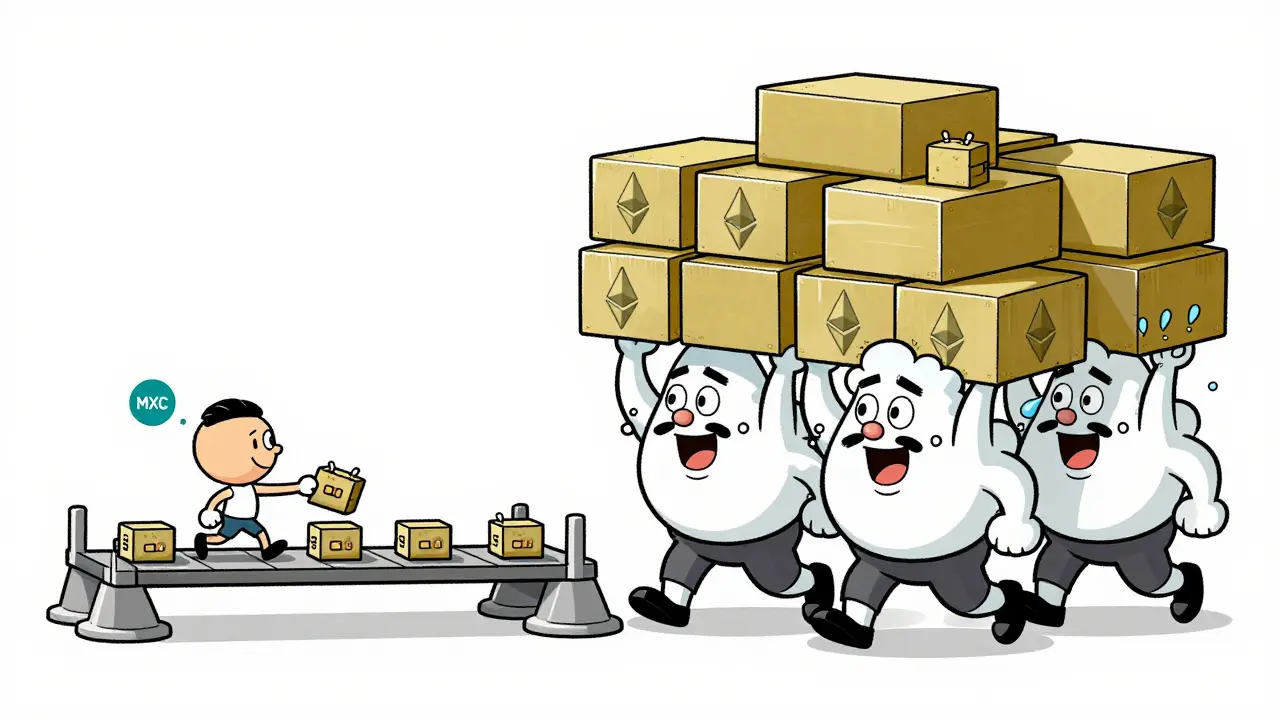
How Does MXC Compare to Other IoT Tokens?
You might ask, "Why not just use IOTA or Helium?" Those are valid questions. The IoT blockchain space is crowded. Here is how MXC stacks up against the heavy hitters.
| Feature | MXC | IOTA ($IOTA) | Helium ($HNT) |
|---|---|---|---|
| Primary Focus | Data Monetization & LPWAN | Tangle Ledger for Device-to-Device | Decentralized Wireless Networks |
| Blockchain Type | Ethereum (ERC-20) | Custom Tangle (DAG) | Solana (formerly own chain) |
| Market Position | Niche / Low Market Share | Top 50 Global Rank | Top 250 Global Rank |
| Staking Rewards | Yes (Supernode Profits) | No (Proof of Work/Work) | Yes (Hotspot Mining) |
IOTA uses a unique structure called the Tangle, which requires no miners and charges zero fees. It’s technically superior for massive scale but has struggled with centralization concerns. Helium focuses on physical infrastructure-people buying hotspots to provide coverage. MXC sits in the middle, focusing on the *data* itself rather than just the connection. Its staking mechanism, allowing users to share in Supernode profits, is a unique incentive model that competitors don’t offer in the same way.
The Ecosystem: Staking, Nodes, and Partnerships
For those who believe in the long-term vision, holding MXC idle isn’t the most effective strategy. The project encourages participation through its network nodes. The MXC Foundation reports over 12,000 active nodes worldwide as of recent updates. These nodes validate transactions and store data.
Users can stake their MXC tokens to support the network. In return, they earn a portion of the profits generated by Supernodes. Some community members have reported annual percentage yields (APY) ranging from 10% to 15%, though this fluctuates based on network activity and token price stability. Keep in mind that staking locks your tokens, meaning you can’t sell them if the market crashes unexpectedly.
Partnerships are crucial for utility. MXC has announced collaborations with companies like Cisco for LPWAN gateway integration. While these sound impressive on paper, the real test is whether these partnerships lead to actual transaction volume. So far, adoption has been slow compared to the explosive growth seen in DeFi or NFT sectors.
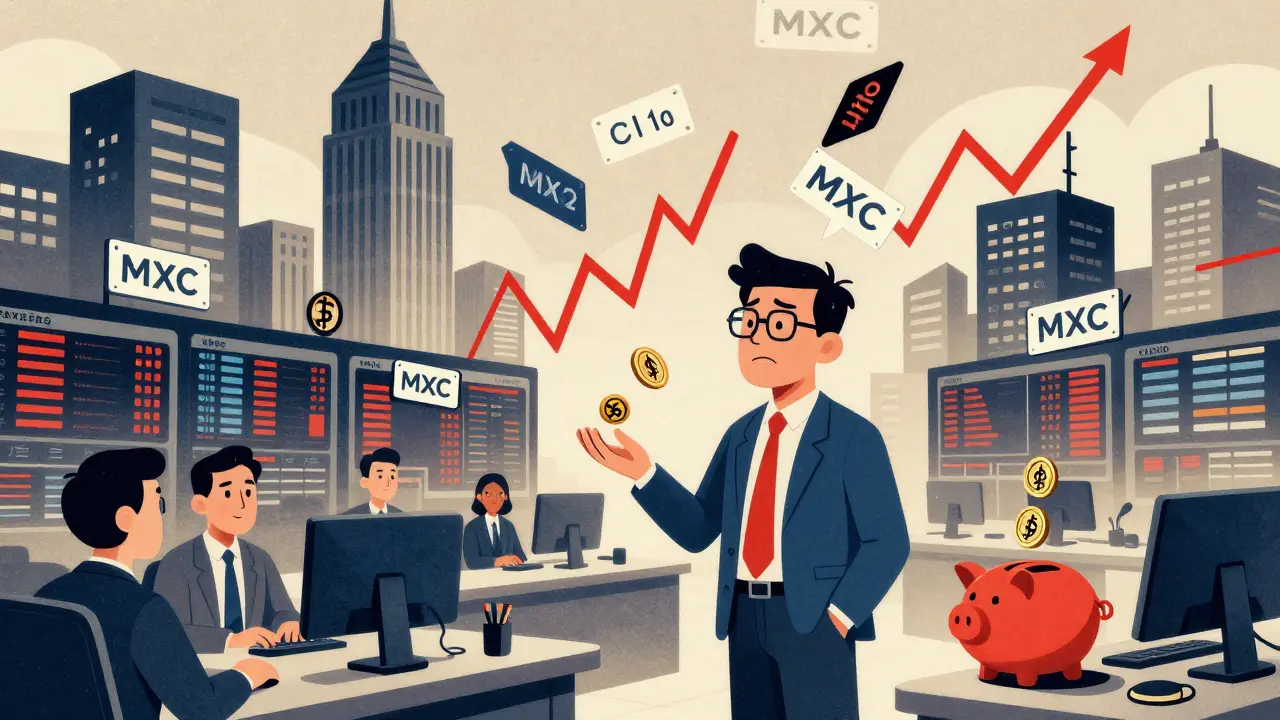
Risks and Challenges: What Could Go Wrong?
Let’s be honest about the downsides. Investing in MXC carries significant risk.
- Regulatory Uncertainty: Because MXC is a utility token tied to a specific ecosystem, regulators in some countries might classify it as a security. No formal actions have been taken yet, but the threat looms over many altcoins.
- Competition: Giants like IBM Watson IoT dominate the enterprise sector. Convincing big corporations to switch to a smaller, experimental blockchain solution is an uphill battle.
- Delisting Risk: As mentioned, several major exchanges have removed MXC pairs. This reduces accessibility and increases the risk of being stuck with tokens you can’t easily trade.
- Technology Hurdles: Integrating blockchain with legacy IoT systems is complex. Developers report a moderate learning curve, and wallet integration issues have led to mixed user reviews.
Analysts at firms like Messari have expressed skepticism, noting that MXC lacks the deep utility required to survive in such a competitive landscape. However, the MXC Foundation argues that as IoT data transactions grow exponentially, demand for their specific solution will follow.
How to Buy and Store MXC Safely
If you decide to proceed, safety should be your priority. Since MXC is an ERC-20 token, you need an Ethereum-compatible wallet. MetaMask, Trust Wallet, or Ledger are popular choices. Never leave large amounts of MXC on an exchange, especially one with low liquidity.
To buy, you typically need to go through a few steps: 1. Purchase Ethereum (ETH) on a major exchange like Coinbase or Binance. 2. Transfer ETH to a decentralized exchange (DEX) like Uniswap or SushiSwap, or a centralized exchange that still lists MXC. 3. Swap ETH for MXC using the correct contract address. 4. Withdraw the MXC to your personal wallet.
Be aware of gas fees. Even if MXC costs pennies, the Ethereum network fee to move it might cost dollars. This is why the team is pushing for Layer 2 integrations-to make micro-transactions viable.
Future Outlook: Is There Hope?
The roadmap includes an MXC 2.0 protocol upgrade aiming for 10x faster transactions and deeper Ethereum Layer 2 integration. If successful, this could drastically reduce costs and improve user experience. The global IoT market is projected to reach $1.1 trillion by 2027. MXC needs only a tiny slice of that pie to justify its existence.
However, time is running out. The crypto market moves fast, and attention spans are short. Unless MXC can demonstrate tangible, widespread usage in industrial or consumer IoT applications soon, it risks becoming obsolete. For now, it remains a high-risk, high-reward bet on the future of decentralized data economies.
Is MXC a good investment in 2026?
MXC is considered a high-risk investment. It has lost over 99% of its value from its all-time high and faces stiff competition from larger projects like IOTA and Helium. While it has real-world utility in the IoT sector, its low liquidity and limited exchange listings make it volatile. Only invest what you can afford to lose.
What is the difference between MXC and Bitcoin?
Bitcoin is a digital currency designed for peer-to-peer payments and store of value. MXC is a utility token built on the Ethereum blockchain, specifically designed to facilitate data transactions within the Internet of Things (IoT) ecosystem. You don't spend MXC for coffee; you use it to pay for data services in smart device networks.
Can I mine MXC?
No, you cannot mine MXC in the traditional sense because it is an ERC-20 token on the Ethereum network, which uses Proof-of-Stake. However, you can participate in the network by running nodes or staking your existing MXC tokens to earn rewards from Supernode profits.
Why are there different prices for MXC on different websites?
Price discrepancies occur due to low liquidity and fragmented trading volumes across different exchanges. Since MXC is not listed on all major platforms, each exchange sets its own price based on local supply and demand. Always check the 24-hour trading volume to gauge the reliability of the listed price.
What is LPWAN and why does MXC use it?
LPWAN stands for Low Power Wide Area Network. It’s a type of wireless network designed for IoT devices that need to send small amounts of data over long distances while consuming minimal battery power. MXC uses LPWAN because it targets the massive market of smart sensors and devices that require efficient, low-cost data transmission.
Where is the MXC Foundation based?
The MXC Foundation is a German non-profit organization headquartered in Berlin. They oversee the development of the MXProtocol and manage the strategic direction of the MXC ecosystem.
