

MAI (ticker: MIMATIC) isn’t another speculative altcoin chasing viral trends. It’s a stablecoin - designed to hold steady at $1.00 - but built entirely on crypto, not bank accounts. Unlike USDT or USDC, which are backed by real dollars held in banks, MAI is backed only by other cryptocurrencies. If you want a dollar-stable asset that doesn’t trust any company or government, MAI is one of the few options. But here’s the catch: it’s tiny, illiquid, and barely on anyone’s radar.
How MAI Works: Overcollateralized, No Banks Needed
MAI is created through the QiDAO protocol, which lets users lock up crypto assets like ETH, MATIC, or other tokens as collateral. You can’t just deposit $100 and get $100 in MAI. You need to deposit, say, $150 worth of crypto to mint $100 of MAI. That 50% buffer is called overcollateralization. It’s there to absorb price drops in your collateral. If the value of your ETH falls too much, your position gets automatically liquidated to protect the system. This is the same model MakerDAO uses for DAI, but MAI only accepts decentralized tokens. No fiat, no corporate bonds, no real-world assets. That’s intentional. The goal is to remove any centralized entity from the equation. If you’re worried about banks freezing funds or regulators shutting down stablecoins, MAI’s design avoids that entirely. The whole system runs on smart contracts on the Polygon blockchain. Polygon was chosen because it’s cheaper and faster than Ethereum. Gas fees are pennies, not dollars. That makes minting and trading MAI practical for small users.Current Market Reality: A Stablecoin Nobody Uses
As of October 2025, MAI’s market cap sits at around $27.4 million. That’s less than 0.02% of the total stablecoin market, which is over $150 billion. For comparison, USDC alone is worth $35 billion. DAI, the next biggest crypto-backed stablecoin, is at $5 billion. MAI isn’t just small - it’s microscopic. Trading volume tells an even starker story. On a good day, MAI trades around $45,700 in 24 hours. That’s less than what a single large DeFi user might move in DAI in five minutes. On CoinMarketCap, the price sometimes dips to $0.87 - a 13% depeg. Other sources show it at $0.99. That kind of inconsistency doesn’t happen with USDT or USDC. It suggests MAI’s liquidity is so thin that a few trades can swing the price. You won’t find MAI on Binance, Coinbase, Kraken, or any major exchange. It’s only listed on six decentralized exchanges, mostly on Polygon: Uniswap, Quickswap, Curve, and Balancer. The biggest trading pair is MIMATIC/USDC.E - meaning most people are trading MAI against a centralized stablecoin. That’s not a vote of confidence in MAI’s independence. It’s a workaround.Who Uses MAI - And Why?
There aren’t many users. But those who use it have a specific reason: they want to avoid KYC. If you live in a country where banks block crypto, or you don’t want to hand over your ID to a centralized exchange, MAI gives you a way to hold a dollar-pegged asset without any identity checks. You don’t need to sign up anywhere. Just connect your wallet, deposit collateral, and mint. It’s also popular among hardcore DeFi builders who believe in censorship resistance. If the entire traditional financial system collapses, MAI’s code still runs. No one can turn it off. That’s powerful - if you’re willing to accept the risks. But for most people? It’s not practical. You can’t pay for coffee with MAI. You can’t cash it out to your bank account easily. If you need to sell $5,000 worth, you’ll likely have to do it in small chunks over hours, watching the price slip each time.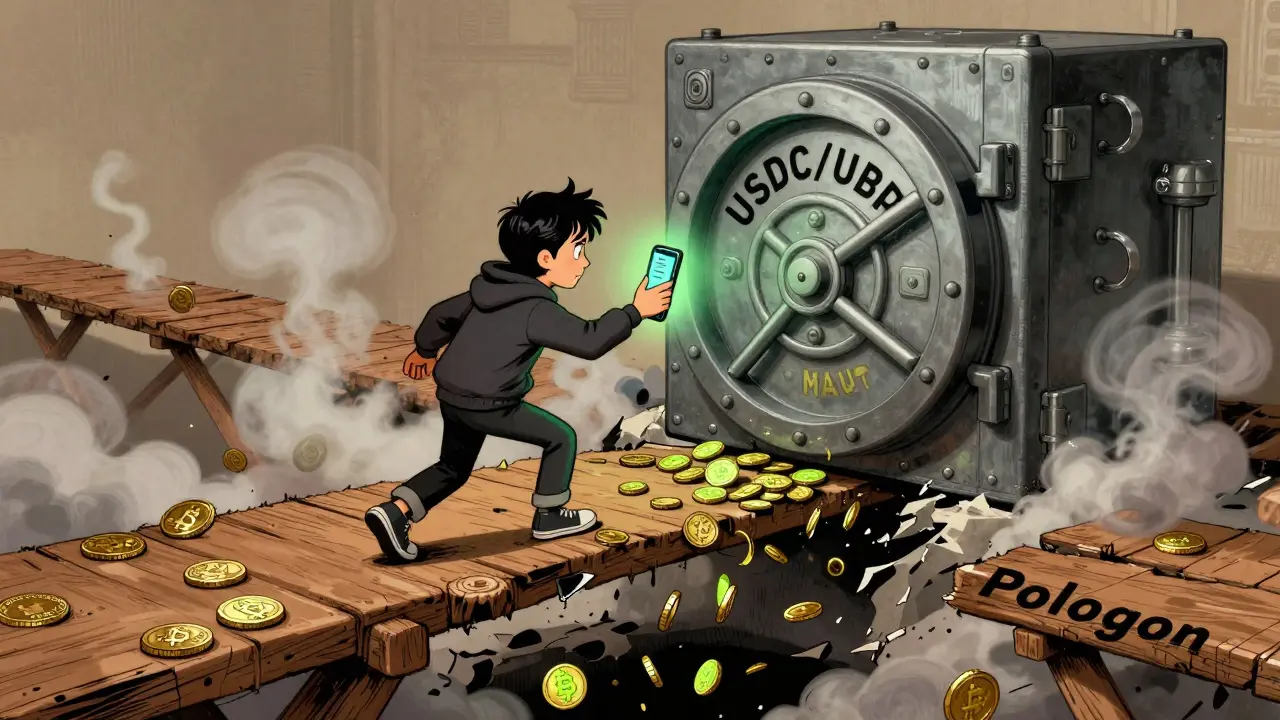
Technical Risks: No Audits, No Transparency
One of the biggest red flags? There’s no public record of a security audit for the QiDAO protocol. Major DeFi projects like Aave or Compound publish full audit reports from firms like CertiK or Trail of Bits. MAI doesn’t. That means no one has independently verified that the smart contracts can’t be hacked or exploited. The GitHub repo (github.com/0xlaozi/qidao) exists, but there’s little activity. No recent commits. No community pull requests. The Twitter account (@0xLaoZi) is the only public face of the project. No team names. No LinkedIn profiles. No press releases. It’s like a black box. The project also doesn’t have a whitepaper. No detailed technical documentation. No roadmap. No funding disclosures. That’s unusual for any serious crypto project, let alone one handling user funds. Compare that to DAI, which has been audited dozens of times, has a public governance forum, and is integrated into hundreds of apps. MAI doesn’t even show up on stablecoins.wtf - a site dedicated to tracking stablecoins.Why MAI Isn’t Going Mainstream
The stablecoin market is a winner-takes-most game. USDT and USDC control 90% of the market because they’re simple: you trust a company that holds dollars. They’re fast, liquid, and regulated. MAI’s value proposition - decentralization - is a niche. Most users don’t care if a stablecoin is decentralized. They care if it stays at $1.00 and works everywhere. MAI fails on both. Even within DeFi, DAI dominates. It’s accepted on Uniswap, Aave, Compound, Yearn, and dozens of other protocols. MAI? You’ll struggle to find it outside of Polygon-based DEXs. The 87% drop in trading volume from the prior period suggests interest is fading, not growing. Without new listings, partnerships, or liquidity incentives, MAI has no path to scale.Can You Still Use MAI? Here’s How (If You Must)
If you still want to try it, here’s what you need:- A Polygon-compatible wallet (like MetaMask), configured for the Polygon network.
- Some MATIC tokens to pay for gas fees.
- Approved collateral - ETH, MATIC, WBTC, or other tokens accepted by QiDAO.
- Go to mai.finance and connect your wallet.
- Deposit your collateral and mint MAI.

Is MAI a Scam?
There’s no evidence MAI is a rug pull. No one has stolen funds. No one has run off with the treasury. The code appears to function as designed. But that doesn’t mean it’s safe. A stablecoin that can’t stay pegged during stress isn’t stable. A project with no transparency isn’t trustworthy. A token with no liquidity can’t be used. Think of MAI like a rare collectible coin - beautiful in theory, but nobody wants to trade it. It’s not a scam. It’s a ghost town.What’s Next for MAI?
The only real development mentioned is a planned move to Polygon zkEVM - a faster, more private version of Polygon. But as of October 2025, it’s not live for trading. No exchange has listed it. No one is using it. Without major exchange listings, liquidity incentives, or a public roadmap, MAI will likely remain a footnote in crypto history - a noble experiment that never caught on. The future of stablecoins belongs to those who balance decentralization with usability. MAI leans too far into ideology and too far away from real-world needs.Final Verdict: For Enthusiasts Only
MAI (MIMATIC) is not a replacement for USDT or USDC. It’s not even a good alternative to DAI. It’s a crypto-native stablecoin built for a very specific type of user: someone who values censorship resistance above all else - even liquidity, stability, and ease of use. If you’re a DeFi purist, want to avoid KYC, and understand the risks of illiquid assets, MAI might be worth a small experiment. For everyone else? Stick with USDC. It’s cheaper, faster, safer, and works everywhere. MAI is a curiosity - not a currency.Is MAI (MIMATIC) really pegged to the US dollar?
MAI is designed to stay at $1.00, but in practice, it often drifts. As of October 2025, prices varied between $0.87 and $0.99 across different exchanges. This inconsistency comes from extremely low trading volume - a few trades can move the price. Major stablecoins like USDC rarely deviate more than 1-2 cents. MAI’s peg is fragile because it lacks liquidity.
Can I buy MAI on Coinbase or Binance?
No. MAI is not listed on any major centralized exchange like Coinbase, Binance, Kraken, or KuCoin. It’s only available on six decentralized exchanges, all on the Polygon network, such as Uniswap and Quickswap. If you want to buy MAI, you’ll need a Web3 wallet and some MATIC for gas fees.
Is MAI backed by real dollars like USDT?
No. MAI is backed only by other cryptocurrencies - like ETH, MATIC, or WBTC - locked in smart contracts. Unlike USDT, which holds actual U.S. dollars in bank accounts, MAI has zero fiat reserves. This makes it fully decentralized but also more vulnerable to collateral price swings.
Why is MAI’s trading volume so low?
MAI’s 24-hour volume is under $50,000 - compared to billions for USDT or DAI. That’s because few people use it. It’s not listed on major exchanges, has no marketing, no partnerships, and offers no clear advantage over better-established stablecoins. Low volume means high slippage and difficulty selling large amounts.
Is MAI safe to use?
There’s no public security audit of the QiDAO smart contracts, which is a major red flag. While no exploit has occurred, the lack of transparency means you’re trusting code no one has verified. Combine that with low liquidity and price instability, and MAI carries higher risk than mainstream stablecoins. Only use funds you’re willing to lose.
What’s the difference between MAI and DAI?
Both are crypto-backed stablecoins using overcollateralization. But DAI is accepted everywhere - on hundreds of DeFi apps and centralized exchanges. MAI is only on a few Polygon DEXs. DAI has a $5 billion market cap; MAI has $27 million. DAI has audits, governance, and a team. MAI has a Twitter handle and a GitHub repo with little activity. DAI is a working stablecoin. MAI is a prototype.

Andrea Stewart
December 29, 2025 AT 16:37MAI’s whole premise is beautiful in theory - no banks, no KYC, pure crypto trustlessness. But theory doesn’t pay your bills. If your stablecoin dips to $0.87 because one whale sells 50k worth, it’s not stable. It’s a gamble with your dollar.
Josh Seeto
December 30, 2025 AT 17:37So MAI is the crypto version of a vintage vinyl record - cool to own, impossible to play on modern systems. Congrats, you’ve built a museum piece that no one wants to listen to.
Kevin Gilchrist
December 31, 2025 AT 18:44MAI is like that one friend who insists they’re ‘anti-establishment’ but still uses your WiFi to stream Netflix. 🤡 You want decentralization? Cool. But can you at least make it work? I need to buy coffee, not join a crypto cult.
Khaitlynn Ashworth
January 1, 2026 AT 17:22Wow. Just… wow. So we’re supposed to be impressed that someone built a stablecoin that’s *technically* decentralized but practically useless? And the kicker? No audits. No team. No roadmap. Just a Twitter account and a GitHub repo that looks like it hasn’t been touched since 2021. This isn’t innovation - it’s negligence dressed up as ideology.
NIKHIL CHHOKAR
January 1, 2026 AT 18:41Let’s be real - most people don’t care about decentralization. They care about reliability. If I can’t use MAI to pay for Uber or withdraw to my bank without jumping through 5 hoops, it’s not a currency. It’s a hobby. And honestly? If you’re using MAI to avoid KYC, you’re probably trying to hide something. Not saying it’s illegal - just saying, why not use a real tool instead of a DIY project?
Mike Pontillo
January 3, 2026 AT 15:42DAI has audits. MAI has a Twitter bio. DAI has partnerships. MAI has a GitHub with 3 commits. DAI works. MAI? It’s a ghost. And ghosts don’t pay for tacos.
rachael deal
January 5, 2026 AT 02:45Hey, I get it - MAI is a passion project. And honestly? I respect the vision. But if you’re going to build something meant to replace real-world money, you’ve gotta make it *actually* usable. Maybe start with a simple liquidity incentive program? Reward people who hold or trade MAI? Get it listed on a few more DEXs? Small steps. This isn’t about greed - it’s about making the dream real.
Elisabeth Rigo Andrews
January 6, 2026 AT 05:59The lack of audits isn’t just a red flag - it’s a full-blown neon sign screaming ‘UNSECURED’. You’re locking up ETH, MATIC, WBTC - real assets - against code that hasn’t been vetted by a single third-party firm. That’s not decentralization. That’s gambling with your collateral. And if the price slippage is already 13%, you’re not holding a stablecoin - you’re holding a time bomb with a $27M fuse.
Bruce Morrison
January 6, 2026 AT 17:08MAI isn’t for everyone. But it’s not for nothing either. For people in countries where banks shut down crypto access, or who’ve been burned by centralized stablecoins, this is a lifeline. It’s not perfect. But sometimes, the only alternative to a broken system is a broken tool. That doesn’t make it worthless. It makes it necessary - for some.
nayan keshari
January 7, 2026 AT 03:37Why does anyone care about this? DAI already exists. USDC works. Everyone else is just chasing a fantasy. MAI is what happens when ideology overrides common sense. It’s not a coin. It’s a protest sign with a token attached.
Jack and Christine Smith
January 8, 2026 AT 19:06ok so i tried minting mait like 2 weeks ago and it took me 45 mins to figure out the polygon network and then my transaction failed bc i forgot to switch networks and then i had to wait 3 days for the gas fee to refund?? like bro why is this so hard?? i just wanna hold a dollar that isnt in a bank??
Raja Oleholeh
January 8, 2026 AT 22:41Prateek Chitransh
January 8, 2026 AT 23:54Let’s not forget - MAI is the only stablecoin that doesn’t rely on a single corporate entity. Even DAI has MakerDAO’s governance, which has ties to institutional players. MAI? Pure code. No middlemen. No lobbyists. No regulatory pressure. That’s why it’s small. That’s why it’s risky. But it’s also the only one that could survive a total collapse of the financial system. If you’re building for the future, not the present, this might be the only real option.