
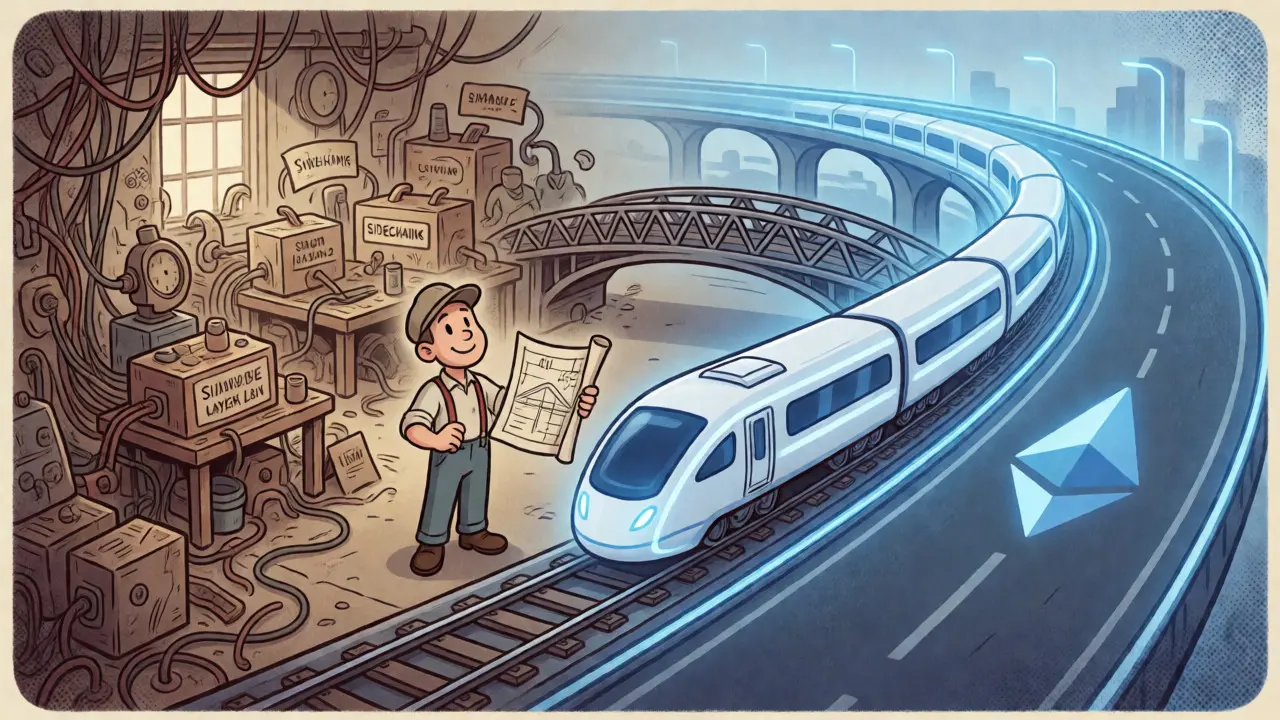
You might remember Lisk as one of the big names in the 2017 crypto boom. It was everywhere. But if you look at it today, you’ll notice something different. It’s not just another altcoin trying to be a generic currency anymore. Lisk has quietly shifted gears. It’s now positioning itself as an Ethereum Layer 2 network designed to bring Web3 to emerging markets with dirt-cheap fees.
If you’re wondering what this means for your portfolio or your developer toolkit, you’re in the right place. We’re going to break down exactly what Lisk is, why it changed its architecture, and whether it still holds value in a market dominated by giants like Solana and Arbitrum.
The Quick Takeaways
- It’s not just a coin: Lisk is a blockchain platform that allows developers to build apps using JavaScript, making it accessible for web devs.
- Major Pivot: Originally a standalone Layer 1 chain, Lisk is transitioning into an Optimism-based Layer 2 on Ethereum.
- Target Market: The new strategy focuses heavily on emerging markets where low transaction costs are critical for adoption.
- Governance: The project is stewarded by the non-profit Lisk Foundation, based in Switzerland.
From Sidechains to Layer 2: A Strategic Shift
To understand where Lisk is going, you have to know where it came from. Launched in 2016 by Max Kordek and Oliver Beddows, Lisk started as a fork of a project called Crypti. The original vision was unique: instead of forcing every app onto one congested main chain (like Ethereum did), Lisk used sidechains. Each application got its own dedicated sidechain, secured by the main Lisk network. This modular approach meant that if one app had a bug or high traffic, it didn’t crash the whole system.
For years, this worked well for scalability. But the crypto landscape changed. Ethereum introduced rollups, which offered similar scalability benefits while inheriting Ethereum’s massive security and liquidity. Suddenly, building a separate Layer 1 ecosystem became harder. Competitors like Binance Smart Chain and Polygon ate up market share. So, the team made a bold decision. They stopped trying to compete as a standalone Layer 1 and decided to join the Ethereum scaling ecosystem.
Today, Lisk is rebranding its infrastructure. It is moving toward being an Ethereum Layer 2 built on the Optimism stack. This isn’t just a marketing tweak; it’s a fundamental architectural change. By leveraging Optimism (OP) technology, Lisk batches transactions and posts them to Ethereum for final settlement. This gives users the speed and low cost of a modern L2 while keeping the robust security guarantees of the Ethereum mainnet.
Why JavaScript? The Developer Angle
One of Lisk’s biggest selling points has always been its developer experience. Most smart contract platforms require you to learn niche languages. On Ethereum, you need Solidity. On Solana, you need Rust. These are powerful but steep learning curves for someone coming from a traditional web background.
Lisk took a different route. It offers a JavaScript SDK. If you know how to build a React app or work with Node.js, you can already write logic for Lisk applications. You don’t need to start from zero. This lowers the barrier to entry significantly. For businesses looking to integrate blockchain features without hiring specialized crypto engineers, this is a huge advantage.
While the move to an EVM-compatible Layer 2 means they will likely support Solidity contracts too, the legacy tooling and community focus remain strong on JavaScript-friendly development. This hybrid approach aims to attract both existing Ethereum developers and the vast pool of web developers who haven’t touched crypto yet.

Tokenomics: What Does LSK Do?
The native token, LSK, isn’t just a speculative asset. It serves specific functions within the network. In the old sidechain model, LSK was used to pay for transaction fees on the main chain and to vote for delegates who secured the network. It operated on a Delegated Proof-of-Stake (DPoS) consensus mechanism.
Here’s how it worked: Token holders voted for 101 "delegates." These delegates were responsible for forging new blocks and maintaining the ledger. In return, they earned block rewards. This system was energy-efficient compared to Bitcoin’s mining but required trust in those 101 nodes.
As Lisk transitions to an Ethereum Layer 2, the role of LSK is evolving. While the exact token utility changes during migration are still being finalized, the general trend in L2 ecosystems is for the native token to play a role in governance and potentially paying for gas or securing the sequencer. However, because it sits on Ethereum, ETH often remains the primary gas token for execution, while LSK retains value through ecosystem growth and staking mechanisms specific to the Lisk environment.
| Feature | Lisk (New L2 Model) | Ethereum (L1) | Solana |
|---|---|---|---|
| Primary Language | JavaScript / Solidity | Solidity | Rust |
| Security Source | Ethereum Mainnet | Native PoS | Native PoH/PoS |
| Transaction Cost | Very Low (Cent fractions) | High (Variable) | Low |
| Target Audience | Emerging Markets / Web Devs | Institutional / DeFi | High-Frequency Trading |
Focusing on Emerging Markets
Why pivot to emerging markets? Because that’s where the next billion users are coming from. In countries across Southeast Asia, Africa, and Latin America, high transaction fees on Ethereum are a dealbreaker. If sending money costs $5, nobody uses it for micro-payments. Lisk’s new identity leans hard into this problem.
The platform highlights integrated local on/off-ramps. This means users can easily convert their local fiat currency into crypto and back out again without jumping through hoops. By combining the low fees of an Optimism rollup with these financial rails, Lisk aims to be the go-to chain for remittances, gaming, and consumer apps in regions where banking infrastructure is spotty. It’s a practical use case, not just abstract tech hype.

Market Performance and Risks
Let’s be real about the numbers. Lisk hit its all-time high of around $35 in early 2018. Today, it trades for pennies-often between $0.10 and $0.50 depending on the market cycle. Its market cap hovers around $90 million, placing it roughly 500th among cryptocurrencies. That’s a long way down from its peak valuation of over $1 billion.
This drop reflects the broader reality for many "old guard" altcoins. They struggled to maintain relevance against newer, faster chains. The pivot to Layer 2 is their attempt to stay alive and relevant. Is it risky? Yes. Execution risk is high. Migrating a live blockchain to a new architecture is complex. Plus, the L2 space is crowded. Arbitrum, Base, and Optimism itself are dominant players. Lisk needs to carve out a specific niche-emerging markets-to survive.
However, the backing of the Lisk Foundation provides stability. Unlike some projects run solely by venture capitalists, the foundation structure suggests a long-term commitment to open-source principles and community governance. Development is handled by Lightcurve GmbH in Berlin, which keeps the technical engine running.
How to Get Involved
If you want to buy LSK, it’s widely available. You can find it on major exchanges like Coinbase, Binance, and Kraken. Since it’s an older asset, liquidity is decent, though not as deep as top-tier coins. Always check the spread before buying.
For developers, the path forward involves exploring the new L2 testnets. Keep an eye on the official Lisk documentation for updates on when the mainnet migration completes. If you’re a JavaScript developer curious about blockchain, Lisk remains one of the friendliest places to start, even as it integrates more EVM tools.
Is Lisk still a good investment?
It depends on your risk tolerance. Lisk is no longer a blue-chip crypto like Bitcoin or Ethereum. It’s a mid-cap asset attempting a significant technological pivot. If you believe in the narrative of Web3 adoption in emerging markets and the success of Ethereum Layer 2 solutions, LSK could offer upside. However, it faces stiff competition from larger L2s like Arbitrum and Base. It’s a higher-risk play compared to established majors.
Can I mine Lisk?
No, you cannot mine Lisk in the traditional sense. Historically, it used Delegated Proof-of-Stake (DPoS), where users voted for delegates to forge blocks. With the shift to an Ethereum Layer 2 architecture, the concept of mining becomes even less relevant, as security is inherited from Ethereum’s Proof-of-Stake consensus. You can stake LSK to participate in governance and earn rewards, depending on the final implementation of the new tokenomics.
What makes Lisk different from other Ethereum Layer 2s?
Most L2s focus on general-purpose scaling or DeFi. Lisk distinguishes itself by targeting emerging markets specifically. It emphasizes user-friendly on/off-ramps for local currencies and leverages its history of JavaScript-friendly development to attract web developers. This geographic and demographic focus is its primary competitive edge.
Who runs Lisk?
The project is governed by the Lisk Foundation, a non-profit organization based in Zug, Switzerland. The core software development is carried out by Lightcurve GmbH, a blockchain studio located in Berlin, Germany. The founders are Max Kordek and Oliver Beddows.
Will Lisk support NFTs?
Yes. As an Ethereum-compatible Layer 2, Lisk supports standard ERC-721 and ERC-1155 tokens, which are the standards for NFTs. Developers can mint and trade NFTs on Lisk with much lower gas fees than on the Ethereum mainnet, making it attractive for gaming and collectible projects.
