

Elastos (ELA) isn't just another cryptocurrency. It's a full-blown attempt to rebuild the internet from the ground up - not with corporate servers and ads, but with blockchain technology and Bitcoin's security. Launched in 2018, Elastos created what it calls the "Smart Web," a decentralized network where users own their data, identity, and digital content. Unlike most crypto projects that focus on payments or DeFi, Elastos is building infrastructure - a new kind of internet where nothing is stored on a company's server, and no one can steal your music, videos, or apps.
How Elastos Uses Bitcoin to Stay Secure
What makes Elastos different is how it secures its network. Instead of running its own miners like Ethereum or Solana, Elastos merged mines with Bitcoin. That means Bitcoin miners can mine both Bitcoin and ELA at the same time, using the same hardware and electricity. No extra power needed. This gives Elastos access to over 50% of Bitcoin's total hash rate - the most secure blockchain in the world. It’s like building a house on top of a steel skyscraper. You get the same protection without building your own foundation.
This isn't just a technical trick. It means Elastos is nearly impossible to attack. A 51% attack on Bitcoin would cost billions. A 51% attack on Elastos? You'd need to control half of Bitcoin’s mining power first. That’s why Elastos is sometimes called "BTC Queen" - it rides on Bitcoin’s back to stay safe.
The Smart Web: No Internet, No Theft
Here’s where Elastos gets really interesting. On the Smart Web, apps don’t connect directly to the internet. They run inside a secure runtime environment - like a locked box on your phone or computer. This box lets apps function normally, but blocks them from accessing your camera, contacts, or browser history without permission. Even better, content creators can publish music, books, or videos directly on the network. Because everything is tracked and signed with blockchain IDs, no one can re-upload your work to YouTube or TikTok and claim it as theirs.
Think of it like a digital library where every book has a blockchain certificate. You can read it, but you can’t copy it. And if you want to sell it, you do it directly - no middlemen like Amazon or Apple taking 30%.
How ELA Coin Actually Works
ELA is the fuel of this whole system. You need it to:
- Pay for storage space on the network
- Buy decentralized domain names (like .elastos)
- Send value between users
- Vote on network upgrades
- Stake to become a supernode and earn rewards
There are only 28.22 million ELA coins ever. As of early 2024, over 21.8 million are already in circulation. New coins are released every two minutes - 70% go to miners, 30% go to the Elastos Foundation to fund development. The inflation rate is fixed at 4% per year, designed to slow down over time.
ELA also has a smallest unit called Sela - 1 ELA = 100,000,000 Sela. This honors Satoshi Nakamoto’s legacy and gives fine-grained control over tiny transactions.

Decentralized Identity and the Carrier Network
Elastos doesn’t just secure data - it gives you full control over who sees it. Every user gets a decentralized identity (DID) tied to their wallet. No phone number. No email. Just a public key. You choose what to share, when, and with whom.
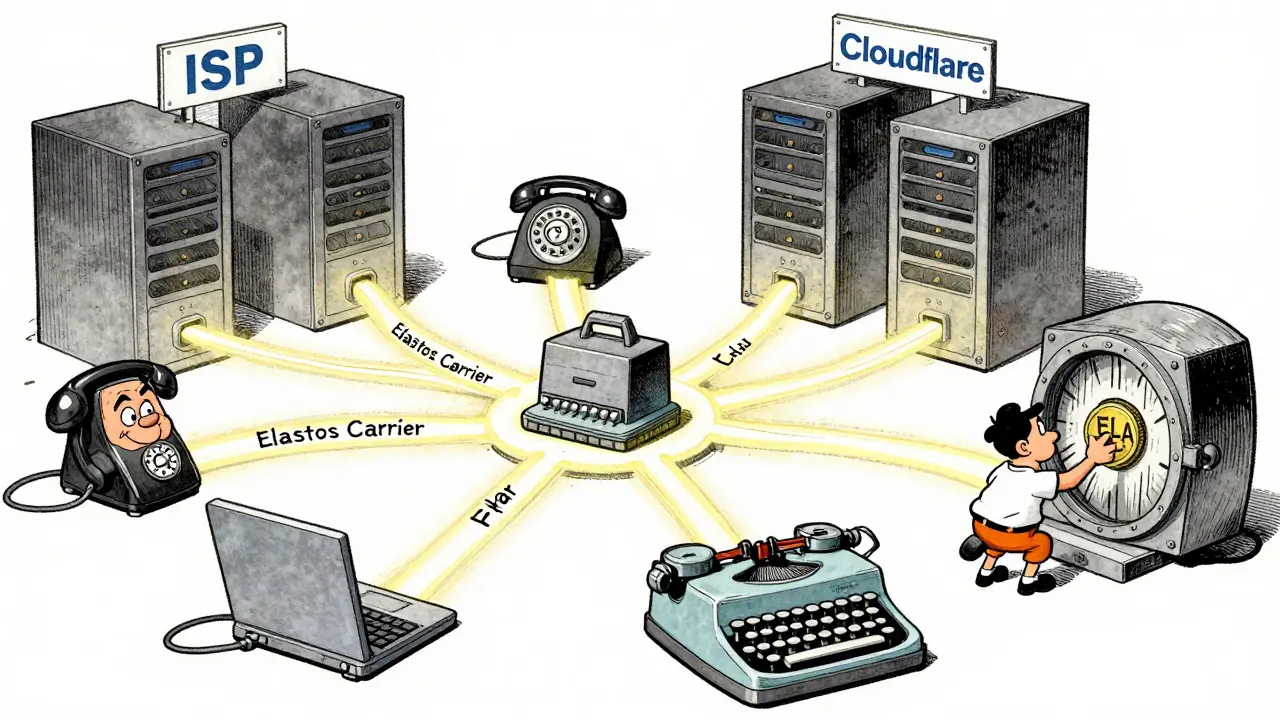
Behind this is the Elastos Carrier - a peer-to-peer network that connects devices directly. No Google, no Cloudflare, no ISPs. Your messages, file transfers, and app communications travel directly from one device to another, encrypted and private. It’s like having your own internet tunnel, separate from the regular web.
BTCD: Turning Bitcoin into Liquid Cash
One of Elastos’ biggest innovations is BTCD - a stablecoin fully backed by Bitcoin. If you own BTC but need cash to pay bills or invest in other projects, you can lock your Bitcoin into the Elastos network and mint BTCD. Each BTCD is worth exactly $1 USD. You can use it in dApps, trade it, or send it - without ever selling your Bitcoin.
This opens up hundreds of billions in dormant Bitcoin value. Right now, most BTC holders just sit on their coins. With BTCD, they can use them as collateral - turning cold storage into active capital. It’s Bitcoin DeFi, built on Bitcoin’s own security.
Who Uses Elastos? Developers and Creators
Elastos isn’t for casual traders. It’s for builders. The platform offers a full software development kit (SDK) so coders can create dApps that run in the Smart Web. These apps can handle:
- Decentralized video hosting
- Music streaming with direct artist payments
- Online marketplaces for digital art
- Private messaging apps
- Tokenized content sales
Developers earn ELA when users pay for their apps. Creators earn when their content is bought or streamed. It’s a closed loop - value stays inside the ecosystem, not siphoned off by big tech.
Market Status in 2026
As of March 2026, ELA trades around $0.48 USD. Its market cap sits at roughly $11 million, with daily volume around $170,000. These numbers are small compared to Bitcoin or Ethereum - but Elastos isn’t trying to beat them. It’s trying to outlast them.
The project raised $94 million in its 2018 token sale and has since funded over 100 ecosystem projects. It’s not a hype coin. It’s a slow-burn infrastructure play. The team has stayed focused on building, not marketing.
Why Elastos Matters
Most crypto projects are trying to replace banks. Elastos is trying to replace Google, Facebook, and Amazon. It’s not about faster transactions or lower fees. It’s about ownership. If you’ve ever lost a video because a platform shut down, or had your music stolen and sold by someone else - Elastos was built for you.
It’s the only major blockchain that uses Bitcoin’s security, not just as a feature, but as its foundation. And it’s the only one that gives creators real control over their work - not just in theory, but in how the software actually works.
If you believe the internet should belong to users, not corporations, Elastos isn’t just another coin. It’s one of the few projects actually trying to fix the system - not just profit from it.

manoj kumar
March 25, 2026 AT 16:18Most of these features already exist on Web3 platforms that don't need 17 different layers of middleware. Elastos is over-engineered and under-delivered.
JOHN NGEH
March 26, 2026 AT 02:42I’ve been watching Elastos for a while now, and honestly, the carrier network feels like the real sleeper hit. No ISPs? No middlemen? That’s the future I want to live in.
Jenni Moss
March 26, 2026 AT 04:04vu phung
March 27, 2026 AT 09:47BTCD as a BTC-backed stablecoin opens up non-custodial liquidity primitives that haven’t been explored at this scale yet.
Lorna Gornik
March 29, 2026 AT 07:06Joshua T Berglan
March 31, 2026 AT 04:00Kayla Thompson
March 31, 2026 AT 17:00Ananya Sharma
April 2, 2026 AT 10:27Mansoor ahamed
April 2, 2026 AT 14:48Nicolette Lutzi
April 3, 2026 AT 18:23Jeannie LaCroix
April 5, 2026 AT 18:03Domenic Dawson
April 7, 2026 AT 05:06Sam Harajly
April 9, 2026 AT 02:37Pradip Solanki
April 9, 2026 AT 12:50Brad Zenner
April 11, 2026 AT 06:14Tony Phillips
April 13, 2026 AT 02:29Abhishek Thakur
April 13, 2026 AT 18:39Jackie Crusenberry
April 13, 2026 AT 22:30Anna Lee
April 15, 2026 AT 11:40Alice Clancy
April 16, 2026 AT 19:24Dominic Taylor
April 17, 2026 AT 20:51Misty Williams
April 19, 2026 AT 16:13namrata singh
April 21, 2026 AT 07:36Andrea Zaszczynski
April 21, 2026 AT 19:47