
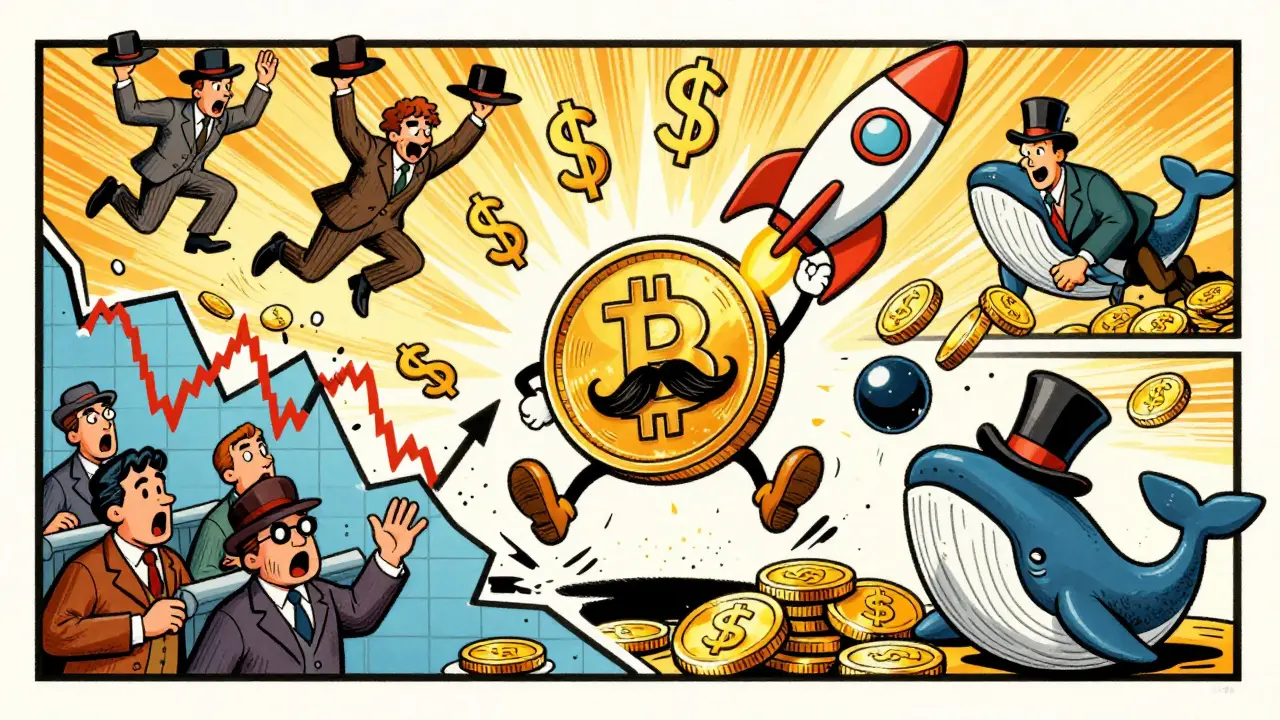
When you see Bitcoin jump 15% in a single day - or drop just as fast - you’re seeing cryptocurrency volatility in action. It’s not just price changes. It’s the raw, unpredictable energy that defines crypto markets. Unlike stocks or gold, where prices move in slow waves, crypto prices can crash or surge overnight. That’s not a glitch. It’s the system. Understanding this volatility isn’t optional if you’re even thinking about investing. It’s the foundation of every decision you’ll make.
What Exactly Is Cryptocurrency Volatility?
Volatility measures how much and how quickly a price changes over time. In crypto, it’s extreme. Bitcoin, the largest cryptocurrency, has historically shown three to four times more volatility than the S&P 500 between 2020 and 2024. That means if the stock market moves 2% in a week, Bitcoin might move 6% to 8%. Some altcoins? They can swing 20% in a day. This isn’t random noise. It’s built into the structure. Cryptocurrencies have small market caps compared to stocks. A single large investor - a "whale" - buying or selling a few million dollars’ worth can shift the price dramatically. There’s not enough liquidity to absorb those moves smoothly. Add in news, tweets, or regulatory rumors, and the market reacts like a spark near gasoline.Why Is Crypto So Much More Volatile Than Stocks?
Traditional markets have decades, even centuries, of rules, institutions, and deep pools of capital. Crypto? It’s still a teenager. Here’s why the swings are so wild:- Small market size: Even with a $2 trillion peak in 2021, crypto is tiny compared to global equities ($120 trillion). Smaller markets are easier to move.
- Limited liquidity: You can’t instantly buy or sell large amounts without changing the price. In stocks, you can trade millions without blinking. In crypto, you might need to wait hours or pay a huge premium.
- Regulatory uncertainty: Will the U.S. ban crypto? Will China crack down again? Will the SEC sue another exchange? No one knows. That fear keeps prices shaky.
- Retail-driven trading: Over 70% of crypto trades come from individual investors, not institutions. These traders often act on emotion - FOMO (fear of missing out) or panic selling - not fundamentals.
- Fixed supply: Bitcoin has only 21 million coins. When demand spikes, there’s no way to print more. That creates massive price pressure.
Historical Examples: When Volatility Hit Hard
You don’t need to guess how volatile crypto is - history shows it. In 2017, Bitcoin went from $1,000 to nearly $20,000 in under a year. Retail investors flooded in, fueled by social media hype. Then came the crash. By early 2018, it had lost 80% of its value. That’s not a correction. That’s a bloodbath. In March 2020, during the early days of the pandemic, Bitcoin dropped 50% in one day. Global markets were crashing. Crypto didn’t escape. But here’s the twist: within weeks, it bounced back - even stronger. Why? Because people started seeing Bitcoin as digital gold, a hedge against inflation and central bank printing. That shift in perception fueled the 2021 bull run. By November 2021, Bitcoin hit $69,000. Tesla had bought $1.5 billion worth. Companies like MicroStrategy were hoarding it. Then came Fed rate hikes, regulatory crackdowns, and the collapse of major exchanges like FTX. By late 2022, Bitcoin was back below $16,000. Another 75% drop. These aren’t anomalies. They’re patterns. Big gains. Bigger losses. Fast.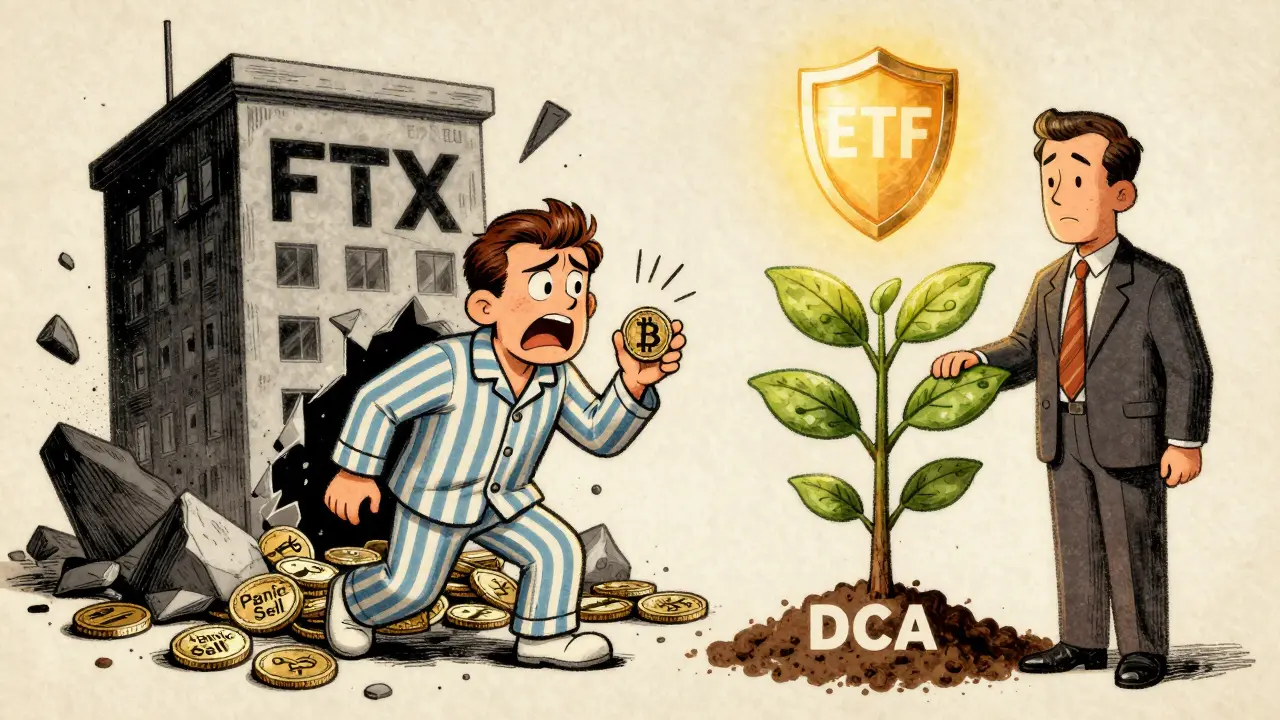
Is Volatility Getting Better?
Yes - slowly. Since 2023, volatility has started to cool. Why? Institutional money is walking in. Bitcoin and Ethereum spot ETFs launched in early 2024. That means pension funds, endowments, and big asset managers can now buy crypto through regulated stock accounts. They’re not day traders. They’re long-term holders. That brings stability. About 6% of all Bitcoin is now held by institutions and ETFs. That’s not a majority, but it’s enough to act as a buffer. These players don’t sell on bad news. They buy the dips. That reduces panic-driven crashes. Also, the market is bigger. $2.3 trillion in 2021. Around $1.5 trillion in late 2025. More money means more liquidity. More liquidity means less price shock from a single trade. But don’t get fooled. Even with these improvements, Bitcoin’s volatility is still 2-3 times higher than the S&P 500. And newer altcoins? They’re still wild. Coins under one year old can swing 100% in a week. That’s not investing. That’s gambling.How to Handle Volatility as an Investor
You can’t eliminate crypto volatility. But you can control how it affects you.- Never invest more than you can afford to lose. If losing your crypto investment would ruin your month, don’t put money in.
- Use dollar-cost averaging (DCA). Instead of buying $5,000 worth of Bitcoin all at once, buy $500 every week. This smooths out the highs and lows. You buy more when prices are low, less when they’re high. It’s the most proven strategy for retail investors.
- Keep crypto small in your portfolio. Most financial advisors recommend 1% to 5% of your total assets. That way, even a 90% drop won’t break you.
- Avoid emotional trading. If you’re checking your portfolio every hour and selling because it dropped 5%, you’re not investing - you’re chasing adrenaline. Set a plan and stick to it.
- Diversify within crypto. Don’t put all your money in Bitcoin. Add Ethereum, maybe a few established altcoins. But avoid meme coins. They’re pure speculation.

Volatility Isn’t Just Risk - It’s Opportunity
Yes, volatility scares people. But it’s also what makes crypto potentially profitable. High risk = high reward. That’s the trade-off. Someone who bought Bitcoin at $3,000 in 2020 and held through the 2021 peak made over 20x. Someone who bought at $69,000 in 2021 and held through 2025? Still up 2x, even after the crash. Volatility creates chances. But only if you’re patient. Only if you’re prepared. Only if you understand that today’s crash isn’t the end - it’s part of the cycle. The most successful crypto investors aren’t the ones who time the market. They’re the ones who stay in it. They know volatility isn’t a bug. It’s the feature.What’s Next for Crypto Volatility?
The trend is clear: as crypto matures, volatility will slowly decline. More regulation. More institutional money. More liquidity. More infrastructure. But it won’t disappear. Crypto will never be as stable as Treasury bonds. It’s not meant to be. Its value lies in its decentralization, scarcity, and global accessibility - traits that come with inherent instability. Think of it like early internet stocks. In the late 1990s, they were wild. Many crashed. But the survivors - Amazon, Google - reshaped the world. Crypto’s future won’t be smooth. But it could be transformative. Your job? Don’t try to predict the next spike. Build a strategy that survives the next crash.Is cryptocurrency volatility higher than stock market volatility?
Yes, significantly. Between 2020 and 2024, Bitcoin’s price swings were three to four times larger than those of the S&P 500. Even during calm periods, crypto moves more erratically. Newer altcoins can be 10 times more volatile than stocks. While stocks have deep liquidity and institutional oversight, crypto markets are smaller, less regulated, and driven more by retail sentiment - all of which amplify price swings.
Can cryptocurrency volatility be predicted?
You can’t predict exact price movements, but you can measure expected volatility. Academic researchers have created crypto volatility indexes (CVX), similar to the VIX for stocks, using options market data to estimate future price swings. These tools show trends - like whether volatility is rising or falling - but they don’t tell you if Bitcoin will go up or down tomorrow. They help you prepare, not predict.
Why does Bitcoin’s price drop so fast after a big rally?
After a sharp rise, retail investors often rush in, driving prices up based on hype. But when the momentum slows, those same investors panic and sell. Since crypto markets are thin - meaning there aren’t enough buyers to absorb large sell orders - prices crash quickly. This cycle repeats because the market still lacks deep institutional buffers. The 2017-2018 and 2021-2022 crashes followed this exact pattern.
Should I avoid crypto because of its volatility?
No - but you must approach it differently than traditional investments. If you can’t handle seeing your portfolio drop 30% in a week, then crypto isn’t right for you. But if you’re willing to hold through the noise, use small position sizes, and invest over time, volatility becomes a tool, not a threat. Many investors have built wealth in crypto precisely because they accepted the risk and stayed disciplined.
How do ETFs reduce crypto volatility?
Bitcoin and Ethereum spot ETFs bring in long-term institutional money - pension funds, mutual funds, endowments - that don’t trade daily. These players buy and hold, reducing the pressure from short-term speculation. Since early 2024, ETFs have held about 6% of all Bitcoin in circulation. That’s not a huge amount, but it’s enough to act as a stabilizing anchor during market panics, helping to smooth out extreme swings.
What’s the safest way to invest in crypto with high volatility?
Use dollar-cost averaging (DCA): invest a fixed amount - like $100 - every week or month, regardless of price. This automatically buys more when prices are low and less when they’re high. Combine it with keeping crypto under 5% of your total portfolio. Avoid leverage, avoid meme coins, and never invest money you need in the next 3-5 years. Patience and discipline beat timing the market every time.

Alexandra Wright
December 28, 2025 AT 01:02Oh wow, another ‘crypto is volatile’ revelation? Newsflash: the market doesn’t care if you’re ‘prepared.’ It eats optimism for breakfast and shits out FOMO by lunch. You think DCA saves you? Try telling that to someone who bought ETH at $4,800 in 2021 and watched it crater to $1,000 while they ‘stayed disciplined.’
Volatility isn’t a feature-it’s a bug in a system designed to extract wealth from people who read blog posts and think they’re investors.
And don’t get me started on ETFs ‘stabilizing’ the market. More institutional money just means bigger whales with better lawyers. The same people who crashed the system are now the ones selling you the life raft.
Stay in it? Sure. But don’t call it investing. Call it paying rent to the casino owners while they count your coins.
And yes, I’ve lost money. Twice. And I still don’t trust this shit.
But hey, at least I’m not the one buying Dogecoin because Elon tweeted a meme.
Jackson Storm
December 29, 2025 AT 03:44lol i just started with 50 bucks in btc last year and now its worth 180… i didnt even try to time it. just bought a little every week like the post said. its wild how much it goes up and down but if you chill and dont panic its kinda fun? like a rollercoaster but you get money at the end… maybe.
also i bought some shiba and lost half of it in a day… oops. but hey, its only play money right? lol
Raja Oleholeh
December 30, 2025 AT 18:43USA crypto hype. India has real economy. Bitcoin useless. We have rupee. No need for digital gamble.
🚀
Michelle Slayden
December 31, 2025 AT 09:30It is, indeed, a fascinating sociological phenomenon: the elevation of a speculative asset with no intrinsic cash flow, governed by algorithmic scarcity and emotional herd behavior, to the status of ‘digital gold.’
One cannot help but draw parallels to the tulip mania of 1637, wherein value was derived not from utility, but from collective belief in perpetual appreciation.
The institutional adoption cited herein is, in truth, a form of financial colonization: capital seeking liquidity in unregulated domains, under the guise of innovation.
Volatility, then, is not merely a market characteristic-it is the manifestation of a systemic failure to anchor value in tangible, measurable, or socially productive terms.
One may mitigate risk through DCA, yes-but one cannot, in good conscience, call such activity ‘investment.’
It is speculation dressed in blockchain.
And yet… one cannot deny the allure.
christopher charles
January 2, 2026 AT 00:54Bro, I’ve been in since 2017… and I’ve seen it all. The crashes. The pumps. The memes. The rug pulls.
But here’s the thing: I don’t check my portfolio every hour. I don’t panic when it drops 10%. I just… keep going.
I DCA’d $200 a month for five years. I didn’t make a fortune, but I didn’t lose my rent money either.
And now? I’ve got a few thousand in BTC and ETH. Not life-changing, but enough to feel like I played the game smart.
Don’t be a hero. Don’t go all-in. Don’t buy shitcoins because someone on TikTok said ‘to the moon.’
Just… keep showing up.
And maybe, just maybe, you’ll be okay.
Vernon Hughes
January 2, 2026 AT 23:39Volatility is the price of decentralization
Stability is the price of control
Choose your poison
Alison Hall
January 4, 2026 AT 03:17My first crypto purchase was $50 of Solana in 2021. I cried when it dropped 80%.
Now I laugh.
Still hold it. Still DCA. Still sleep fine.
You got this 💪
Mike Reynolds
January 4, 2026 AT 18:01Man I used to check my portfolio like 20 times a day. Now I check it once a month. It’s weird how much calmer I am.
Not because the market got less crazy-but because I stopped letting it control me.
Also I stopped reading Reddit threads about ‘the next 100x coin.’
Best decision I ever made.
dayna prest
January 5, 2026 AT 07:37Volatility? Please. Crypto’s not volatile-it’s just honest. Stocks pretend they’re stable while hedge funds front-run your 401k. Crypto just slaps you in the face and says ‘you thought this was a savings account?’
It’s not a bug. It’s a feature designed to filter out the weak, the greedy, and the delusional.
And honestly? I respect that.
Most people can’t handle truth. That’s why they cry when their meme coin dies.
Meanwhile, the ones who stayed? They’re sipping tequila on a beach in Bali while you’re still checking CoinMarketCap at 3 a.m.
Brooklyn Servin
January 5, 2026 AT 15:36Look I’ve lost 80% twice and still hold. Why? Because I’m not here for the hype. I’m here for the tech.
Bitcoin’s blockchain is the most secure network ever built. Ethereum’s smart contracts? Revolutionary.
Volatility? Yeah, it’s wild. But so was the internet in 1999.
People lost money. A lot of it.
But the ones who stuck around? They built the future.
I’m not betting on price. I’m betting on infrastructure.
And if you can’t see that? Then yeah, you’re gonna get wrecked.
But that’s not my problem.
It’s yours.
Phil McGinnis
January 6, 2026 AT 06:42Western financial elites have engineered this volatility as a distraction. The true wealth lies in state-backed digital currencies, not this decentralized circus.
Why do you think the U.S. government tolerates it? Because it keeps the masses occupied while they quietly consolidate power.
Bitcoin is not money. It is a psychological experiment. A placebo for the disillusioned.
And you? You are the lab rat.
Wake up.
Ian Koerich Maciel
January 8, 2026 AT 01:02I used to be the guy who bought at the top... and sold at the bottom.
Then I started reading. Not memes. Not influencers. Actual papers. Whitepapers. Historical market data.
It changed everything.
Now I only buy when volatility is high and prices are down.
And I sleep like a baby.
Also, I don’t touch altcoins under 2 years old.
They’re not coins. They’re lottery tickets.
And I don’t play the lottery.
Not anymore.
Andy Reynolds
January 9, 2026 AT 00:45Volatility is the cost of entry into a new financial system.
Think of it like the early days of the internet. People thought it was a fad. Then Amazon happened.
Crypto’s not about getting rich quick.
It’s about being part of something bigger.
And yeah, it’s messy.
But so was the printing press.
So was electricity.
So was the car.
If you’re scared of the bumps, you’ll miss the ride.
And honestly? You’ll regret it.
Alex Strachan
January 10, 2026 AT 10:14They say ‘volatility is the feature’ like it’s a badge of honor.
Bro, if your ‘investment’ can drop 50% because a dog tweeted, maybe you’re not investing.
Maybe you’re just emotionally attached to a spreadsheet.
And yes, I’ve been there.
I cried when my Shiba hit $0.000001.
Then I laughed.
Now I just DCA and ignore it.
It’s not about being right.
It’s about not being broke.
And yes, I still own it.
But I don’t talk about it at family dinners.
Rick Hengehold
January 11, 2026 AT 10:08Set your limits. Stick to them.
That’s it.
No need for complicated strategies.
Just don’t bet your rent.
And don’t let it ruin your sleep.
Simple.
Done.
Brandon Woodard
January 11, 2026 AT 23:53One might argue that volatility is not a flaw in the system, but rather a necessary mechanism for price discovery in an environment devoid of centralized valuation metrics.
Yet, one must also acknowledge that this mechanism disproportionately benefits those with capital, information, and access to liquidity-thereby reinforcing structural inequality.
The notion that retail investors ‘choose’ volatility is a myth.
They are merely the final layer of the pyramid.
And yet…
Still, one cannot deny the poetic beauty of decentralized trustless networks.
Irony abounds.
Antonio Snoddy
January 13, 2026 AT 05:08Have you ever stopped to think that maybe, just maybe, the entire crypto market is a psychological warfare experiment designed by shadowy actors to desensitize the masses to financial instability?
Think about it.
Every time you panic-sell, you’re reinforcing the system.
Every time you buy the dip, you’re feeding the machine.
And every time you say ‘it’s just volatility,’ you’re accepting your role as a pawn in a game you didn’t even know you were playing.
The real question isn’t whether crypto is volatile.
It’s whether you’re still awake.
Because if you’re still reading this…
You’re already in.
And you might never get out.
And that’s the real scam.
Ryan Husain
January 14, 2026 AT 08:38I appreciate the nuance here. Volatility isn’t inherently bad-it’s a signal.
But I also think we need to be honest: the market is still too immature to be called a legitimate asset class.
It’s a hybrid of speculation, technology, and cultural movement.
And that’s okay.
As long as we don’t pretend it’s the same as bonds or blue-chip stocks.
Respect the risk.
Don’t glorify it.
And never, ever let it define your net worth.
Rajappa Manohar
January 14, 2026 AT 09:29crypto not for me. i lost money. i stop.
my job pay me good. i dont need gamble.
nayan keshari
January 16, 2026 AT 00:06Volatility? More like manipulation.
Big players pump and dump. Retail gets crushed.
ETFs? Just Wall Street in a hoodie.
Don’t be fooled.
This isn’t finance.
This is a casino with a blockchain logo.
Johnny Delirious
January 17, 2026 AT 18:19The future of money is decentralized. Volatility is the growing pain.
Those who flee now will miss the revolution.
Those who stay? They’ll be the ones writing the history books.
Be bold.
Be patient.
Be prepared.
And above all-
Don’t look back.
Bianca Martins
January 19, 2026 AT 11:40I started with $100 in Bitcoin in 2020.
Went all in on Dogecoin in 2021. Lost it all.
Went back to BTC and ETH. DCA’d like a champ.
Now I’ve got more than I started with.
Not rich. Not broke.
Just… smarter.
And I still check my phone every time my phone buzzes.
Still working on that part 😅
alvin mislang
January 20, 2026 AT 00:48Anyone who invests in crypto is either a fool or a criminal.
Either way, you’re not helping society.
You’re just feeding the algorithm.
And you wonder why the world’s falling apart?
It’s because people like you think gambling is investing.
Grow up.
Monty Burn
January 21, 2026 AT 12:26Volatility means the market is alive
Stability means it's dead
Which do you want?
Kenneth Mclaren
January 22, 2026 AT 15:14They say volatility is natural. But what if it’s engineered?
What if the big players use AI to trigger flash crashes right before ETF inflows?
What if the ‘whales’ are just bots controlled by hedge funds who own the exchanges?
What if the whole thing is a simulation?
And you? You’re just a character in it.
Checking your portfolio.
Buying the dip.
Waiting for the moon.
But never realizing you’re already trapped.
Wake up.
The system isn’t broken.
It’s working exactly as designed.
Alexandra Wright
January 22, 2026 AT 22:09And yet… here we are.
Still reading.
Still buying.
Still hoping.
Because deep down, we know something’s changing.
And we don’t want to miss it.
Even if it kills us.