
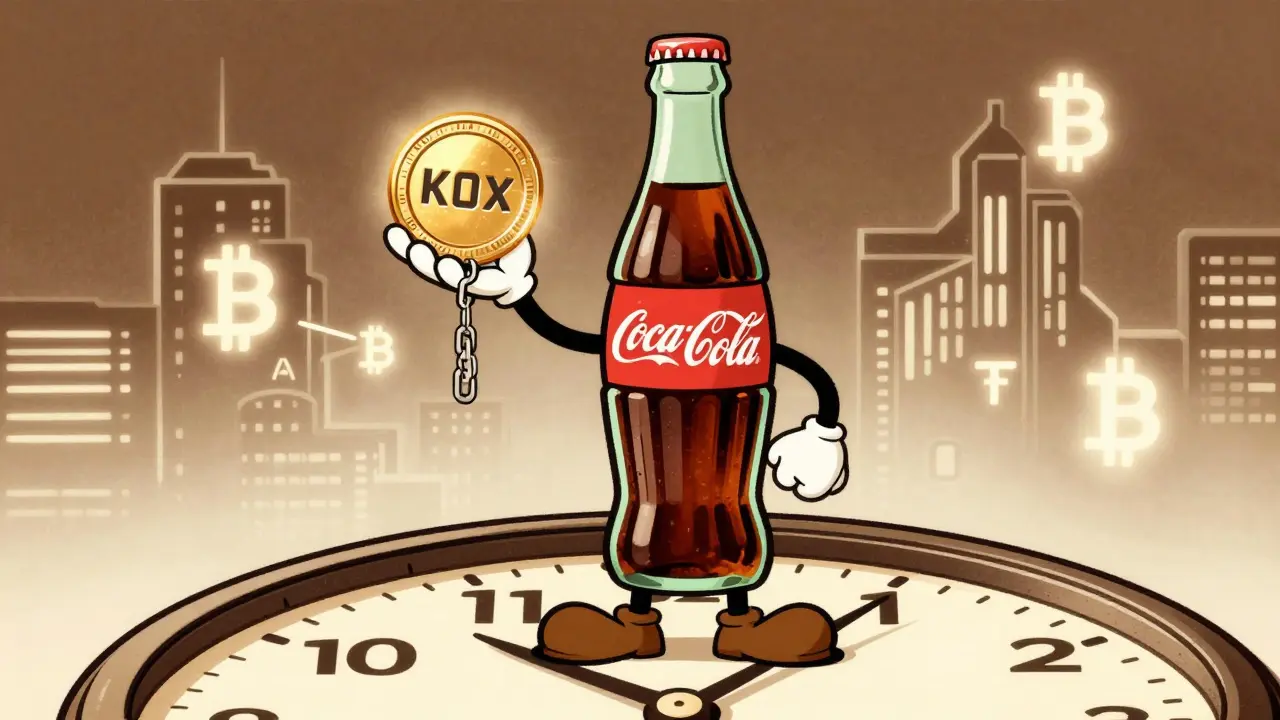
There’s a new way to own a piece of Coca-Cola - not with a stock certificate, not through a brokerage, but as a Coca-Cola tokenized stock called KOx (or KOX). It’s not a cryptocurrency in the traditional sense like Bitcoin or Ethereum. It’s not even a meme coin. It’s something weirder, and maybe more interesting: a digital token that mirrors the price of actual Coca-Cola shares, traded 24/7 on crypto platforms. If you’ve ever wondered how you could buy a fraction of Coca-Cola stock without a U.S. bank account or during a weekend, this is it.
What Exactly Is KOx?
KOx is a blockchain-based token that represents ownership of real Coca-Cola Company stock. Each token is backed 1:1 by a physical share of Coca-Cola (ticker: KO) held in custody by a regulated financial institution. That means if you own 1 KOx, you’re not just betting on Coca-Cola’s price - you’re holding a digital claim to an actual share of the company, locked in a smart contract.
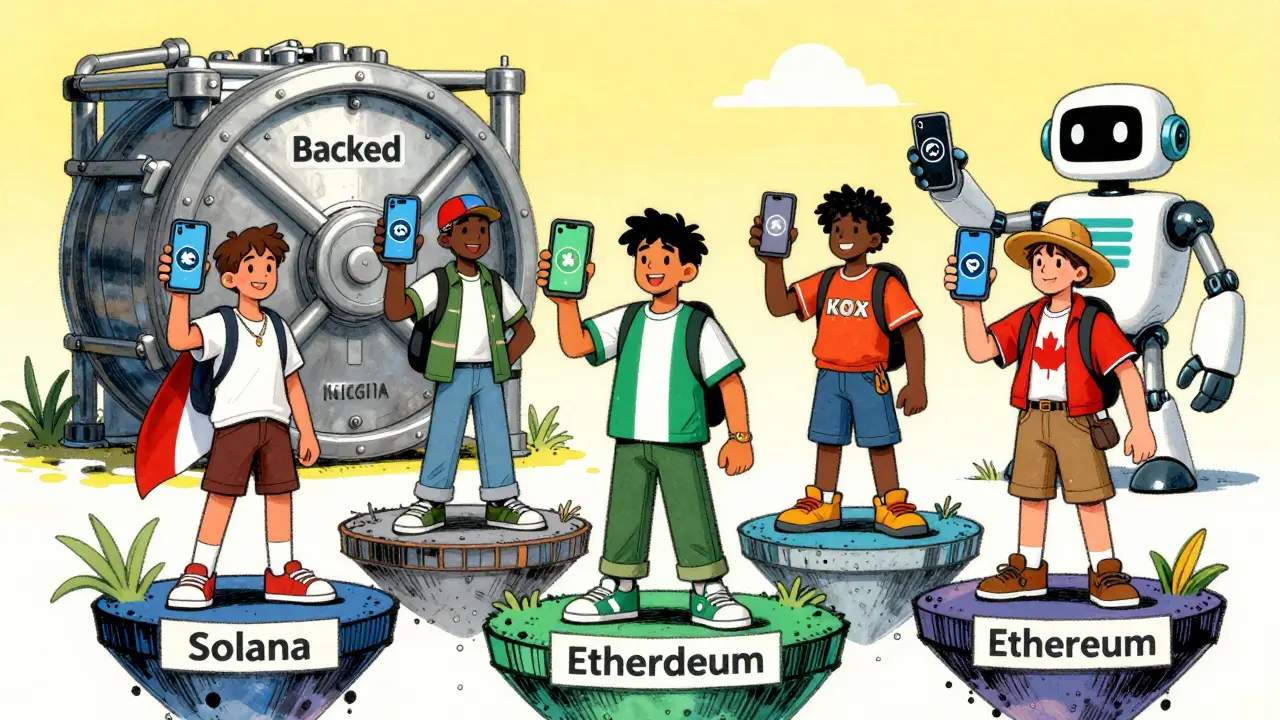
It’s issued by a company called Backed, which specializes in tokenizing traditional stocks. The token runs on both Solana (SPL) and Ethereum (ERC-20), so you can store it in wallets like Phantom or MetaMask. As of late February 2026, there are about 8,599.996 total KOx tokens in circulation. That’s not a lot - but each one is worth around $81.15, giving the whole thing a market cap of roughly $706,550.
Here’s the kicker: you can buy as little as $1 worth of KOx. No minimums. No broker fees. Just open a crypto wallet, go to Kraken or another supported exchange, and trade.
How Is KOx Different From Buying Coca-Cola Stock Normally?
Buying Coca-Cola stock through Fidelity or Charles Schwab means you’re stuck with market hours: 9:30 a.m. to 4 p.m. ET, Monday through Friday. You need a U.S. address, a Social Security number, and you’re subject to settlement delays. KOx removes all of that.
With KOx:
- You can trade anytime - weekends, holidays, 3 a.m. - because crypto markets never sleep.
- You don’t need a U.S. bank account. Investors from Canada, Brazil, or Nigeria can buy it if their exchange allows it.
- You can hold it in your crypto wallet. No custodian fees. No paperwork.
- You can use it as collateral in DeFi loans or earn yield through staking protocols.
But here’s what you don’t get:
- No voting rights. You can’t vote on Coca-Cola’s board decisions, shareholder proposals, or dividend policies.
- No direct communication from Coca-Cola. You won’t get annual reports, investor letters, or earnings call invites.
- No dividends paid directly. The issuer collects dividends from the underlying shares and may distribute them as cash or new tokens - but it’s not automatic or guaranteed.
- You can’t redeem KOx for actual stock easily. If you try, you’ll pay fees, and you might end up with less value than you started with.
Think of KOx as a price tracker with superpowers - not a replacement for owning real stock.
Who Backs KOx? Is It Safe?
The underlying Coca-Cola shares aren’t sitting on some random server. They’re held by regulated third-party custodians - banks or financial institutions licensed to hold assets for clients. This separation means if Kraken gets hacked or goes bankrupt, your KOx tokens aren’t at risk. The shares are locked in a separate vault, legally insulated from exchange failures.
Backed, the issuer, follows EU-style regulatory guidelines. They’ve published a base prospectus that outlines fees, risks, and how redemption works. It’s not the same as SEC registration in the U.S., but it’s more structured than most crypto projects.
Still - it’s not FDIC insured. It’s not a stock. It’s a tokenized asset. That means if Backed shuts down, or if the custodian fails, your claim could be in legal limbo. There’s no guarantee you’ll get your money back.
Trading KOx: Where and How
KOx is listed on several exchanges, but the most accessible for retail users is Kraken. You can buy it with USD, EUR, or even Bitcoin. The Kraken mobile app lets you purchase KOx directly with a tap, no brokerage account needed.
Other platforms include decentralized exchanges like Uniswap and Jupiter, where you swap ETH or SOL for KOx. But liquidity is thin. The 24-hour trading volume hovers between $38,000 and $40 million - depending on the source. That’s a red flag. If you try to buy $10,000 worth at once, you might end up paying 5% more than the listed price due to slippage.
There are only 247 wallets holding KOx. That’s not a broad base of investors. It’s mostly concentrated among a few dozen traders and institutional players. This makes it easy to manipulate and hard to exit if the market turns.
Why Does This Even Exist?
Tokenized stocks like KOx are part of a bigger trend: bringing Wall Street into Web3. Companies like Gemini and Dinari are doing the same with Apple, Tesla, and Microsoft. The idea is simple: why should only Americans with bank accounts be able to invest in U.S. stocks? Why wait five days for settlement? Why pay $5 per trade?
KOx removes friction. It opens up U.S. equities to billions of people who were locked out before. For a teenager in Indonesia or a freelancer in Nigeria, KOx is the first real way to own a piece of a global brand - not just speculate on its price.
But it’s still early. The market cap of all tokenized stocks combined is less than $1 billion. That’s a drop in the ocean compared to the $2 trillion market cap of Coca-Cola itself.
Is KOx a Good Investment?
It depends on what you want.
If you believe Coca-Cola’s stock will rise over the next year - and you want to profit from it without a brokerage account - then KOx makes sense. The price moves almost exactly with KO stock. Over the last 30 days, the correlation has been 99.2%.
But if you’re looking for long-term wealth building, you’re better off buying actual shares. Why? Because of fees.
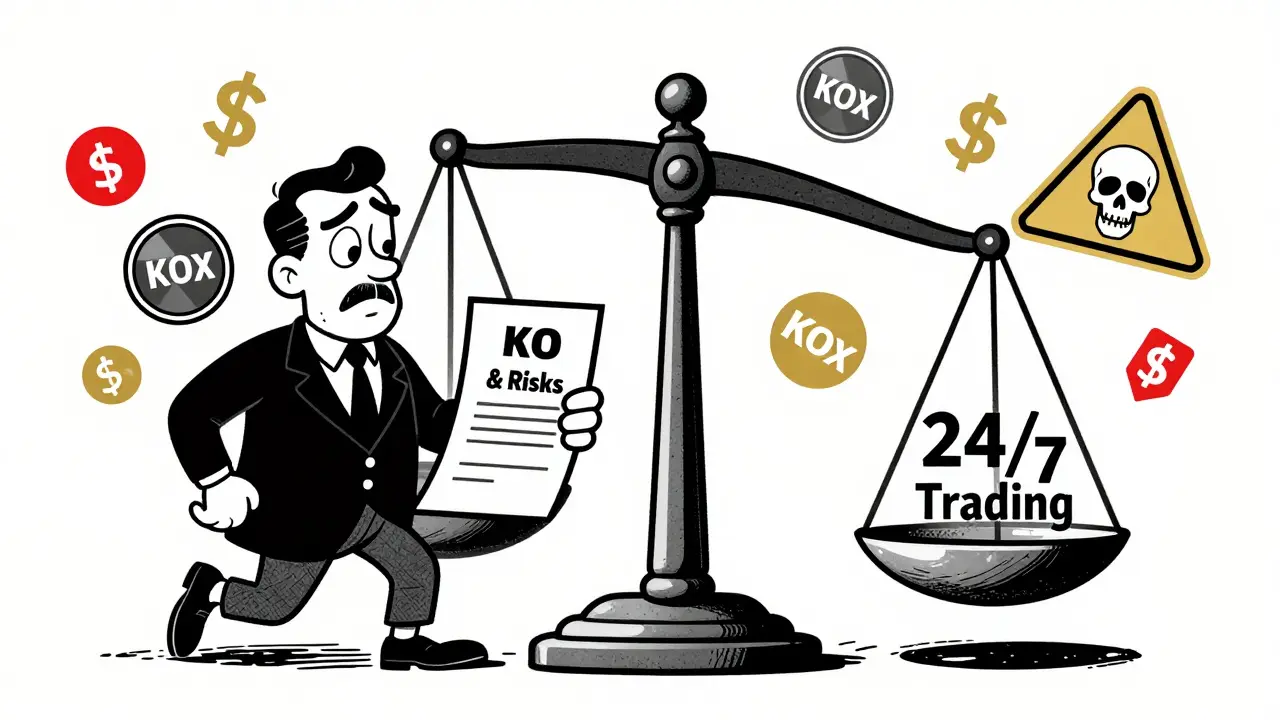
Every time you buy, sell, or redeem KOx, you pay a fee. These add up. Over five years, those fees could eat into your gains by 10-15%. Plus, you miss out on dividends and voting rights. You’re not an investor - you’re a trader.
Also, KOx isn’t regulated like a stock. If governments crack down on tokenized equities, exchanges could delist it overnight. There’s no safety net.
What’s the Future of KOx?
Backed says it plans to add dividend automation, voting rights via proxy, and integration with DeFi lending platforms. Imagine using your KOx as collateral to borrow USDC, then using that loan to buy more KOx - all without leaving your wallet.
But none of that exists yet. Right now, KOx is a niche product for crypto-savvy investors who want exposure to Coca-Cola without the bureaucracy. It’s not for everyone. It’s not even for most people.
If you’re curious, start small. Buy $10 worth. See how it works. Don’t treat it like a stock. Treat it like a high-tech futures contract.
Is KOx the same as Coca-Cola stock?
No. KOx is a token that tracks the price of Coca-Cola stock (KO), but it’s not the same thing. You don’t own the actual share. You own a digital claim backed by one. You can’t vote, you don’t get direct communications from the company, and you can’t easily redeem it for physical shares without paying fees.
Can I get dividends from KOx?
Possibly, but not directly. The issuer collects dividends from the underlying Coca-Cola shares and may distribute them as cash or additional tokens. But this isn’t guaranteed, and it’s subject to delays and fees. You won’t receive dividends the same way a shareholder does.
Is KOx safe to hold in my crypto wallet?
Yes, as long as you’re using a secure wallet like Phantom or MetaMask. The underlying Coca-Cola shares are held by regulated custodians, not by the exchange. Even if Kraken goes down, your tokens aren’t lost. But if the issuer (Backed) fails or gets shut down, your claim could become unenforceable.
Can I buy KOx in Canada?
Yes. Kraken allows Canadian residents to buy KOx through its platform after completing identity verification. You’ll need to provide proof of address and government ID. Other exchanges may or may not support Canadian users - check their regional restrictions.
What happens if Coca-Cola’s stock price crashes?
KOx will crash too - because it’s designed to mirror the price of the real stock. If KO drops 20%, KOx drops 20%. There’s no insulation. You lose value just like any investor. The only difference is you’re also paying fees on top of your losses.
Is KOx a scam?
No, it’s not a scam. It’s a regulated product issued by a known company (Backed) with transparent custody arrangements. But it’s not risk-free. The risks are subtle: fees, liquidity, regulatory uncertainty, and lack of shareholder rights. Treat it like a high-risk financial instrument - not a guaranteed investment.
Final Thoughts
KOx is a clever hack - a way to own Coca-Cola without the old system. But it’s still experimental. It’s not for long-term investors. It’s for crypto users who want exposure to U.S. stocks, 24/7 trading, and the flexibility of blockchain. If you’re okay with paying fees, accepting no voting rights, and accepting that this might vanish if regulators act - then go ahead. Start with $10. See how it moves. Don’t bet your savings on it.
The future of investing might be tokenized. But right now, KOx is just a bridge - not the destination.

Deborah Robinson
March 1, 2026 AT 09:37Michelle Mitchell
March 2, 2026 AT 09:43Jeremy buttoncollector
March 2, 2026 AT 20:33Michelle Xu
March 4, 2026 AT 03:37Ryan Burk
March 4, 2026 AT 22:18Don B.
March 6, 2026 AT 02:45Arya Dev
March 7, 2026 AT 16:04Andrew Hadder
March 8, 2026 AT 20:27Neeti Sharma
March 9, 2026 AT 12:19Nadia Shalaby
March 11, 2026 AT 10:04Molley Spencer
March 12, 2026 AT 09:47John Fuller
March 12, 2026 AT 13:41Lucy Simmonds
March 14, 2026 AT 01:07Maggie House
March 14, 2026 AT 15:31Dana Sikand
March 15, 2026 AT 21:38Cameron Pearce Macfarlane
March 16, 2026 AT 00:36Elizabeth Smith
March 16, 2026 AT 04:33Robert Kromberg
March 16, 2026 AT 13:19Daisy Boliaan
March 17, 2026 AT 02:01