
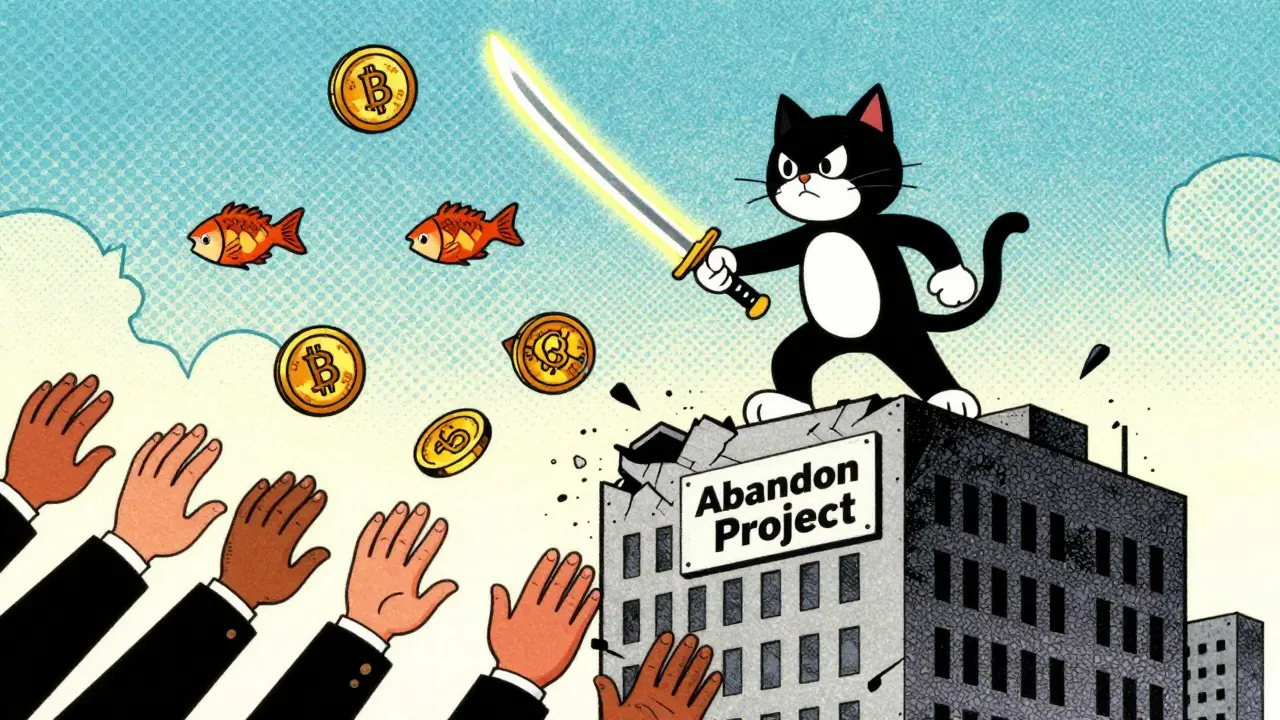
When you hear Catana (CATANA), you might picture a sleek, futuristic crypto project with whitepapers, team members, and a roadmap. But the real story is stranger-and more interesting. Catana isn’t a polished startup. It’s a token that was abandoned, then picked up by its community and given a second chance. That’s rare in crypto. Most projects vanish after the first dump. Catana didn’t. It became something else: a community-owned experiment on Solana.
First, let’s get the basics out of the way. Catana (CATANA) is a cryptocurrency built on the Solana blockchain. That means it moves fast and costs almost nothing to send. Solana handles over 65,000 transactions per second, and fees are often under a penny. For a token like CATANA, that’s a big deal. It lets people trade, swap, and move tokens without getting crushed by gas fees like on Ethereum.
But here’s the twist: Catana wasn’t originally meant to last. The developer launched it, got some early buyers, then disappeared. No update. No announcement. Just silence. That’s the end of the road for 99% of tokens. But instead of fading away, the holders took over. No CEO. No team. Just a group of people who owned the coin deciding what to do next. That’s Web3 in action-true decentralization. No one owns Catana. Everyone who holds it does.
The token supply is simple. There are 1 billion CATANA tokens that will ever exist. Right now, 999,963,958 are in circulation. That’s almost the full supply. No more coins are being mined. No inflation. The project didn’t create a new token standard. It didn’t build a DeFi app or a gaming platform. It’s just a token with a logo-a cat holding a katana-and a community that refuses to let it die.
Price-wise, Catana is all over the map. On CoinMarketCap, it’s trading around $0.0002555. On Bybit, it’s $0.00026684. Coinpedia says it’s $0.0002. Why the difference? Because it’s listed on a handful of exchanges, and not all of them have deep buyers. The 24-hour trading volume ranges between $86,000 and $182,000. That’s not zero-but it’s not liquid either. You can sell if you need to. But buying? That’s harder.
For example, CoinSwitch has blocked new purchases of CATANA. Why? Low liquidity. If too many people try to buy at once and there aren’t enough sellers, the price spikes. Exchanges do this to protect users from wild swings. It’s a warning sign: if you want to get in, you’ll need to look elsewhere. Try decentralized exchanges like Jupiter or Raydium on Solana. That’s where most of the trading actually happens.
There’s no official website with a team bio. No roadmap with milestones. No audited smart contract. The project doesn’t have a treasury. It doesn’t pay developers. It doesn’t even have a Discord server with 10,000 members. What it does have is a token on Solana, a logo, and a group of people who still hold it. That’s it.
So what’s the point? Why does it still exist? The answer is community. People believe in the idea-not the product. The cat with the katana is a symbol. It represents resilience. It’s the token that refused to die. That’s powerful in crypto, where so many projects are built on hype, not loyalty.
Some call it a meme coin. Others call it a ghost project. But those who still hold it? They see it as a test. Can a token survive without a team? Can a community steer a project without a central authority? Catana is that test. And so far, it’s holding up.
There’s no utility beyond being a token on Solana. You can’t stake it. You can’t use it to pay for services. You can’t earn rewards from it. It doesn’t power any app. It’s not part of a DeFi protocol. It’s just a token. But in crypto, sometimes that’s enough. If enough people believe in it, it has value. Not because of what it does-but because of who holds it.
Market data shows Catana sits at #4113 on CoinGecko by market cap. That’s deep in the long tail. It’s not a top 100 coin. It’s not even in the top 1,000. Its fully diluted valuation is around $7.65 million in BTC. That’s tiny compared to Bitcoin or Ethereum. But for a token with no team and no roadmap? That’s a win.
If you’re thinking of buying Catana, here’s what you’re really buying: a bet on community. You’re not buying a product. You’re not buying innovation. You’re buying a belief that people will keep holding, trading, and defending this token-even without a company behind it. That’s rare. And in crypto, rare things sometimes become valuable.
There’s no guarantee it will rise. It might drop to $0.0001. Or it might spike to $0.001 if a big holder decides to dump. It’s volatile. It’s risky. But it’s also one of the few coins where the community-not the code-is the real story.
How Catana compares to other Solana tokens
| Feature | Catana (CATANA) | Solana (SOL) | Raydium (RAY) | Orca (ORCA) |
|---|---|---|---|---|
| Blockchain | Solana | Solana | Solana | Solana |
| Market Cap (USD) | $7.65M | $12.8B | $410M | $290M |
| Circulating Supply | 999.83M | 446M | 330M | 300M |
| 24H Volume | $86K-$182K | $1.8B | $110M | $85M |
| Official Team | None (community-run) | Yes | Yes | Yes |
| Use Case | Community token | Network gas & staking | DeFi AMM & liquidity | DeFi AMM & swaps |
| Buy Restrictions | Yes (on CoinSwitch) | No | No | No |
Compare Catana to SOL, RAY, or ORCA, and the difference is obvious. Those tokens have teams, apps, and clear functions. Catana has nothing but its holders. That’s not a weakness-it’s a statement. In a world where tokens are created to raise money, Catana was created to stay alive.
Why Catana still matters
Catana isn’t here to make you rich. It’s here to prove something else: that crypto doesn’t need a CEO. It doesn’t need a whitepaper. It doesn’t need a marketing budget. All it needs is a group of people who believe in it enough to keep holding.
Most tokens die because the team leaves. Catana didn’t die because the team left. It survived because the community stayed.
If you’re looking for a project with a roadmap, Catana isn’t it. If you’re looking for a token with a story-real, messy, and human-then Catana might be the most interesting one on Solana.
Is Catana (CATANA) a good investment?
Catana is not a traditional investment. It doesn’t have a team, product, or utility. Its value comes from community belief. If you’re looking for steady growth or returns, this isn’t the coin for you. If you’re interested in crypto as a social experiment-where a token survives without any corporate backing-then Catana is a rare case study. Only invest what you can afford to lose.
Can I buy Catana on Coinbase or Binance?
No, Catana is not listed on major exchanges like Coinbase or Binance. It trades only on smaller platforms and decentralized exchanges on Solana, such as Jupiter and Raydium. Some centralized exchanges like Bybit list it, but liquidity is low. Buying is possible, but not easy. Always check the exchange’s official listing before trading.
Why is buying Catana restricted on CoinSwitch?
CoinSwitch restricts buying Catana because of low liquidity. When a token has few buyers and sellers, sudden trades can cause wild price swings. To protect users, exchanges block new purchases while still allowing sales. This means you can sell your CATANA, but you can’t easily buy more. It’s a sign the market is thin-not that the token is fake.
What is the total supply of Catana?
The maximum supply of Catana is 1,000,000,000 tokens. As of now, 999,963,958 are in circulation. That means nearly all tokens have been released. There’s no inflation, no future minting, and no hidden supply. The supply is fixed and transparent on the Solana blockchain.
Does Catana have a website or official team?
No. Catana has no official website, no team, and no public roadmap. It was abandoned by its original creator and taken over by holders. Any website or social media claiming to represent Catana is unofficial. The only real source of truth is the Solana blockchain itself, where the token’s transactions and supply are permanently recorded.
Is Catana a meme coin?
Yes, in structure-but not in spirit. Meme coins like Dogecoin or Shiba Inu are often created for fun or hype. Catana was created, abandoned, and then revived by its community. It’s not a joke. It’s a proof of concept: a token that survives without any central authority. Its cat-and-katana branding is fun, but its story is serious.
What to do next
If you’re curious about Catana, don’t buy it hoping to get rich. Instead, track it. Watch how the price moves on Jupiter or Raydium. See how often it’s traded. Notice if more people start talking about it. Read the blockchain. Check the wallet addresses. See if any large holders are moving tokens.
Catana is a mirror. It reflects what crypto could be-without CEOs, without ads, without promises. It’s not perfect. It’s not polished. But it’s real. And in a world full of hype, that’s worth paying attention to.

Lauren J. Walter
March 20, 2026 AT 00:13The fact that people still trade this thing is either profound or deeply concerning. I'm leaning toward both.
S F
March 21, 2026 AT 16:42Angelica Stovall
March 21, 2026 AT 21:00Bryan Roth
March 21, 2026 AT 21:33We don't need another DeFi protocol. We need more projects that survive because people care. Not because they're pumped. Because they're loyal.
sai nikhil
March 22, 2026 AT 14:50Sahithi Reddy
March 23, 2026 AT 21:47George Hutchings
March 25, 2026 AT 06:46Henrique Lyma
March 25, 2026 AT 12:26Derek Lynch
March 25, 2026 AT 21:19Shreya Baid
March 27, 2026 AT 10:04Christopher Hoar
March 27, 2026 AT 10:48Sarah Zakareckis
March 29, 2026 AT 00:51Heather James
March 29, 2026 AT 23:20Graham Smith
March 31, 2026 AT 16:00Jerry Panson
March 31, 2026 AT 17:23rajan gupta
April 2, 2026 AT 00:06Billy Karna
April 3, 2026 AT 07:10Cheri Farnsworth
April 3, 2026 AT 12:41Gene Inoue
April 3, 2026 AT 16:59Ricky Fairlamb
April 5, 2026 AT 13:22Arlene Miles
April 7, 2026 AT 08:58Tony Weaver
April 8, 2026 AT 02:25Patty Atima
April 9, 2026 AT 17:14Lucy de Gruchy
April 11, 2026 AT 14:52Konakuze Christopher
April 11, 2026 AT 22:51