
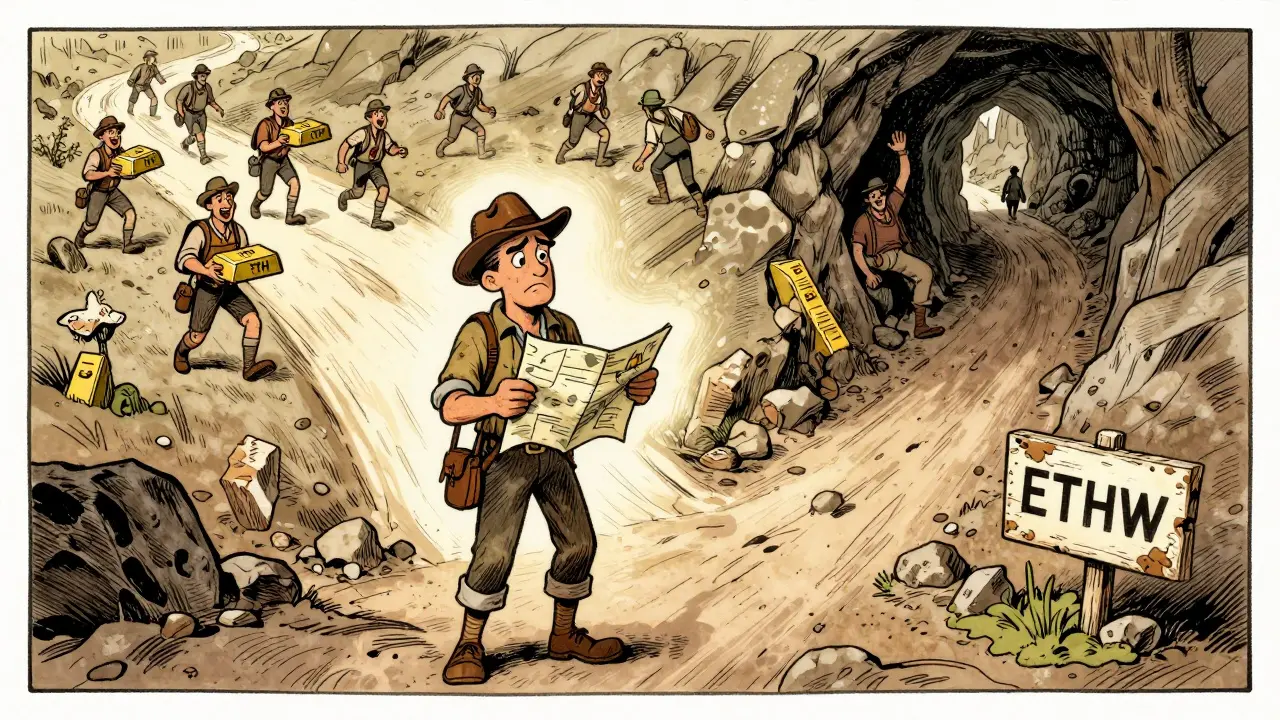
Have you ever stumbled upon a cryptocurrency with a name that sounds familiar but feels slightly off? If you are looking for CakeWSwap, you might be wondering if it is the next big thing in decentralized finance or just another obscure project on the fringe of the crypto world. The short answer is that CakeWSwap (CAKEW) is a very small decentralized exchange protocol operating on the EthereumPoW network. It is not the famous PancakeSwap you might be thinking of. In fact, as of mid-2026, it sits at the extreme edge of market relevance, with virtually no liquidity and negligible trading volume.
If you clicked this title hoping to find a high-yield investment opportunity, I need to set your expectations right immediately. This is not a mainstream asset. It is a micro-cap token tied to a specific fork of Ethereum that exists primarily for niche users interested in the EthereumPoW ecosystem. Understanding what CAKEW actually is-and what it isn’t-is crucial before you even consider interacting with its smart contracts.
The Origin Story: Born from the Ethereum Merge
To understand CakeWSwap, you have to look back at one of the biggest events in crypto history: the Ethereum Merge in September 2022. When Ethereum transitioned from Proof-of-Work (PoW) to Proof-of-Stake (PoS), a minority group of miners and developers wanted to keep the original mining-based version alive. They created EthereumPoW (ETHW), a blockchain fork that continued using the proof-of-work consensus mechanism.
CakeWSwap launched in October 2022, making it one of the first decentralized exchanges (DEXs) built specifically for this new chain. Its purpose was simple: allow users to swap ERC-20 tokens on the ETHW network without relying on centralized intermediaries. However, unlike major DEXs that expanded across multiple chains like BNB Chain, Polygon, or Arbitrum, CakeWSwap has remained strictly confined to EthereumPoW. This single-chain limitation has severely restricted its growth potential and user base.
Tokenomics: Why the Numbers Are So Low
Let’s talk about the hard data, because the numbers tell a stark story. According to aggregators like DefiLlama and CryptoRank, the metrics for CAKEW are practically invisible compared to industry standards.
- Total Supply: Exactly 1,000,000 CAKEW tokens.
- Market Capitalization: Effectively $0.00 (due to rounding).
- Trading Volume: $0.00 on most tracked platforms.
- Total Value Locked (TVL): Approximately $85.03 on EthereumPoW.
- Price: Often recorded as fractions of a cent, such as $0.000016.
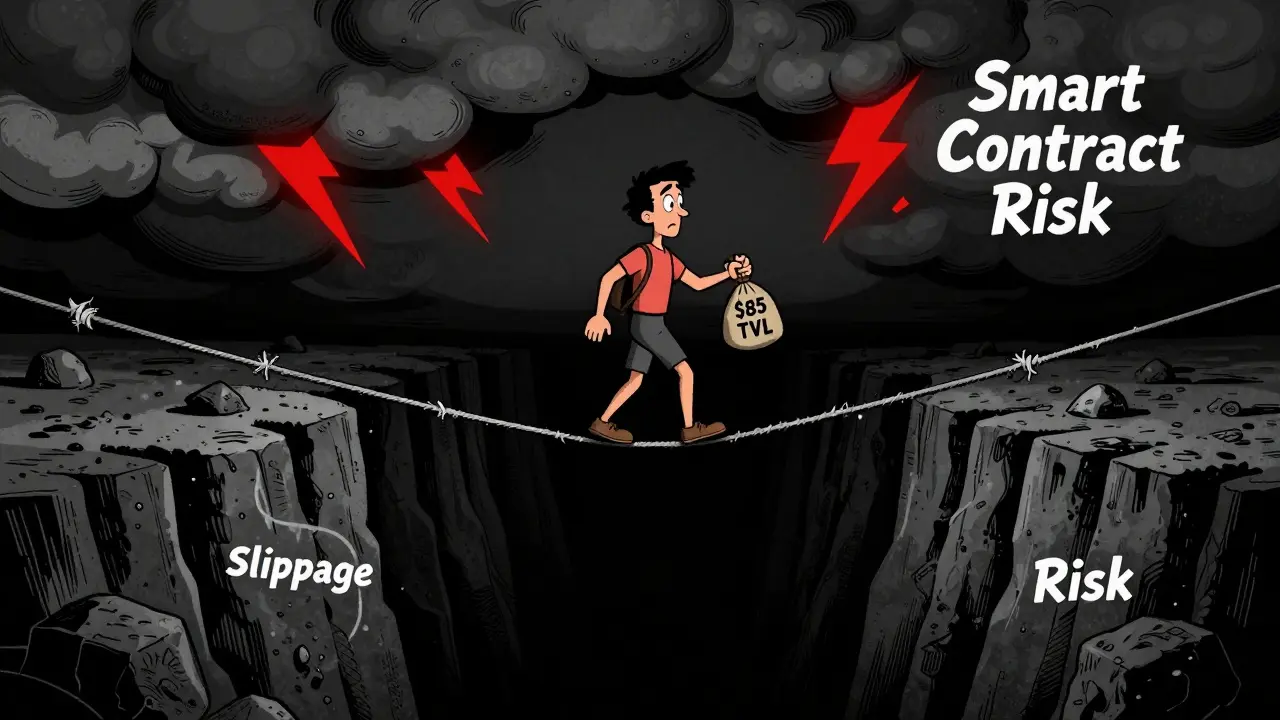
When you see a TVL of less than $100, it means there is almost no money locked in the protocol’s liquidity pools. For context, major DEXs hold billions in TVL. With only $85 locked in, even a trade of $10 could cause massive slippage-meaning the price would swing wildly against you. There is simply no depth in the pool to absorb significant buying or selling pressure.
CakeWSwap vs. PancakeSwap: Don't Get Confused
This is the most critical distinction you need to make. Many new crypto investors confuse CakeWSwap (CAKEW) with PancakeSwap, which uses the ticker CAKE. These two projects are completely unrelated, despite the similar names.
| Feature | CakeWSwap (CAKEW) | PancakeSwap (CAKE) |
|---|---|---|
| Network | EthereumPoW (ETHW) | BNB Chain (and others) |
| Market Cap (Approx.) | $0.00 (Micro-cap) | $438 Million+ |
| Daily Volume | $0.00 | $30 Million+ |
| Features | Basic Swaps & Farming | Swaps, Staking, NFTs, Lottery, IFOs |
| Exchange Listings | None (Unlisted on Binance) | Listed on Major Exchanges |
| Token Utility | Farming Rewards Only | Governance, Staking, Fees |
PancakeSwap is a top-100 cryptocurrency with a robust ecosystem, active development, and millions of users. CakeWSwap is an anonymous, low-activity protocol with minimal features. Never assume they are the same thing. Investing in CAKEW based on the reputation of CAKE would be a costly mistake.

How Does the Protocol Actually Work?
Despite its tiny size, CakeWSwap functions like a standard Automated Market Maker (AMM). Here is the technical breakdown of how it operates on the EthereumPoW chain:
- Liquidity Pools: Users deposit pairs of ERC-20 tokens (e.g., ETHW and USDT) into a smart contract. This creates a pool of funds that other traders can swap against.
- LP Tokens: In return for depositing funds, providers receive Liquidity Provider (LP) tokens. These tokens represent their share of the pool.
- Farming Rewards: Users can stake these LP tokens in "farms" within the CakeWSwap interface. In exchange, they earn CAKEW tokens as a reward.
- Trading Fees: Traders pay a fee when swapping tokens, which is distributed proportionally to the liquidity providers.
There is no evidence of advanced features like concentrated liquidity, cross-chain bridges, or governance voting for CAKEW holders. It is a bare-bones DeFi application designed solely to facilitate basic swaps and yield farming on a niche network.
Risks and Limitations You Must Know
If you are considering interacting with CakeWSwap, you need to understand the severe risks involved. This is not a safe harbor for capital preservation.
1. Extreme Illiquidity
With a TVL of roughly $85, the market is incredibly thin. If you try to buy a significant amount of CAKEW, you will likely drive the price up artificially due to slippage. Conversely, trying to sell could crash the price instantly. You may find yourself unable to exit your position at all.
2. Lack of Centralized Exchange Support
Major exchanges like Binance explicitly state that CAKEW is not listed for trading. You cannot simply log into Binance and buy CAKEW with fiat currency. You must use decentralized methods, such as the Binance Web3 Wallet or Bitget Convert, to acquire it. This adds complexity and friction to the process.
3. Project Abandonment Risk
There are no public roadmaps, no named founders, and no active community sentiment indicators for CakeWSwap. The lack of updates suggests the project may be maintained by a very small team or potentially abandoned. In DeFi, if the developers stop maintaining the smart contracts or marketing the platform, the value often drops to zero.
4. Smart Contract Vulnerabilities
While many DeFi protocols undergo audits, smaller, anonymous projects often skip this step. Without independent security audits, there is a higher risk of bugs or exploits that could drain the liquidity pool.
How to Access CakeWSwap (If You Still Want To)
If you are determined to explore CAKEW for educational purposes or speculative reasons, here is how you can technically access it. Note that this involves using non-custodial wallets and interacting directly with blockchain networks.
- Set Up a Wallet: You need a wallet that supports the EthereumPoW (ETHW) network. MetaMask is commonly used, but you must add the custom RPC details for EthereumPoW manually.
- Acquire ETHW: You will need ETHW to pay for gas fees on the EthereumPoW network. This usually requires bridging assets from other chains or buying ETHW on a niche exchange that supports it.
- Connect to CakeWSwap: Navigate to the official CakeWSwap website (ensure you verify the URL carefully to avoid phishing sites). Connect your wallet.
- Swap or Provide Liquidity: You can swap existing tokens for CAKEW or provide liquidity to earn rewards. Be aware of the high slippage settings you may need to adjust.
- Alternative via Aggregators: Platforms like Bitget offer conversion tools that might allow you to convert other assets into CAKEW, though liquidity remains a bottleneck.
Final Thoughts: Is CAKEW Worth Your Time?
In the grand scheme of decentralized finance, CakeWSwap is a footnote. It serves a very specific, tiny segment of users who are deeply invested in the EthereumPoW narrative. For the average investor, trader, or DeFi enthusiast, CAKEW offers little utility, no governance power, and significant financial risk due to its illiquidity.
If you are looking for exposure to DeFi success stories, established protocols like Uniswap, PancakeSwap, or Curve Finance offer better infrastructure, deeper liquidity, and proven track records. CakeWSwap remains an experimental artifact of the post-Merge era, best observed rather than invested in.
Is CakeWSwap (CAKEW) the same as PancakeSwap (CAKE)?
No, they are completely different. PancakeSwap (CAKE) is a major decentralized exchange on the BNB Chain with a market cap over $400 million. CakeWSwap (CAKEW) is a tiny, obscure protocol on the EthereumPoW network with negligible value and liquidity. Do not confuse the two.
Can I buy CAKEW on Binance?
No. Binance explicitly states that CAKEW is not listed for trade or service on its centralized platform. You can only acquire it through decentralized means, such as using the Binance Web3 Wallet to interact with the EthereumPoW network or via conversion tools on other platforms like Bitget.
What is the total supply of CAKEW?
The total supply of CAKEW is exactly 1,000,000 tokens. However, the circulating supply is unclear, and the market capitalization is effectively zero due to extremely low trading activity and price.
Why is the TVL of CakeWSwap so low?
The Total Value Locked (TVL) is around $85 because the protocol operates on EthereumPoW, a niche fork with limited adoption. Most DeFi users prefer larger networks like Ethereum Mainnet or BNB Chain, leaving CakeWSwap with very few liquidity providers.
Is it safe to invest in CAKEW?
It is highly risky. Due to extreme illiquidity, lack of central exchange listings, and no clear development roadmap, CAKEW carries a high risk of total loss. Slippage can be severe, and you may not be able to sell your tokens easily.
What network does CakeWSwap operate on?
CakeWSwap operates exclusively on the EthereumPoW (ETHW) network. It does not support Ethereum Mainnet, BNB Chain, or any other Layer 1 or Layer 2 solutions.
