
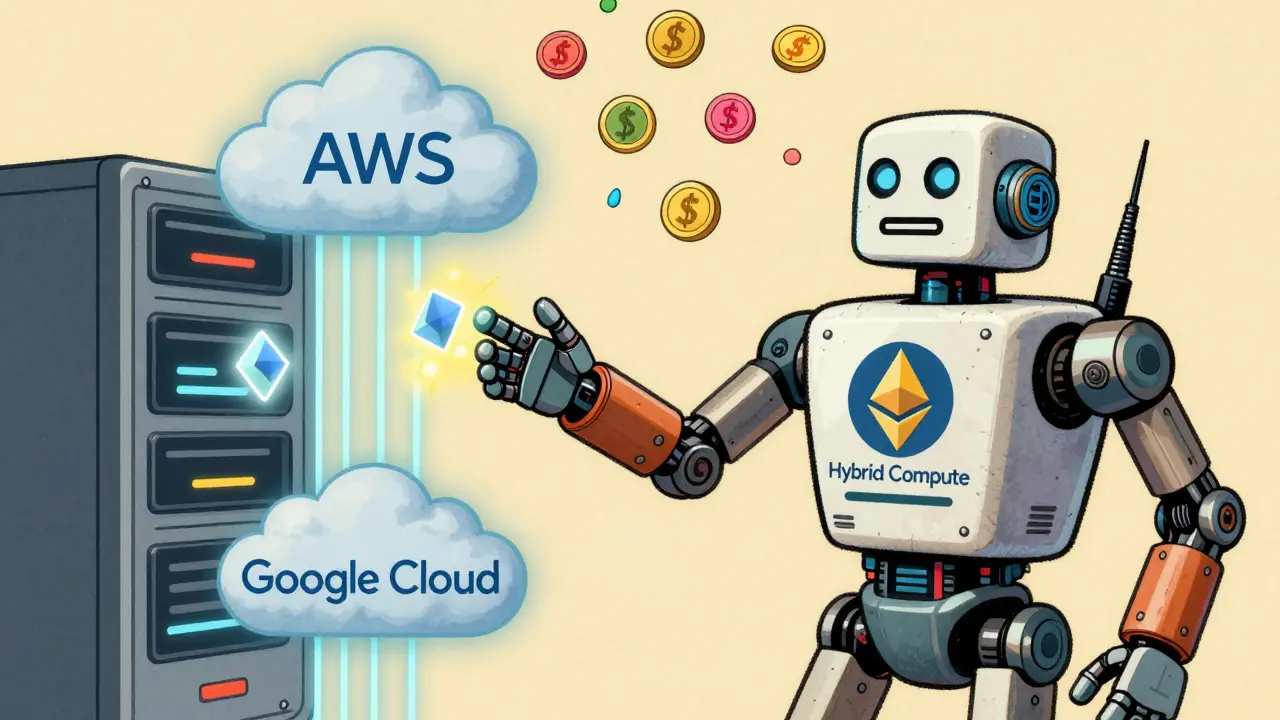
Most people hear "crypto coin" and think of Bitcoin or Ethereum. But behind the scenes, a quiet revolution is happening in the layers beneath them - and Boba Network is one of the most unusual players in that space. It’s not just another Ethereum scaling tool. It’s trying to do something no other layer-2 network has pulled off at scale: bring real-world computing power on-chain. If you’ve ever wondered why your DeFi app can’t use AI, pull live weather data, or run complex game logic without costing $50 in gas, Boba Network might be the answer.
What Exactly Is Boba Network?
Boba Network is a layer-2 blockchain built on top of Ethereum using optimistic rollup technology. That means it batches hundreds of transactions together and submits them as one to Ethereum, slashing fees and speeding things up. But here’s where it gets different: Boba doesn’t just move transactions faster. It lets smart contracts call out to off-chain servers - like AWS or Google Cloud - to run heavy computations and bring the results back on-chain. This is called Hybrid Compute, and it’s Boba’s secret sauce.Think of it like this: traditional blockchains are like tiny, ultra-secure calculators. They’re perfect for tracking who owns what, but terrible at running AI models or processing video streams. Boba turns that calculator into a remote-controlled robot that can tap into powerful cloud computers when it needs to. That opens up possibilities like:
- Decentralized games with real-time physics and AI opponents
- DeFi protocols that adjust interest rates based on live stock market data
- NFTs that change based on real-world events - like weather, traffic, or sports scores
Boba Network launched its mainnet beta in August 2021. It was developed by Enya, a software company, and the same team behind the original OMG Network. Unlike many layer-2 projects that only work on Ethereum, Boba supports multiple chains: Ethereum, Avalanche, BNB Chain, Fantom, and Moonbeam. That makes it one of the few truly multichain execution layers.
The BOBA Token: More Than Just a Coin
The native token of Boba Network is called BOBA. It’s not just a speculative asset - it has real functions inside the system:- Governance: Holders vote on upgrades, fee structures, and new features. One token = one vote.
- Gas fees: You can pay for transactions in BOBA, ETH, or other tokens - a rare flexibility.
- Staking rewards: Stake your BOBA to help secure the network and earn a share of transaction fees.
As of January 2026, the circulating supply is around 160 million BOBA, with a maximum cap of 500 million. That’s a slow, four-year inflation schedule - different from fixed-supply coins like Bitcoin. The token price hovers around $0.04, and daily trading volume is roughly $1.27 million. That’s small compared to Arbitrum’s $200M+ daily volume, but it’s not unusual for a niche technical project.
What’s interesting is that BOBA isn’t trying to beat Arbitrum or Optimism in raw transaction volume. It’s trying to win in complexity. If you need to run a machine learning model inside a smart contract, Boba is one of the only places you can do it.
How Hybrid Compute Changes Everything
This is where Boba stands out - and why it’s worth paying attention to, even if you’re not a developer.Standard layer-2s like Arbitrum or Optimism are great at making Ethereum cheaper and faster. But they still run everything on-chain. That means every calculation, every data lookup, every decision has to be done by the blockchain nodes - and that’s expensive and slow.
Boba’s Hybrid Compute breaks that rule. Here’s how it works:
- A smart contract on Boba needs to know the current price of gold.
- Instead of pulling that data from an oracle (which can be manipulated), it sends a request to a trusted off-chain server.
- The server fetches the price from a financial API, runs a calculation, and signs the result.
- The signed result is sent back to Boba, where it’s verified and used in the smart contract.
This is a game-changer. You can now build apps that react to live data - stock prices, weather, social media trends, even GPS locations - without paying $100 in gas or waiting 10 minutes. And because the off-chain computation is cryptographically verified, you don’t have to trust the server. The system ensures the result is valid before accepting it.
Developers are already using this for:
- AI-powered NFTs that evolve based on user behavior
- Decentralized insurance that pays out when satellite imagery shows flood damage
- Metaverse worlds with real-time physics engines powered by cloud GPUs
No other layer-2 offers this. Not Arbitrum. Not Polygon. Not zkSync. Boba is the only one bridging Web3 with Web2 infrastructure at scale.

Who Uses Boba Network?
Boba isn’t for casual traders. It’s for builders who need more than simple token swaps.Right now, its biggest users are:
- Web3 gaming studios: Games need fast, cheap transactions and complex logic. Boba’s low fees and Hybrid Compute let them build richer gameplay without breaking the bank.
- DeFi protocols needing real-world data: Projects that want to use live market data, credit scores, or supply chain info can do it securely on Boba.
- AI and machine learning teams: Developers training models on-chain are stuck. Boba lets them run training off-chain and only store the results on-chain - saving 90%+ in costs.
As of early 2026, Boba has processed over 72 million transactions and supports nearly 10,000 smart contracts. That’s a lot for a niche player, but it’s still tiny next to Arbitrum’s billions. Still, the quality of projects matters more than quantity. Boba hosts some of the most technically ambitious dApps in crypto.
Pros and Cons: Is Boba Worth It?
Here’s the honest breakdown:
Pros
- Hybrid Compute: The only layer-2 that lets you run off-chain code securely.
- Multichain: Works on Ethereum, Avalanche, BNB, Fantom, and Moonbeam.
- Low fees: 40-100x cheaper than Ethereum mainnet.
- EVM-compatible: If you know Solidity, you can deploy on Boba in hours.
- Flexible gas: Pay in BOBA, ETH, or other tokens - no need to swap first.
Cons
- Low adoption: Transaction volume is tiny compared to leaders like Arbitrum.
- Centralization risk: Only whitelisted parties can post state roots to Ethereum. If they go offline, withdrawals freeze.
- Less liquidity: Harder to trade BOBA without slippage. Not ideal for big investors.
- Complex setup: Using Hybrid Compute requires extra coding. Not beginner-friendly.
For most people just sending ETH or trading tokens, Arbitrum or Polygon are better choices. But if you’re building something that needs AI, real-time data, or complex logic - Boba is the only option.
How to Get Started with Boba Network
If you want to use Boba, here’s how:
- Get a wallet: MetaMask or Coinbase Wallet work fine.
- Add Boba Network: Go to docs.boba.network and copy the network settings (chain ID, RPC URL, etc.).
- Bridge funds: Use the official Boba bridge to move ETH or other tokens from Ethereum or another chain to Boba.
- Use dApps: Try games like MetaSoccer or DeFi tools like BobaSwap built on Boba.
- Stake BOBA: If you hold the token, stake it on the Boba DAO portal to earn rewards and vote on upgrades.
For developers: Boba’s documentation is solid. The GitHub repo is active. You can deploy your Ethereum dApp on Boba with almost zero changes - then add Hybrid Compute later when you need it.
What’s Next for Boba Network?
Boba’s roadmap isn’t public, but its direction is clear: become the go-to layer-2 for smart, data-heavy applications. The team is likely working on:
- More integrations with cloud providers (AWS, Azure, Google Cloud)
- Better tools for AI developers to plug in models
- Partnerships with gaming studios and DeFi protocols
- Improving decentralization - possibly opening up proposer roles
The layer-2 market is getting crowded. Arbitrum and Optimism have the users. zkSync has the tech. But Boba has the only tool that can connect blockchain to the real world - and that could be enough to survive.
If Web3 is going to move beyond simple payments and into AI, automation, and real-time systems, it needs a layer that can handle complexity. Boba Network is betting everything on that idea. Whether it wins or fades depends on one thing: whether developers believe it’s worth the extra effort.
Frequently Asked Questions
Is Boba Network safe to use?
Boba Network is built on Ethereum’s security, so the underlying chain is solid. But it has a centralization risk: only whitelisted parties can submit state updates. If they go offline, withdrawals could freeze. It’s safer than a centralized exchange, but not as decentralized as Arbitrum or zkSync. Use it for apps you trust, not for large, long-term holdings.
Can I stake BOBA to earn rewards?
Yes. You can stake BOBA tokens through the Boba DAO portal. Stakers help secure the network and earn a portion of transaction fees paid in ETH or other tokens. Rewards are distributed automatically. The current APY varies between 5-12%, depending on network usage.
How is Boba different from Arbitrum or Optimism?
Arbitrum and Optimism are optimized for speed and low cost - perfect for simple transfers and DeFi trades. Boba does that too, but adds Hybrid Compute: the ability to run off-chain code and bring results back on-chain. This lets you build AI apps, real-time games, and data-driven DeFi - things other layer-2s can’t do. But Boba is less mature and has lower liquidity.
Can I buy BOBA on Coinbase or Binance?
BOBA is listed on major exchanges like Binance, KuCoin, and Gate.io. It’s not available on Coinbase yet. Always use the official Boba Network bridge to move funds - never send tokens directly from an exchange to Boba without checking the network.
Why is BOBA’s price so low?
BOBA’s price reflects low market demand, not low tech value. It’s a niche tool for developers, not a retail speculation coin. With only $1.27M daily volume and limited marketing, it hasn’t caught on with traders. But its real value is in use - not price. If developers start building big apps on it, the token could rise.
Does Boba Network support NFTs?
Yes. NFTs work perfectly on Boba. In fact, it’s ideal for dynamic NFTs - ones that change based on real-world data. For example, a digital artwork could update its colors based on the weather in Paris, or a game character could evolve based on player stats. Boba’s Hybrid Compute makes this possible without expensive on-chain calculations.
Final Thoughts
Boba Network isn’t the fastest, biggest, or most popular layer-2. But it’s the only one that lets you build apps that think - not just transact. If you’re a developer, it’s worth exploring. If you’re a user, try one of its dApps. You might be using AI-powered crypto without even realizing it.

Dave Ellender
January 23, 2026 AT 19:04Boba’s Hybrid Compute is the real deal. I’ve been testing it with a game dev team and the difference between running physics on-chain vs off-chain is night and day. Gas fees dropped 90%, and the AI opponents actually feel smart now. No other L2 lets you do this without begging for oracle data that’s always late or manipulated.
It’s not for everyone, but if you’re building something that needs real-time input? This is the only path forward.
Adam Fularz
January 25, 2026 AT 08:48lol so bobas just a fancy way to use aws? i mean why not just use aws and call it a day? blockchain is dead anyway. everyone knows it. this is just crypto bros trying to make cloud computing sound revolutionary.
Adam Lewkovitz
January 25, 2026 AT 14:09USA built the internet. USA built cloud computing. And now some startup from nowhere thinks they can outsmart it with a blockchain? This is why America’s tech dominance is slipping. We’re letting foreign devs play with our infrastructure while we chase shiny tokens.
Hybrid Compute? More like Hybrid Delusion. Stick to DeFi simple, America.
David Zinger
January 26, 2026 AT 20:13Hybrid Compute? More like Hybrid Scam 🤡
Only whitelisted parties submit state roots?? So it's centralized?? Then why are we calling this blockchain??
Also BOBA token is a meme coin with a techy name 😂
Stop pretending this isn't just another pump-and-dump with extra steps 🤦♂️
And don't even get me started on that 'AI NFTs' nonsense - they're just JPEGs that change when someone updates a server 😭
Who's funding this? VC ghosts? 🕵️♂️
steven sun
January 27, 2026 AT 21:39yo this is actually fire🔥
i just deployed a dapp on boba and my users arent getting ripped off by gas fees anymore
the hybrid compute lets me run ai moderation on comments without crashing the chain
if you're building anything real - stop wasting time on arbitrum and go to boba
they're the only ones thinking ahead 🚀
Athena Mantle
January 29, 2026 AT 08:37Let me just say - this is the most overhyped thing since the metaverse 😒
Hybrid Compute? That’s just a glorified webhook with a blockchain wrapper
And don’t get me started on “dynamic NFTs” - if your art changes based on weather, it’s not art, it’s a dashboard
Also, BOBA’s price is $0.04 because nobody believes in it - and they’re right 🙃
Blockchain isn’t a magic fix for bad software design.
Also, I’m Canadian and I’m embarrassed for you Americans right now 🇨🇦😭
Arielle Hernandez
January 31, 2026 AT 01:32Boba Network represents a critical evolution in blockchain architecture - particularly in its integration of off-chain computational resources with on-chain verifiability. The use of cryptographic proofs to validate external computations introduces a novel trust minimization paradigm that, while not yet fully decentralized, significantly expands the functional envelope of smart contracts.
For developers, the EVM compatibility and multi-chain support lower entry barriers substantially. The flexibility in gas token payment is an elegant solution to liquidity fragmentation. However, the centralization of state root submission remains a systemic vulnerability that must be addressed through a permissionless proposer mechanism before institutional adoption can occur.
One must distinguish between speculative valuation and technological utility. BOBA’s low market cap does not negate its architectural innovation - it merely reflects market immaturity. This is not a currency. It is a protocol layer for computation. The distinction matters profoundly.
HARSHA NAVALKAR
February 2, 2026 AT 00:01i read this whole thing and just felt... empty
like i wasted 10 minutes of my life
why does this even exist
why are people excited about this
why am i even commenting
just let me go back to trading eth
...
Mathew Finch
February 3, 2026 AT 13:49Hybrid Compute? That’s not innovation - that’s a betrayal of blockchain’s core principle: decentralization.
Letting AWS run your logic? You might as well just use Google Cloud and call it a SaaS app.
And BOBA? It’s a token with no real demand, no adoption, and no future.
People are so desperate to believe in crypto that they’ll buy into anything with a whitepaper and a buzzword.
This isn’t the future. This is the graveyard of bad ideas.
And don’t even get me started on ‘AI NFTs.’ That’s not art. That’s a spreadsheet with a JPEG attached.
Jessica Boling
February 5, 2026 AT 04:00so boba lets you run ai on the blockchain? cool
so now my nft can change color if it rains in tokyo
how revolutionary 🤡
next theyll make a coin that updates based on my ex texting me
we’re not building the future here
we’re just giving tech bros a new toy to play with
and calling it innovation
lol
pass
Tammy Goodwin
February 6, 2026 AT 05:45I actually tried using Boba for a small NFT project last month. The gas fees were insane at first, but once I got the bridge set up, it was smooth. The Hybrid Compute feature let me tie my NFTs to live weather data - like, if it snows in Chicago, the snowflake on the NFT grows. People loved it.
It’s not for everyone, but if you’re doing something creative? It’s worth the learning curve.
Shamari Harrison
February 7, 2026 AT 11:03If you’re new to layer-2s and wondering where to start - don’t jump straight into Boba unless you’re building something complex. Start with Arbitrum or Polygon to get comfortable.
But if you’re a dev who needs real-time data, AI, or dynamic logic - Boba is the only game in town. The docs are solid, the community is small but helpful, and the team listens.
It’s not perfect. But it’s the only one trying to solve the real problems - not just make transactions cheaper.
Give it a shot. You might be surprised.
tim ang
February 8, 2026 AT 00:21guys i just used boba to build a game where your nft pet evolves based on how much you walk in real life (using phone gps)
it cost me like 20 cents in gas
on ethereum it wouldve been 15 bucks
and the ai that decides how it grows? ran on aws
but verified on chain
its wild
and i’m not even a dev
just a guy who likes dogs
if you’re scared of crypto - try this first
it’s not magic
but it’s real
Anna Topping
February 9, 2026 AT 07:45It’s funny how people think blockchain is about decentralization - but everyone’s just trying to offload the hard parts to Amazon.
Hybrid Compute? That’s not innovation. That’s surrender.
If you need cloud servers to run your smart contract, why not just build a website?
Blockchain should be about trustless systems - not trust-but-verify systems.
This feels like the crypto version of ‘I’ll just use Google to do my homework.’
It works… but it’s not the point.
Jeffrey Dufoe
February 9, 2026 AT 20:34so boba is like a better version of arbitrum for people who want to do fancy stuff?
ok that makes sense
i dont get all the tech talk but if it saves money and lets games be cooler then cool
i’ll try it
katie gibson
February 9, 2026 AT 22:45BOBA is the future 🤯
imagine your nft turns into a dragon if your favorite team wins
imagine your defi loan adjusts if the stock market crashes
imagine your digital art evolves with your mood
THIS ISN’T CRYPTO
THIS IS MAGIC
and if you hate it you’re just scared of change
also i bought 10k boba at .02
you’re all late
but i forgive you 💖
Ashok Sharma
February 10, 2026 AT 19:37In India, we face high transaction costs on Ethereum daily. Boba Network has reduced our gas fees by over 90%. The Hybrid Compute feature allows us to integrate real-time agricultural price data into our DeFi lending platform - something previously impossible.
While centralization is a concern, the team is transparent about it and actively working on solutions. For developers in emerging markets, Boba is not just useful - it’s transformative.
Margaret Roberts
February 12, 2026 AT 16:56They’re lying. This is all a front for the government to track your every move.
Hybrid Compute? That’s just a backdoor for the NSA to feed data into your wallet.
Why would they let AWS be the only one submitting state roots? Because they control AWS.
And BOBA? It’s not a coin - it’s a tracker.
They want you to think it’s for games and NFTs… but it’s for surveillance.
Don’t use it. Don’t even look at it.
They’re watching you right now.
Harshal Parmar
February 12, 2026 AT 22:55look i know this sounds like a lot of tech jargon but i’ve been using boba for my startup for 8 months now and honestly it changed everything
we built a system where farmers in rural india can get microloans based on satellite weather data - and the whole thing runs on boba
the cost? less than $0.10 per transaction
on ethereum? $15
the ai that predicts crop yields? runs on google cloud
but the loan contract? locked on chain
and the farmers? they don’t even know what blockchain is - they just see their money arrive faster
so yeah
this isn’t about crypto bros
this is about real people
and boba is actually helping
don’t knock it till you’ve tried it
you might be surprised
and if you are - tell someone who needs it
that’s all i ask
Darrell Cole
February 13, 2026 AT 09:29Hybrid Compute is a clever workaround but fundamentally undermines the entire premise of blockchain
Decentralized computing requires decentralized computation
Offloading logic to AWS is not innovation - it’s outsourcing your trust
And BOBA’s tokenomics? A classic pump disguised as utility
The only thing more dangerous than a bad blockchain is a bad blockchain that thinks it’s revolutionary
This isn’t the future
This is the last gasp of a dying paradigm
And you’re all just cheering for the funeral
Dave Ellender
February 15, 2026 AT 00:14That’s exactly why I think Boba’s centralization risk is overstated - the state root submitter is audited, multisig, and can be replaced by DAO vote. It’s not perfect, but it’s a phased transition. We’re not asking for full decentralization from day one. We’re asking for a path to it.
And if you’re going to compare this to AWS… then you’re missing the point. It’s not about the server. It’s about the cryptographic guarantee that the result is valid, verifiable, and immutable.
That’s the innovation. Not the cloud. The proof.