
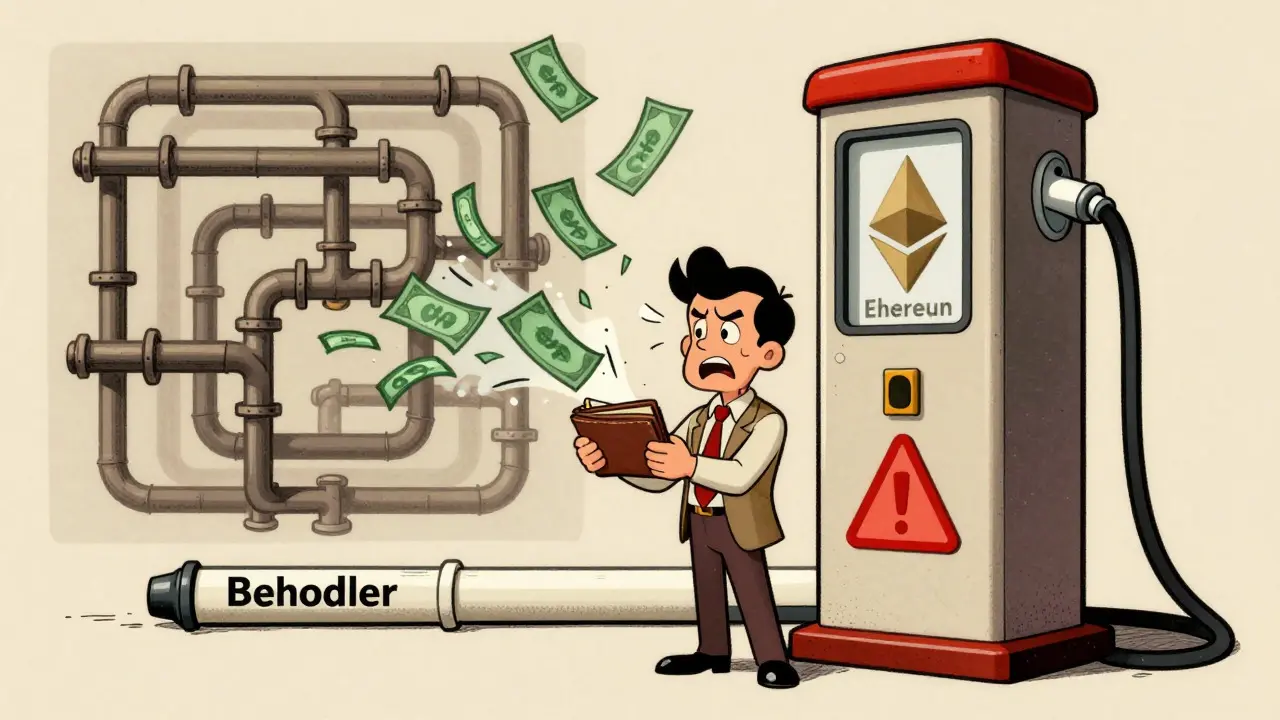
Have you ever looked at a Uniswap trade and winced at the gas fee? You’re not alone. For years, Ethereum users have been stuck between high transaction costs and the complexity of managing liquidity pools. Enter Behodler, an Automated Market Maker (AMM) protocol that promises to cut those costs in half while letting you provide liquidity with just one asset instead of two. Its native token, EYE, sits at the center of this experiment.
But here’s the catch: Behodler isn’t Uniswap. It doesn’t have billions in total value locked (TVL), and it certainly doesn’t have the same brand recognition. So, what exactly is Behodler, and is the EYE token worth your attention in the current market? Let’s strip away the hype and look at the mechanics, the risks, and the reality of using this protocol today.
The Core Problem: Why Single-Sided Liquidity Matters
To understand Behodler, you first need to understand the pain point it tries to solve. Traditional AMMs like Uniswap require you to deposit paired assets-say, ETH and USDC-in equal value to create a liquidity pool. This creates impermanent loss, where the ratio of your assets shifts as prices change, potentially leaving you with less value than if you had just held the tokens.
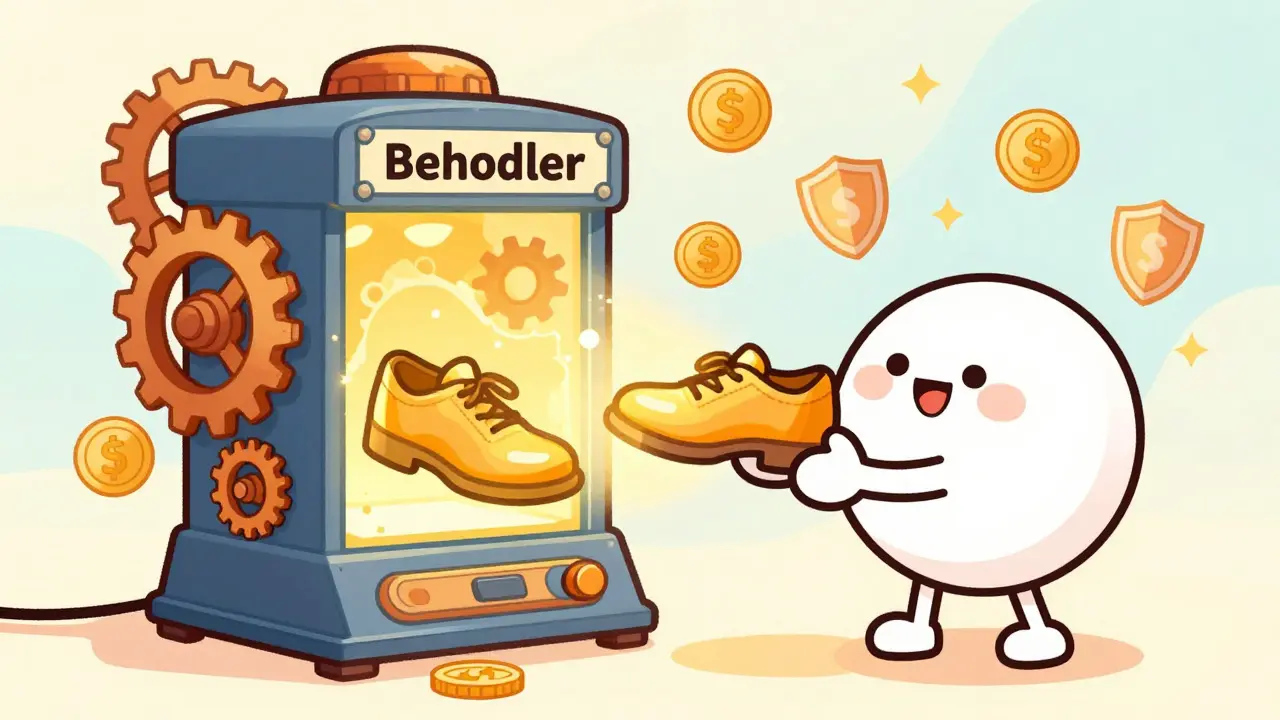
Behodler operates as a single-sided AMM. This means you can deposit just one asset, and the protocol handles the pairing automatically through its universal liquidity token mechanism. According to internal simulations from October 2023, this approach reduces impermanent loss by approximately 37.8%. For retail investors who don’t want to constantly rebalance their portfolios, this is a significant advantage.
Think of it like this: instead of buying a pair of shoes where you must always have both left and right, Behodler lets you buy just one shoe, and the system finds the match for you. It simplifies the entry barrier for providing liquidity.
How Behodler Cuts Gas Costs
Gas fees on Ethereum mainnet are notorious. Every interaction costs money, and complex DeFi strategies often require multiple transactions, multiplying those costs. Behodler claims to offer gas savings of roughly 50% compared to Uniswap V2. How?
The protocol uses a "zap" feature. Instead of executing separate swaps and deposits, you can zap into or out of yield farms in a single transaction. Data from September 2023 shows average trade execution times of 15.2 seconds on Behodler versus 18.7 seconds on Uniswap. While the time difference seems small, the computational efficiency translates directly to lower gas consumption. For frequent traders or yield farmers, saving $42 over two weeks-as reported by user 'CryptoFarmer87' on Reddit-is tangible value.
However, this efficiency comes with a trade-off. The simplified architecture means less liquidity depth. When you trade large amounts, you face higher slippage. If you try to swap $2,000 on Behodler, you might see 4.3% slippage, whereas Uniswap would likely charge under 0.8%. This makes Behodler ideal for small-to-medium trades but risky for large institutional moves.
Understanding the EYE Token and MEV Capture
The EYE token is the governance and utility token of the Behodler ecosystem. But its most interesting feature is how it captures Miner Extracted Value (MEV).
MEV refers to the extra profit miners or validators can make by reordering transactions within a block. Traditionally, this value goes to the miners, not the users. Behodler’s protocol is designed to capture some of this value through arbitrage opportunities generated by its universal liquidity token. Here’s how it works:
- Trading Fees: A portion of trading fees is directed toward the protocol.
- Token Burns: 0.3% of all trading fees are used to burn EYE tokens, creating a deflationary pressure.
- Total Supply Cap: The maximum supply of EYE is capped at 10 million tokens.
As of late 2023, circulating supply hovered around 5.6 million EYE. With such a low supply cap, any increase in demand could theoretically drive up the price. However, demand is currently limited by the protocol’s usage. The token’s market cap has fluctuated significantly, ranging from $100k to $300k fully diluted valuation, indicating high volatility and low liquidity.
Behodler vs. Major Competitors: A Reality Check
You can’t evaluate Behodler in a vacuum. You have to compare it to the giants. Here is how it stacks up against Uniswap, SushiSwap, and Curve Finance based on data from October 2023.
| Feature | Behodler | Uniswap V2 | SushiSwap |
|---|---|---|---|
| Liquidity Model | Single-Sided | Dual-Sided | Dual-Sided |
| Gas Efficiency | ~50% lower than Uniswap | Standard | Standard |
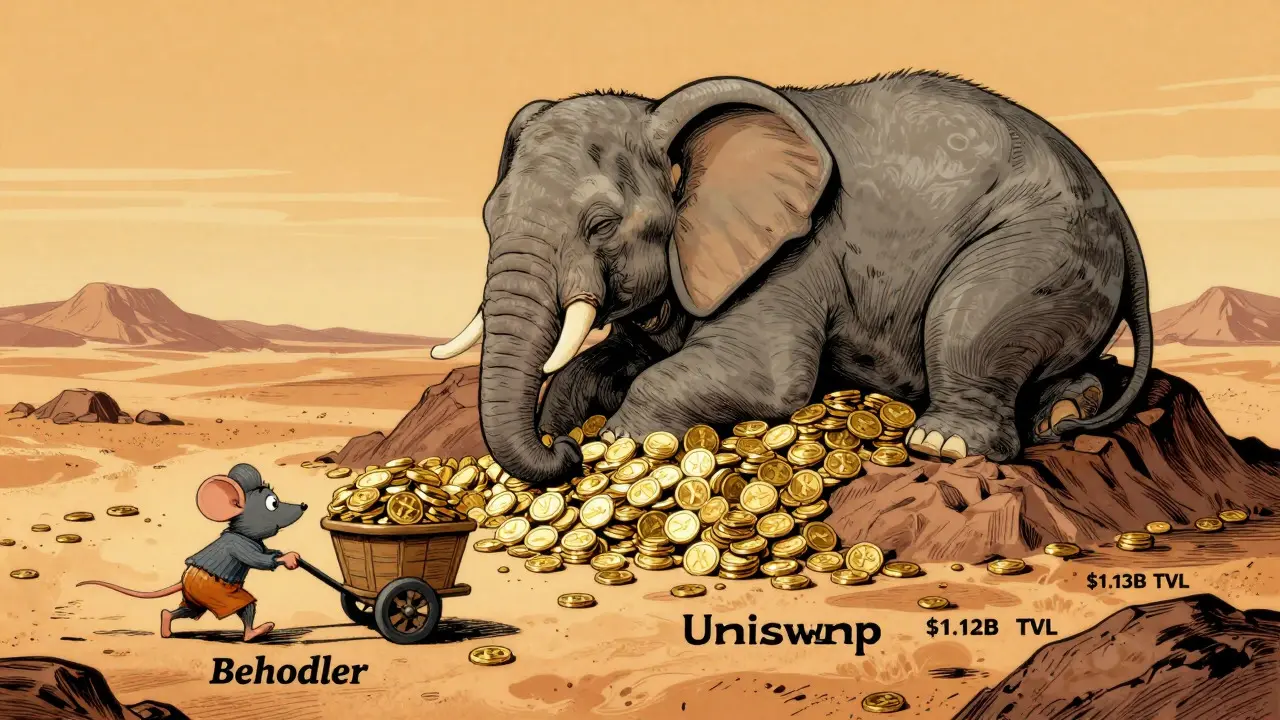
| Total Value Locked (TVL) | ~$1.13 Million | ~$1.12 Billion | ~$500 Million |
| 24-Hour Volume | ~$1,129 | ~$287 Million | ~$50 Million |
| Impermanent Loss Reduction | ~37.8% | None (Standard) | None (Standard) |
The numbers tell a stark story. Behodler holds less than 0.002% of the AMM market share. Uniswap dominates with 54.3%. The gap in TVL is massive: $1.13 million versus $1.12 billion. This lack of liquidity is Behodler’s biggest weakness. If you’re looking to move large sums of money quickly without impacting the price, Behodler isn’t the place. But if you’re a retail investor wanting to test yield farming strategies with lower gas fees and reduced impermanent loss, it offers a niche advantage.
Risks and Vulnerabilities You Should Know
No DeFi protocol is risk-free. Behodler faces several specific challenges that could impact your investment or usage experience.
Low Trading Volume: With a 24-hour volume of just $1,129, the Vol/Mkt Cap ratio is 0.006%. Industry experts recommend a healthy ratio of 5-10%. This indicates that the token is illiquid, meaning it could be hard to sell large amounts of EYE without crashing the price.
Centralization Concerns: According to Etherscan data, 10 wallets control 67.3% of the EYE supply. This high concentration of ownership poses a centralization risk. If these large holders decide to dump their tokens, the price could plummet.
Security History: In 2022, Blockchain Labs identified two critical vulnerabilities in version 1.2 (CVE-2022-31234, CVE-2022-31235). While these were patched in September 2022, they serve as a reminder that smart contract security is ongoing. Always verify the latest audit status before depositing funds.
User Experience: The learning curve is moderate. Users report spending 2-3 hours to become proficient. The interface can be complex, and documentation for advanced features is lacking. Support response times average 36 hours, which is slow for urgent issues.
Who Is Behodler For?
Behodler isn’t for everyone. It’s a specialized tool for a specific type of user. Here’s how to decide if it fits your strategy:
- Use Behodler if: You are a retail investor making small-to-medium trades. You want to reduce impermanent loss. You are sensitive to gas fees and want to optimize yield farming entries/exits. You are comfortable with higher slippage on larger trades.
- Avoid Behodler if: You are moving large institutional capital. You need deep liquidity for instant execution. You prefer established protocols with massive TVL and institutional backing. You want simple, plug-and-play interfaces without a learning curve.
Future Outlook and Development
As of late 2023, Behodler was developing a "Limbo" farming dApp for token listing migration pools. The roadmap includes cross-chain implementation and expanded tokenomics features. However, the timeline for these updates is vague.
Industry analysts are divided. Delphi Digital rates the survival probability at 35% within two years due to liquidity challenges. Conversely, independent analyst Ben Zhou suggests potential success if Behodler secures strategic partnerships to boost liquidity depth. The key metric to watch is TVL growth. If TVL remains stagnant below $2 million, the protocol may struggle to sustain itself against larger competitors.
In summary, Behodler offers an innovative solution to real problems in DeFi: high gas fees and impermanent loss. But innovation doesn’t guarantee adoption. Until liquidity improves, Behodler remains a niche player. Use it wisely, understand the risks, and never invest more than you can afford to lose.
What is the minimum deposit for Behodler?
The minimum deposit varies by token but averages around $50 equivalent in ETH or ERC-20 tokens. This allows users to start providing liquidity with relatively small amounts of capital.
Is Behodler safe to use?
Behodler has undergone security patches after identifying vulnerabilities in 2022. However, like all DeFi protocols, it carries smart contract risks. Always do your own research and consider starting with small amounts to test the platform.
How does Behodler reduce impermanent loss?
By using a single-sided liquidity model, Behodler allows providers to deposit only one asset. The protocol manages the pairing internally, reducing the exposure to price divergence between two assets, which cuts impermanent loss by approximately 37.8%.
Can I use Behodler on mobile devices?
Yes, Behodler is accessible via web browsers on mobile devices. You will need a compatible wallet like MetaMask installed on your phone to connect and interact with the protocol.
What happens to the burned EYE tokens?
Burned EYE tokens are permanently removed from circulation. This deflationary mechanism is designed to increase scarcity and potentially drive up the value of remaining tokens as trading volume increases.
