
Have you ever scrolled through your Solana wallet and seen a token with a name that sounds like an inside joke? You are not alone. Bag on Bonk (BAG) is exactly that kind of asset: a meme-themed cryptocurrency that lives on the Solana blockchain. It launched in July 2025, riding the wave of internet culture and the massive popularity of its bigger cousin, Bonk (BONK).
If you are wondering whether this "backpack" token is just another flash-in-the-pan or if it has actual staying power, you need to look past the funny name. This guide breaks down what BAG actually is, how its supply works, where you can trade it, and why it might be risky for your portfolio.
The Story Behind the Backpack
To understand BAG, you first have to understand the vibe of the Solana meme coin ecosystem. In late 2022, after the collapse of FTX, the Solana community needed a morale booster. That is when Bonk (BONK) arrived as the network's first major dog-themed meme coin. It helped revitalize trading activity and brought new users to the chain.
Bag on Bonk took a different angle. Instead of being a dog, it focuses on the "backpack." Why? Because in Web3 slang, having a "bag" means holding onto your assets even when prices drop. The backpack symbolizes carrying value, memes, and identity across the blockchain. Before it was even a tradable token, the backpack image was already a recognizable cultural marker within the Bonk community. When the token finally launched on July 5, 2025, it formalized that existing meme into a financial asset.
The project started with anonymous developers, but things shifted quickly. By mid-July 2025, the project underwent a "community takeover." This means the original creators stepped back, handing over control of the roadmap and marketing to the people who actually hold the tokens. There is no big corporation or famous CEO behind BAG right now; it is run by the crowd.
Tokenomics: Fixed Supply and No Hidden Minting
One of the biggest fears in the meme coin world is inflation-when developers secretly create more tokens to sell at a profit. Bag on Bonk tries to avoid this trap with a straightforward structure.
- Total Supply: Approximately 1 billion BAG tokens (specifically around 999.82 million).
- Circulating Supply: Nearly 100% of the total supply is already in circulation.
- Minting: The smart contract on Solana does not allow any further minting.
This fixed supply model is crucial. It means the number of BAG tokens will never increase. If demand goes up, the price must rise because there are no new tokens to dilute your holdings. Data from trackers like CoinMarketCap and CoinGecko confirms that the fully diluted valuation (FDV) matches the market cap almost exactly, proving there are no locked-up reserves waiting to dump on the market later.
| Attribute | Value / Detail |
|---|---|
| Blockchain | Solana (SPL Token Standard) |
| Launch Date | July 5, 2025 |
| Max Supply | ~1 Billion (Fixed) |
| Category | Meme Coin / Community Token |
| Governance | Community Takeover (No central team) |
How Does BAG Compare to BONK?
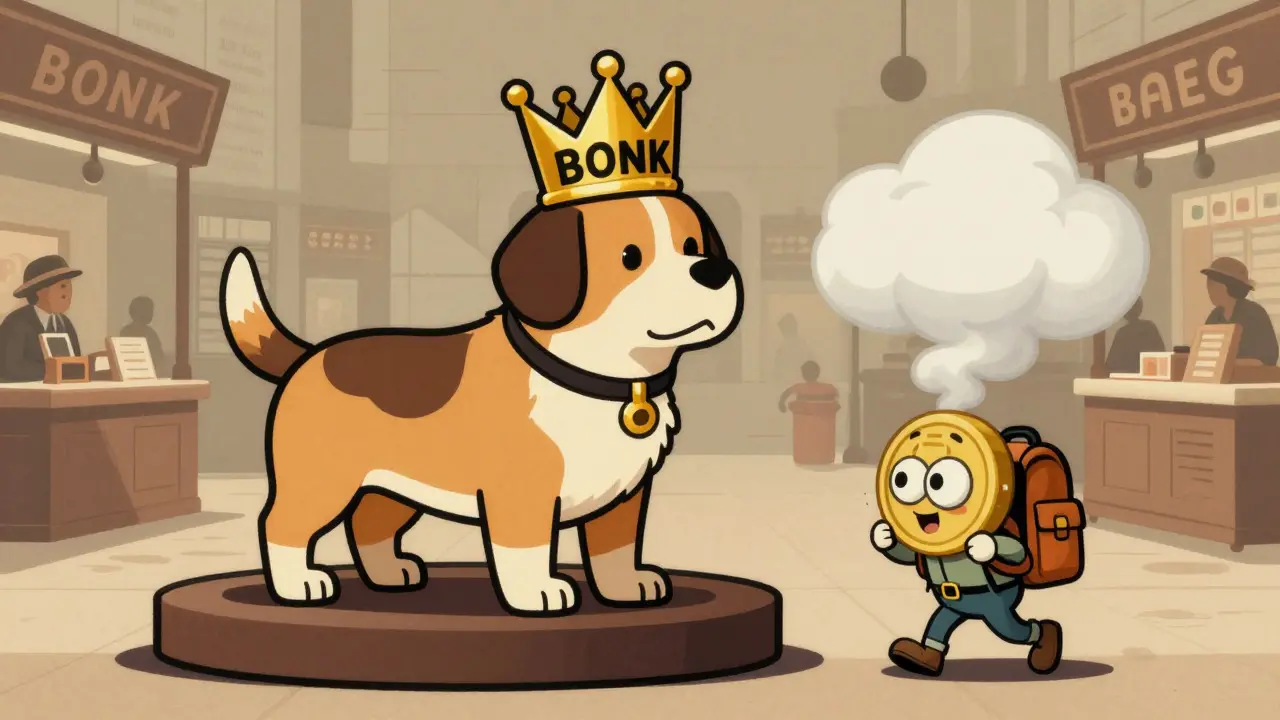
It is impossible to talk about Bag on Bonk without comparing it to Bonk. They share the same DNA, but they play very different roles in the market.
Bonk is a heavyweight. As of mid-2026, BONK sits near rank #111 on global crypto charts with a market capitalization hovering around $484 million. It has deep liquidity, meaning you can buy or sell millions of dollars worth of it without moving the price too much. It is widely listed on major centralized exchanges and is used for tipping, gaming, and DeFi integrations across Solana.
Bag on Bonk, on the other hand, is a micro-cap asset. Its market cap fluctuates between roughly $1 million and $2 million. On some days, the entire 24-hour trading volume might only be a few thousand dollars. While BONK is a mainstream meme coin, BAG is a niche speculative asset. Think of BONK as the popular kid in school and BAG as the cool underground band everyone in the specific fan club knows about, but outsiders rarely hear.
The relationship is symbiotic. BAG leverages the brand recognition of the Bonk ecosystem. If Solana and BONK continue to grow, BAG benefits from the spillover attention. However, if the broader meme coin sector cools down, small caps like BAG usually suffer the most severe drops due to lower liquidity.
Where and How to Trade BAG
Because BAG operates on the Solana blockchain, you cannot buy it directly with a credit card on every platform. You typically need to go through a decentralized exchange (DEX) or a specialized centralized exchange (CEX) that supports smaller altcoins.
Decentralized Exchanges (DEXs): The primary venue for trading BAG is Raydium, one of Solana's largest DEXs. Most traders use the BAG/SOL pair here. To do this, you need a Solana wallet (like Phantom or Solflare), some SOL tokens to pay for transaction fees, and a connection to a DEX aggregator like Jupiter. Jupiter helps find the best price across various pools, which is important for low-volume tokens to minimize slippage.
Centralized Exchanges (CEXs): By 2026, BAG had expanded beyond just DEXs. It is listed on platforms like Bybit, MEXC, and NDAX. These platforms offer easier on-ramps, allowing you to deposit fiat currency (like USD or CAD) and swap it directly for BAG. For example, NDAX lists a direct BAG/CAD pair, making it accessible for Canadian traders without needing to touch a self-custody wallet initially.
Note on Liquidity: Always check the order book before buying large amounts. With daily volumes sometimes under $15,000, a single large buy order could spike the price artificially, while a large sell order could crash it. This is known as high slippage.

Risks and Realities: Is It Worth Your Money?
Let’s be real: investing in a meme coin called "Bag on Bonk" is not conservative investing. It is speculation. Here is what you need to watch out for.
1. Extreme Volatility Small-cap meme coins swing wildly. Historical data shows BAG has experienced price swings of over 10x from its all-time lows to highs in short periods. A 50% drop in a day is not uncommon for assets in this tier. Never put money into BAG that you cannot afford to lose entirely.
2. Lack of Fundamental Utility Unlike Bitcoin (store of value) or Ethereum (smart contracts), BAG does not generate revenue. Its value is derived purely from community sentiment and hype. While the roadmap mentions future integration with gaming DApps and staking features, these are promises, not current realities. As of early 2026, there are no major games actively using BAG as a core currency.
3. Community Governance Risks The "community takeover" is a double-edged sword. On one hand, it prevents a single developer from rug-pulling the project. On the other hand, it can lead to decision paralysis. Without a strong leadership team, development can stall, and marketing efforts may become disjointed. The success of BAG depends entirely on how active and coordinated its holder base remains.
4. Smart Contract Security While the token has a fixed supply and no reported hacks as of mid-2026, there are no public, independent security audits cited in major profiles. In the world of crypto, "no news is good news," but it also means you are trusting the code based on reputation rather than verified proof. Always verify the contract address yourself before swapping.
Future Outlook: Gaming and Staking?
The narrative for BAG is shifting from pure meme status to utility-seeking. The community and early developers have outlined plans to integrate BAG into gaming-focused decentralized applications (DApps). The idea is to use the "backpack" theme literally-perhaps as an inventory system or reward mechanism in Solana-based games.
Additionally, staking opportunities are being explored. Staking would allow holders to lock their BAG tokens to earn rewards, potentially reducing selling pressure and increasing engagement. However, as of now, specific details like Annual Percentage Yields (APY) or partner game titles remain vague. Until these utilities go live, BAG remains primarily a speculative play on Solana's meme culture.
What is the current price of Bag on Bonk (BAG)?
As of mid-2026, BAG trades in a narrow range, typically between $0.0009 and $0.0020 USD depending on the exchange and liquidity conditions. Prices vary significantly between decentralized exchanges like Raydium and centralized platforms like Bybit due to fragmented liquidity. Always check real-time data on multiple sources before trading.
Is Bag on Bonk a scam?
There is no evidence of a scam or hack associated with BAG as of 2026. The token has a fixed supply, preventing arbitrary inflation, and underwent a community takeover, removing centralized control from anonymous founders. However, like all meme coins, it carries high financial risk due to volatility and lack of fundamental value. Do your own research before investing.
How do I buy Bag on Bonk (BAG)?
You can buy BAG on centralized exchanges like Bybit, MEXC, or NDAX using fiat currency or stablecoins. Alternatively, you can trade it on Solana-based decentralized exchanges like Raydium using a wallet such as Phantom. You will need SOL tokens to pay for transaction fees when using DEXs.
What is the difference between BAG and BONK?
BONK is a large-cap, widely adopted meme coin with a market cap of hundreds of millions of dollars and deep liquidity. BAG is a micro-cap niche token tied to the Bonk community's "backpack" meme. BAG has a smaller market cap (around $1-2 million), lower liquidity, and higher volatility compared to BONK.
Does Bag on Bonk have a maximum supply?
Yes, Bag on Bonk has a fixed maximum supply of approximately 1 billion tokens. The smart contract prevents any further minting, meaning the total number of BAG tokens will never increase. Nearly 100% of this supply is currently circulating.
