
Imagine sending money across the globe in minutes without a bank taking a cut. That is the promise of payment cryptocurrencies. These are digital assets designed specifically for one job: transferring value from person to person. Unlike other crypto tokens that give you access to apps or games, payment cryptos act like digital cash. They let you buy coffee, pay rent, or send money to family abroad using decentralized networks instead of traditional banks.
You might have heard of Bitcoin, but it is just the first of many. This guide breaks down what makes a cryptocurrency a "payment" coin, how they differ from other digital assets, and which ones actually work for everyday spending in 2026.
The Core Definition: What Makes Crypto a "Payment" Coin?
To understand payment cryptocurrenciesdigital currencies designed primarily for exchanging goods and services rather than governance or utility, you need to look at their primary function. In the world of blockchain, not all coins are created equal. Some exist to help run a network (like Ethereum’s Ether), while others exist simply to be spent.
A payment cryptocurrency has three main traits:
- Medium of Exchange: Its main goal is to facilitate transactions between buyers and sellers.
- Decentralized Ledger: It runs on a public blockchain where anyone can verify transactions without a central authority like a bank.
- Cryptographic Security: It uses advanced math to secure transfers and control the creation of new units.
Think of it this way. If you use a token to vote on changes to a software project, that is a governance token. If you use a token to pay for cloud storage, that is a utility token. But if you hand over a coin to buy a laptop, and the seller accepts it as full payment, you are using a payment cryptocurrency.
Bitcoin: The Original Standard
When people talk about digital money, Bitcointhe first decentralized cryptocurrency launched in 2009 by Satoshi Nakamoto is always the starting point. Launched in 2009, Bitcoin set the template for every payment crypto that followed. It was built to solve the "double-spend" problem-allowing digital value to be transferred securely without a middleman.
Bitcoin has a hard cap of 21 million coins. This scarcity makes it attractive as a store of value, often called "digital gold." However, as a payment method, it has limitations. Transactions can take up to an hour to confirm fully, and during busy times, fees can spike. For buying a $5 coffee, paying $2 in fees doesn't make sense. This is why Bitcoin is often used more for large, cross-border settlements or long-term savings rather than daily micro-transactions.
Litecoin: The Faster Alternative
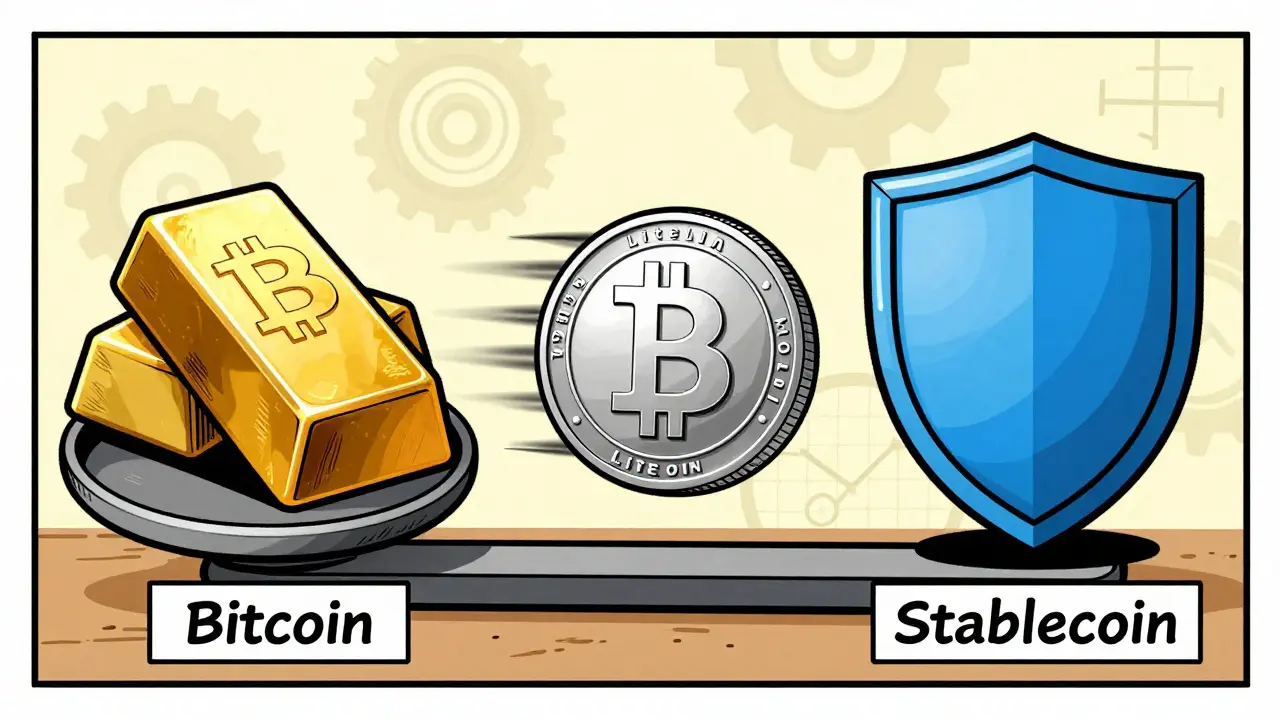
If Bitcoin is digital gold, Litecoina peer-to-peer cryptocurrency created by Charlie Lee in 2011 as a faster alternative to Bitcoin is often compared to silver. Created by Charlie Lee in 2011, Litecoin was engineered specifically to address Bitcoin's speed issues. It uses a different hashing algorithm called Scrypt, which allows for faster block generation.
While Bitcoin takes roughly 10 minutes to process a block, Litecoin does it in about 2.5 minutes. This means your transaction confirms four times faster. Additionally, Litecoin typically has lower transaction fees. For merchants who want to accept crypto but don't want to wait around for confirmations, Litecoin offers a smoother experience. It maintains the same basic security model as Bitcoin but optimizes for speed and cost-efficiency.
Privacy Coins: Monero and Zcash
Not everyone wants their financial history visible on a public ledger. This is where privacy-focused payment cryptocurrencies come in. Moneroa privacy-centric cryptocurrency that uses ring signatures and stealth addresses to hide transaction details (XMR) is the leader in this space. Unlike Bitcoin, where you can trace funds back to a wallet address, Monero obscures the sender, receiver, and amount. It uses ring signatures to mix your transaction with others, making it impossible to distinguish yours from the rest.
Zcasha cryptocurrency that utilizes zero-knowledge proofs to enable private transactions (ZEC) takes a slightly different approach. It offers two types of transactions: transparent (like Bitcoin) and shielded. Shielded transactions use a technology called zk-SNARKs (Zero-Knowledge Succinct Non-Interactive Arguments of Knowledge). This proves a transaction is valid without revealing any underlying data. If you value anonymity above all else, these coins are your best options, though they face stricter regulatory scrutiny in many countries.
Stablecoins: The Volatility Solution
One of the biggest hurdles for payment cryptocurrencies is price volatility. You might buy a shirt for 0.001 BTC today, but tomorrow that same amount could be worth twice as much or half as much. To fix this, we have stablecoins. While technically a subset of crypto, Tethera stablecoin pegged to the US Dollar to maintain a consistent value (USDT) and USD Coina regulated stablecoin backed by reserves of cash and short-term US Treasuries (USDC) function as payment currencies.
These coins are pegged to fiat currencies like the US Dollar. One USDC always equals approximately $1. This makes them ideal for everyday payments because the value doesn't swing wildly. You get the speed and low fees of blockchain transfers with the stability of traditional money. Many users convert volatile cryptos into stablecoins before making purchases to protect their purchasing power.
How Payment Cryptos Compare to Traditional Methods
| Feature | Credit Cards / Banks | Bitcoin | Litecoin | Stablecoins (USDC) |
|---|---|---|---|---|
| Transaction Speed | Seconds to Days | ~10 Minutes | ~2.5 Minutes | Seconds to Minutes |
| Cost | High (Interchange fees) | Variable (Often High) | Low | Very Low |
| Reversibility | Yes (Chargebacks) | No | No | No |
| Privacy | None (Bank records) | Pseudonymous | Pseudonymous | Pseudonymous |
| Global Access | Limited by borders | Universal | Universal | Universal |
The table above highlights why people choose crypto. Traditional banking involves intermediaries that charge fees and can reverse transactions. Crypto is irreversible and borderless. However, the lack of chargebacks means you must be careful when sending money. There is no customer service hotline to call if you send funds to the wrong address.
Challenges in Everyday Adoption
Despite the technology being mature, widespread adoption for daily payments remains slow. Why? First, there is the issue of merchant acceptance. While major companies like Microsoft or Overstock have accepted Bitcoin in the past, most local shops still prefer Visa or Mastercard. Integrating crypto payment processors adds complexity for small business owners.
Second, tax implications vary by country. In some jurisdictions, every time you spend Bitcoin, it is considered a taxable event because you are disposing of an asset. This creates a reporting burden for users who just want to buy groceries.
Third, user experience matters. Managing private keys and seed phrases is daunting for non-tech users. If you lose your wallet password, your money is gone forever. Centralized exchanges offer recovery options, but they reintroduce the risk of hacking and censorship that crypto aims to avoid.
How to Start Using Payment Cryptocurrencies
If you want to try using these digital assets, here is a practical roadmap:
- Choose a Wallet: Download a reputable mobile wallet like Trust Wallet or Exodus. These allow you to store multiple coins, including Bitcoin, Litecoin, and stablecoins.
- Buy Crypto: Use a regulated exchange like Coinbase or Kraken to purchase crypto with your local currency. Verify your identity as required by law.
- Transfer to Wallet: Move your crypto from the exchange to your personal wallet. This gives you control over your private keys.
- Find Accepting Merchants: Look for businesses that display crypto payment logos. Websites like BitPay provide directories of merchants accepting various coins.
- Start Small: Begin with small transactions to understand the fee structures and confirmation times. Remember, transactions cannot be undone.
Always double-check wallet addresses before sending funds. Copy-paste errors are common and costly. Consider using a hardware wallet like Ledger or Trezor for larger amounts to keep your keys offline and secure.
The Future of Digital Payments
As we move through 2026, the line between traditional finance and crypto continues to blur. Layer 2 solutions, such as the Lightning Network for Bitcoin, are solving the speed and cost issues. These allow for instant, near-zero-fee transactions that settle on top of the main blockchain. This makes Bitcoin viable for buying coffee again.
Regulatory clarity is also improving. Governments are defining rules for stablecoins and exchanges, which brings legitimacy and safety for consumers. While crypto may not replace fiat currency entirely, it is carving out a permanent role in the global economy. It offers a choice for those who want financial sovereignty, lower fees, and access to a borderless network.
Whether you use it for saving, investing, or spending, understanding what payment cryptocurrencies are is the first step toward participating in this new financial era.
Is Bitcoin safe for everyday payments?
Bitcoin is secure, but it can be slow and expensive for small purchases due to network congestion. For everyday payments, many users prefer faster alternatives like Litecoin or stablecoins like USDC, which offer lower fees and quicker confirmations.
Can I get my money back if I send crypto to the wrong address?
No. Cryptocurrency transactions are irreversible. Once you send funds to an incorrect address, they are lost forever unless the recipient voluntarily returns them. Always double-check addresses before confirming a transaction.
What is the difference between a payment coin and a utility token?
A payment coin, like Bitcoin or Litecoin, is designed to transfer value and act as money. A utility token provides access to a specific service or application within a blockchain ecosystem, such as paying for gas fees on Ethereum or voting in a decentralized organization.
Are privacy coins like Monero legal?
In most countries, owning Monero is legal. However, many centralized exchanges have delisted privacy coins due to regulatory pressure regarding anti-money laundering laws. Users should check their local regulations before trading or using privacy-focused cryptocurrencies.
Why do stablecoins matter for payments?
Stablecoins like USDC and Tether provide the benefits of blockchain technology-speed, low cost, and decentralization-without the price volatility of Bitcoin or Ethereum. This makes them practical for merchants and consumers who want predictable values for transactions.
