

Imagine walking into a high-stakes poker game where your chance of dealing the next hand depends entirely on how much money you’ve thrown onto the table. That is the essence of Proof-of-Stake (PoS) validator selection. Unlike the energy-hungry mining wars of Bitcoin’s Proof-of-Work era, PoS networks like Ethereum choose who gets to validate transactions and create new blocks based on economic commitment rather than computational brute force.
If you are trying to understand how decentralized networks stay secure without burning coal, you need to look under the hood at the algorithms that pick these validators. It is not just about having the most coins. It involves randomness, reputation, and strict penalties for bad behavior. This guide breaks down exactly how this selection process works, why it matters for network security, and what it means for anyone looking to stake their assets.
The Core Mechanism: Randomness Meets Stake Weighting
At its heart, validator selection in PoS systems is a balancing act between fairness and incentive. The network needs to ensure that those with more skin in the game have a higher probability of being chosen, but it also needs to prevent predictability. If attackers could guess who will propose the next block, they could launch targeted attacks.
To solve this, networks use Verifiable Random Functions (VRFs). A VRF is a cryptographic tool that generates a random number which can be verified by everyone on the network without revealing the seed used to generate it. Here is how the process typically flows:
- Eligibility Check: The system identifies all active validators who meet the minimum staking requirements (e.g., 32 ETH on Ethereum).
- Random Number Generation: Each eligible validator generates a private random number using their secret key and the current epoch data.
- Threshold Comparison: The validator compares their random number against a threshold determined by their stake size relative to the total network stake.
- Selection Confirmation: If the number falls within the threshold, the validator is selected as the block proposer or attester for that slot.
This method ensures that while a validator with 10x the stake has roughly 10x the chance of being selected over time, no one can know when they will be picked. This unpredictability is crucial for preventing collusion and long-range attacks.
Ethereum’s Specific Approach: Proposers vs. Attesters
Ethereum, the largest PoS network by market cap, offers the clearest example of this mechanism in action. After "The Merge" in 2022, Ethereum moved entirely to PoS, introducing a dual-role structure for each 12-second time slot.
In any given slot, two roles are assigned:
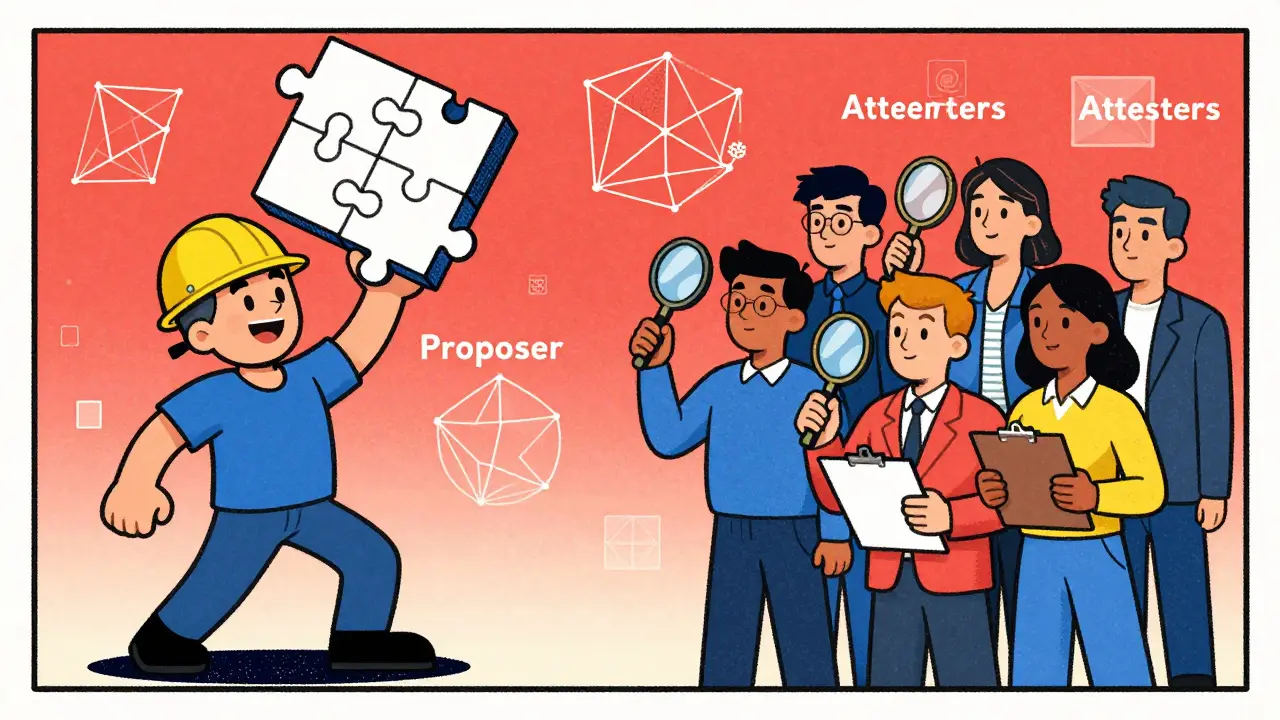
- The Block Proposer: One validator is chosen to assemble a new block containing pending transactions. They sign the block and broadcast it to the network.
- The Committee of Attesters: A group of other validators is randomly selected to verify the proposed block. They check if the transactions are valid and if the block follows protocol rules.
Why split the role? It adds redundancy. Even if the proposer acts maliciously or makes an error, the attesters must agree on the block’s validity for it to be finalized. If the majority of attesters reject a block, it is discarded. This creates a robust check-and-balance system that relies on honest participation from a diverse set of validators.
| Feature | Block Proposer | Attester |
|---|---|---|
| Primary Responsibility | Create and broadcast new block | Verify block validity and state transitions |
| Selection Frequency | Once per slot (12 seconds) | Multiple validators per slot |
| Risk Level | Higher (must include valid txns) | Moderate (must vote correctly) |
| Reward Structure | Base reward + transaction fees | Base reward for timely attestation |
Beyond Ethereum: Nominated and Delegated PoS
Not all PoS systems work like Ethereum. Different blockchains have tweaked the selection algorithm to prioritize different values, such as lower barriers to entry or faster finality.
Nominated Proof-of-Stake (NPoS), used by Polkadot, allows token holders to nominate validators without running nodes themselves. In this model, users delegate their stake to professional validators. The selection algorithm considers both the validator’s own stake and the total stake delegated to them by nominators. This expands participation while keeping technical operations in the hands of experts.
Delegated Proof-of-Stake (DPoS), seen in networks like EOS or Tron, takes democracy further. Token holders vote directly for a fixed number of witnesses (validators). These top-voted validators take turns producing blocks. While this increases efficiency and scalability, it often leads to centralization, as power concentrates among a small group of popular validators.
Cardano uses a unique hybrid approach with Stake Pools. ADA holders delegate their tokens to pool operators. The selection algorithm picks pools based on their total stake, but individual delegators do not need to run infrastructure. Pool operators compete on performance and fee structures, creating a market-driven selection environment.
The Cost of Failure: Slashing and Downtime
Validator selection isn’t just about rewards; it’s about risk. The concept of "slashing" is the backbone of PoS security. If a validator behaves maliciously-such as signing two conflicting blocks (equivocation) or going offline for extended periods-the protocol automatically destroys a portion of their staked funds.
For Ethereum validators, the slashing penalty can range from a few ETH to the entire 32 ETH deposit, depending on the severity of the offense. This economic deterrent ensures that validators have a strong financial incentive to act honestly and maintain uptime. It transforms security from a technical problem into an economic one: attacking the network becomes financially ruinous.
Downtime penalties are less severe but still impactful. If a validator misses too many attestations due to hardware failure or internet outages, they receive fewer rewards and may eventually be ejected from the active validator set. This forces operators to invest in reliable infrastructure, including redundant servers and failover mechanisms.

Technical Barriers and Infrastructure Requirements
Running a validator is not a "set and forget" investment. It requires significant technical expertise. Validators must maintain dedicated servers with stable internet connections, sufficient RAM, and fast storage to keep up with chain synchronization.
Key operational challenges include:
- Key Management: Protecting private keys from theft is paramount. Many validators use cold storage solutions or multi-signature setups to mitigate risk.
- Software Updates: Blockchain clients frequently update to fix bugs or implement upgrades. Missing an update can lead to desynchronization and missed rewards.
- Monitoring: Continuous monitoring of node health, peer connections, and latency is essential to avoid downtime penalties.
Because of these complexities, many users opt for staking services or liquid staking derivatives. These platforms allow users to earn staking rewards without managing infrastructure, though they introduce counterparty risk and typically charge a fee of 3-10% of rewards.
Future Trends: Lowering Barriers and Increasing Access
The landscape of validator selection is evolving. Ethereum’s upcoming upgrades aim to reduce the 32 ETH minimum stake requirement through features like "Danksharding" and improved client efficiency. This could allow smaller participants to run independent validators, enhancing decentralization.
Liquid staking protocols are also reshaping the ecosystem. By issuing tokens that represent staked assets, these platforms allow users to maintain liquidity while participating in consensus. This innovation bridges the gap between passive investing and active network participation, potentially broadening the base of stakeholders who influence validator selection indirectly.
As PoS matures, we can expect more sophisticated selection algorithms that incorporate reputation scores, historical performance metrics, and geographic distribution to prevent centralization. The goal remains clear: create a system where security is robust, participation is accessible, and incentives align with the health of the network.
How does PoS validator selection differ from Proof-of-Work mining?
In Proof-of-Work (PoW), miners compete to solve complex mathematical puzzles using computational power. The first to solve the puzzle gets to add the block. In Proof-of-Stake (PoS), validators are selected pseudo-randomly based on the amount of cryptocurrency they have staked. There is no energy-intensive competition; instead, selection probability is proportional to stake size, making it far more energy-efficient.
What happens if a PoS validator goes offline?
If a validator goes offline, they miss opportunities to propose blocks or attest to them, resulting in reduced rewards. Prolonged downtime can lead to "inactivity leaks," where the validator loses a small amount of stake over time. In severe cases, consistent unavailability can result in ejection from the validator set, requiring the user to re-stake to participate again.
Can I become a validator with less than 32 ETH on Ethereum?
Currently, the standard requirement for running an independent Ethereum validator is exactly 32 ETH. However, you can participate with less by joining a staking pool or using a liquid staking service. These platforms aggregate funds from multiple users to meet the 32 ETH threshold, distributing rewards proportionally. Future Ethereum upgrades may lower this barrier for solo validators.
What is slashing in PoS systems?
Slashing is a penalty mechanism in PoS networks where a validator loses a portion or all of their staked funds for violating protocol rules. Common offenses include signing two different blocks for the same height (equivocation) or proposing invalid blocks. Slashing ensures that validators have a strong financial incentive to act honestly and securely.
Why is randomness important in validator selection?
Randomness prevents predictability in who will produce the next block. If attackers could predict the block proposer, they could attempt to censor transactions or launch coordinated attacks against that specific validator. Verifiable Random Functions (VRFs) ensure that selection is fair, unpredictable, and transparent, maintaining the security and decentralization of the network.
