
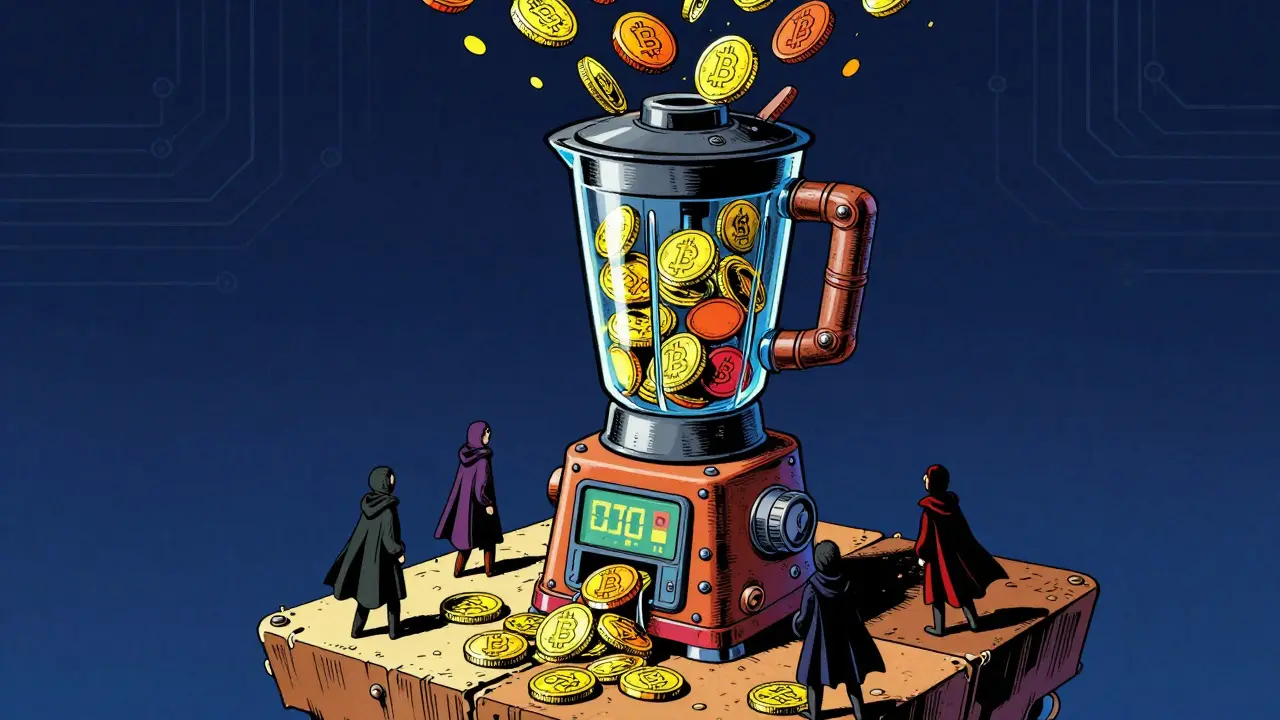
Imagine writing a piece of code, uploading it to the internet, and then being told by the government that the code itself is now a sanctioned entity. That is exactly what happened with Tornado Cash is an Ethereum-based cryptocurrency mixing platform designed to provide transaction privacy by pooling funds. For years, it was the gold standard for privacy on the blockchain, but it eventually became the center of a legal war between the U.S. government and the world of decentralized finance.
The Basics of Crypto Mixing
To understand why the government cares, you first have to understand how crypto mixers work. In a normal blockchain transaction, everything is public. If I send you 1 ETH, anyone can see my address and your address. Mixers break this trail. They act like a digital blender: multiple users deposit their coins into a pool, the mixer shuffles them, and then users withdraw them to new, unrelated addresses.
Tornado Cash used a high-tech method called zero-knowledge proofs. This allows the system to prove that you deposited money without revealing which specific deposit belongs to you. It's like showing a ticket to enter a club without showing your ID. By supporting various denominations (0.1, 1, 10, and 100 ETH), it allowed users to blend in with others, making it nearly impossible for analysts to trace where the money went.
Why the U.S. Stepped In
Privacy is great for regular people, but it's a dream for cybercriminals. The Office of Foreign Assets Control (known as OFAC) noticed a disturbing pattern. The platform wasn't just being used by privacy enthusiasts; it was becoming a laundromat for stolen billions.
The biggest red flag was the Lazarus Group, a state-sponsored hacking collective from North Korea. According to Treasury Department data, this group used the mixer to wash over $455 million. It didn't stop there. High-profile thefts, like the $96 million Harmony Bridge Heist and the $7.8 million Nomad Heist, both saw funds funnelled through the protocol to hide the loot.
On August 8, 2022, the U.S. government decided enough was enough. They sanctioned the protocol under Executive Order 13694. This meant that any "U.S. person"-which includes citizens and companies-was legally prohibited from interacting with the mixer's smart contracts. If you used it, you weren't just using a tool; you were technically violating federal sanctions.
| Entity | Date Sanctioned | Primary Reason | Target Type |
|---|---|---|---|
| Blender.io | May 6, 2022 | Money Laundering | Website/Service |
| Tornado Cash | August 8, 2022 | Lazarus Group / Heists | Smart Contract / Code |
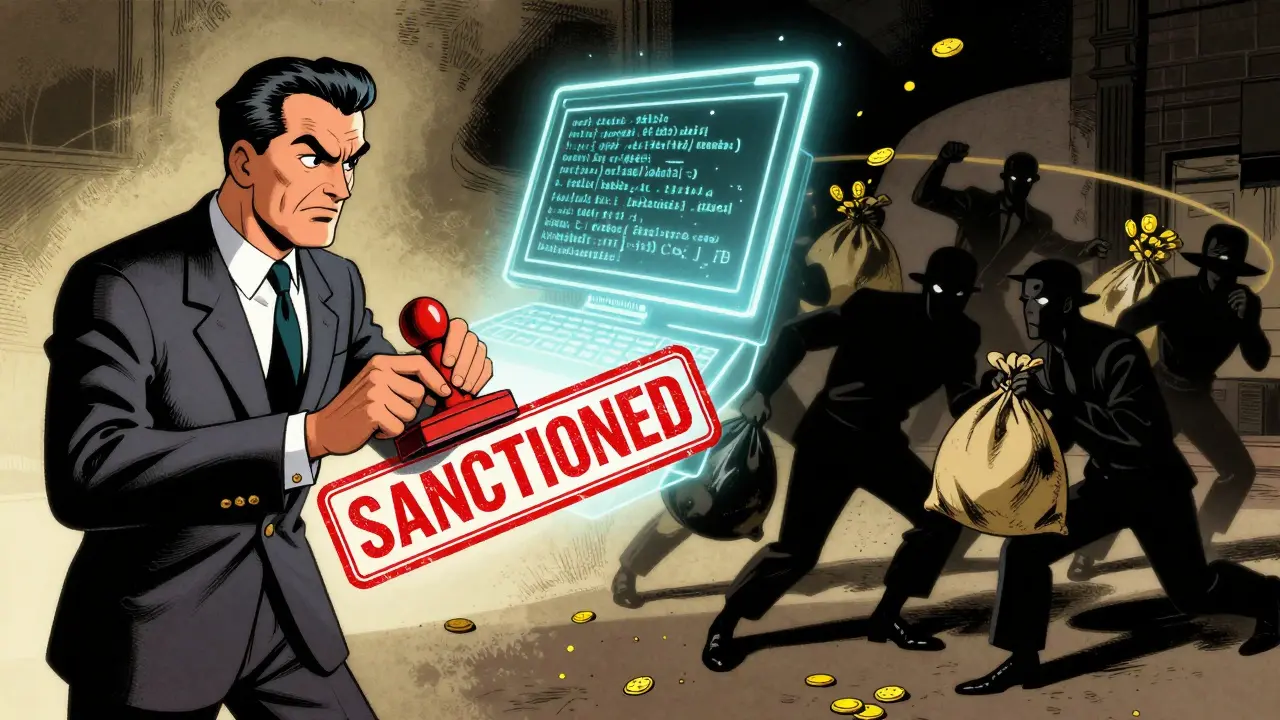
Can You Actually Sanction Code?
This is where the legal drama gets intense. Usually, sanctions target people, companies, or countries. But Tornado Cash is a decentralized protocol. It runs on Ethereum smart contracts. Once those contracts are deployed, they are immutable-meaning they cannot be changed or turned off by any human, even the people who wrote them.
Lawyers and developers argued that sanctioning code is like sanctioning the laws of physics or a mathematical formula. If the software operates autonomously, who is actually being punished? The government's stance was that the software served as a financial tool, and because it lacked basic "know-your-customer" (KYC) controls, it was a weapon for criminals.
This created a nightmare for developers. If you write open-source code and someone uses it for a crime, are you responsible? The case of co-founder Roman Storm highlights this tension. In August 2025, a jury reached a split verdict. Storm was convicted of conspiracy to operate an unlicensed money transmitting business, but the jury couldn't agree on the more serious money laundering charges. This suggests that while the law sees the *operation* of the business as a crime, it's still struggling to define the *creation* of the code as such.
The Ripple Effect on DeFi
The fallout from this case sent shockwaves through the Decentralized Finance (known as DeFi) ecosystem. It proved that the U.S. government is willing to target the plumbing of the blockchain, not just the people using it.
- Compliance Burdens: Cryptocurrency exchanges now have to screen every single transaction. If a coin has ever touched a sanctioned Tornado Cash address, it's often flagged or frozen.
- Developer Chill: Privacy-focused developers are now hesitant to launch projects. The fear is that if their tool becomes "too effective" at hiding money, they might end up in a federal courtroom.
- Market Volatility: The native governance token, TORN, became a barometer for regulatory news. When reports surfaced that sanctions might be lifted in March 2025, the price jumped from roughly $8 to $15 almost overnight.

Did the Sanctions Actually Work?
If the goal was to stop money laundering, the results are mixed. Technically, the smart contracts are still there. They haven't disappeared because you can't "delete" a contract from a decentralized blockchain. Bad actors who are determined enough can still find ways to interact with the protocol, often by using relayers to mask their identity even further.
In fact, some analysis suggests that sanctions have had a negligible effect on professional exploiters. The people stealing millions are usually the ones most capable of bypassing these restrictions. The people most affected are actually law-abiding users who wanted financial privacy for legitimate reasons, but now find their funds frozen by exchanges because they once used a mixer.
What Happens Next?
We are entering a new era of "regulated privacy." Future protocols are likely to build in compliance features-like "view keys" that allow users to share their history with auditors while keeping it hidden from the public. The goal is to find a middle ground where a user can have privacy from their neighbor, but not from the law.
The Tornado Cash saga is a wake-up call. It tells us that the "code is law" philosophy has a limit, and that limit is where the U.S. Treasury Department decides to draw a line. As we move forward, the industry will have to decide if it can coexist with government oversight or if it must build entirely new, more resistant systems.
Is it illegal for a U.S. citizen to use Tornado Cash?
Yes. Since the OFAC sanctions in August 2022, U.S. persons and entities are prohibited from interacting with the Tornado Cash smart contracts. Doing so can lead to severe civil and criminal penalties.
Can the government actually shut down Tornado Cash?
Not in the traditional sense. Because Tornado Cash is deployed as immutable smart contracts on the Ethereum blockchain, there is no "off switch." While the government can block the website interface or penalize users, the underlying code continues to function on the network.
Why is the Roman Storm case important?
The case sets a legal precedent regarding the liability of software developers. It explores whether creating an open-source tool that facilitates crime is the same as participating in the crime itself.
What is the difference between a mixer and a regular wallet?
A regular wallet tracks a linear history of transactions. A mixer breaks that history by pooling funds from many users and redistributing them, making it difficult to tell who sent money to whom.
Will other privacy tools be sanctioned?
It is possible. The Tornado Cash case provides a blueprint for the government to target tools that they believe facilitate large-scale money laundering or sanctions evasion, regardless of whether the tool is open-source.

Arlen Medina
April 7, 2026 AT 16:03Honestly it's about time we shut down these digital laundromats. If you're not doing anything illegal you shouldn't need to hide your transactions from the federal government in the first place. It's just common sense that the US needs to lead the charge in cleaning up this DeFi wild west before it's too late. Anyone claiming this is a violation of 'code as speech' is just trying to help criminals hide stolen loot. Period.
vijendra pal
April 9, 2026 AT 09:31Omg i didnt know about zero knowledge proofs!! 🤯 so cool how it works like a ticket but no ID lol. just hopey they find way to stop bad guys without ruining it for us 🚀✨
Arwyn Keast
April 10, 2026 AT 22:03Absolute shambles. The systemic failure of regulatory frameworks to address smart contract immutability is laughable. We are seeing a clumsy attempt to apply legacy sanctions to an algorithmic architecture. It's simply inefficient and fundamentally misunderstand the nature of the blockchain layer.
david head
April 11, 2026 AT 06:31totally agree with the privacy part 😊 its kind of scary how one piece of code can be illegal now lol 😱
Alexandra Lance
April 12, 2026 AT 19:00Oh please, as if the government actually cares about 'North Korean hackers' 🙄. This is clearly just a beta test for a global financial surveillance system where they can freeze your assets the second you think a forbidden thought. Wake up people! They want total control over every satoshi we own 👁️🤡
Trish Swanson
April 13, 2026 AT 21:36The legal precedent here is wild!!! Sanctioning math is a slippery slope... for sure.
Taylor Meadows
April 13, 2026 AT 23:25You all are missing the point. The energy you're spending defending a protocol is just a mask for your own greed. Most of you probably tried to use these mixers to dodge taxes and now you're playing the 'privacy' card to feel morally superior. It's pathetic and transparent.
Siddharth Bhandari
April 15, 2026 AT 00:47From a technical standpoint, the relayer mechanism effectively mitigates the impact of front-end sanctions. Users can still interact with the contract via direct calls or alternative interfaces, which is why the Treasury's approach is viewed as largely symbolic by the developer community.
Bruce Micciulla Agency
April 16, 2026 AT 21:29the sheer incompetence of thinking a blacklist on a public ledger actually stops a determined state actor is mind boggling really just theater for the masses while the actual exploiters move to monero or more sophisticated chains anyway and the retail users are the ones getting their accounts locked by binance because of a single hop from years ago
Patty Levino
April 18, 2026 AT 21:18If anyone is worried about their funds being flagged, I'd suggest looking into the specific compliance requirements of your exchange. Some are more lenient than others if you can prove the source of funds was legitimate before the mixer was used.
Evan Borisoff
April 20, 2026 AT 09:18The American government has a sovereign right to dictate the terms of financial engagement within its borders regardless of the underlying technology being utilized. If the Lazarus Group is using these specific Ethereum-based smart contracts to facilitate the theft of hundreds of millions of dollars, it is the duty of the OFAC to neutralize that utility through every available legal mechanism, including the designation of the code itself as a sanctioned entity to prevent further capital flight to enemy states.
Suzanne Robitaille
April 22, 2026 AT 06:32It's truly a tragedy of the digital age! We strive for a world of anonymity and freedom, yet we find ourselves shackled by the very laws that were meant to protect us. What a heartbreaking irony that a tool for privacy becomes a tool for persecution!
sekhar reddy
April 24, 2026 AT 03:20THIS IS ABSOLUTE MADNESS!!! How can you arrest a man for writing code? It is a total disaster for the tech industry in this country and the world! Ridiculous!!!
Manisha Sharma
April 25, 2026 AT 23:17Typical western desperation to control everything they dont understand. They call it 'money laundering' but it is just their fear of a laisured economy where they arent the masters of the mint. Truly a pathetic display of hegemony.
Sharhonda Walker
April 27, 2026 AT 14:19i think the vview keys mentiond at the end is a good compromise if you want to stay legal but keep privacy from random peopel on the net
Matthew Wright
April 29, 2026 AT 06:35I wonder if the 'view keys' approach will actually be adopted widely... or if it'll just be another way for the government to back-door everything???
Hugo Lopez
April 30, 2026 AT 06:22I really hope we can find a way to balance security and privacy for everyone! 🤝 It's a tough spot for the developers, but maybe we can all learn from this. Stay positive everyone! ✨😊
Diana Martín Prieto
May 2, 2026 AT 02:37For those wondering about the technical side, remember that smart contracts are essentially just if-then statements on a global computer. Trying to 'ban' them is like banning the number 7. The interface is what gets shut down, but the logic remains on the chain.
Krystal Moore
May 3, 2026 AT 23:05Honestly, the fact that people are defending the Lazarus Group just because they like 'privacy' is just gross. Those guys are literally stealing from people to fund a regime that's a nightmare. Stop pretending this is about philosophy and start admitting it's about funding crime.
akash temgire
May 4, 2026 AT 10:42The distinction between the creation of code and the operation of a business is logically sound.
Emily 2231
May 5, 2026 AT 07:16The Treasury is just pretending the sanctions work to keep the public asleep while they integrate the CBDCs to track every single penny we spend. This is all a distraction from the real war on cash and financial independence. It is a coordinated effort to eliminate the last bastions of private wealth transfer. Do not trust the narrative provided by the state.
Brooke Herold
May 5, 2026 AT 12:30It's interesting to see how different cultures view this. In some places, privacy is a luxury; in others, it's a human right.
gladys christine
May 7, 2026 AT 07:20my heart goes out to all the developers who just wanted to make something cool and now they're facing jail time!!! it is just too much drama for some lines of code 😭💔
Susan Payne
May 8, 2026 AT 04:13The lack of ethical consideration in the development of these tools is appalling. One cannot claim ignorance when the primary function of the software is to obscure the origin of funds. It is a moral failing of the highest order to prioritize 'code' over the prevention of international theft.