

As of 2026, there is no single rulebook for cryptocurrency in the United States. What you can do with Bitcoin in Wyoming is completely different from what’s allowed in New York. This isn’t a glitch - it’s the system. With no clear federal law covering crypto since the GENIUS Act took effect in September 2025, states have become the real decision-makers. If you’re running a crypto business, trading heavily, or just holding digital assets, where you live matters more than you think.
Why States Control Crypto Rules
The federal government has been stuck for years. The SEC says crypto is a security. The CFTC says it’s a commodity. Congress couldn’t agree. So, states stepped in. New York started it back in 2015 with the BitLicense. Since then, 47 states have passed their own laws. Some are strict. Others are welcoming. The result? A patchwork that’s confusing, expensive, and sometimes contradictory.Companies don’t choose to operate in New York because it’s easy. They do it because they have to - maybe because their customers are there. But many have moved. Kraken Bank, Avanti Financial, and dozens of others now call Wyoming home. Why? Because Wyoming lets them operate like banks. That’s not a metaphor. It’s the law.
How Different States Handle Crypto
Let’s break down the top four states shaping the national landscape.New York: The Strictest
New York’s BitLicense is the gold standard for heavy regulation. If your business touches crypto - even just storing it for users - you need this license. It costs $5,000 just to apply. You need at least $2 million in net capital. You must prove your cybersecurity plan meets NYDFS 500.00 standards. You need biometric access controls. And you must store 80% of customer assets in cold storage approved by the state.Since 2015, only 37 companies have gotten a BitLicense. Over 100 applications were rejected. Coinbase and Circle left New York years ago. Why? Because compliance costs $350,000 per year on average. That’s not a tax - that’s a business killer for startups.
Users suffer too. Complaints take an average of 217 days to resolve. Compare that to California’s 38% faster resolution rate. New York’s system isn’t about innovation. It’s about control.
Wyoming: The Crypto Haven
Wyoming didn’t just pass a law. It built a new kind of bank. In 2018, it created Special Purpose Depository Institutions (SPDIs). These aren’t regular banks. They’re crypto banks. They can hold digital assets, issue stablecoins, and get FDIC insurance - all under state supervision.Over 12 crypto-native banks now operate in Wyoming. Kraken Bank alone processed $4.1 billion in crypto transactions in 2024. The state doesn’t tax crypto. No sales tax on digital assets. No capital gains tax either. That’s why 63% of all new crypto banking jobs in the U.S. since 2020 are in Wyoming.
It’s not easy to get an SPDI charter. You need $25 million in capital. But for companies ready to scale, it’s worth it. Wyoming’s regulatory sandbox lets firms test products without fear of being shut down. That’s why 34% more crypto startups launch in sandbox states like Wyoming than elsewhere.
California: The Middle Ground
California doesn’t require a license. It requires registration. If your business handles over $500,000 in crypto per year, you file with the Department of Financial Protection and Innovation (DFPI). The fee? $500. The process? 45 to 60 days. No $2 million capital requirement. No biometric access controls.As of Q3 2025, 142 crypto firms are registered in California. That’s more than any other state except Texas. The state has started 17 enforcement actions - mostly against unregistered platforms. But it’s not about stopping innovation. It’s about transparency.
Users benefit. Dispute resolution is faster. Consumer complaints are tracked publicly. And because California has so many users, most major exchanges still offer full service here - even if they’re headquartered elsewhere.
Texas: Light Touch, Heavy Enforcement
Texas doesn’t require licensing. Instead, it uses its existing Finance Code Chapter 152. If you’re transmitting crypto, you need a money transmitter license. But the bar is low. You need a cybersecurity plan. That’s it. No cold storage rules. No minimum capital. No biometrics.But Texas doesn’t mess around when someone breaks the rules. The state has cracked down hard on unlicensed exchanges and Ponzi schemes. In 2024, Texas recovered over $89 million from crypto fraud cases. The state’s philosophy? Let innovation happen, but punish fraud fast.
What the Numbers Say
The data doesn’t lie. States with clear, business-friendly rules win.- Wyoming generated $427 million in state revenue from crypto in 2024 - 7.3% of its total budget.
- New York, despite having 10x the population, made only $189 million - just 0.8% of its revenue.
- States with innovation-friendly laws attracted 83% of institutional crypto custody investments since 2022.
- Multi-state crypto operators spend an average of $287,000 per year just on state compliance fees.
- 68% of crypto businesses say state regulatory uncertainty is their biggest operational headache.
It’s not about how big the state is. It’s about how clear the rules are.
What’s Changing in 2026
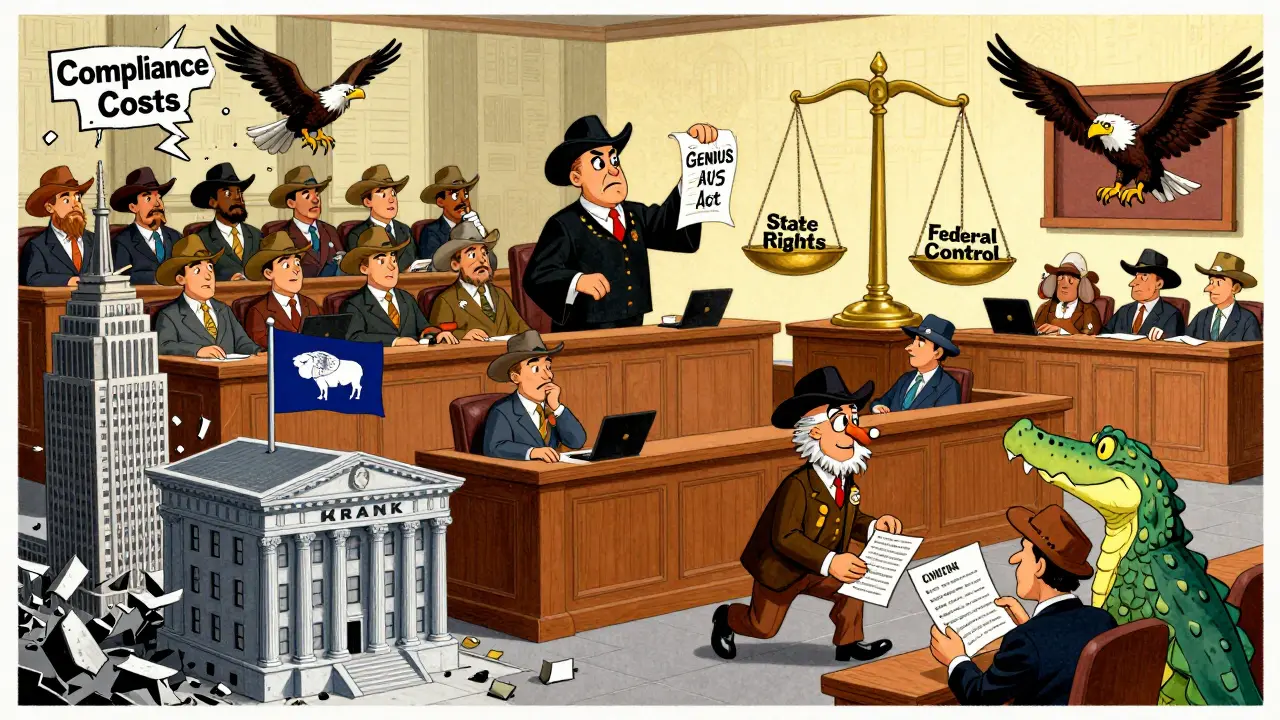
The federal government isn’t stepping back. The GENIUS Act, signed in September 2025, sets baseline rules for stablecoins: 100% reserve backing, regular audits, and clear disclosure. But it doesn’t override state laws. That’s the catch.Now, 22 states are suing the federal government, claiming the GENIUS Act violates the 10th Amendment. They say states have the right to regulate - and they’re not giving up.
Meanwhile, 14 states are updating their laws to align with federal rules. Massachusetts, which has seen $2.1 billion lost to crypto scams since 2020, is doubling down on enforcement. Arizona and Nevada are expanding their sandboxes. Florida is pushing for crypto-friendly tax breaks.
By 2027, experts predict one of two outcomes: either federal law will override state rules - or states will form a formal partnership with Washington to create a unified system.
What This Means for You
If you’re a regular user:- Don’t assume your exchange works everywhere. Coinbase may not offer full services in New York. Kraken may not be available in Massachusetts.
- Check if your state requires reporting. Some states now require you to report crypto gains on your state tax return.
- If you’re moving, consider where your crypto is stored. A wallet in Wyoming has more legal protection than one in New York.
If you’re running a business:
- Don’t start in New York unless you have $500,000+ in legal and compliance budget.
- Wyoming is the best bet for long-term growth - even if you don’t live there. You can incorporate there and operate remotely.
- California is a safe middle ground. Registration is cheap. Enforcement is predictable.
Top 5 States for Crypto in 2026
| State | Regulatory Model | Annual Compliance Cost | Business Licenses Issued | Key Advantage |
|---|---|---|---|---|
| Wyoming | SPDI Bank Charter | $42,000 | 12+ crypto banks | Full banking rights, no state tax |
| California | Registration Only | $85,000 | 142 registered firms | Low barrier, large user base |
| Texas | Money Transmitter License | $50,000 | 89 active licenses | Fast enforcement, low overhead |
| Arizona | Regulatory Sandbox | $35,000 | 23 startups in sandbox | Test products legally without license |
| New York | BitLicense | $350,000 | 37 active licenses | Market access, but high cost |

What to Avoid
Don’t assume federal law protects you. The SEC still considers most cryptocurrencies unregistered securities. That means even if your state allows you to trade, the feds could shut you down tomorrow.Don’t use an exchange that doesn’t disclose its regulatory status. If they won’t say whether they’re licensed in your state, walk away.
Don’t ignore state tax rules. In 2025, 18 states began taxing crypto as property. If you sell Bitcoin in California, you owe state capital gains tax - even if you didn’t owe federal.
Frequently Asked Questions
Is crypto legal in all 50 states?
Yes, owning and trading cryptocurrency is legal in all 50 states. But what you can do with it - like running an exchange, mining at scale, or offering crypto-backed loans - depends entirely on your state’s laws. Some states make it nearly impossible for businesses to operate. Others encourage it.
Can I incorporate my crypto business in Wyoming if I live in Florida?
Yes. You don’t need to live in Wyoming to incorporate there. Many crypto firms are legally based in Wyoming but operate remotely from Texas, Florida, or even overseas. Wyoming’s SPDI framework allows out-of-state operators to apply for a charter as long as they meet capital and compliance requirements.
Why do some states have higher compliance costs than others?
It’s about risk. New York requires extensive audits, cybersecurity controls, and capital reserves because it’s trying to prevent fraud at all costs. Wyoming assumes most firms are honest and focuses on structural safeguards - like FDIC insurance and transparency rules. California strikes a balance: registration, not licensing, with moderate oversight. The cost reflects the state’s philosophy: control vs. freedom.
Does the GENIUS Act override state laws?
No. The GENIUS Act sets federal minimum standards for stablecoins, but it does not preempt state laws. States can still enforce stricter rules. That’s why 22 states are suing the federal government - they believe the Act overreaches. For now, you must comply with both federal and state rules.
Which state is best for individual crypto investors?
For most individual investors, it doesn’t matter much - as long as you use a reputable exchange. But if you’re trading large amounts or holding crypto long-term, consider where your assets are stored. Wyoming and Texas offer stronger legal protections for asset holders. California has better consumer dispute resolution. New York offers the most oversight - but at a cost. If you’re not a business, focus on exchange security, not state law.
Next Steps
If you’re a business owner: Review your state’s current crypto law. If you’re in New York, consider relocating operations. If you’re in Texas or California, make sure your registration is up to date. If you’re in a state with no clear rules, consult a lawyer before launching anything.If you’re an investor: Know which exchanges are licensed in your state. Check if your state taxes crypto. Use wallets that offer multi-sig and insurance - especially if you hold over $10,000.
The U.S. crypto regulatory landscape is still evolving. But one thing is clear: where you are matters. The next five years will decide whether we get one national system - or 50 different ones.

karan narware
March 10, 2026 AT 09:14So let me get this straight: we’ve got 50 different rulebooks, each written by a state legislature that probably thinks ‘blockchain’ is a type of yoga… and somehow, we’re surprised crypto is a mess? 🤦♀️
Wyoming’s not a haven-it’s a tax loophole with a cowboy hat. And New York? They’re not regulating crypto-they’re performing exorcisms on Bitcoin with $350k compliance fees.
Meanwhile, in India, we just let people trade on Telegram and call it ‘peer-to-peer innovation.’ No licenses. No audits. Just vibes.
But hey, at least we’re not suing the feds because we’re ‘losing sovereignty.’ You’re not losing sovereignty-you’re losing your mind.
And don’t get me started on ‘SPDI’ banks. That’s not banking. That’s a sci-fi novel where the protagonist is a stablecoin with a lawyer.
Meanwhile, my cousin in Kerala bought Dogecoin with his pension and now he’s teaching yoga to goats. He doesn’t know what a BitLicense is. He thinks ‘cold storage’ means his fridge.
But you know what? He’s happier than any NYDFS auditor. And he’s not paying $85k a year to prove he’s not a money launderer.
States don’t need to ‘regulate’ crypto. They need to stop pretending they understand it.
The real innovation isn’t in Wyoming’s charter. It’s in the guy in Bangalore who mined Bitcoin on his laptop while his WiFi was down.
Stop overcomplicating. Stop overtaxing. Stop overlawyering.
Let people trade. Let them lose. Let them win.
And for god’s sake, stop calling it ‘financial sovereignty.’ You’re not a nation-you’re a spreadsheet with a flag.
Next up: Texas declares Dogecoin as legal tender. I’ll believe it when I see a cowboy riding a Shiba Inu.
And yes-I’m serious. That’s the next phase.
Michael Suttle
March 12, 2026 AT 03:01They’re all lying. 🤫
The Feds didn’t sign the GENIUS Act-they signed a backroom deal with JPMorgan. That’s why they let states fight. So the big banks can pick winners.
Wyoming? Owned by BlackRock. California? Controlled by Coinbase. Texas? Run by hedge funds with fake ‘money transmitter’ licenses.
They want you to think it’s about ‘innovation.’ It’s about control.
And don’t you dare think you’re ‘safe’ in New York. They’re just waiting for you to move your BTC… then they’ll freeze your wallet and say ‘fraud.’
They’re all the same. Just different costumes.
💎 #CryptoIsAScam #TheyControlEverything
Tina Keller
March 14, 2026 AT 01:33I’ve been following this for years, and honestly? The real story isn’t the laws-it’s the people.
Wyoming’s not magic. It’s just that nobody there cares enough to make it hard. No one’s trying to ‘protect’ you. They’re just letting you do your thing.
Meanwhile, New York is trying to protect you from yourself. Like a parent who won’t let you ride a bike without 17 layers of padding.
And California? They’re the middle school teacher who says ‘follow the rules, but also… be chill.’
The data doesn’t lie: places that treat crypto like a tool-not a threat-get the most growth.
It’s not about regulation. It’s about trust.
People don’t want to be policed. They want to be free to fail.
And yeah, I get it-fraud happens. But you don’t stop innovation because some idiot scams people. You punish the scammer. Not the whole industry.
The real tragedy? We’re spending billions on compliance while ignoring the real problem: financial illiteracy.
If people understood what they’re doing, they wouldn’t need 50 rulebooks.
They’d just… know.
vasantharaj Rajagopal
March 15, 2026 AT 09:21The regulatory fragmentation is a classic case of institutional path dependency. The SEC’s jurisdictional ambiguity, coupled with the CFTC’s commodity-centric framing, has created a regulatory arbitrage environment where state-level actors are incentivized to optimize for competitive advantage rather than systemic coherence.
SPDI charters represent a novel institutional innovation-de facto private banking infrastructure under state charter, insulated from federal securities law via preemption gaps.
However, the structural asymmetry between high-capital jurisdictions like Wyoming and low-barrier states like Texas introduces systemic risk: capital concentration in a single regulatory enclave increases systemic vulnerability.
Moreover, the absence of inter-state reciprocity protocols means compliance costs are not scalable-each jurisdiction requires distinct legal architecture.
The GENIUS Act’s non-preemption clause is not a failure-it is a deliberate federalist accommodation. The real issue is the lack of harmonization mechanisms, not the existence of state sovereignty.
Without a national clearinghouse for regulatory filings, we are merely replicating the 19th-century banking chaos-with blockchain.
ann neumann
March 15, 2026 AT 12:17I knew it. I KNEW IT.
This is all a setup. The states aren’t regulating-they’re preparing for the collapse.
Wyoming? They’re hoarding crypto like it’s gold in a bunker. They know the dollar’s going to crash. They know the Fed’s printing trillions. They’re building their own empire.
New York? They’re the last bastion of the old world. They’re trying to drown crypto in paperwork so it dies before it can rise.
And the feds? They’re just waiting. Waiting for the people to panic. Waiting for the banks to beg for help.
They’re letting this chaos happen so they can step in later and say ‘We had to take control. For your safety.’
It’s the same story as 2008. Same playbook.
They want your money. They want your data. They want your life.
And they’re using ‘regulation’ to make you think you’re safe.
But you’re not.
You’re being herded.
Don’t you see? The real crime isn’t fraud.
It’s compliance.
William Montgomery
March 16, 2026 AT 16:15If you’re running a business and you don’t know your state’s crypto rules, you’re not a founder-you’re a liability.
Stop blaming the government. Start doing your homework.
Wyoming’s not for everyone. California’s not for everyone. But knowing which one fits your business? That’s basic.
And if you think ‘I’ll just move to Wyoming’ like it’s a vacation… you’re going to get crushed.
It’s not a loophole. It’s a legal structure with capital requirements, audits, and federal oversight.
You want freedom? Then earn it.
Not by hiding. By building.
Mara Alves Mariano
March 17, 2026 AT 13:22Oh my god. Wyoming? Really? The state that can’t even decide if they want to be a state or a theme park?
Let me guess-next they’ll start issuing crypto driver’s licenses and letting you pay tolls in Dogecoin.
Meanwhile, New York is the only state that still has real infrastructure. Real banks. Real people.
Wyoming’s ‘crypto haven’ is just rich guys playing with Monopoly money while the rest of us pay for their ‘innovation’ with higher taxes and worse services.
And don’t even get me started on ‘state sovereignty.’ You’re not a sovereign nation. You’re a state with a bad Yelp review.
Stop pretending this is freedom. It’s just capitalism with a cowboy hat.
And if you think California is ‘middle ground’-you’ve never been to Silicon Valley. They’re the ones who invented the whole scam.
Wake up. This isn’t innovation. It’s a Ponzi with a state seal.
Adam Ashworth
March 18, 2026 AT 16:36Wyoming’s model works because it’s simple: if you meet the capital and compliance standards, you get full banking rights. No gray areas.
California’s registration system works because it’s transparent. You know what you’re signing up for.
Texas? Low cost, high enforcement. That’s smart.
New York? It’s a regulatory graveyard.
The takeaway? Clarity beats complexity. Consistency beats chaos.
If you’re building a business, pick the state that gives you predictability-not the one that gives you a ‘brand.’
It’s not about patriotism. It’s about profit.
Allison Davis
March 19, 2026 AT 15:23One thing everyone’s missing: this isn’t about crypto. It’s about trust in institutions.
People don’t trust federal regulators. So they turn to states that seem more responsive.
Wyoming doesn’t have a big bureaucracy. So people trust it more.
New York has layers of red tape. So people distrust it.
It’s psychology, not policy.
And that’s why the ‘best’ state isn’t the one with the most rules-it’s the one that feels most aligned with its users.
That’s the real lesson here.
Tom Jewell
March 20, 2026 AT 02:30There’s something beautiful about this chaos.
It’s like the Wild West-but instead of guns, we’ve got smart contracts.
Every state is a different experiment. Wyoming: libertarian utopia. New York: bureaucratic fortress. Texas: shoot-first-ask-later.
And you know what? That’s how progress happens.
Not through federal mandates. Not through consensus.
Through competition.
States are laboratories. Some will fail. Some will thrive.
And the market will decide.
I don’t need a single rulebook.
I need freedom to choose.
And right now? That’s what we have.
Let’s not fix it until we see what works.
Howard Headlee
March 20, 2026 AT 12:41Y’ALL ARE OVERTHINKING THIS.
WYOMING IS THE FUTURE. PERIOD.
They don’t tax you. They don’t hassle you. They let you build.
Meanwhile, New York? They’re still asking for ‘biometric access controls’ like we’re running a nuclear silo.
Do you know how many startups die before they even launch because of NYDFS?
Thousands.
And for what? So a bureaucrat can feel powerful?
Stop worshiping ‘safety.’ Start worshiping ‘growth.’
Wyoming’s not ‘easy.’ It’s ‘smart.’
And if you’re not in Wyoming, you’re already behind.
Move. Adapt. Win.
Julie Tomek
March 22, 2026 AT 04:27As someone who has reviewed regulatory frameworks across multiple jurisdictions, I must emphasize that the current state-by-state model, while administratively burdensome, reflects a principled adherence to federalism.
The GENIUS Act, while establishing baseline standards for stablecoins, appropriately defers to state authority in areas not preempted-particularly in the regulation of non-stablecoin digital assets and consumer protection.
That said, the absence of a unified filing system, inter-state reciprocity, or standardized compliance protocols creates inefficiencies that disproportionately impact small-to-medium enterprises.
Recommendation: A voluntary interstate compact, modeled after the Nationwide Multistate Licensing System (NMLS), could harmonize licensing without sacrificing state autonomy.
Collaboration, not conflict, is the path forward.
Brandon Kaufman
March 23, 2026 AT 02:23Just want to say-this guide saved me.
I was about to launch a crypto app in New York. Then I read this.
Changed my whole plan. Incorporated in Wyoming. Registered in California. All good.
Don’t let fear stop you.
Just know the rules.
You got this.
Craig Gregory
March 24, 2026 AT 12:32The entire premise is flawed.
States don’t regulate crypto.
They regulate the *illusion* of crypto.
Every ‘license’ is a tax on innovation disguised as consumer protection.
Every ‘sandbox’ is a controlled environment where the state decides who gets to play.
Wyoming’s SPDI? A corporate welfare program for venture capital.
Texas’s enforcement? A theater for political theater.
New York’s BitLicense? A monument to regulatory vanity.
The only thing these states have in common? They’re all trying to monetize a technology they don’t understand.
And the worst part?
We’re letting them.
Anshita Koul
March 25, 2026 AT 03:34Imagine… if we didn’t have 50 rulebooks… but one global one.
Imagine if blockchain was meant to break borders… not build them.
States are clinging to 19th-century ideas while the world moves to decentralized trust.
Wyoming’s not the future.
It’s a distraction.
The real future is decentralized identity. Self-custody. On-chain compliance.
Not state charters.
Not licenses.
Not bank charters.
Just code.
And people who understand it.
Not lawyers.
Not regulators.
Just… builders.
PIYUSH KOTANGALE
March 26, 2026 AT 17:53Good breakdown. 🙌
Wyoming = best for founders.
Texas = best for growth.
California = best for scale.
New York = best for… legacy.
Choose wisely.
vishnu mr
March 28, 2026 AT 03:50so wyoming is like the dubai of crypto? lol
and new york is like… the prison?
hmmmm
Grace van Gent-Korver
March 28, 2026 AT 16:24I’m just a regular person who owns some Bitcoin.
I don’t care about charters or SPDIs.
I just want to know if I can sell it without getting fined.
And honestly? I still don’t know.
Can someone just… tell me?
Zephora Zonum
March 30, 2026 AT 09:36How quaint. You think state-by-state regulation is the pinnacle of governance? How very… American.
In Europe, we have harmonized frameworks. In Singapore, we have clarity.
Here? We have 50 versions of ‘maybe.’
It’s not innovation. It’s incompetence dressed as federalism.
And you call Wyoming a haven?
It’s a tax haven with a blockchain logo.
How original.