
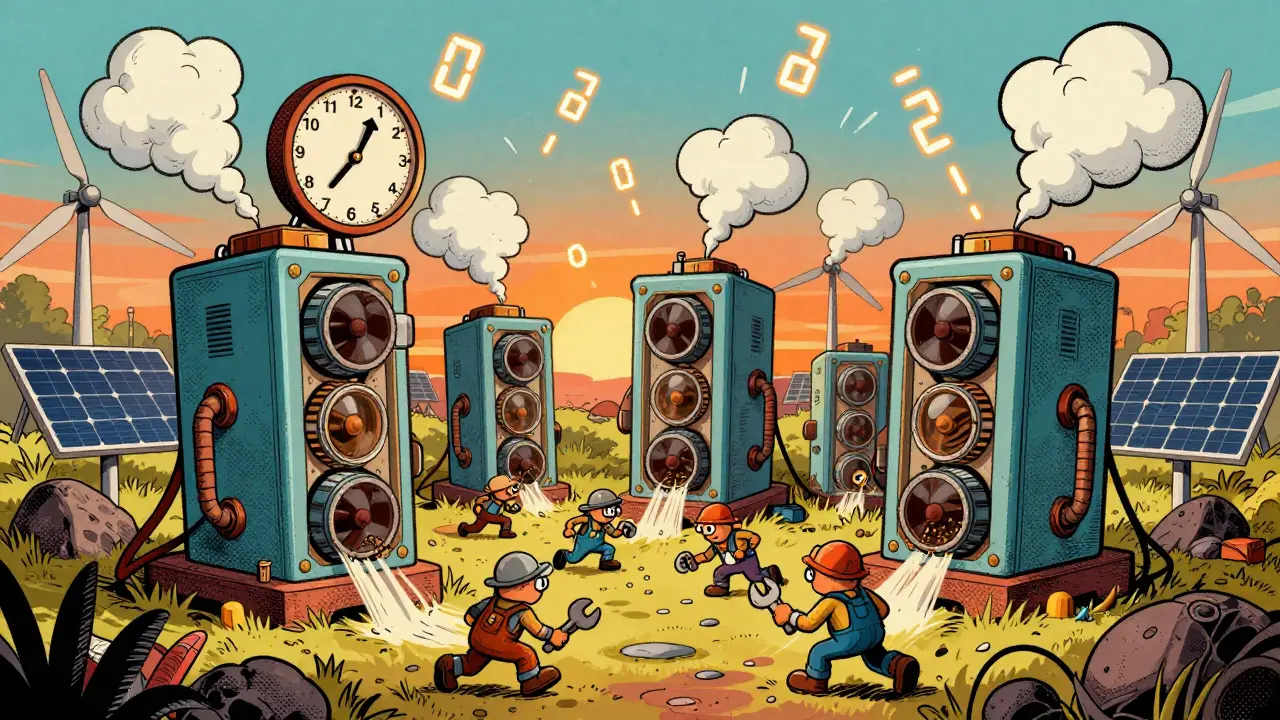
When you hear that Bitcoin’s hash rate hit 1.2 exahashes per second, what does that actually mean? It’s not just a big number-it’s the heartbeat of the entire Bitcoin network. Every second, over a quintillion calculations are being made by machines spread across the globe, all racing to solve the same cryptographic puzzle. This isn’t science fiction. It’s how Bitcoin stays secure, honest, and unstoppable.
What Is Hash Rate, Really?
Hash rate is the total computing power used by the Bitcoin network to process transactions and secure the blockchain. Think of it like a giant digital lottery where millions of machines guess numbers nonstop. Each guess is called a hash. The more guesses per second, the higher the hash rate.
It’s measured in hashes per second. But because Bitcoin’s network is so massive, we use bigger units:
- 1 GH/s = 1 billion hashes per second
- 1 TH/s = 1 trillion hashes per second
- 1 EH/s = 1 quintillion hashes per second (that’s 1,000,000,000,000,000,000)
As of early 2026, Bitcoin’s hash rate hovers around 1.2 EH/s. That’s more than all the supercomputers on Earth combined-just for one blockchain. And it’s growing. Every two weeks, the network automatically adjusts how hard the puzzle is to keep block times steady at roughly 10 minutes, no matter how many miners join or leave.
Why Does Hash Rate Matter for Security?
Bitcoin doesn’t have banks, police, or CEOs. It runs on code and competition. The only thing stopping someone from cheating-like spending the same Bitcoin twice-is the sheer cost of overpowering the network.
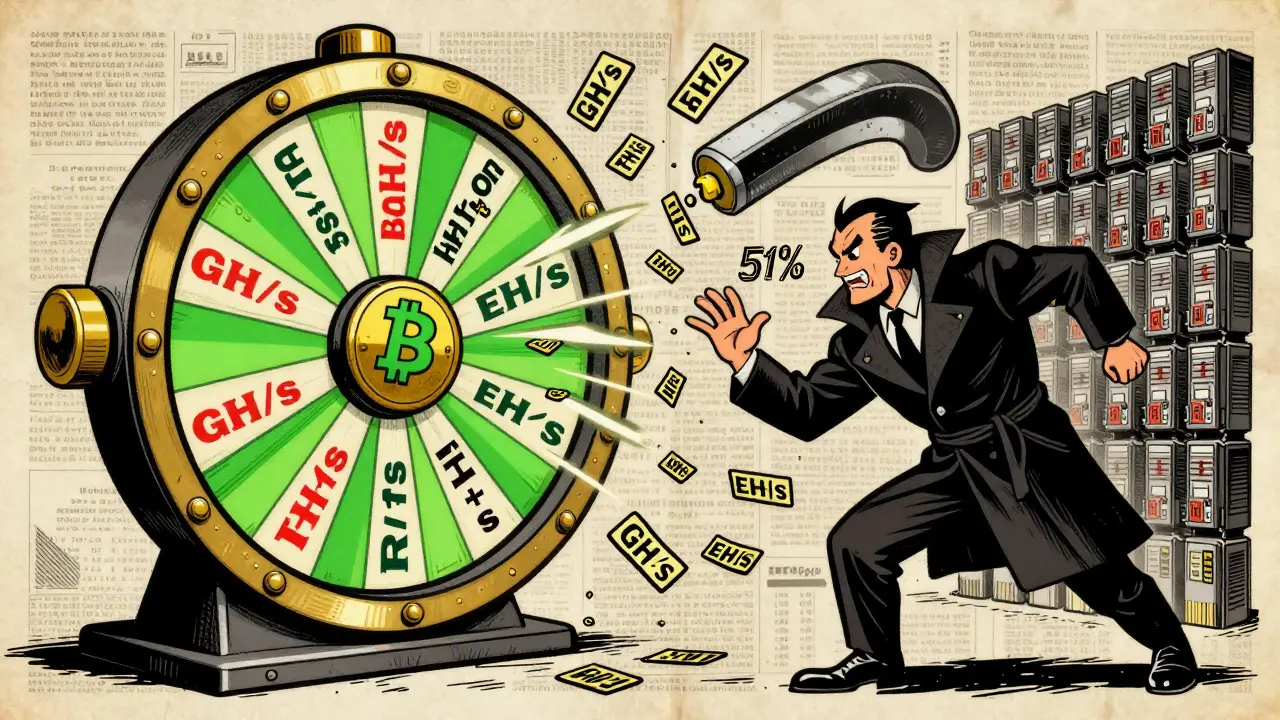
This is where hash rate becomes your invisible shield. The higher the hash rate, the harder it is for a bad actor to launch a 51% attack. That’s when someone tries to control more than half of the network’s total computing power. If they succeed, they could reverse transactions, block payments, or double-spend coins.
But here’s the catch: to control 51% of Bitcoin’s current hash rate, you’d need to buy, power, and maintain mining equipment worth tens of billions of dollars. You’d need access to massive amounts of cheap electricity. You’d need to outbid every other miner on the planet. And even then, the network would likely split, and Bitcoin’s price would crash-making your attack worthless.
That’s why hash rate is the best real-time indicator of Bitcoin’s security. If the number drops suddenly-say, due to a government ban on mining or a power outage in a major mining region-trading platforms watch closely. Some even pause withdrawals or delist Bitcoin temporarily. A falling hash rate means less protection. A rising one means more trust.
How Mining Actually Works
Miners don’t just guess randomly. They take a block of recent Bitcoin transactions, add a random number (called a nonce), and run it through a math function called SHA-256. The output is a fixed-length string of letters and numbers-a hash.
The goal? Find a hash that starts with a certain number of zeros. The more zeros required, the harder the puzzle. Miners keep changing the nonce and hashing again-billions of times per second-until they hit the right one.
The first miner to solve it broadcasts the block to the network. Others verify it’s correct. If it checks out, the block gets added to the chain. The winner gets rewarded with newly minted Bitcoin and transaction fees.
This system works because it’s expensive and slow to solve, but fast and cheap to verify. It’s a perfect balance. And it only works if thousands of miners are playing by the rules, competing with real money at stake.
The Hardware Behind the Numbers
Early Bitcoin mining was done on regular computers. Then came graphics cards (GPUs). Then, in 2013, everything changed with ASICs-Application-Specific Integrated Circuits.
These are machines built for one thing: hashing SHA-256 as fast and efficiently as possible. Modern ASICs like the Bitmain Antminer S21 or MicroBT Whatsminer M56 can each do over 200 TH/s. That’s 200 trillion guesses per second. A single unit uses about 3,000 watts-enough to power a small home.
Because of this, mining has become a capital-intensive industry. You can’t just plug in a laptop and start earning. You need:
- Specialized hardware (costing $2,000-$10,000 per unit)
- Access to cheap electricity (often under $0.05 per kWh)
- Proper cooling and ventilation
- Reliable internet and uptime
Most miners now join mining pools-groups that combine their hash power. When a pool finds a block, rewards are split based on how much computing power each miner contributed. This gives smaller miners a steady, if smaller, income instead of waiting months for a solo win.
Hash Rate and Bitcoin’s Price: Are They Connected?
Yes-but not always immediately.
When Bitcoin’s price rises, more miners join. Why? Because the reward is worth more. More miners mean more hash rate. That’s a positive feedback loop: higher price → more mining → stronger network → more confidence → higher price.
But it’s not instant. Building a mining farm takes months. Ordering ASICs can take 6-12 months. Electricity contracts need negotiation. So when Bitcoin surges, hash rate often lags behind by weeks or even months.
The reverse is also true. When the price crashes, some miners can’t cover their electricity bills. They shut down. Hash rate drops. But the network doesn’t break. Every 2,016 blocks (about every two weeks), Bitcoin automatically lowers the mining difficulty to match the reduced hash rate. This keeps block times stable.
That’s the beauty of it: the system self-corrects. It doesn’t need a central authority. It just needs math and incentives.

Where Is Hash Rate Located Today?
Bitcoin mining used to be dominated by China. After the 2021 ban, the network didn’t collapse-it relocated.
Today, the largest mining hubs are in:
- United States (especially Texas and Georgia, thanks to cheap natural gas and renewables)
- Kazakhstan (low electricity costs, but politically unstable)
- Canada (Quebec and Ontario, with hydro power)
- Russia (some regions use excess energy from oil/gas fields)
- Georgia and Paraguay (renewable-heavy grids)
This geographic spread is critical for security. If one country cracks down, the network doesn’t die. It just shifts. Decentralization isn’t just about who owns Bitcoin-it’s about who secures it.
What Happens If Hash Rate Keeps Rising?
It gets stronger. And more energy-intensive.
Bitcoin’s total electricity use is often criticized. But here’s the nuance: most new mining is powered by stranded, flared, or otherwise wasted energy. In Texas, miners use excess wind power at night. In Canada, hydro dams idle in summer and ramp up mining. In Kazakhstan, miners use coal plants that would otherwise pollute without benefit.
Some experts argue Bitcoin mining is becoming the world’s largest demand-response energy buyer-turning waste into value. As renewable grids expand, Bitcoin’s hash rate may become a tool to stabilize them, absorbing surplus power when supply exceeds demand.
Long-term, hash rate isn’t going down. It’s going up. Faster hardware, better cooling, smarter energy sourcing-all of it pushes the network toward greater security. And that’s the point. Bitcoin’s value isn’t just in scarcity. It’s in the cost of breaking it.
What Should You Watch For?
If you’re holding Bitcoin, tracking hash rate is one of the best ways to gauge network health without reading charts or listening to hype.
Watch for:
- Sudden drops-could signal miner exodus, regulatory crackdown, or energy crisis
- Steady growth-means confidence is rising, miners are betting on the future
- Geographic shifts-if mining moves to a new region, it might mean better sustainability or new risks
- Difficulty adjustments-if difficulty drops sharply after a price crash, it means miners left, but the network is adapting
Tools like Blockchain.com, BitInfoCharts, and CoinWarz show real-time hash rate graphs. You don’t need to understand every number-just notice the trend. Is it going up? That’s good. Is it flat or falling? That’s a signal to pay attention.
Hash rate isn’t just a technical metric. It’s a measure of collective belief. Every gigahash represents a person or company betting on Bitcoin’s future. The more hashes, the more people are willing to spend real money to protect it.

Hannah Campbell
January 15, 2026 AT 07:59And you call this security? I call it a pyramid scheme with more fans and less charisma.
Bryan Muñoz
January 15, 2026 AT 20:52every hash is a spy cam feeding data to the shadow gov
you think this is about money? it's about control
they want your soul in binary
Christina Shrader
January 17, 2026 AT 00:39Kelly Post
January 18, 2026 AT 03:33Vinod Dalavai
January 19, 2026 AT 17:54Nishakar Rath
January 20, 2026 AT 06:49hash rate is just a placebo for people who can't do basic math
it's like counting how many times a guy sneezes and calling it a cure for cancer
Jason Zhang
January 20, 2026 AT 21:17Haley Hebert
January 21, 2026 AT 15:24Jill McCollum
January 23, 2026 AT 06:37Hailey Bug
January 23, 2026 AT 22:20Dustin Secrest
January 24, 2026 AT 01:45Josh V
January 25, 2026 AT 16:50Hash rate falling = time to buy
Simple as that
Pat G
January 26, 2026 AT 21:23Alexandra Heller
January 27, 2026 AT 16:14myrna stovel
January 27, 2026 AT 22:38Liza Tait-Bailey
January 29, 2026 AT 10:52Chris O'Carroll
January 30, 2026 AT 17:34Bill Sloan
January 31, 2026 AT 22:01Anthony Ventresque
February 1, 2026 AT 19:33Katherine Melgarejo
February 1, 2026 AT 23:56Patricia Chakeres
February 2, 2026 AT 04:36Anna Gringhuis
February 3, 2026 AT 10:17Michael Jones
February 4, 2026 AT 08:15Hannah Campbell
February 6, 2026 AT 03:12