

Imagine trying to buy a stock, but the broker is illegal, the exchange is blocked by firewalls, and getting caught could mean losing your savings-or worse. That is the daily reality for millions of people in mainland China who still want exposure to Bitcoin and Ethereum. Despite one of the strictest financial crackdowns on earth, an estimated $86.4 billion in cryptocurrency transactions flowed through China between July 2022 and June 2023. This figure actually dwarfs the legal trading volume in neighboring Hong Kong during the same period.
It seems contradictory. How does a market this size survive when the government has explicitly banned exchanges, mining, and banking support for crypto? The answer lies in a complex mix of desperation, sophisticated technology, and a regulatory gray area that traders navigate at their own peril. If you are curious about how this underground ecosystem works, or if you have connections in China and wonder about the safety of sending funds there, understanding these mechanics is crucial.
The Legal Gray Zone: What Is Actually Banned?
To understand the risk, you first need to separate fact from fiction regarding Chinese law. The narrative isn't simply "crypto is illegal." It is much more nuanced, which is exactly what allows the black market to thrive.
Since the comprehensive ban issued by the People's Bank of China (PBOC) in 2021, several activities are strictly prohibited:
- Commercial Cryptocurrency Services: Any business offering exchange services, payment processing, or custody solutions for crypto is illegal.
- Mining Operations: All proof-of-work mining farms were forcibly shut down, with equipment confiscated and electricity cut off.
- Banking Support: Traditional banks like ICBC and China Construction Bank are forbidden from facilitating any crypto-related transfers.
However, here is the twist: Personal Ownership of digital assets like Bitcoin remains technically legal. In 2025, Chinese courts even referred to cryptocurrencies as "legal property" in certain rulings. This creates a bizarre situation where you can own a Bitcoin, but you cannot legally buy it, sell it, or trade it through official channels. This distinction is the lifeline of the underground market. Traders argue they are merely transferring "property," not engaging in commercial activity, though enforcement agents often see it differently.
How the Underground Market Operates
If you walk into a coffee shop in Shanghai or Shenzhen, you won't see people flashing QR codes for Bitcoin payments. The infrastructure is hidden, digital, and highly decentralized. The underground ecosystem relies on three main pillars to bypass state controls.
Peer-to-Peer (P2P) Networks
This is the backbone of Chinese crypto trading. Instead of using centralized exchanges like Binance (which are blocked), traders use P2P platforms that act as bulletin boards. One person wants to buy USDT (a stablecoin); another wants to sell. They agree on a price, transfer Chinese Yuan (CNY) via bank transfer or Alipay, and the seller releases the crypto. These platforms often operate out of jurisdictions outside China, making them hard to shut down completely.
The Hong Kong Bridge
Hong Kong serves as the critical gateway for mainland traders. While Hong Kong has embraced regulated crypto trading, many mainland residents maintain bank accounts or corporate entities there. High-net-worth individuals often route their funds through Hong Kong to access institutional-grade liquidity. This isn't just small-scale retail; large OTC (Over-the-Counter) brokers facilitate millions of dollars in trades daily, connecting mainland buyers with global sellers.
Virtual Private Networks (VPNs)
You cannot access international crypto sites without bypassing the Great Firewall. Traders invest heavily in premium, private VPN services and proxy networks. Free or public VPNs are risky because they can be monitored or shut down instantly. The tech stack for a serious trader includes multiple backup connection methods to ensure they never lose access to their portfolios during market volatility.
| Method | Risk Level | Anonymity | Liquidity |
|---|---|---|---|
| P2P Platforms | High (Account Freeze Risk) | Medium | High |
| Hong Kong Routing | Medium (Legal Complexity) | Low (KYC Required) | Very High |
| OTC Brokers | High (Counterparty Fraud) | High | Medium |
| Cross-Border Remittance | Extreme (Capital Control Violation) | Low | Low |

Why Do They Keep Trading? The Economic Push Factors
People don't break severe laws for fun. They do it because the alternative-staying within the traditional Chinese financial system-has become increasingly unattractive. Several economic factors drive this demand.
First, consider the performance of domestic markets. In 2023, China's blue-chip CSI Index fell by 35% over 36 months. For context, Morgan Stanley analysts noted that earnings at listed Chinese companies missed forecasts for ten consecutive quarters. When your local stock market is losing value steadily, investors look elsewhere.
Second, there is a lack of investment diversity. With real estate markets cooling and government bonds offering low yields, wealthy Chinese citizens are desperate for portfolio diversification. Cryptocurrencies offer a way to hedge against inflation and currency devaluation. Even though the government injects billions into equity markets to stabilize sentiment, individual investor confidence remains weak.
Third, and perhaps most significantly, is the desire for capital mobility. China maintains strict capital controls, limiting how much money individuals can move abroad. Crypto provides a loophole. By converting Yuan to stablecoins like USDT, traders can effectively move wealth across borders, bypassing the $50,000 annual limit on foreign exchange purchases. This makes crypto not just an investment, but a tool for financial sovereignty.
The Real Risks: More Than Just Fines
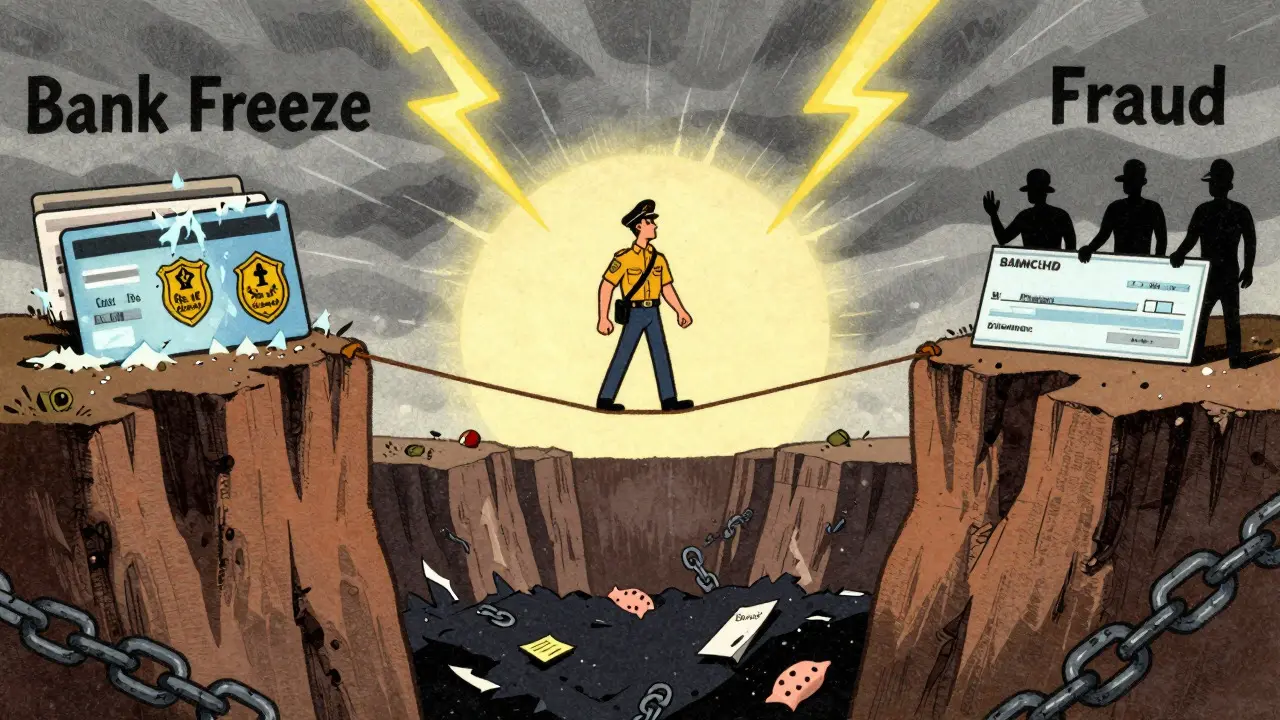
If you decide to participate in or facilitate underground crypto trading in China, you are walking a tightrope. The risks are not theoretical; they are immediate and severe.
Financial Account Freezes
This is the most common punishment. Chinese banks monitor transactions for suspicious patterns. If your account receives funds from someone involved in a scam or illegal crypto trade, your entire account can be frozen instantly. Unfreezing it requires visiting a police station, providing extensive documentation, and potentially waiting months. For many, this means being locked out of their livelihood.
Legal Prosecution
While personal ownership is tolerated, organizing trades or running an OTC desk can lead to criminal charges under laws related to illegal business operations or money laundering. Penalties can include imprisonment and heavy fines. The definition of "commercial" activity is vague, leaving traders vulnerable to arbitrary enforcement.
Counterparty Fraud
In an unregulated P2P environment, there is no consumer protection. Scammers frequently engage in "chargeback fraud," where they send fake bank transfer screenshots or reverse payments after receiving crypto. Without legal recourse, victims rarely recover their losses. Trust is established through reputation scores on platforms, but these can be manipulated.
Technical Vulnerabilities
Relying on third-party VPNs introduces security risks. Some providers log user data and may hand it over to authorities if pressured. Additionally, accessing exchanges through unstable connections increases the chance of transaction errors or failed trades during high-volatility periods.
The Future: Digital Yuan vs. Decentralized Assets
Where is this heading? The Chinese government is not sitting idle. Their counter-strategy is the Digital Yuan (e-CNY). Unlike Bitcoin, the e-CNY is a central bank digital currency (CBDC) fully controlled by the state. It offers digital convenience without sacrificing monetary policy control or privacy from the government.
Shanghai regulators have recently begun discussing stablecoin regulations, hinting at a potential shift toward controlled integration rather than total prohibition. However, the fundamental tension remains: decentralized crypto threatens the state's monopoly on money creation and capital flow management.
Expect the underground market to persist as long as domestic investment opportunities remain poor and capital controls stay tight. The sophistication of these networks will likely increase, with more traders moving toward privacy-focused coins or decentralized finance (DeFi) protocols that are harder to trace. But for now, the gap between the official ban and the underground reality shows no sign of closing.
Is it illegal to own Bitcoin in China in 2026?
Technically, personal ownership of Bitcoin is not explicitly criminalized. Courts have recognized crypto as "legal property" in some contexts. However, buying, selling, or trading it through commercial channels is strictly prohibited. The line between "holding" and "trading" is thin and often determined by enforcement discretion.
Can I use Binance or Coinbase in mainland China?
No. Major international exchanges like Binance and Coinbase are blocked by the Great Firewall. Accessing them requires a VPN, which itself carries legal risks. Furthermore, these platforms often restrict users identified as residing in mainland China to comply with sanctions and local laws.
What happens if my bank account gets frozen due to crypto?
If your account is flagged for suspicious crypto-related activity, it will be frozen by the bank pending investigation. You must contact the bank to learn which police department is handling the case. You will need to provide proof of legitimate income and source of funds. The process can take weeks or months, and funds may be seized if linked to illegal activities.
Why is Hong Kong important for Chinese crypto traders?
Hong Kong has a legal and regulated cryptocurrency market. Mainland traders use Hong Kong bank accounts and corporate structures to access global liquidity, bypass mainland capital controls, and conduct larger OTC trades with greater legal certainty than available in mainland China.
Will China legalize crypto trading in the future?
Full legalization of decentralized crypto trading is unlikely in the near term due to conflicts with capital controls and the promotion of the Digital Yuan. However, limited regulation of stablecoins or specific digital assets may emerge, particularly in special economic zones like Shanghai, to capture some of the market activity currently happening underground.
