
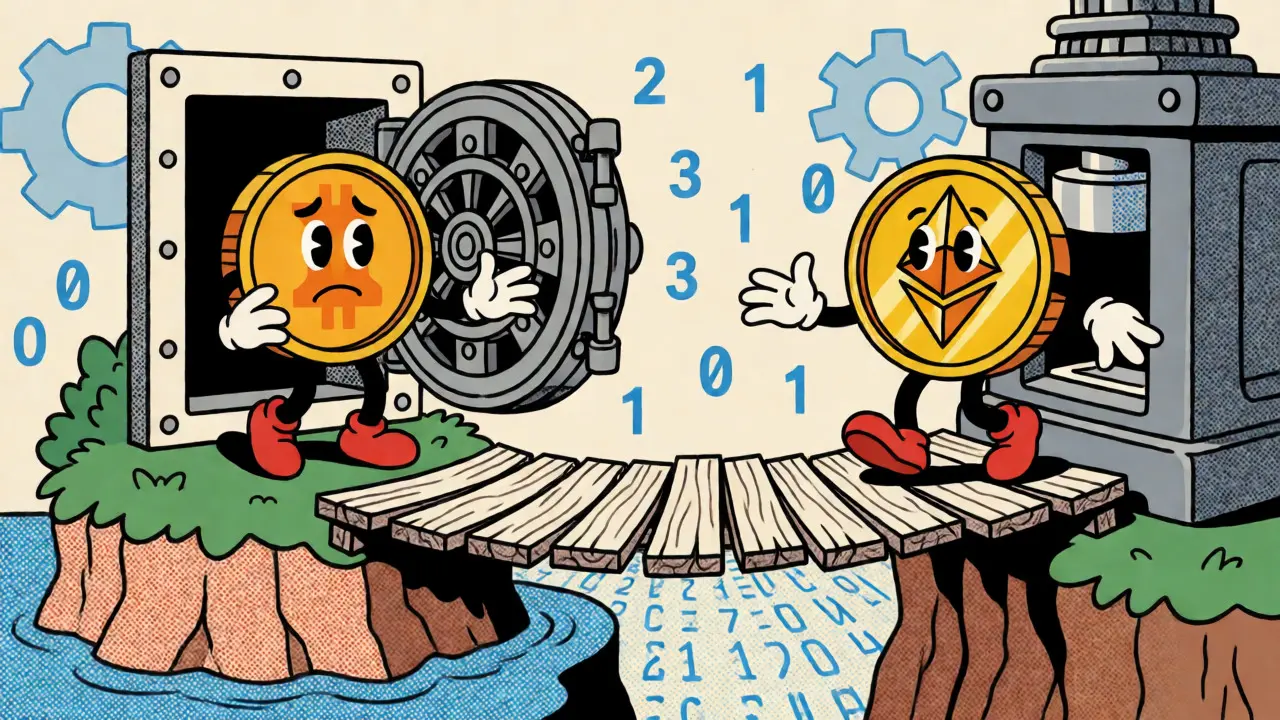
You move Bitcoin to Ethereum. You get WBTC, a token that looks like Bitcoin but lives on Ethereum. It trades instantly, earns yield in DeFi, and feels seamless. But behind that smooth interface sits a vault. Someone holds your actual Bitcoin. If they lose the keys, go bankrupt, or act maliciously, your wrapped token becomes worthless paper. This is the core tension of wrapped asset bridges: they enable interoperability by introducing centralized trust into a decentralized system.
The Core Mechanism: Lock and Mint
How does this actually work? When you bridge assets, you don't send Bitcoin across chains. Blockchains can't talk directly. Instead, you lock your native asset in a smart contract vault on the source chain. A corresponding amount of wrapped tokens gets minted on the destination chain. The security model relies entirely on the integrity of this lock-mint relationship. If the vault holds 10 BTC, there should be exactly 10 WBTC in circulation. Any deviation breaks the peg.
This architecture creates a single point of failure. Unlike pure liquidity pools where users trade against each other, wrapped bridges depend on a custodian. That custodian might be a consortium of companies, a DAO, or a centralized entity. In early implementations, a single private key often controlled billions in value. Today, top-tier bridges use multi-signature wallets and Multi-Party Computation (MPC) to distribute risk. But the fundamental dependency remains: if the custodian fails, the wrapped asset fails.
Custody Models: Who Holds the Keys?
Not all custody setups are equal. The industry has moved from naive single-key solutions to complex institutional-grade frameworks. Understanding these models helps you assess risk before moving funds.
| Model | Security Level | Trust Assumption | Example Tech |
|---|---|---|---|
| Single Key | Low | One entity controls all funds | Standard EOA Wallet |
| Multi-Sig | Medium-High | M of N signers must approve | Gnosis Safe |
| MPC (Multi-Party Computation) | High | Key shards distributed; no single point | Fireblocks, TSS |
| Light Client Verification | Very High | Mathematical proof of state | Chainlink CCIP, IBC |
Gnosis Safe is a standard for multi-sig wallets. It requires multiple parties to sign off on transactions. If one signer is compromised, the funds remain safe as long as enough honest signers exist. However, collusion among signers is still possible.
Fireblocks uses MPC technology. Here, the private key is never assembled in one place. Instead, it's split into shards held by different devices or locations. To sign a transaction, these shards communicate without ever revealing the full key. This eliminates the "hack the hot wallet" attack vector common in earlier bridges.
Real-World Vulnerabilities and Exploits
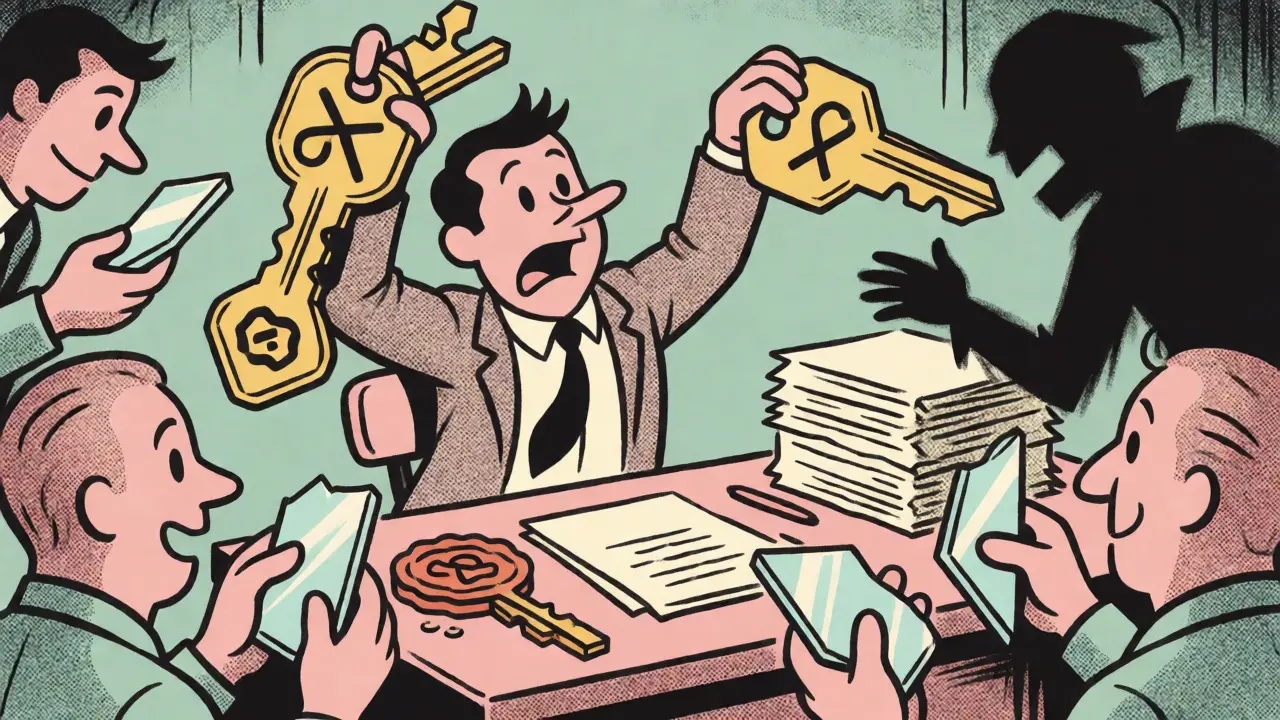
History shows us what goes wrong. In 2021, several bridge hacks occurred not because of cryptographic failures, but due to operational errors or compromised custodians. One notable incident involved $32 million in losses because a custodial system had a single point of failure. Attackers didn't break the math; they broke the people or the software managing the keys.
Another major risk is the "oracle problem." How does the destination chain know the source chain locked the funds? Usually, an oracle reports this status. If the oracle is manipulated or lags, you might receive wrapped tokens that aren't backed yet. Or worse, you might see a false report of insolvency. Security researcher Samczsun highlighted this in a viral thread, noting that many users assume redemption is guaranteed, when in reality, it depends on the custodian honoring requests.
Transparency is another gap. Only about 37% of wrapped asset bridges publish regular proof-of-reserves. Without this, you're trusting blind. You have no practical way to verify that 1:1 backing exists at any given moment until a crisis hits.
Proof-of-Reserves and Zero-Knowledge Proofs
The solution gaining traction is Proof-of-Reserves (PoR). This involves independent auditors verifying that the vault holds enough assets to cover all issued tokens. Monthly attestations by accounting firms are becoming standard for institutional bridges. But traditional audits are slow and backward-looking.
Newer protocols are using Zero-Knowledge (ZK) proofs. These allow a custodian to prove they hold sufficient reserves without revealing specific account details or balances publicly. For example, the WBTC Improvement Proposal 12 introduced mechanisms to cryptographically verify backing. This shifts trust from "believe the auditor" to "verify the math." By 2025, experts predict 75% of major bridges will incorporate some form of cryptographic PoR, up from just 22% in 2023.

User Best Practices for Safer Bridging
As a user, you can't change the bridge's code, but you can manage your exposure. Here’s how to navigate the risks:
- Check the Custodian: Who holds the keys? Is it a known entity like BitGo or a new startup? Look for names with track records.
- Verify Audits: Has the bridge been audited by reputable firms like OpenZeppelin, Trail of Bits, or Quantstamp? Multiple audits are better than one.
- Monitor Proof-of-Reserves: Does the bridge publish monthly attestations? If not, treat it as higher risk.
- Diversify Bridges: Don't put all your eggs in one basket. If you need $1M in wrapped ETH, consider splitting it across two different bridge providers.
- Understand Redemption Rights: Read the terms. Can you redeem your underlying asset easily? Are there fees or delays? Some bridges freeze redemptions during high volatility.
Remember, wrapped assets are IOUs. They are convenient, but they add a layer of counterparty risk that native assets do not have. If you're holding large amounts long-term, consider whether the yield earned in DeFi outweighs the risk of custodial failure.
The Future: Decentralized Verification
The ultimate goal is removing the trusted custodian entirely. Protocols like Chainlink's Cross-Chain Interoperability Protocol (CCIP) aim to provide decentralized verification. Instead of trusting a company to report the state of the source chain, a network of nodes verifies it. This reduces reliance on any single entity.
Regulations are also tightening. The EU's MiCA framework now requires bridge operators to maintain sufficient liquid reserves. This forces transparency and accountability. While regulation doesn't prevent hacks, it ensures that operators have skin in the game and adhere to strict capital requirements.
Security researcher Dan Robinson warns that technological improvements don't eliminate the fundamental risk. As long as assets are locked in a vault managed by humans or semi-centralized systems, there is residual risk. The best defense is awareness and diversification.
What happens if a wrapped asset bridge loses its collateral?
If the bridge loses the underlying collateral (e.g., through a hack or mismanagement), the wrapped token typically loses its 1:1 peg. The price may drop significantly below the value of the native asset. Users may face delays or inability to redeem their original assets until the bridge operator resolves the issue or compensates holders.
Are wrapped tokens safer than native tokens?
No, wrapped tokens generally carry additional risk. Native tokens rely only on the blockchain's consensus mechanism. Wrapped tokens rely on both the blockchain AND the security of the custodian holding the underlying asset. This adds counterparty risk, making them inherently less secure than native assets.
How can I verify if a bridge is trustworthy?
Look for three things: 1) Reputable security audits from firms like OpenZeppelin or Trail of Bits. 2) Regular proof-of-reserves reports published by independent auditors. 3) A transparent list of custodians and their insurance coverage. Avoid bridges that lack public audit history or clear custody details.
What is Multi-Party Computation (MPC) in bridging?
MPC is a cryptographic method where a private key is split into multiple parts (shards) held by different parties. No single party ever holds the complete key. Transactions are signed by combining these shards without assembling the full key. This prevents theft even if one shard holder is compromised, enhancing security over traditional multi-sig wallets.
Can I redeem my wrapped tokens for the original asset anytime?
Usually yes, but it depends on the bridge's rules. Most allow redemption, but there may be fees, minimum amounts, or processing times. During periods of extreme market stress or if the bridge faces liquidity issues, redemptions might be paused or delayed. Always check the specific bridge's documentation for redemption policies.
