

Imagine trading stock options, forex pairs, and Bitcoin perpetuals on a single platform without handing over your private keys. That is the promise of RubyDex, a Layer-2 decentralized derivatives exchange designed to offer centralized exchange speed while maintaining user custody of funds. It positions itself as a bridge between the ease of traditional exchanges and the security of decentralized finance.
However, promises in the crypto world often outpace reality. As of mid-2026, RubyDex remains an emerging player with significant ambition but limited market traction. This review breaks down how it works, what makes it unique, and whether it’s ready for your portfolio.
What Is RubyDex?
RubyDex is a hybrid decentralized exchange (DEX) specializing in linear contract perpetual futures across cryptocurrencies, traditional assets, and NFTs. Unlike standard spot DEXs like Uniswap, which rely on automated market makers (AMMs), RubyDex uses an order book model. This allows traders to place limit orders and market orders just like they would on Binance or Coinbase Pro.
The core innovation lies in its asset coverage. While most derivatives DEXs focus solely on crypto pairs, RubyDex integrates traditional financial instruments. You can trade perpetual contracts for major stocks, forex currencies, and commodities. Additionally, it claims leadership in NFT perpetuals, allowing users to speculate on the floor price of NFT collections using data from marketplaces like Blur and OpenSea.
| Feature | Centralized Exchange (CEX) | Pure DEX (e.g., GMX) | RubyDex |
|---|---|---|---|
| Custody | Exchange holds funds | User holds funds | User holds funds |
| Trading Engine | Centralized Order Book | On-chain AMM or Hybrid | Hybrid (Centralized engine, Decentralized wallet) |
| Asset Classes | Crypto only (mostly) | Crypto only | Crypto, Stocks, Forex, NFTs |
| KYC Required | Yes | No | No |
| Speed/Latency | High | Variable (depends on chain) | High (via cloud servers) |
How the Hybrid Architecture Works
The biggest hurdle for decentralized exchanges has always been speed. Blockchain transactions are slow compared to centralized databases. RubyDex solves this with a split architecture. The trading engine runs on centralized cloud servers to ensure millisecond execution speeds comparable to top-tier CEXs. However, your funds never leave your wallet. They interact exclusively with the decentralized zones of the platform.
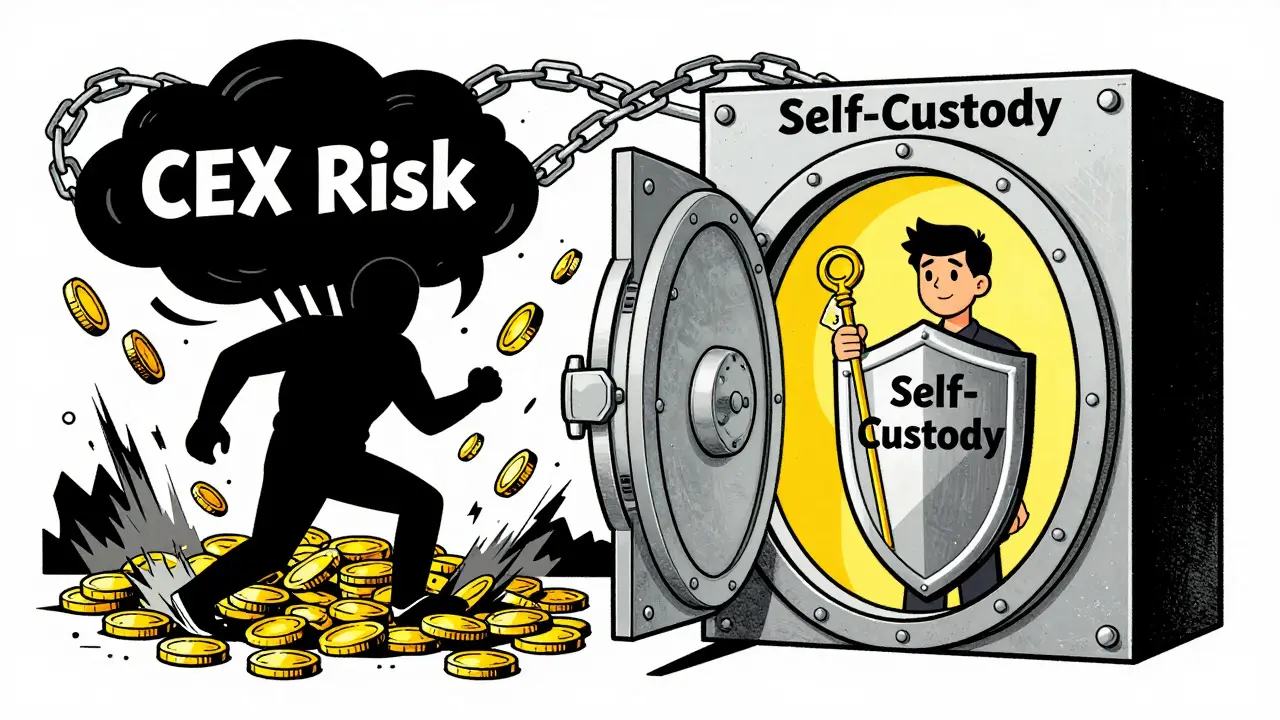
This means you connect your wallet-such as MetaMask or WalletConnect-and sign transactions directly. There is no need to deposit funds into an exchange-controlled hot wallet. If the platform were to go bankrupt tomorrow, your assets would still be in your control. This addresses the primary risk of centralized exchanges: counterparty risk.
For liquidity, RubyDex employs an innovative pool system. Liquidity Providers (LPs) lend assets to professional market makers. In return, LPs earn flexible annual percentage yields (APYs) based on interest rates paid by these market makers. This helps keep the order books deep and reduces slippage for traders executing large orders.
Supported Assets and Trading Features
RubyDex stands out because of what you can trade. Most DeFi platforms are siloed within the cryptocurrency ecosystem. RubyDex attempts to break those walls.
- Cryptocurrency Perpetuals: Standard BTC, ETH, and altcoin futures with leverage.
- Traditional Assets: Perpetual contracts tied to stock indices, individual equities, forex pairs, and commodities like gold or oil. This taps into markets with trillions in daily volume.
- NFT Perpetuals: A niche but growing sector where users trade the price movement of NFT floor prices rather than owning the art itself. Data is sourced from Blur, OpenSea, LooksRare, and X2Y2.
The interface mimics familiar centralized exchange layouts, featuring charting tools, order history, and position management. For users migrating from CEXs, the learning curve is minimal. You don’t need to understand complex smart contract interactions to place a simple limit order.
Liquidity and Market Adoption Status
Here is where the story gets complicated. Despite the ambitious feature set, RubyDex faces significant challenges regarding adoption and liquidity. As of late 2025 and early 2026, reports indicate that RubyDex has a Total Value Locked (TVL) of $0.0 million. This suggests very few users have deposited capital into its liquidity pools or opened leveraged positions.
CoinMarketCap lists RubyDex as an "Untracked Listing," meaning there is insufficient verifiable volume data to generate reliable charts or rankings. In the competitive derivatives DEX space, dominated by giants like GMX (with hundreds of millions in TVL) and Kwenta, low liquidity can lead to high slippage and wider spreads. If you try to trade a large amount on a thin order book, your entry and exit prices may suffer significantly.
Furthermore, user feedback is scarce. Major review platforms and crypto communities like Reddit’s r/DeFi show little discussion about RubyDex. Without a strong community track record, it is difficult to verify the quality of customer support or the reliability of the platform during high-volatility events.
Regulatory Risks and Challenges
By bringing traditional assets like stocks and forex into the decentralized sphere, RubyDex enters a regulatory gray area. In many jurisdictions, including the United States, trading unregistered securities via decentralized protocols attracts scrutiny from bodies like the SEC. The SEC’s aggressive enforcement actions against DeFi projects in 2024 and 2025 highlight this risk.
If regulators decide that RubyDex’s stock perpetuals constitute unregistered securities offerings, the platform could face legal hurdles that restrict access for users in certain countries. This is a risk not present when trading pure crypto assets, which are generally treated more leniently under current frameworks.
Additionally, the multichain nature of RubyDex introduces technical complexity. Supporting multiple blockchains requires robust bridging solutions and cross-chain communication protocols. Any vulnerability in these bridges could expose users to exploits, although the non-custodial nature limits total loss to the specific assets involved in a transaction.

Who Should Use RubyDex?
RubyDex is likely best suited for advanced DeFi users who want exposure to traditional financial markets without leaving their wallets. If you are interested in speculating on Tesla stock or Gold prices using crypto collateral, and you prioritize self-custody above all else, RubyDex offers a unique proposition.
It is less ideal for beginners or those seeking high liquidity. Newcomers might find the concept of perpetual futures confusing, and the lack of deep liquidity could result in poor trade execution. Traders looking for the deepest order books and tightest spreads should probably stick to established CEXs or larger derivatives DEXs like dYdX or GMX until RubyDex gains more market share.
Conclusion: High Potential, Early Stage
RubyDex represents an interesting experiment in merging TradFi and DeFi. Its hybrid architecture successfully addresses the speed issues of pure DEXs while preserving user custody. The inclusion of stocks, forex, and NFTs sets it apart from competitors. However, the lack of liquidity, untracked volume status, and regulatory uncertainties mean it remains a high-risk option. Treat it as an emerging project worth watching, but proceed with caution if you plan to allocate significant capital.
Is RubyDex safe to use?
RubyDex is non-custodial, meaning you retain control of your funds through your own wallet, which reduces the risk of exchange hacks or insolvency. However, smart contract risks and regulatory uncertainties around traditional asset trading remain. Always do your own research and start with small amounts.
Does RubyDex require KYC?
No, RubyDex does not require Know Your Customer (KYC) verification. Users simply connect their Web3 wallets to access the platform, maintaining privacy and anonymity typical of decentralized exchanges.
What assets can I trade on RubyDex?
You can trade perpetual futures for cryptocurrencies, traditional assets (stocks, forex, commodities), and NFT floor prices. This broad range is unique among decentralized derivatives platforms.
Why is RubyDex TVL reported as $0?
A TVL of $0 indicates very low current adoption and liquidity. This is common for new or niche DeFi projects. It suggests that while the technology exists, few users have locked capital in the protocol yet, which can impact trading efficiency due to slippage.
How does RubyDex achieve fast trading speeds?
RubyDex uses a hybrid model. The matching engine runs on centralized cloud servers for speed, while fund custody remains decentralized in user wallets. This combines the performance of CEXs with the security of DEXs.
