
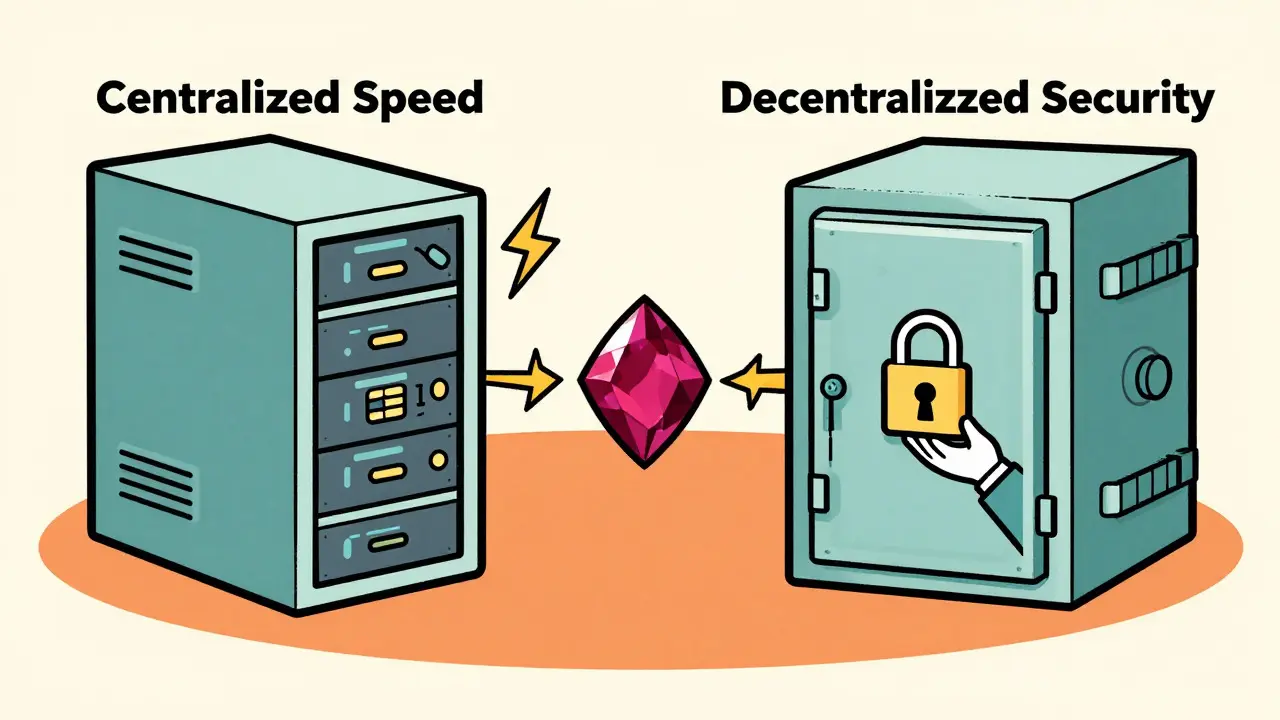
Imagine getting the lightning-fast execution of a centralized exchange like Binance or Coinbase, but keeping your keys and full control over your funds. That is the promise of RubyDex, a Layer-2 derivatives decentralized exchange (DEX) designed to bridge the gap between centralized speed and decentralized security. In a market flooded with options, RubyDex stands out not just for its tech, but for what it lets you trade: everything from Bitcoin futures to stocks, forex, and even NFT perpetuals. But does it actually work as advertised, or is it another ambitious project struggling to find users?
The short answer is that RubyDex offers a fascinating architectural experiment. It uses a hybrid model to solve the biggest pain point in DeFi trading: slippage and latency. However, if you are looking for deep liquidity and a bustling community right now, you might be disappointed. As of late 2025, data suggests RubyDex has minimal Total Value Locked (TVL), meaning there isn't much money flowing through it yet. Let's break down exactly how it works, who it is for, and whether you should risk your capital on this emerging platform.
How RubyDex Works: The Hybrid Architecture
Most decentralized exchanges force you to choose between speed and security. Pure order-book DEXs can be slow because every trade requires on-chain confirmation. Automated Market Makers (AMMs) are faster but often suffer from high slippage when trading large amounts. RubyDex tries to have its cake and eat it too by splitting its operations into two zones.
First, there is the Centralized Zonea cloud-based server environment housing the core trading engine to match orders at high speed. This part handles the heavy lifting-matching buy and sell orders instantly, just like a traditional centralized exchange (CEX). This ensures that when you click 'buy,' you get filled immediately without waiting for blockchain confirmations for the match itself.
Second, there is the Decentralized Zonethe wallet interaction layer where user funds remain under self-custody and never leave the user's control during trading. Your funds stay in your wallet. They only interact with the smart contracts when you deposit, withdraw, or settle positions. This means no one else holds your assets. If the centralized servers go down, your money is safe in your wallet; you just can't trade until they come back up.
This setup allows RubyDex to offer an Order Book Model. You can place limit orders, market orders, and use stop-losses, which feels familiar if you've ever traded on a CEX. For liquidity providers, RubyDex uses a unique lending system. Instead of just sitting in a pool, LPs lend assets to professional market makers. These market makers pay interest rates determined by demand, allowing LPs to earn flexible APYs while ensuring the order books stay deep enough for traders to execute large orders without moving the price too much.
What Can You Trade? Beyond Crypto
Here is where RubyDex gets really interesting. Most derivatives DEXs focus solely on cryptocurrencies. RubyDex expands the playground significantly. According to its listings on CoinMarketCap and Alchemy, the platform supports linear contract perpetual futures across three major categories:
- Cryptocurrencies: Standard pairs like BTC/USD and ETH/USD.
- Traditional Financial Assets: Stocks, forex pairs, and commodities. This taps into markets that handle trillions in daily volume globally.
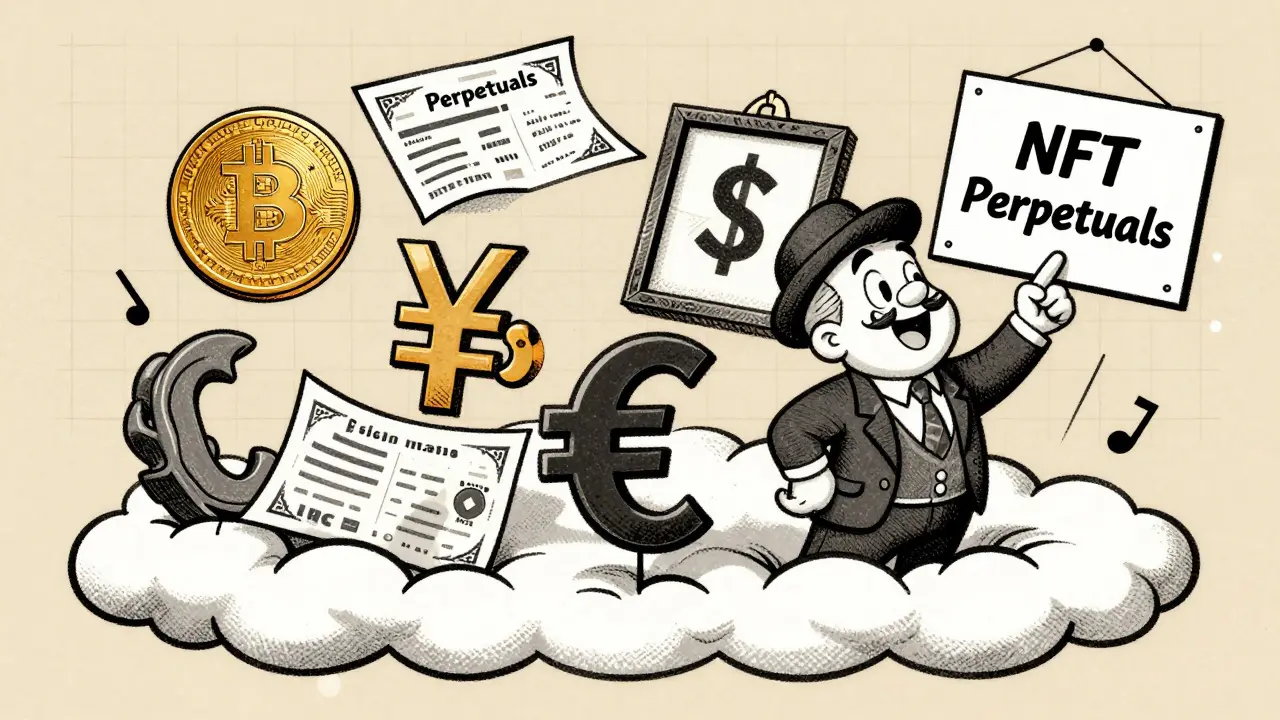
- NFT Perpetuals: This is RubyDex's flagship differentiator. You can trade NFT floor prices as perpetual contracts. Data is pulled from major marketplaces like Blur, OpenSea, LooksRare, and X2Y2.
Trading NFT perpetuals means you don't need to own the actual JPEG to bet on its price going up or down. You can leverage your position on the Blue Chip NFT index or specific collections. For traditional assets, this opens the door for crypto natives to hedge against stock market crashes or commodity spikes without leaving their Web3 wallets. However, keep in mind that trading traditional assets on a decentralized platform introduces regulatory gray areas, especially in jurisdictions like the United States.
Liquidity and Adoption: The Elephant in the Room
A trading platform is only as good as its liquidity. If there is no one on the other side of your trade, you face massive slippage or inability to exit positions. Here is the hard truth about RubyDex right now: adoption is low.
Data from HittinCorners.com in 2025 reports RubyDex's Total Value Locked (TVL) at $0.0M. CoinMarketCap lists it as an "Untracked Listing" due to unverified volume data. Compare this to established derivatives DEXs like GMX, which reported over $336 million in TVL in late 2024, or Kwenta with around $108 million. RubyDex is essentially empty compared to these giants.
| Platform | Type | Key Asset Classes | Estimated TVL (Late 2024/2025) | User Base Status |
|---|---|---|---|---|
| RubyDex | Hybrid L2 DEX | Crypto, TradFi, NFTs | $0.0M (Reported) | Early/Niche |
| GMX | AMM DEX | Crypto | $336M+ | Established |
| Kwenta | Order Book DEX | Crypto | $108M+ | Established |
| Bitoro | Perpetuals DEX | Crypto | Varying | Growing |
Why does this matter? Low TVL means fewer market makers are actively providing depth. While RubyDex claims to attract professional market makers via its lending protocol, the lack of verified volume suggests this ecosystem hasn't fully matured. For a casual trader, this might mean wider spreads than you'd see on Binance. For a pro, it could mean opportunities to front-run less efficient pricing, but also higher counterparty risk if the liquidity dries up completely during volatile moves.
Pros and Cons: Is RubyDex Right for You?
Let's look at the practical sides of using RubyDex today.
The Good:
- Self-Custody: You never give up your private keys. Your funds sit in your wallet until settlement.
- Asset Diversity: Few places let you trade S&P 500 futures or NFT indices alongside Bitcoin in one interface.
- No KYC: Connect your wallet and start trading. No identity verification required.
- Speed: The hybrid engine aims to eliminate the lag associated with pure on-chain order matching.
The Bad:
- Low Liquidity: With near-zero reported TVL, executing large trades may result in poor pricing.
- Regulatory Risk: Trading traditional assets (stocks/commodities) on a DEX puts you in a legal gray area depending on your country.
- Unproven Track Record: There are very few user reviews on Trustpilot or Reddit. The platform is still finding its footing.
- Gas Fees: While trading is off-chain, deposits, withdrawals, and settlements require gas fees on the underlying blockchain.
Who Should Use RubyDex?
RubyDex isn't for everyone. If you are a beginner looking for a simple way to buy and hold Bitcoin, stick to a reputable CEX or a well-established AMM like Uniswap. If you are a high-frequency trader needing millisecond precision and deep liquidity, GMX or dYdX might currently serve you better due to their larger user bases.
RubyDex is best suited for:
- DeFi Natives Who Hate Centralization: You want to trade derivatives but refuse to trust a company with your funds.
- NFT Speculators: You want to hedge your NFT portfolio or speculate on floor prices without buying/selling the actual assets.
- Early Adopters: You believe in the long-term vision of bridging TradFi and DeFi and are willing to accept higher risks for potential early-mover advantages (like higher yields for LPs before competition drives them down).

Security and Risks
Security in a hybrid model is complex. Since funds stay in your wallet, the risk of a "exchange hack" stealing your entire balance is lower than on a CEX. However, you are exposed to smart contract risk. If the decentralized zone's contracts have bugs, funds could be drained. Additionally, because the matching engine is centralized, there is operational risk. If the cloud servers fail or are compromised, trading halts. While your funds aren't stolen, your positions might be stuck.
Always check if the platform's code has been audited by reputable firms. As of late 2024, specific audit details were not prominently featured in mainstream reviews, which is a red flag for cautious investors. Always start small. Test the withdrawal process with a tiny amount before committing significant capital.
Final Thoughts
RubyDex represents an ambitious attempt to fix the fragmented nature of financial markets. By combining crypto, traditional assets, and NFTs into a single self-custodial interface, it solves a real problem: accessibility. However, technology alone doesn't make a successful exchange. Liquidity does. Community does. Until RubyDex can demonstrate consistent volume and deeper liquidity pools, it remains a speculative play rather than a primary trading hub. Keep an eye on its TVL growth and regulatory developments. If it gains traction, it could become a powerhouse. For now, treat it as an experimental tool in your DeFi toolkit.
Is RubyDex a centralized or decentralized exchange?
RubyDex is a hybrid platform. It is primarily a decentralized exchange (DEX) because users retain custody of their funds in their own wallets. However, it uses a centralized component (cloud servers) for its trading engine to ensure fast order matching, blending the speed of a CEX with the security of a DEX.
Can I trade stocks and forex on RubyDex?
Yes, RubyDex offers perpetual futures contracts for traditional financial assets, including stocks, forex, and commodities. This allows crypto users to gain exposure to traditional markets without leaving their Web3 wallets, though regulatory risks apply depending on your location.
What are NFT perpetuals?
NFT perpetuals allow you to trade the price movement of NFT floor prices without owning the actual NFT. RubyDex aggregates data from marketplaces like Blur and OpenSea to create these derivative contracts, enabling you to go long or short on NFT collections with leverage.
Why is RubyDex TVL so low?
As of 2025, RubyDex reports $0.0M in Total Value Locked (TVL). This indicates low current adoption and limited liquidity compared to established competitors like GMX. It is an emerging platform that has not yet attracted significant capital from users or market makers.
Do I need to do KYC to use RubyDex?
No, RubyDex operates as a non-custodial DEX. You simply connect your Web3 wallet (like MetaMask) to start trading. There is no Know Your Customer (KYC) verification process required, preserving user privacy.
How does RubyDex generate revenue for Liquidity Providers?
RubyDex uses a lending model where Liquidity Providers (LPs) lend assets to professional market makers. These market makers pay interest rates based on demand, allowing LPs to earn flexible Annual Percentage Yields (APYs) rather than relying solely on trading fees.
