

When you look at the crowded world of cryptocurrency exchanges, finding a platform that balances speed, privacy, and security can feel like searching for a needle in a haystack. OneDex is a decentralized exchange built on the MultiversX blockchain that promises fast, private, and permissionless trading without intermediaries. Launched in 2023, it positions itself as a minimalist peer-to-peer marketplace. But here is the real question: does the promise of decentralization outweigh the risks of operating without clear regulatory oversight? Before you connect your wallet, we need to look past the marketing and examine the hard data regarding liquidity, fees, and safety.
What Exactly Is OneDex?
To understand OneDex, you first need to understand its foundation. Unlike centralized exchanges like Binance or Coinbase, where a company holds your funds, OneDex operates as a Decentralized Exchange (DEX). This means trades happen directly between users via smart contracts. The platform is built specifically on the MultiversX a high-performance blockchain known for scalability and energy efficiency through shard technology.
This architectural choice defines everything about the user experience. Because it lives on MultiversX, OneDex inherits the network's speed and low transaction costs. However, it also limits your universe. You are primarily trading assets native to this ecosystem. If you are looking to trade Bitcoin or Ethereum directly, this isn't the place. OneDex focuses on tokens within the MultiversX family, making it a specialized tool rather than a general-purpose crypto supermarket.
The Liquidity Reality Check
Liquidity is the lifeblood of any exchange. Without it, you cannot buy or sell assets quickly without suffering massive price slippage. Here is where OneDex shows some interesting-and concerning-characteristics. Recent data indicates a 24-hour trading volume of approximately $10.8 million. That sounds decent on paper, but the distribution tells a different story.
Nearly 96.5% of that entire volume comes from a single pair: WEGLD/USDC the primary trading pair involving MultiversX staked EGLD and USD Coin. This extreme concentration suggests that while there is activity, it is heavily skewed toward one specific asset. For traders interested in other tokens listed on the platform, liquidity might be thin. Thin liquidity means wider spreads and potentially higher costs when entering or exiting positions. It also signals limited market adoption across the broader range of available pairs.
| Metric | Value/Status | Implication for Traders |
|---|---|---|
| Total Cryptocurrencies | 25 | Limited selection compared to major DEXs |
| Active Pairs | 54 | Focused depth over breadth |
| Trading Fee | 0.3% | Standard for DEXs; predictable cost structure |
| Margin Trading | Not Available | Spot trading only; lower risk profile |
| CoinMarketCap Status | Untracked Listing | Volume not independently verified by major aggregators |
Fees and Trading Features
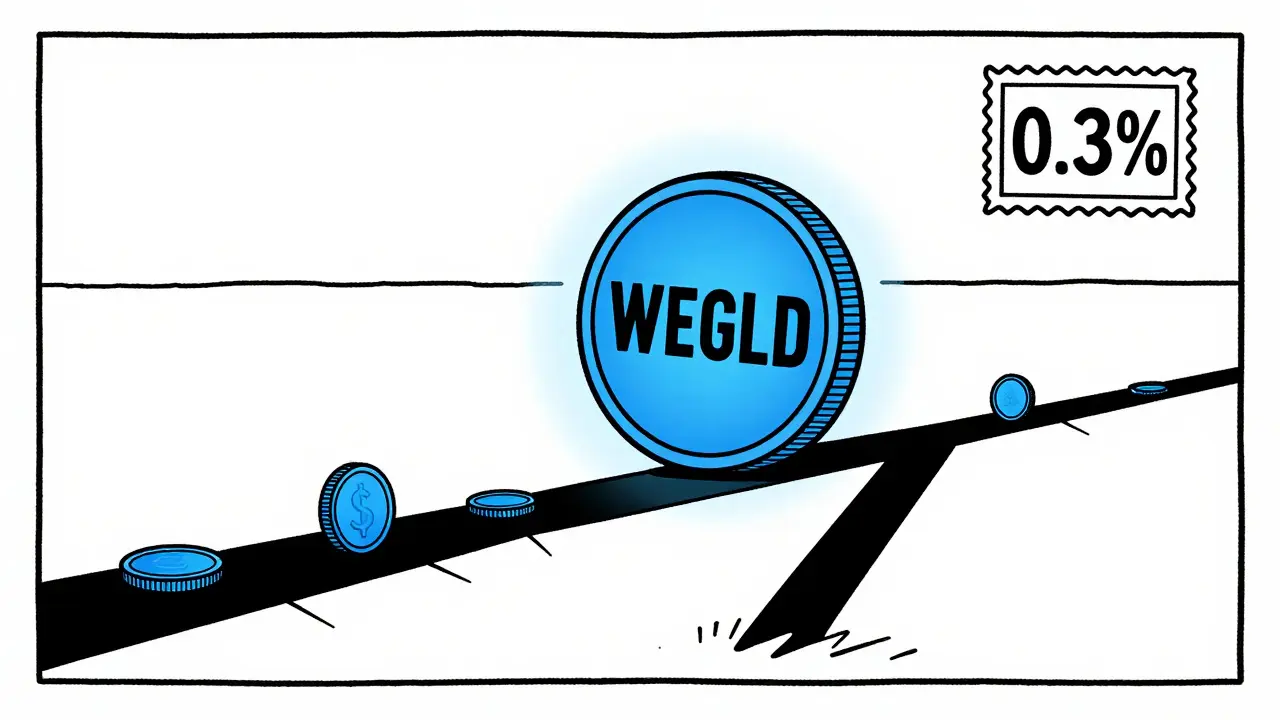
Let’s talk about what you pay. OneDex uses a flat fee structure of 0.3% per transaction. In the world of decentralized finance, this is standard fare. It is comparable to Uniswap or SushiSwap. There are no hidden withdrawal fees or tiered structures based on your VIP status. You pay the same rate whether you are trading $100 or $10,000.
However, feature-wise, OneDex keeps things simple. There is no margin trading. No leverage. No futures. If you are a day trader who relies on 10x or 50x leverage to amplify gains, you will find OneDex lacking. Competitors like Avantis offer up to 100x leverage on forex and commodities. OneDex deliberately avoids this complexity. For conservative investors who prefer spot trading and want to avoid the liquidation risks associated with leverage, this simplicity is a benefit. For aggressive traders, it is a dealbreaker.
You can deposit fiat indirectly through stablecoins like USDC and USDT. Since it is a non-custodial platform, you never actually "deposit" funds into an account held by OneDex. Instead, you interact with smart contracts using your own wallet. This aligns with the core ethos of decentralization: you retain control of your assets at all times.
Safety, Regulation, and Trust Signals
This is the most critical section for any potential user. When you trade on a centralized exchange, you rely on their compliance teams and insurance funds. On a DEX like OneDex, you rely on code and community audits. But what about the entity behind the code?
Here, the picture gets murky. OneDex was incorporated in Romania but lists its registered location as the United Kingdom in some databases. According to assessments from regulatory watchdogs like WikiBit, OneDex currently holds no valid regulatory license. WikiBit has classified the exchange as having a "Suspicious Regulatory License" status with a medium potential risk rating. They explicitly warn users to be aware of the lack of regulation.
Why does this matter? If something goes wrong-whether it’s a bug in the smart contract, a phishing attack, or operational failure-you have no recourse. There is no customer support team to refund you, no regulator to file a complaint with, and no insurance fund to cover losses. The "permissionless" nature that offers privacy also removes consumer protections.
Third-party trust scores reflect this ambiguity. ScamAdviser notes mixed signals. While they conclude the site is likely "legit and safe to access," they simultaneously flag negative social media references and a low trust score. The domain has been registered for several years, which adds a layer of legitimacy, but the absence of positive user ratings on major review platforms is telling. Silence often speaks louder than noise in the crypto space.
How OneDex Compares to Alternatives
To put OneDex in perspective, let’s compare it to two types of competitors: other MultiversX-focused DEXs and larger, multi-chain alternatives.
If you stay within the MultiversX ecosystem, SpookySwap a popular automated market maker on the Fantom network, often cited as a comparative benchmark for DEX usability or similar platforms might offer more diverse liquidity pools. However, if you look at broader DEXs like Uniswap the leading decentralized exchange on Ethereum with deep liquidity across thousands of tokens, the difference is stark. Uniswap supports virtually every ERC-20 token, whereas OneDex is limited to the MultiversX subset.
For those seeking advanced features, platforms like Avantis offer leveraged trading and access to traditional assets like forex. OneDex does not compete here. Its niche is pure, simple spot trading within a specific blockchain environment. If your goal is to hold long-term positions in MultiversX-related tokens without the hassle of leverage or complex interfaces, OneDex serves that purpose. If you want breadth, depth, or regulatory clarity, you might be better served elsewhere.

Who Should Use OneDex?
Based on the analysis, OneDex is not for everyone. It fits a very specific user profile:
- MultiversX Ecosystem Believers: Users who already hold EGLD or related tokens and want to swap them efficiently within the same chain.
- Privacy-Focused Traders: Individuals who prioritize self-custody and do not want to undergo KYC (Know Your Customer) procedures required by centralized exchanges.
- Conservative Spot Traders: Those who want to buy and hold without the temptation or risk of margin trading.
Conversely, you should probably avoid OneDex if:
- You require high liquidity for large orders outside the WEGLD/USDC pair.
- You demand regulatory assurance and customer support.
- You are looking to trade Bitcoin, Ethereum, or Solana directly.
- You rely on independent volume verification from platforms like CoinMarketCap (which lists OneDex as untracked).
Final Verdict
OneDex is a functional, minimalist tool for a specific job. It delivers on its promise of fast, private, and permissionless trading within the MultiversX ecosystem. The 0.3% fee is fair, and the lack of leverage reduces unnecessary risk for casual holders. However, the lack of regulatory licensing, concentrated liquidity, and unverified volume status raise significant red flags for serious investors.
Use OneDex if you understand the risks of decentralized finance and are comfortable operating without regulatory safeguards. Treat it as a utility for swapping specific assets, not as a primary repository for your crypto wealth. Always start with small amounts to test the waters, and never invest more than you can afford to lose. In the world of crypto, your keys are your castle-but make sure the castle walls are secure before you move in.
Is OneDex a safe exchange to use?
OneDex is a decentralized exchange, meaning you retain control of your funds via your wallet. However, it lacks valid regulatory licenses and has received mixed trust signals from third-party assessors. While the smart contracts may be secure, the absence of regulatory oversight means you have no consumer protection in case of disputes or technical failures. Proceed with caution and only trade amounts you are willing to risk.
What cryptocurrencies can I trade on OneDex?
OneDex hosts 25 cryptocurrencies, primarily focused on the MultiversX ecosystem. The most active pair is WEGLD/USDC. You will not find major assets like Bitcoin or Ethereum directly on this platform. It is designed for trading tokens native to the MultiversX blockchain.
Does OneDex charge fees?
Yes, OneDex charges a flat trading fee of 0.3% on all transactions. This fee is applied to each trade you execute. There are no additional withdrawal fees or tiered pricing structures.
Can I use leverage or margin trading on OneDex?
No, OneDex does not offer margin trading or leverage. It is a spot-trading-only platform. This design choice reduces complexity and risk but also limits opportunities for amplified returns.
Why is OneDex listed as "Untracked" on CoinMarketCap?
CoinMarketCap lists OneDex as an "Untracked Listing" because its volume data is not independently verified or meets the platform's criteria for tracking. This often indicates lower liquidity, limited reporting standards, or concerns about data reliability. It does not necessarily mean the exchange is fraudulent, but it does mean less transparency.
Which blockchain does OneDex operate on?
OneDex operates on the MultiversX blockchain. This provides high-speed transactions and low fees but restricts trading to assets compatible with the MultiversX network.
