
You might be wondering if you missed the boat on one of the biggest cryptocurrency events of recent years. The Midnight Network is a privacy-focused sidechain built on the Cardano ecosystem that launched the massive 'Glacier Drop' airdrop in 2025. If you held crypto back in mid-2025, you likely had a shot at free NIGHT tokens. But here is the hard truth: the main claiming window closed on October 4, 2025. That means if you haven't claimed yet, you are out of luck for the primary distribution.
However, understanding how this worked is still valuable. Whether you want to learn from the process for future drops or understand what happens next with the unclaimed tokens, the details matter. This breakdown covers exactly who qualified, how the math worked, and why the project structured things the way it did.
What Was the Midnight Glacier Drop?
The Glacier Drop was not just another marketing stunt. It was a strategic move to distribute the entire genesis mint of NIGHT tokens-24 billion of them-to real users. The goal was to bootstrap a decentralized network where people actually care about privacy and governance, rather than just flipping tokens for quick profit.
Charles Hoskinson, the founder of Cardano, developed Midnight to solve a major problem in blockchain: the tension between transparency and privacy. Most chains force you to choose one or the other. Midnight aims for "rational privacy," allowing selective disclosure so you can stay compliant with regulations while keeping your data safe. To make this work, they needed a broad base of participants, hence the massive airdrop.
| Feature | Detail |
|---|---|
| Total Tokens Distributed | 24 Billion NIGHT |
| Snapshot Date | June 11, 2025 |
| Claim Window | July-August 2025 (Closed Oct 4, 2025) |
| Eligible Chains | BTC, ETH, XRP, SOL, AVAX, BNB, BAT, ADA |
| Minimum Holding | $100 USD value at snapshot time |
Who Qualified for the Airdrop?
Eligibility wasn't random. It was based on a specific snapshot taken on June 11, 2025. The system looked at wallets across eight major blockchain networks. If you held at least $100 worth of the native asset on any of these chains at that exact moment, you were in the running. The supported chains were:
- Bitcoin (BTC)
- Ethereum (ETH)
- Ripple (XRP)
- Solana (SOL)
- Avalanche (AVAX)
- BNB Chain (BNB)
- Brave (BAT)
- Cardano (ADA)
Here is where it gets interesting. The allocation wasn't equal for everyone. The project wanted to reward its core community first. So, 50% of the total supply (12 billion tokens) went exclusively to Cardano holders. Another 20% went to Bitcoin holders. The remaining 30% was split among the other six chains based on the dollar value of their holdings. This meant if you held $1,000 in ETH, you got a proportional share of that 30% pool.
There were strict exclusions too. Any address flagged on the OFAC Specially Designated Nationals list was automatically blocked. This was a compliance measure to ensure the network could operate legally. Additionally, the system used algorithms to detect Sybil attacks-where bots create thousands of fake wallets to farm tokens. Only legitimate, human-controlled wallets passed the check.
The Claiming Process: Why It Closed Early
Even if you qualified, claiming the tokens required action. The portal opened in July 2025 and stayed open for 60 days, closing firmly on October 4, 2025. Since today is May 23, 2026, that door is shut. But understanding the process helps explain why so many people might have missed it.
To claim, you had to connect your wallet to the official site (midnight.gd or midnight.network). You couldn't just log in with an exchange account like Coinbase or Binance. The system required proof that you controlled your private keys. This meant you needed a self-custody wallet like Eternl, Lace, Yoroi, or MetaMask.
The verification involved two steps:
- Custody Proof: You signed a message with your eligible wallet to prove you owned the funds without moving them.
- Destination Address: You provided a fresh, unused Cardano wallet address to receive the NIGHT tokens.
This second step was a hurdle for many. Even if you were a Bitcoin-only holder, you had to set up a Cardano wallet to receive the rewards. For users unfamiliar with multi-chain setups, this friction caused delays. Combine that with the complexity of digital signatures, and it's easy to see why some eligible users failed to complete the process before the deadline.
Vesting Schedule: No Instant Liquidity
If you successfully claimed, you didn't get to sell everything immediately. The NIGHT tokens came with a 360-day vesting schedule designed to prevent a massive dump on the market. Here is how the unlock works:
- Phase 1: 25% unlocks after 90 days from mainnet launch.
- Phase 2: Another 25% unlocks at day 180.
- Phase 3: Next 25% at day 270.
- Phase 4: Final 25% at day 360.
Note that the clock starts ticking only after the Midnight mainnet goes live, not when you claim. The exact times for each unlock are randomized within those windows to prevent coordinated selling pressure. This forces participants to engage with the network over the long term, participating in governance and block production rather than just cashing out.
What Happens to Unclaimed Tokens?
Just because you missed the Glacier Drop doesn't mean the tokens vanish. The project has a three-phase distribution model to ensure all 24 billion tokens eventually reach the community.
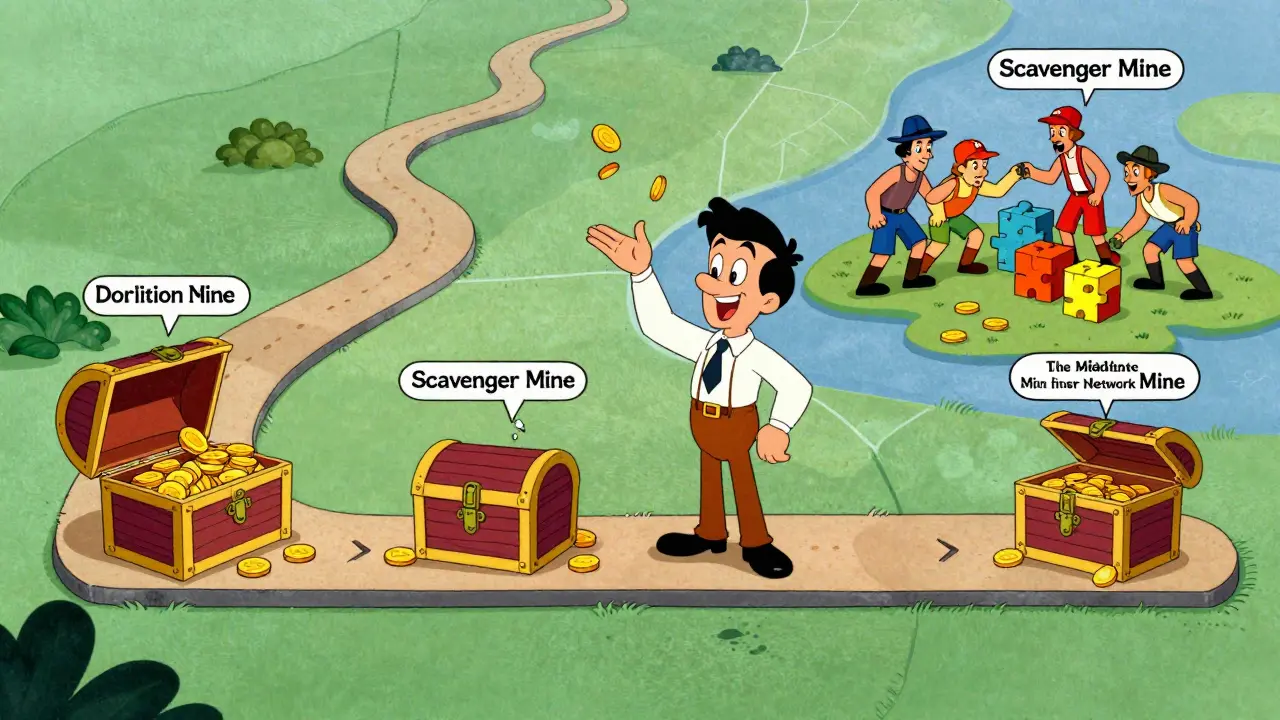
Since the October 4, 2025 deadline has passed, all unclaimed NIGHT tokens have moved to Phase 2: the Scavenger Mine. In this phase, participants earn a share of the leftover allocation by solving public-good computational puzzles. This serves two purposes: it distributes the remaining tokens to active community members and it helps seed the core network infrastructure with useful computation.
If tokens remain after the Scavenger Mine, they move to Phase 3: Lost-and-Found. This is a final recovery opportunity post-mainnet launch for anyone who missed the earlier phases. This cascading structure ensures no central entity hoards the supply; instead, it rewards ongoing engagement.
Why Midnight Matters for Privacy
The Glacier Drop was more than just free money; it was a test of the Midnight philosophy. Traditional blockchains like Bitcoin are fully transparent, which is great for security but bad for privacy. Fully anonymous coins like Monero offer privacy but struggle with regulatory compliance. Midnight tries to hit the middle ground.
By using advanced cryptography, Midnight allows users to hide transaction details from the public view while still being able to reveal them to regulators or auditors when necessary. This "rational privacy" approach could make blockchain viable for enterprises and governments that need data protection but also need to follow laws. The dual-token model supports this: NIGHT is the utility token for governance and participation, while DUST is used for transaction fees. This separation helps keep the economic model stable and focused on network health.
Lessons for Future Airdrops
The Midnight Glacier Drop offers clear lessons for crypto holders looking out for the next big opportunity:
- Self-Custody is Key: If your coins are on an exchange, you likely won't qualify for most serious airdrops. Move funds to a personal wallet early.
- Watch the Dates: Snapshots happen at undisclosed times. Don't try to game the system last minute; just hold steady.
- Understand the Friction: Complex claiming processes require multiple wallets and signatures. Start setting up compatible wallets before the drop goes live.
- Read the Vesting Terms: Free tokens aren't always liquid. Check the lock-up periods before assuming you can sell immediately.
The Midnight Network represents a significant step forward for the Cardano ecosystem and the broader crypto industry. By prioritizing privacy, compliance, and long-term engagement, it sets a new standard for how projects can launch and grow. While the initial airdrop window is closed, the network continues to evolve, offering opportunities for those willing to participate in its development through mining and governance.
Can I still claim the Midnight NIGHT airdrop in 2026?
No, the primary claiming window for the Glacier Drop closed on October 4, 2025. However, unclaimed tokens have moved to the "Scavenger Mine" phase, where they can be earned through computational puzzles. There is also a future "Lost-and-Found" phase for latecomers.
Which blockchains were eligible for the Midnight airdrop?
The airdrop targeted holders on eight chains: Bitcoin (BTC), Ethereum (ETH), Ripple (XRP), Solana (SOL), Avalanche (AVAX), BNB Chain (BNB), Brave (BAT), and Cardano (ADA). You needed to hold at least $100 worth of the native asset on any of these chains at the time of the June 11, 2025 snapshot.
Why did I need a Cardano wallet to claim NIGHT tokens?
Midnight is a sidechain built on the Cardano ecosystem. Therefore, NIGHT tokens exist on the Cardano network. Even if you qualified via Bitcoin or Ethereum holdings, you had to provide a valid Cardano wallet address to receive the tokens. Wallets like Eternl, Lace, or Yoroi were recommended for this purpose.
How does the NIGHT token vesting schedule work?
NIGHT tokens unlock in four equal phases of 25% over a 360-day period starting from the Midnight mainnet launch. Each quarter unlocks at a randomized time within its 90-day window to prevent coordinated selling. This encourages long-term participation in the network's governance and development.
Is the Midnight Network compliant with regulations?
Yes, Midnight emphasizes "rational privacy." It excludes addresses on the OFAC sanctions list and uses cryptographic tools that allow for selective disclosure. This design aims to balance user privacy with regulatory requirements, making it suitable for enterprise use cases where compliance is mandatory.
