
Imagine you have a list of 1 million bank transactions. You want to prove one of them hasn’t been changed-without sending all million records over the network. That’s where Merkle tree security properties come in. It’s not magic. It’s math. And it’s why Bitcoin and Ethereum can verify billions of transactions without storing every single one in full on every device.
What a Merkle Tree Actually Does
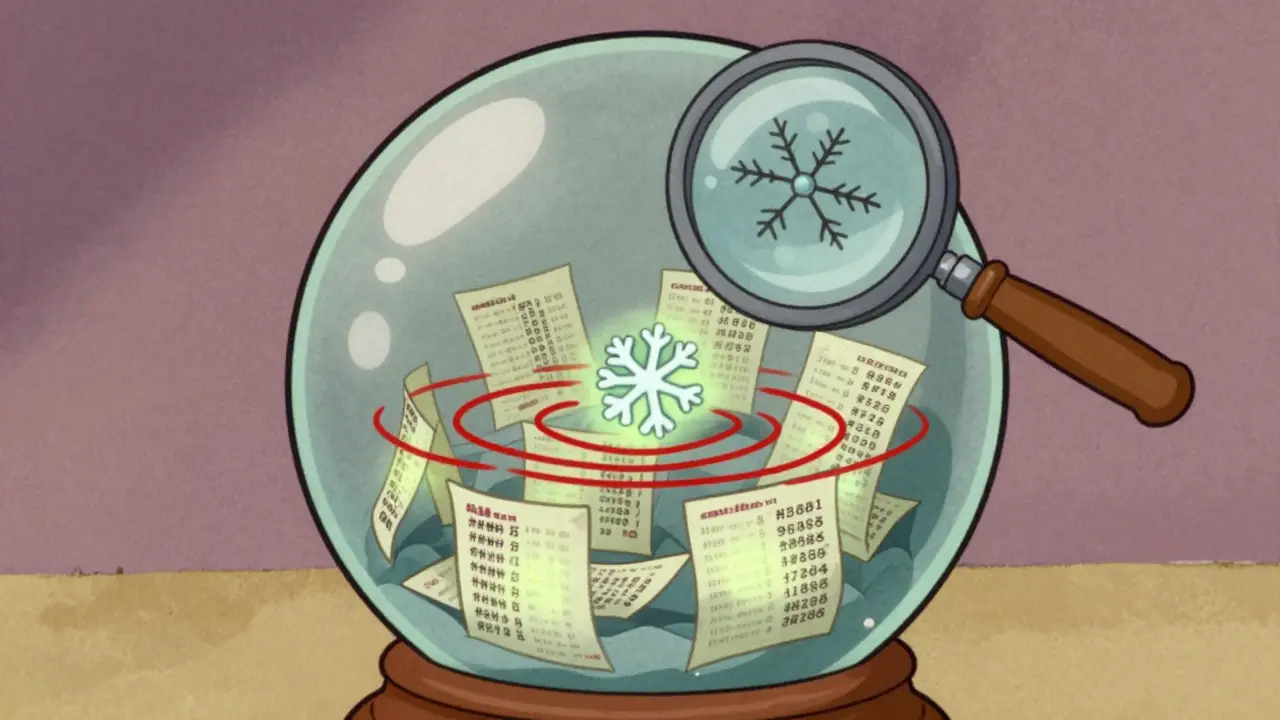
A Merkle tree is a way to organize data so that even a tiny change anywhere in the dataset instantly shows up at the top. Every piece of data-like a transaction-gets hashed into a unique 64-character string. These hashes are paired up, combined, and hashed again. This keeps happening until you end up with one final hash: the Merkle root. That root is the fingerprint of the entire dataset. If one transaction changes-even a single digit-the whole root changes. It’s like shaking a snow globe. One flake moves, and the whole picture looks different. This isn’t just efficient. It’s secure by design. Cryptographic hash functions like SHA-256 make it practically impossible to find two different inputs that produce the same output. That’s called collision resistance. And without it, Merkle trees wouldn’t work.Why Merkle Trees Are Essential for Blockchain
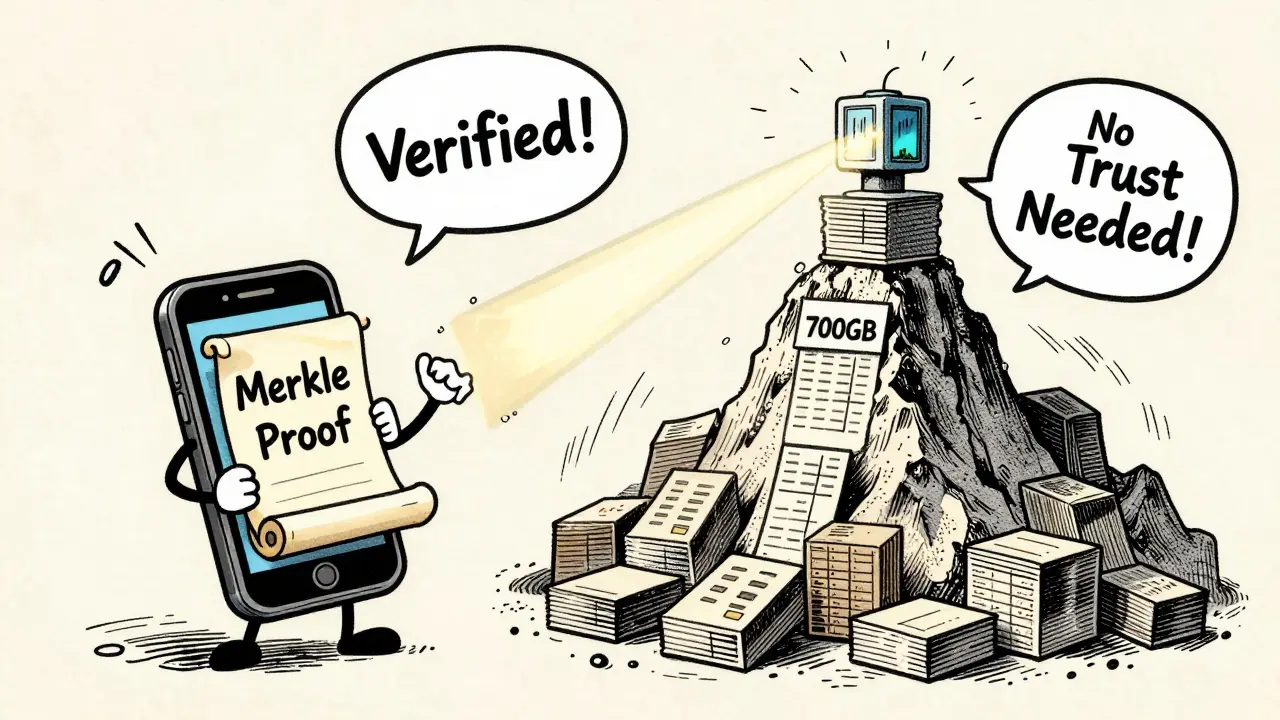
Without Merkle trees, every Bitcoin node would need to download and store every transaction ever made. That’s over 700 gigabytes of data-and growing. Your phone couldn’t handle it. Even a desktop would struggle. Merkle trees solve this by letting nodes verify transactions with just a small proof. You don’t need the whole ledger. You only need the hashes along the path from your transaction up to the root. This is called a Merkle proof. It’s typically 200-400 bytes, no matter how big the dataset is. This is why lightweight wallets like Electrum or Phantom can run on your phone. They don’t store the blockchain. They just check the Merkle root against the full node’s version. If the root matches, your transaction is valid. No need to trust the wallet provider. The math proves it.Four Core Security Properties
Merkle trees aren’t just about saving space. They deliver four critical security benefits that make them indispensable:- Efficient integrity checks - You can verify data integrity without downloading everything. Just compare the root hash.
- Minimal bandwidth use - A Merkle proof for one transaction is tiny, even in a massive blockchain.
- Tamper-evident structure - Any change to any data, anywhere, breaks the root. Instant detection.
- Membership proofs - You can prove a transaction exists without revealing any others. This keeps private data private.
Membership Proofs: Proving Something Exists Without Revealing It
Let’s say you’re a user on a decentralized finance platform. You want to prove you own a certain token. But you don’t want the whole list of token holders exposed. That’s a privacy risk. With a Merkle tree, the platform gives you a proof showing your token’s hash is part of the tree. You don’t get to see anyone else’s data. The system only confirms your item is in the set. This is called a zero-knowledge membership proof. This isn’t just for crypto. Banks use similar methods to verify customer eligibility for loans without sharing full customer lists. Governments use it to confirm citizenship status without exposing national databases. The key is that the proof is cryptographically tied to the root. If someone tries to fake your membership, the root won’t match. The system rejects it. No exceptions.How Solana Uses Merkle Trees to Cut Costs
Solana took Merkle trees further with something called state compression. Instead of storing every NFT or account update on-chain, they store only the Merkle root. The actual data lives off-chain, but the root proves it hasn’t been tampered with. Before state compression, minting one billion NFTs on Solana cost about 12 million SOL in transaction fees. After implementing Merkle tree-based compression, that dropped to 507 SOL. That’s a 99.99% reduction. How? Because instead of writing a million individual transactions, they wrote one root update. The rest is verified later with tiny proofs. This is why Solana can handle tens of thousands of transactions per second. Merkle trees made it possible.Zero-Knowledge Proofs and Merkle Trees
Merkle trees are the backbone of many zero-knowledge (ZK) systems. ZK proofs let you prove you know something without revealing what it is. Think of it like proving you’re over 21 without showing your ID. In ZK blockchains like zkSync or Aztec, Merkle trees store user balances. When you send funds, you prove you have the balance using a Merkle proof-without revealing your address or how much you had before. The network checks the proof against the root. If it fits, the transaction is valid. This combination makes private transactions possible on public blockchains. It’s not just about anonymity. It’s about control. You decide what to reveal-and what to keep hidden.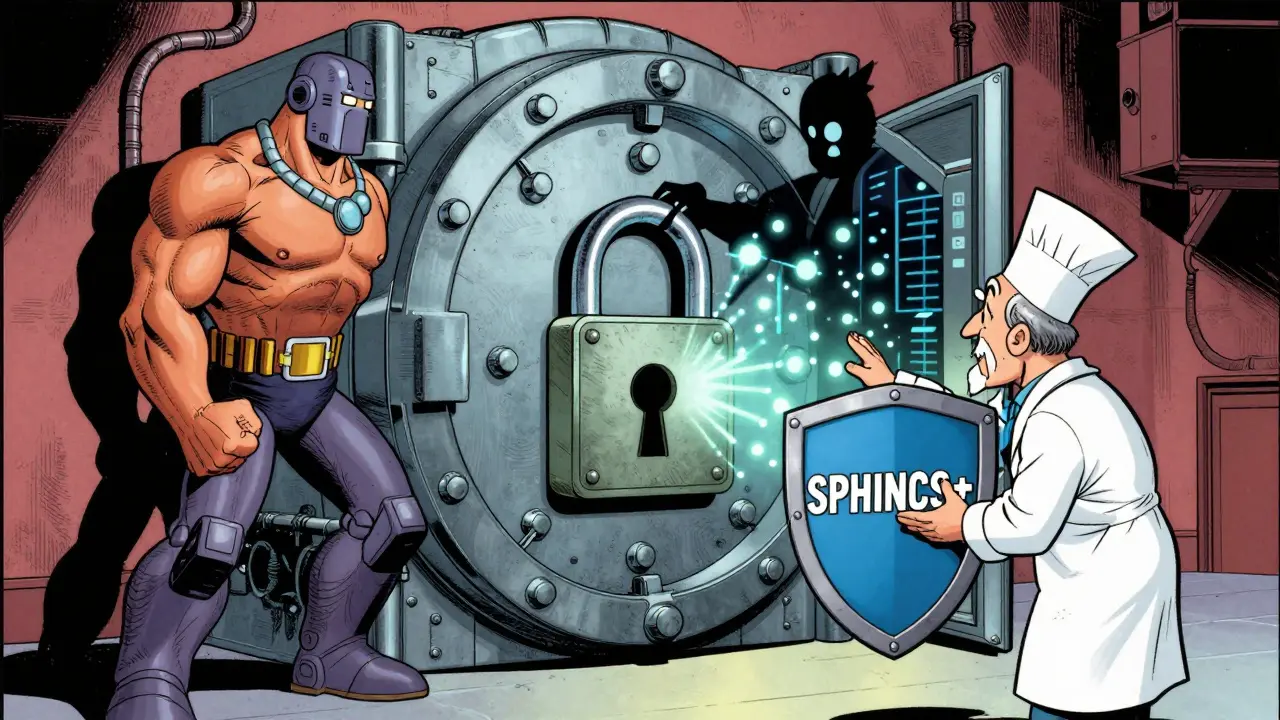
What Can Go Wrong?
Merkle trees are strong-but not invincible. Their security depends entirely on the hash function. If SHA-256 were broken, Merkle trees would be too. That’s why researchers are already working on quantum-resistant hash functions. Quantum computers could theoretically crack current hash functions using Grover’s algorithm. While that’s still years away, the crypto world is preparing. New hash functions like SHA-3 and SPHINCS+ are being tested for Merkle tree use in post-quantum systems. There’s also a privacy leak risk. Even if data isn’t revealed, the tree’s structure can hint at patterns. For example, if a Merkle tree has 1,024 leaves, you know there are 1,024 transactions. If one day it jumps to 1,025, you know something changed. That’s not a breach-but it’s metadata. Some advanced systems now add random padding or blinding factors to hide these patterns.Why This Matters Beyond Crypto
Merkle trees aren’t just for Bitcoin. They’re used in:- Git version control - to verify file changes without syncing entire repositories
- Cloud storage - Dropbox and Google Drive use similar structures to detect file tampering
- Distributed databases - companies verify data consistency across servers without transferring everything
- IoT networks - sensors send tiny proofs to confirm their data hasn’t been spoofed
The Bottom Line
Merkle trees are one of the quiet heroes of blockchain. They don’t get headlines. But without them, crypto wouldn’t scale. They turn impossible problems-verifying massive datasets with limited resources-into simple math checks. They give you proof, not promises. And in a world full of scams and fake data, that’s worth more than gold.What is the Merkle root in a blockchain?
The Merkle root is the single hash at the top of a Merkle tree that represents the entire set of transactions in a block. It’s created by recursively hashing pairs of transaction hashes until only one remains. If even one transaction changes, the Merkle root changes completely. Nodes use this root to verify that a block’s data hasn’t been altered without downloading every transaction.
How does a Merkle proof work?
A Merkle proof is a short list of sibling hashes that connects a specific transaction to the Merkle root. To verify a transaction is part of a block, you take its hash, combine it with the sibling hashes in order, and recompute upward. If the result matches the stored Merkle root, the transaction is confirmed. You don’t need the full block-just a few hundred bytes of data.
Can Merkle trees be hacked?
Merkle trees themselves can’t be hacked-their structure is mathematically sound. But their security depends on the underlying hash function. If SHA-256 were broken (e.g., by quantum computers), attackers could create fake transactions with matching hashes. That’s why the crypto community is already testing quantum-resistant hash functions for future use in Merkle trees.
Why are Merkle trees better than storing full data?
Storing full data requires massive storage and bandwidth. Merkle trees reduce both. Instead of downloading a 1 GB blockchain to verify one transaction, you download a 300-byte proof. This makes lightweight wallets, mobile apps, and IoT devices possible. It also lets nodes sync faster and use less power.
Do all blockchains use Merkle trees?
Most major blockchains use them-including Bitcoin, Ethereum, Litecoin, and Solana. Some newer chains use variations like Merkle Patricia Tries (Ethereum’s account state) or optimized versions for state compression. A few experimental chains avoid them for simplicity, but they sacrifice scalability. Merkle trees remain the industry standard for efficient, secure data verification.
Can Merkle trees hide data completely?
Merkle trees don’t hide the data itself-they just prove it’s there. But when combined with zero-knowledge proofs, they can verify data without revealing it. For example, you can prove you own a token without showing your balance or address. This layered approach keeps data private while maintaining verifiable integrity.

Bradley Cassidy
December 15, 2025 AT 15:38Shruti Sinha
December 16, 2025 AT 08:11Kayla Murphy
December 17, 2025 AT 00:17Craig Nikonov
December 18, 2025 AT 05:43Terrance Alan
December 19, 2025 AT 17:37SeTSUnA Kevin
December 21, 2025 AT 10:27Sue Bumgarner
December 22, 2025 AT 01:06Florence Maail
December 22, 2025 AT 11:42Elvis Lam
December 22, 2025 AT 17:09Jonny Cena
December 23, 2025 AT 08:57George Cheetham
December 24, 2025 AT 06:55Timothy Slazyk
December 26, 2025 AT 00:04Madhavi Shyam
December 26, 2025 AT 07:55Amy Copeland
December 26, 2025 AT 17:36Dionne Wilkinson
December 27, 2025 AT 23:25Tom Joyner
December 28, 2025 AT 13:56Samantha West
December 30, 2025 AT 09:53Heather Turnbow
December 31, 2025 AT 08:00Patricia Amarante
December 31, 2025 AT 22:07Rebecca Kotnik
January 1, 2026 AT 20:12Chevy Guy
January 2, 2026 AT 20:21Greg Knapp
January 3, 2026 AT 05:56