

Imagine sending money to a friend across the world instantly, with fees so low they are practically zero. Now imagine doing it without clogging up the main blockchain network. This is not science fiction; it is the reality of Lightning Network, a prime example of how state channels work in practice. While the term "state channel" sounds like dense computer science jargon, the concept is actually quite simple: it’s a way for two parties to update their financial relationship privately and frequently, only touching the public ledger when they are done. The Lightning Network takes this general concept and specializes it exclusively for payments on the Bitcoin blockchain.
If you have ever struggled with slow Bitcoin transaction times or high gas fees during network congestion, you know why this technology matters. By moving transactions off-chain, the Lightning Network solves one of Bitcoin’s biggest bottlenecks: scalability. But how exactly does it function as a state channel? And what are the trade-offs compared to other blockchain solutions? Let’s break down the mechanics, the real-world performance, and what this means for your Bitcoin.
What Is a State Channel?
To understand the Lightning Network, you first need to understand the engine under the hood: the state channel. A state channel is a mechanism that allows two or more participants to exchange multiple transactions between each other with only two on-chain transactions required. Think of it like a tab at a bar. You and your friends order drinks (transactions) all night long. The bartender updates the tab (the state) every time you order. You don’t pay cash for every single drink. Instead, you settle the final bill (the closing transaction) once, leaving the bar. The individual orders never hit the bank directly; only the final total does.
In blockchain terms, the "tab" is secured by cryptography. Both parties sign each update to the state. Because these signatures are valid, either party can force the current state onto the main blockchain if things go wrong. This creates a trustless environment where you don’t need to trust your counterparty, just the math. General state channels, like those found on Ethereum, can handle any kind of state change-game moves, data updates, or complex smart contract interactions. However, the Lightning Network narrows this focus entirely to payment channels. This specialization is its superpower. By focusing only on moving value, it achieves higher efficiency and speed than general-purpose channels.
How Lightning Network Implements State Channels
The Lightning Network, created by Joseph Poon and Thaddeus Dryja in 2016, implements state channels using a specific set of cryptographic tools. The core mechanism relies on Hash Time-Locked Contracts (HTLCs). An HTLC is a smart contract feature that locks funds in a channel until a specific condition is met-usually the revelation of a secret hash-or a timeout occurs. This ensures that if a payment fails midway through a multi-hop route, the funds are returned to the sender automatically. No one gets stuck holding the bag.
Here is how the process works step-by-step:
- Opening the Channel: You and a peer lock a certain amount of Bitcoin into a multi-signature address on the main Bitcoin blockchain. This is the only on-chain transaction needed to start.
- Updating the State: Every time you send or receive payment, you both sign a new transaction that reflects the updated balance. These transactions are kept offline. Crucially, each new signed transaction invalidates the previous ones. This prevents double-spending within the channel.
- Closing the Channel: When you are done transacting, either party can broadcast the latest signed transaction to the Bitcoin network. The funds are released according to the final balance.
This structure allows for near-instant finality. Unlike traditional Bitcoin transactions that require block confirmations (which can take 10 minutes to an hour), Lightning payments are confirmed the moment the receiver validates the signature. According to data from November 2025, the average fee for a Lightning payment is roughly 0.5 satoshis (about $0.0002), compared to on-chain fees that averaged $1.87 during periods of high congestion. That is a cost reduction of over 99%.
Key Metrics and Network Health
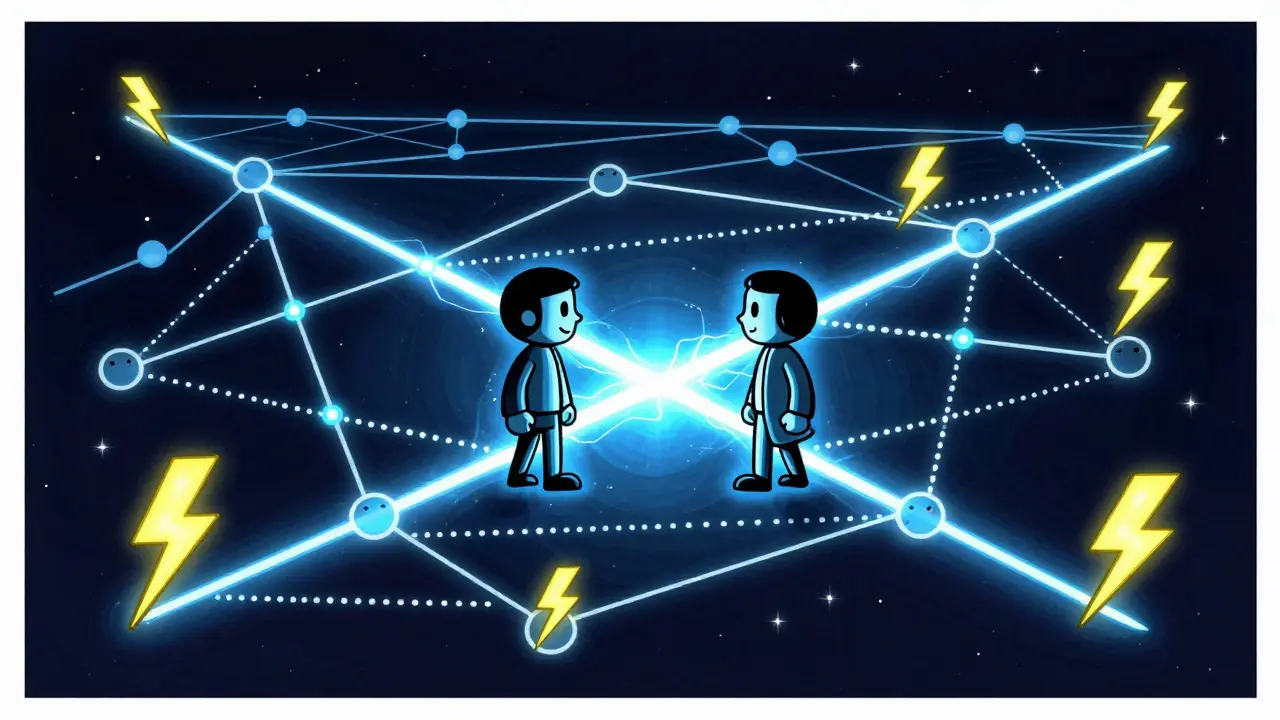
Theoretical models are great, but does it work in the wild? The numbers suggest yes, with some growing pains. As of late 2025, the Lightning Network has seen significant growth. There were approximately 18,742 public nodes and 89,352 active channels, representing a 12.7% year-over-year increase. The network processes an estimated 4.7 million off-chain payments daily. To put that in perspective, that is millions of micro-transactions happening every day without adding a single byte of weight to the main Bitcoin blockchain.
| Metric | On-Chain Bitcoin | Lightning Network |
|---|---|---|
| Average Fee | $1.87 (Oct 2025 avg) | $0.0002 (0.5 sats) |
| Confirmation Time | 10 mins - 1 hour | Instant (< 1 second) |
| Throughput Potential | ~7 transactions per second | 1,000+ TPS per channel |
| Privacy | Public ledger | Private (off-chain) |
| Complexity | Low (send/receive) | Medium (liquidity management) |
However, the network is not without its challenges. One major issue is liquidity fragmentation. For a payment to succeed, there must be a path of open channels with sufficient capacity from sender to receiver. If the path is broken, the payment fails. In October 2025, routing failures accounted for 32.7% of failed payments. This highlights a critical difference between Lightning and general state channels: while Ethereum’s Raiden Network aims for broader interoperability, Lightning’s success depends heavily on the health and connectivity of its node graph.
Liquidity Management: The Real Challenge
If you decide to run a Lightning node, you quickly learn that opening a channel is the easy part. Keeping it useful is harder. Each channel has three critical metrics: total capacity, inbound capacity, and outbound capacity. Your outbound capacity is limited by your peer’s inbound capacity, and vice versa. As you send money out, your outbound capacity shrinks. If you run out of outbound capacity, you cannot send more payments unless you rebalance.
Rebalancing involves moving funds back into your channel, often by sending a payment to yourself through the network. This requires technical skill and costs small fees. Many new users struggle here. A survey from November 2025 showed that 63.4% of users reported liquidity imbalances as their primary frustration. Furthermore, 18.7% of new users had to force-close their channels due to going offline, resulting in penalty fees. For example, one user reported paying a 1,200-satoshi penalty after being offline for 14 days.
Experienced operators mitigate this by maintaining channels older than 90 days, which routing algorithms prefer by 37.2%. They also keep their peers online above 95% of the time and use atomic multipath payments to split large transactions across multiple routes, reducing the risk of failure. Tools like ThunderHub help simplify this management, used by 67.2% of node operators. For those who find self-custody too complex, custodial services like Strike offer a smoother experience, abstracting away the channel management entirely. Strike alone serves 17 million users as of late 2025, proving that usability is key to mass adoption.

Lightning vs. Other State Channel Implementations
Is Lightning the best implementation of state channel technology? It depends on what you want to achieve. If you want to build a decentralized game or a complex DeFi application, Lightning is not the right tool. It is specialized for payments. Ethereum’s state channels, such as the Raiden Network, support general state updates. This flexibility comes at a cost. Ethereum state channels typically have longer dispute periods (averaging 48 hours) compared to Lightning’s 24-hour window. Additionally, Ethereum’s throughput is lower, averaging 200 transactions per second per channel, versus Lightning’s theoretical 1,000 TPS.
Dr. Christian Decker, a core developer at Blockstream, argues that Lightning solves the Byzantine Generals Problem through economic incentives rather than heavy consensus mechanisms. This makes it incredibly efficient for its specific niche. However, critics like Dr. Emin Gün Sirer point out centralization risks. Data shows that the top 100 nodes control 47.3% of total network capacity. This concentration can lead to reliability issues for smaller nodes, as routing algorithms favor well-connected hubs. Despite this, the Ledger Academy awarded Lightning 4.2/5 stars in late 2025, praising its instant finality and minimal fees while noting the complexity of liquidity management.
Future Developments and Innovations
The technology is evolving rapidly. One major advancement is channel splicing, which allows users to add or remove capacity from an existing channel without closing it. This reduces the on-chain footprint by 63% compared to traditional methods. Another upcoming feature, scheduled for Q1 2026, is "phantom channels," which improve routing efficiency by 27% by allowing payments to appear as if they traveled through a channel that doesn’t technically exist, enhancing privacy and bypassing capacity constraints.
Regulatory frameworks are also catching up. The EU’s MiCA framework recognizes Lightning channels as ancillary payment systems, subject to lighter regulation than exchanges. In the U.S., the FinCEN issued guidance in September 2025 requiring service providers with over $1,000 in daily volume to implement KYC procedures. This suggests that while the technology remains decentralized, the entry points for mainstream users will likely become more regulated.
Looking ahead, the consensus among experts is that Lightning’s long-term viability hinges on solving liquidity fragmentation. With 41.3% of network capacity currently idle due to imbalanced channels, innovations in routing protocols and automated liquidity management are critical. If these hurdles are cleared, projections suggest Lightning could handle 12-15% of all Bitcoin transactions by 2027.
Is the Lightning Network safe?
Yes, the Lightning Network is considered secure because it inherits the security of the underlying Bitcoin blockchain. Funds are locked in multi-signature addresses, and cryptographic proofs ensure that neither party can cheat. However, user error, such as losing private keys or failing to monitor channel disputes, can lead to fund loss. Always use reputable software and keep backups.
Do I need to run a full node to use Lightning?
Not necessarily. While running your own node offers maximum privacy and control, many users rely on custodial wallets or third-party services like Strike or Cash App. These services manage the node infrastructure for you, making it easier to send and receive payments without technical setup. However, self-custody is recommended for larger amounts.
What happens if my Lightning channel goes offline?
If your node goes offline for an extended period, your peer may force-close the channel. This triggers a penalty mechanism where you might lose a portion of your funds (typically around 1,000-1,200 satoshis) to discourage negligence. To avoid this, ensure your node has stable internet and high uptime (above 95%).
Can I use Lightning for anything other than Bitcoin?
Currently, the Lightning Network is built specifically for Bitcoin. While similar state channel technologies exist for Ethereum and other blockchains, they are separate networks. However, future developments may enable cross-chain interoperability, allowing assets from other chains to move over Lightning-like structures.
Why do some Lightning payments fail?
Payments fail primarily due to lack of liquidity in the routing path. If the intermediate nodes do not have enough inbound or outbound capacity to forward the payment, the transaction fails. Using atomic multipath payments (AMP) can help by splitting the payment across multiple routes, increasing the chance of success.
