
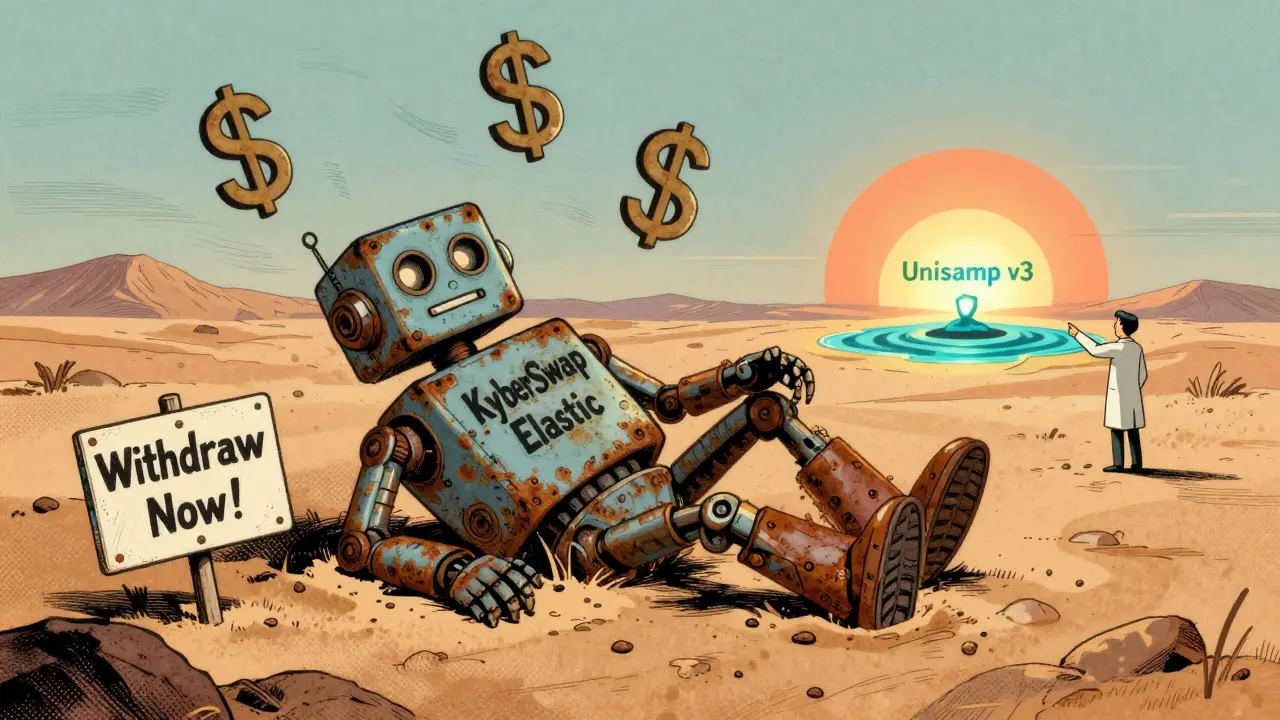
When you hear "KyberSwap Elastic," you might think of a cutting-edge decentralized exchange with smart features that boost your returns. But right now, the reality is very different. As of January 2026, KyberSwap Elastic on Ethereum is inactive. No trades. No volume. And the platform has told users to pull their funds out immediately due to a serious security issue.
This isn’t a slow-down. It’s a full stop.
KyberSwap Elastic launched in 2022 as the advanced version of KyberSwap’s original AMM model. It was built for experienced traders who wanted more control - specifically, the ability to lock their liquidity within custom price ranges instead of spreading it out across the whole market. This is called "concentrated liquidity," and it’s the same idea Uniswap v3 used. But KyberSwap Elastic added something Uniswap didn’t: automatic fee compounding. Every time you earned trading fees as a liquidity provider, the protocol reinvested them for you. No manual claiming. No missed opportunities. Just passive growth.
That sounded great on paper. And for a while, it worked. Traders who understood price ranges and volatility could earn more per dollar locked in than they could on older AMMs. The protocol also had dynamic fees that adjusted based on market conditions - a smart touch for reducing impermanent loss during wild swings.
But here’s the catch: you had to be technical. You needed to know how to pick the right price bounds. Too narrow, and you’d get pulled out of position fast. Too wide, and you lost the efficiency advantage. This wasn’t for beginners. It was for people who tracked charts, understood liquidity zones, and checked their positions daily.
Then came the incident.
In late 2025, a vulnerability was exploited in the Elastic protocol’s fee reinvestment smart contract. Attackers drained small amounts from multiple liquidity pools over several days, triggering alarms. The KyberSwap team didn’t wait. They issued an emergency alert: "Withdraw your funds immediately. Do not deposit more."
Since then, nothing has moved on KyberSwap Elastic (Ethereum). Trading volume is $0.00. The only listed pair is C98/USDT - and even that hasn’t traded in over six days. The platform’s own monitoring tools flag it as "Anomaly - Trading price or volume is an outlier against the average." The status? "Inactive - No trades in the last 3 hours."
Compare that to Uniswap v3, which still handles over $1 billion in daily volume across Ethereum and other chains. Or to SushiSwap’s concentrated liquidity pools, which are active and growing. Even newer entrants like Curve V2 are seeing steady usage. KyberSwap Elastic? Dead.
What’s worse? The broader KyberSwap ecosystem - the aggregator part - is still alive. It pulls liquidity from 8 blockchains: Ethereum, Polygon, Arbitrum, Optimism, BSC, Avalanche, Fantom, and more. It processed $3.7 billion in monthly volume as of March 2025. Its website still gets over 200,000 visits a month. But that’s the aggregator. Not Elastic. Not the concentrated liquidity engine. That part is frozen.
And here’s the real problem: users can’t trust it anymore. Even if the team fixes the bug, people will remember the warning. They’ll remember the $0 volume. They’ll remember that the platform didn’t just pause - it vanished. And in crypto, trust doesn’t come back easily.
Some might ask: "Can’t they just relaunch?"
Possibly. But relaunching a concentrated liquidity protocol isn’t like restarting a website. It requires rebuilding confidence. It means proving the code is bulletproof. It means convincing users who lost money - or nearly lost money - to come back. And that’s a mountain no team can climb overnight.
Even if they fix it, the competition is moving fast. Uniswap v3 is adding new fee tiers. Balancer is rolling out dynamic weights. Curve is optimizing for stablecoins with better capital efficiency. KyberSwap Elastic doesn’t just need to be fixed - it needs to be better than all of them. And right now, it’s not even on the map.
So what should you do?
If you have funds in KyberSwap Elastic (Ethereum): Withdraw them. Now. Don’t wait for a "fix." Don’t hope for a recovery. The team told you to leave. Listen.
If you’re looking for a concentrated liquidity DEX on Ethereum: Skip KyberSwap Elastic. Try Uniswap v3 instead. It’s battle-tested. It has deep liquidity. It’s still growing. And it doesn’t have a security alert flashing on its homepage.
If you want automated compounding: Look at other platforms that offer similar features without the risk. Some yield optimizers like Yearn or Beefy Finance let you stake LP tokens from Uniswap v3 and auto-compound returns - safely. You get the same benefit without tying your funds to a broken protocol.
KyberSwap Elastic was built for smart users. But smart users don’t stay where the lights are out. They move where the action is.
The broader KyberSwap platform still has value. Its aggregator is one of the best for finding the cheapest swap rates across chains. It’s non-custodial. No KYC. Fast. Cheap. And it works. But Elastic? That’s a dead end.
As of January 2026, KyberSwap Elastic (Ethereum) is not a crypto exchange you use. It’s a case study in what happens when innovation outpaces security.
Why KyberSwap Elastic Was Different
KyberSwap Elastic wasn’t just another AMM. It was designed to solve a real pain point: capital inefficiency.
Traditional AMMs like Uniswap v2 or SushiSwap spread your liquidity evenly from $0 to infinity. That means most of your funds sit idle, earning nothing. If ETH trades between $2,000 and $3,000, your $10,000 might only be actively used for $2,200-$2,800. The rest? Locked up, useless.
KyberSwap Elastic changed that. You picked your range - say, $2,400 to $2,800 for ETH/USDT. All your capital worked inside that zone. That meant higher fees per dollar invested. If the price stayed inside your range, your returns could be 5x or more than a traditional pool.
And then came the kicker: auto-compounding. Every time someone traded inside your range, you earned fees. Instead of having to claim them manually and re-stake, KyberSwap Elastic did it for you. Fees turned into more liquidity. More liquidity meant more fees. It was compounding, built into the protocol.
That’s why it attracted professional liquidity providers. Not retail traders. Not people just dipping into DeFi. These were users who ran spreadsheets, tracked volatility, and adjusted ranges weekly. They knew the math. They understood slippage. They weren’t chasing yields blindly.
But that also made it fragile. One mistake in range selection - or a sudden price spike - could pull you out of position. And if the smart contract that handled compounding had a flaw? That flaw could be exploited by anyone with the right tools.
How It Compared to Uniswap v3
Uniswap v3 and KyberSwap Elastic were built on the same core idea: concentrated liquidity. But they diverged in execution.
Uniswap v3 gives you full control. You set the range. You claim fees. You re-stake manually. It’s powerful - but it’s also a full-time job. You need to monitor your positions. You need to rebalance. You need to pay gas every time you adjust.
KyberSwap Elastic tried to remove the friction. It automated the claiming and reinvestment. That’s a huge plus for passive users. No need to log in every week. No need to remember to claim. It just worked.
But here’s what Uniswap v3 had that KyberSwap Elastic didn’t: trust. Uniswap v3 has been live since 2021. It’s been audited. It’s been attacked. It’s been stress-tested. It’s handled billions in value. KyberSwap Elastic? It lived for under three years before a critical flaw exposed it.
Uniswap v3 also has deeper liquidity. More users. More tokens. More trading pairs. On KyberSwap Elastic, you had one pair: C98/USDT. That’s not a DEX. That’s a ghost town.
And while Uniswap v3 lets you choose from multiple fee tiers (0.01%, 0.05%, 0.3%, 1%), KyberSwap Elastic’s dynamic fees were less transparent. You didn’t always know what fee you were paying - or why it changed.
Who Should Have Used It - and Who Shouldn’t
KyberSwap Elastic was never meant for everyone.
Good fit:
- Experienced DeFi users who understand price ranges and impermanent loss
- Liquidity providers who want to automate fee compounding
- Traders who monitor markets daily and adjust positions
- Users comfortable with high technical risk for higher potential returns
Bad fit:
- Beginners who don’t know how to pick a price range
- People looking for "set and forget" yields
- Users who can’t afford to lose funds if the contract fails
- Anyone who doesn’t check security alerts
It’s not that the idea was bad. It’s that the execution didn’t survive real-world conditions. And in crypto, survival matters more than innovation.

The Bigger Picture: KyberSwap as a Whole
Don’t confuse KyberSwap Elastic with KyberSwap as a platform.
The KyberSwap aggregator - the part that finds the best rates across 8 chains - is still fully operational. It’s fast. It’s non-custodial. It’s used by thousands daily. If you want to swap ETH for USDC on Arbitrum and get the best price, KyberSwap’s main interface still works great.
But Elastic was a separate product. A high-risk, high-reward module. And now, it’s gone.
The fact that the aggregator is thriving doesn’t mean Elastic will come back. It just means the company still has other revenue streams. That doesn’t help you if your funds are stuck in a broken contract.
And while KyberSwap has added 17 new API integrations and expanded to Ronin, none of that fixes the Ethereum Elastic protocol. It’s like a restaurant having great appetizers but serving spoiled main courses. You won’t come back for dinner.
What Happens Next?
No one knows.
The KyberSwap team hasn’t released a timeline for fixing Elastic. There’s no public audit report. No roadmap. No update since the withdrawal notice.
There are two possible paths:
- Recovery: They fix the bug, re-audit the code, relaunch with a new contract, and convince users to return. This would require massive transparency - and even then, many won’t come back.
- Abandonment: They quietly shut it down. The protocol becomes a footnote. Users move on. The team focuses on the aggregator and other chains.
Right now, path #2 looks far more likely.
And that’s the lesson here: in DeFi, even the smartest ideas can die quickly if security is ignored. Innovation without safety is just risk with a fancy name.
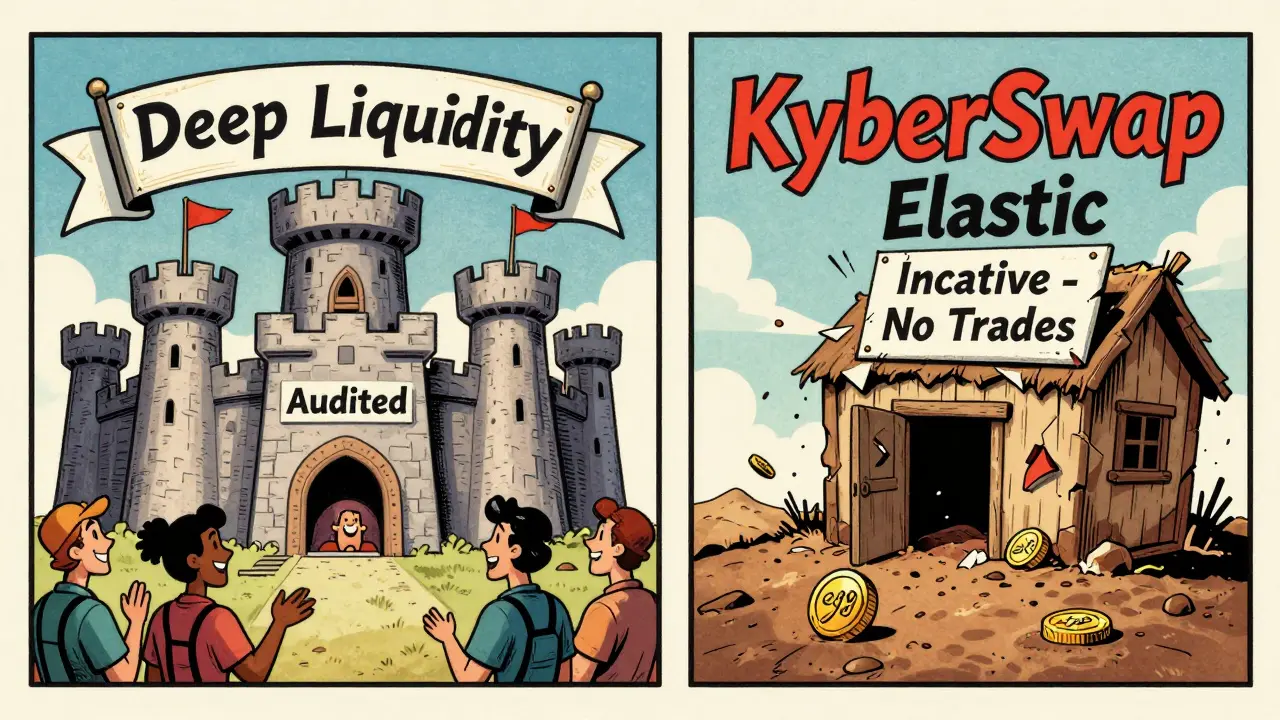
Alternatives to KyberSwap Elastic
If you’re looking for concentrated liquidity with automation, here are safer options:
- Uniswap v3 + Beefy Finance: Stake your v3 LP tokens in Beefy for auto-compounding. Proven track record. Audited. Active.
- Balancer V2: Dynamic weights, customizable pools, and lower slippage. Good for multi-token strategies.
- Curve V2: Optimized for stablecoins. Lower impermanent loss. High volume.
- Yearn Finance: For yield optimization across multiple protocols. Not concentrated liquidity, but solid for passive income.
All of these have been tested under real market conditions. None have asked users to withdraw funds due to a security breach.
Final Verdict
KyberSwap Elastic (Ethereum) is not a functioning exchange. It’s a cautionary tale.
It had a brilliant idea: make concentrated liquidity easier with automation. But it failed on the most basic requirement - security.
Don’t be fooled by the name. Don’t be tempted by past performance. Don’t wait for a comeback.
If you’re still holding funds in KyberSwap Elastic: Withdraw them. Today.
If you’re looking for a decentralized exchange with concentrated liquidity: Go with Uniswap v3. It’s safe. It’s active. It’s proven.
KyberSwap Elastic was a prototype that never made it to market. And now, it’s gone.

Callan Burdett
January 17, 2026 AT 01:42Also, why do devs think they can skip security audits? It's not 2017 anymore.
Anthony Ventresque
January 18, 2026 AT 11:41Uniswap v3 is still king. No question. But if you want automation without the risk? Beefy’s v3 vaults are the real MVP.
Patricia Chakeres
January 19, 2026 AT 17:41Also, why is Uniswap still alive? Because they’re backed by the same VCs that own the Fed. This whole thing is a controlled demolition.
Anna Gringhuis
January 20, 2026 AT 16:05Uniswap v3 works because it’s simple. You set the range. You claim the fees. You do the work. No magic. No auto-compound. No 'trust me bro' smart contracts. Just code you can read. That’s why it survives.
Lauren Bontje
January 21, 2026 AT 19:45Uniswap? Still alive because it’s Swiss. No drama. Just cold, hard, boring code.
Stephanie BASILIEN
January 22, 2026 AT 11:05One must therefore conclude that the pursuit of capital efficiency, while economically rational, must be tempered by epistemic humility. The absence of a formal, publicly accessible audit trail further undermines the legitimacy of its operational claims.
Dustin Secrest
January 23, 2026 AT 21:58DeFi isn’t about the code. It’s about the people behind it. And when those people disappear, the code becomes a tombstone.
Stephen Gaskell
January 24, 2026 AT 03:44Shaun Beckford
January 25, 2026 AT 12:09And now? The whole thing’s a ghost town. C98/USDT? That’s not a trading pair - it’s a memorial.
Alexandra Heller
January 25, 2026 AT 17:10KyberSwap Elastic didn’t die because of a bug. It died because its users didn’t care enough to demand better. And that’s the real tragedy.
myrna stovel
January 26, 2026 AT 01:48Try Uniswap v3 + Beefy. It’s not glamorous, but it’s safe. And honestly? That’s the real win. You don’t need to be a wizard to make money. Just be careful.
Hannah Campbell
January 26, 2026 AT 12:33Bro I’ve seen this movie. It’s called every DeFi project ever. The only difference now is that they’re using bigger words to make it sound smart. 'Concentrated liquidity'? Sounds like a fancy way to say 'I put all my eggs in one basket and forgot to lock the basket'.
Also, why is everyone still talking about this? Let it rot. I’m going to go buy some Bitcoin and sleep like a baby.
Pramod Sharma
January 26, 2026 AT 16:27Liza Tait-Bailey
January 27, 2026 AT 00:46nathan yeung
January 28, 2026 AT 08:14Uniswap v3 isn’t sexy. But it’s real. And that’s enough.
Bharat Kunduri
January 29, 2026 AT 13:57Chris O'Carroll
January 29, 2026 AT 14:39Meanwhile, the real traders are off buying Bitcoin and laughing. KyberSwap? Just another ghost in the graveyard of failed DeFi dreams.
Christina Shrader
January 30, 2026 AT 07:27Don’t be like me. Don’t wait for a comeback. Pull your funds. Find a better home. The market doesn’t wait for anyone.