
Have you ever stared at a chart, watched your position get liquidated by a slippage spike on a centralized exchange, and wondered if there was a better way? You aren't alone. The rise of decentralized finance (DeFi) promised freedom, but for many traders, it delivered high fees and slow speeds. Enter KTX.Finance, a decentralized spot and perpetual derivatives exchange built on the BNB Chain. It promises up to 100x leverage, no counterparty risk, and a single multi-asset pool design that claims to solve the capital efficiency problems plaguing other platforms.
But here is the catch: does the promise match the reality? With a native token (KTC) showing wild volatility and mixed market sentiment, jumping in blind is risky. This review cuts through the marketing hype to look at the mechanics, the tokenomics, and the real-world usability of KTX.Finance as we head into late 2026.
How KTX.Finance Actually Works
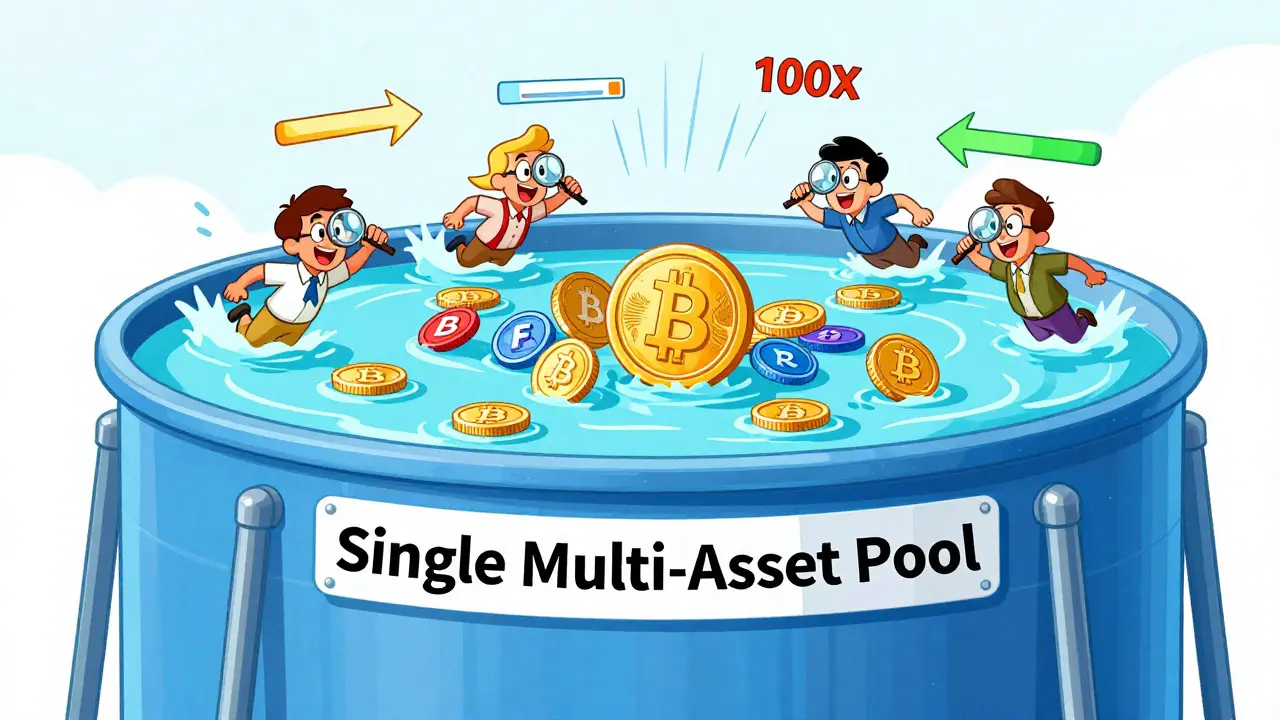
Most decentralized exchanges force you to choose between liquidity pools for specific pairs, which often leads to fragmented capital and wide spreads. KTX.Finance flips this model. Instead of separate pools for every asset, they use a single multi-asset pool architecture. Think of it like a giant reservoir where all liquidity mixes together. When you trade, you are interacting with this shared pool rather than a specific counterparty or an isolated pair.
This design has two major implications:
- For Traders: You can access leverage up to 100x on various assets without worrying about finding a specific liquidity provider for that exact pair. The platform handles the matching internally within the pool structure.
- For Liquidity Providers (LPs): Your capital works harder. Instead of sitting idle in a BTC/USDT pool while ETH trades are happening elsewhere, your funds contribute to the overall health of the ecosystem, earning fees from all trading activity across the platform.
The entire process happens on-chain via the BNB Chain. Why BNB Chain? Because speed and cost matter when you are leveraged 50x or 100x. Ethereum mainnet gas fees could eat your profits before the trade even settles. By leveraging the Binance Smart Chain infrastructure, KTX.Finance offers near-instant settlement at a fraction of the cost.
The KTC Token: Utility vs. Speculation
Every DeFi protocol needs a governance or utility token, and KTX.Finance uses KTC (KTX.Finance Token). Understanding KTC is crucial because its performance often dictates the platform's stability and user incentives.
Here are the hard numbers regarding the tokenomics:
- Total Supply: 100 million KTC.
- Circulating Supply: Approximately 1.25 million KTC (as per early data, though this likely expands over time).
- Price Volatility: Extremely high. Data sources show discrepancies ranging from $0.016 down to $0.000135, indicating thin liquidity or significant recent dilution events.
If you are looking to buy KTC, you will typically find it on centralized exchanges like KuCoin. The process involves standard KYC verification, linking a payment method, and swapping USDT or fiat for KTC. However, be wary of the spread. With such a low circulating supply relative to the total, large sell-offs can crash the price instantly. Technical indicators like the 14-Day RSI have frequently shown oversold conditions (below 30), suggesting that while momentum might be bullish in short bursts, the long-term trend has been bearish.
| Metric | Value / Status | Implication for Users |
|---|---|---|
| Total Supply | 100 Million | Inflationary pressure if unlocked gradually. |
| Volatility Rate | ~49.44% | High risk for holders; potential arbitrage for pros. |
| RSI (14-Day) | Often < 30 | Frequently oversold; caution advised for buying dips. |
| Network | BNB Chain | Low transaction costs for transfers and staking. |
Trading Experience: Leverage Without the Middleman
Let’s talk about the core product: trading. KTX.Finance supports spot trading, margin trading, and perpetual futures. The standout feature is the leverage capability. You can open positions with up to 100x leverage. For context, most regulated centralized exchanges cap retail leverage at 20x or 50x due to regulatory pressures. In DeFi, limits are often dictated by smart contract risk parameters.
Does it feel smooth? Generally, yes. The interface is designed to mimic familiar centralized exchange layouts, reducing the learning curve. You connect your wallet (MetaMask, Trust Wallet, etc.), deposit collateral, and start trading. There is no personal verification required to trade, preserving anonymity-a key selling point for privacy-focused users.
However, "no counterparty risk" doesn’t mean "no risk." You still face:
- Smart Contract Risk: If the code has a bug, funds can be drained. While audits are common, they are not guarantees.
- Liquidation Risk: At 100x leverage, a 1% move against you wipes out your position. The automated liquidation engine on KTX.Finance is aggressive to protect the pool’s solvency.
- Slippage: While the single-pool model aims to reduce this, low-liquidity pairs can still suffer during high-volatility events.
Who Backs KTX.Finance?
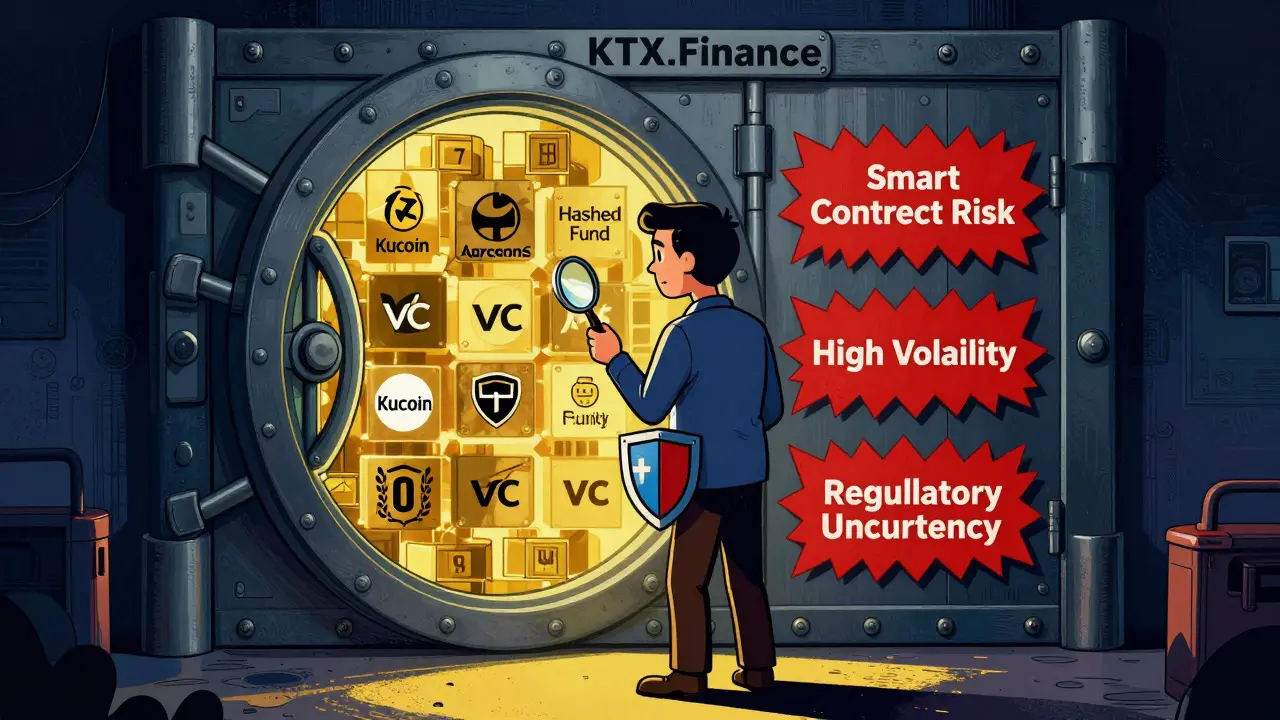
In the crypto world, backing matters. It signals due diligence and financial runway. KTX.Finance isn’t bootstrapped by a lone developer in a basement. They have secured investment from notable venture capital firms, which adds a layer of credibility.
The investor roster includes:
- Tier 2 Lead Investor: Hashed Fund.
- Tier 2 Venture Investor: KuCoin Ventures.
- Tier 3 Investors: Sky9 Capital, Caladan.
- Tier 4 Investors: CRIT Ventures, GSG (Great South Gate), Trinito, 100&100 Ventures.
This diverse group suggests institutional confidence. KuCoin Ventures’ involvement is particularly interesting given that KuCoin is one of the primary places to trade the KTC token. It creates a symbiotic relationship: the exchange lists the token, providing liquidity, while the token drives activity back to the protocol.
Risks and Red Flags to Watch
No review is complete without pointing out where things could go wrong. Here is what you need to keep an eye on before depositing significant capital.
1. Price Discrepancies and Liquidity Depth
The massive difference in reported prices across trackers (CoinGecko vs. CoinCodex) is a warning sign. It indicates that liquidity is fragmented or that the token is traded on venues with poor depth. If you try to sell a large amount of KTC, you could experience severe slippage, crashing the price further.
2. Concentration of Power
With only 1.25 million tokens circulating out of 100 million, the majority of the supply is likely held by the team, investors, or reserved for future unlocks. This creates inflationary pressure. As new tokens enter circulation, the price may drop unless demand increases proportionally.
3. Regulatory Uncertainty
While KTX.Finance is non-custodial, regulators are increasingly targeting DeFi protocols that offer high-leverage derivatives. The SEC and other global bodies have scrutinized similar platforms. Operating on BNB Chain helps avoid some Ethereum-centric scrutiny, but the threat remains.
Future Roadmap: Beyond BNB Chain
KTX.Finance isn’t planning to stay siloed on one blockchain. The team has committed to implementing cross-chain compatibility. This means eventually trading assets from Ethereum, Polygon, or Arbitrum directly on their platform without bridging manually. This is a critical evolution because it expands the total addressable market and reduces friction for users who prefer different ecosystems.
Additionally, the goal is to integrate with existing DeFi protocols to create a comprehensive ecosystem. Imagine using KTX.Finance for derivatives, then seamlessly lending your unused collateral on Aave or Compound through a single interface. This "DeFi Lego" approach is where the industry is heading, and KTX.Finance is positioning itself as a key connector.
Verdict: Is KTX.Finance Worth Your Attention?
If you are a seasoned DeFi trader comfortable with smart contract risks and high volatility, KTX.Finance offers a compelling proposition. The single multi-asset pool is an innovative solution to liquidity fragmentation, and the 100x leverage options are unmatched by most competitors. The backing from reputable VCs provides a safety net against outright rug pulls.
However, if you are a beginner, proceed with extreme caution. The KTC token is highly speculative, and the leverage tools can destroy capital quickly. Start small. Test the waters with minimal deposits. Monitor the liquidity depth before entering large positions. And always remember: in DeFi, you are your own bank, which means you are also your own security guard.
Is KTX.Finance safe to use?
Like any decentralized exchange, KTX.Finance carries inherent risks. While it eliminates counterparty risk by using a non-custodial pool model, you still face smart contract risks. Always verify the latest audit reports and start with small amounts to test the platform's reliability. The presence of reputable investors like Hashed Fund and KuCoin Ventures adds a layer of credibility, but never invest more than you can afford to lose.
What is the maximum leverage available on KTX.Finance?
KTX.Finance allows traders to engage in perpetual trading with up to 100x leverage. This high leverage is made possible by the platform's efficient capital utilization and single multi-asset pool design. However, higher leverage significantly increases the risk of liquidation, so proper risk management is essential.
How do I buy KTC tokens?
You can purchase KTC tokens on supported centralized exchanges like KuCoin. The process involves creating an account, completing KYC verification, depositing funds (via bank transfer or credit card), and then swapping your currency for KTC. Once purchased, you can transfer them to a compatible wallet to interact with the KTX.Finance platform.
Why does KTX.Finance use the BNB Chain?
KTX.Finance operates on the BNB Chain (formerly Binance Smart Chain) primarily for its speed and low transaction costs. High-frequency trading and leverage operations require fast block times and minimal gas fees to be profitable. Ethereum mainnet fees would make frequent trading prohibitively expensive for most users. Future plans include cross-chain compatibility to expand beyond BNB Chain.
What is the single multi-asset pool?
The single multi-asset pool is KTX.Finance's core technical innovation. Instead of creating separate liquidity pools for each trading pair, all assets share a unified pool. This improves capital efficiency for liquidity providers, as their funds are utilized across all trading activities, and ensures deeper liquidity for traders, reducing slippage and improving price stability.
