
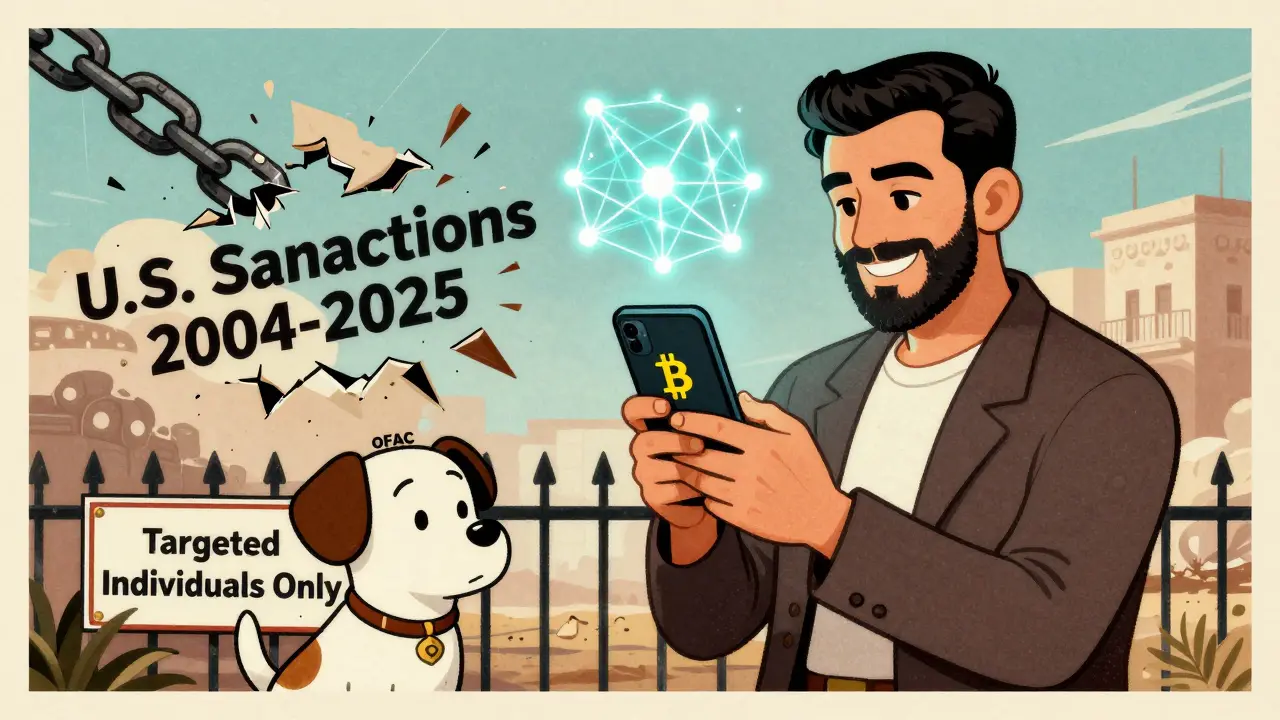
When the U.S. lifted broad sanctions on Syria on July 1, 2025, it didn’t just change trade rules-it opened a door that had been welded shut for over 20 years. At the same time, Cuba’s financial isolation got tighter. These shifts didn’t just affect banks and importers. They reshaped how cryptocurrency moves in and out of both countries. For anyone trying to send money, run a business, or even trade Bitcoin in these places, the difference between Syria and Cuba today is stark.
What Changed in Syria?
Before June 2025, U.S. sanctions on Syria were among the most comprehensive in the world. They blocked almost all financial transactions with Syrian entities, froze assets, and cut off access to the global banking system. The Central Bank of Syria was on the Specially Designated Nationals (SDN) List. Any U.S. bank that tried to process a payment to Syria risked fines in the millions. That all changed with Executive Order 14312 issued on June 30, 2025, which revoked six prior executive orders dating back to 2004, terminated the national emergency declaration that justified the sanctions, and removed all Syrian financial institutions from the SDN List. Overnight, U.S. banks could open correspondent accounts with Syrian banks. American companies could legally export financial services. Even PayPal and Stripe could, in theory, process payments to Syria-though most still hesitate due to lingering risk. The big win for crypto? Binance and other major exchanges removed Syria from their restricted jurisdiction list. Syrians could now trade Bitcoin, Ethereum, and stablecoins without needing a VPN or offshore account. Trading volumes spiked. Peer-to-peer (P2P) platforms like LocalBitcoins and Paxful saw a 300% increase in Syrian users in the first 90 days after the sanctions lift. But here’s the catch: Targeted sanctions still exist on the Assad family, former regime officials, individuals tied to the captagon drug trade, and those involved in human rights abuses. If you’re sending crypto to someone on that list-even accidentally-you’re still in violation. That’s why most institutions still treat Syria like a high-risk zone. They don’t block it anymore, but they don’t trust it either.Why Syria’s Crypto Rules Are Still a Gray Zone
Syria doesn’t have a law that says crypto is legal. It doesn’t have a law that says it’s illegal. That’s not a loophole-it’s a vacuum. There’s no central bank oversight. No licensing for exchanges. No reporting requirements for crypto transactions. The country’s Anti-Money Laundering and Combating the Financing of Terrorism (AML/CFT) framework was designed for cash and wire transfers, not blockchain addresses. So when a Syrian business receives USDT from a Turkish supplier, there’s no official way to prove it’s clean. This ambiguity scares off big players. A U.S.-based fintech company might want to help Syrian exporters get paid via crypto, but they can’t get insurance. A European bank won’t clear a wire to a Syrian crypto wallet because they can’t verify the beneficiary’s identity under AML rules. That’s where tools like Lightspark’s Grid Switch come in. Instead of sending Bitcoin directly, Grid Switch uses the Lightning Network to settle payments between institutions in real time, while the actual funds move through regulated domestic payment systems. It’s crypto infrastructure without the crypto exposure. For businesses that need to operate in Syria without triggering compliance alarms, it’s the only viable path.
Cuba Got Tighter-Not Looser
While Syria opened up, Cuba shut down further. In July 2025, the Trump administration issued National Security Presidential Memorandum 5 (NSPM-5) which reversed Biden’s 2023 easing of Cuba sanctions and re-imposed strict limits on travel, remittances, and financial transactions. Even U.S. citizens can’t send more than $1,000 per quarter to Cuban individuals. Non-U.S. subsidiaries of American companies are now explicitly covered under the Cuba Assets Control Regulations (CACR) meaning a German firm owned by a U.S. parent can’t ship goods to Cuba. The message was clear: any attempt to bypass U.S. sanctions, even indirectly, will be punished. That’s why Key Holding, LLC paid $608,825 in July 2025. The company’s subsidiary in Colombia had arranged 36 freight shipments to Cuba. No one thought it was a big deal. But OFAC didn’t care. They fined them anyway. It was a warning shot to every logistics company, shipping agent, and fintech firm that thought they could work around the rules. For crypto users in Cuba, this means trouble. Binance and Coinbase still restrict Cuban users. Even if you have a foreign bank account, you can’t link it to a Cuban wallet. Most Cuban crypto traders rely on P2P platforms with cash-in-hand deals, but those are risky. If you’re caught with more than $10,000 in crypto, you could be charged with violating the CACR.Why the Difference Between Syria and Cuba?
Why lift sanctions on Syria but tighten them on Cuba? It’s not about human rights or democracy. It’s about strategy. Syria’s regime, under President Ahmed al-Sharaa, made a deal: cut ties with Iran, stop supporting armed groups, and help dismantle the captagon drug network. In return, the U.S. removed sanctions. It was a transaction, not a moral victory. Cuba, on the other hand, has deep ties to Russia and Venezuela. It hosts Russian military advisors. It’s a hub for smuggling oil from Iran. And it hasn’t signaled any willingness to change. So the U.S. doubled down. The crypto angle? Syria’s openness is an opportunity. Cuba’s isolation is a trap. In Syria, crypto is becoming a bridge to global commerce. In Cuba, it’s a liability.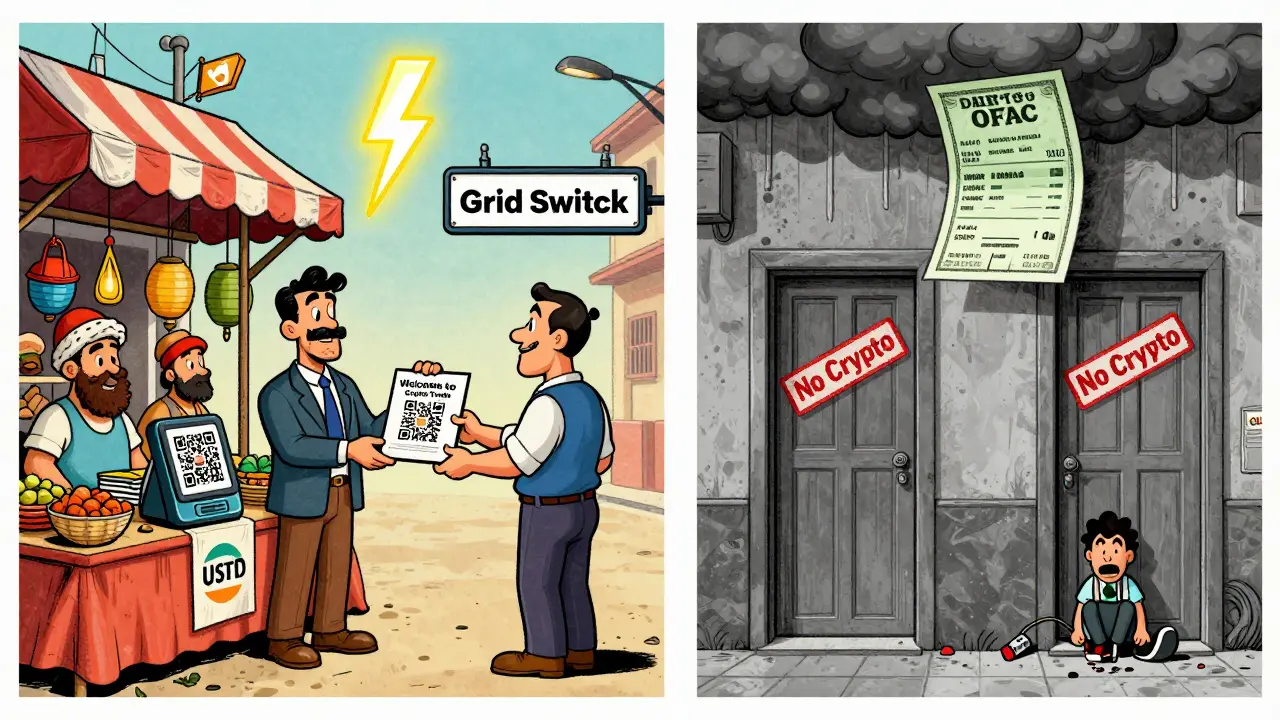
What This Means for Crypto Users in 2026
If you’re in Syria:- You can now use major exchanges like Binance and Kraken without restrictions.
- You can receive stablecoins like USDT or USDC from international partners.
- You can use crypto for cross-border payments-just avoid anyone on the OFAC targeted list.
- You still can’t get a bank account in the U.S. or EU. Crypto is your best option.
- You’re still blocked from most global exchanges.
- P2P trading is your only option-but it’s risky and slow.
- Any crypto transaction over $1,000 could draw attention from OFAC.
- Even if you’re not a U.S. citizen, if you have a U.S. bank account or use a U.S.-based app, you’re at risk.
What’s Next?
The U.S. isn’t done changing sanctions. Iran still faces maximum pressure. Russia’s sanctions are expanding. Venezuela is stuck. And the EU is drifting apart on enforcement. But for Syria and Cuba, the path is clear: Syria is becoming a crypto-friendly market-not because it’s safe, but because it’s necessary. The U.S. wants to rebuild trade. Crypto is the fastest way to do it. Cuba remains locked out-not because crypto is dangerous, but because the U.S. sees it as a tool for regime survival. Until that changes, crypto in Cuba will stay underground. The lesson? Sanctions aren’t just about politics. They’re about access. And in 2026, your ability to use crypto in one country might mean the difference between survival and isolation.Can Syrians now use Binance without restrictions?
Yes. As of July 1, 2025, Binance and other major exchanges removed Syria from their restricted jurisdiction list following the U.S. sanctions lift. Syrians can now trade, deposit, and withdraw crypto without needing a VPN or offshore account. However, users must still avoid transacting with individuals or entities on OFAC’s targeted sanctions list.
Why can’t Cubans use crypto exchanges like Binance?
Cuba remains under strict U.S. sanctions under the Cuba Assets Control Regulations (CACR). Even though crypto isn’t explicitly banned, exchanges like Binance and Coinbase restrict Cuban users to avoid violating OFAC rules. Sending crypto to Cuba could be seen as facilitating prohibited financial transactions, especially if the recipient is a government-linked entity or individual.
Is crypto legal in Syria?
Syria has no laws that explicitly legalize or ban cryptocurrency. It exists in a legal gray zone. While the lifting of U.S. sanctions made crypto transactions possible, there is no regulatory framework for exchanges, licensing, or reporting. Users must comply with Syria’s broader AML/CFT rules, which were designed for traditional banking, not blockchain.
Can U.S. companies do business with Syria now?
Yes, but with caution. U.S. companies can now legally export financial services, invest, and open bank accounts in Syria. However, targeted sanctions remain in place against the Assad family, former regime officials, and those linked to captagon trafficking or human rights abuses. Any business must conduct enhanced due diligence to avoid violating these restrictions.
What happened to the $608,825 fine against Key Holding, LLC?
In July 2025, Key Holding, LLC paid $608,825 to OFAC for arranging 36 freight shipments from Colombia to Cuba through its subsidiary. The fine was imposed under the Cuba Assets Control Regulations, which apply to non-U.S. subsidiaries of U.S. companies. This case shows that OFAC enforces sanctions aggressively-even when violations are minor or unintentional.

Jeannie LaCroix
March 24, 2026 AT 03:07Sam Harajly
March 24, 2026 AT 11:28Ananya Sharma
March 25, 2026 AT 09:18Kevion Daley
March 26, 2026 AT 12:21Tammy Stevens
March 27, 2026 AT 10:16Justin Credible
March 28, 2026 AT 17:45Dheeraj Singh
March 30, 2026 AT 12:46Mike Yobra
March 31, 2026 AT 10:16Mansoor ahamed
April 1, 2026 AT 02:29Nicolette Lutzi
April 2, 2026 AT 02:47Domenic Dawson
April 2, 2026 AT 06:25Pradip Solanki
April 3, 2026 AT 03:23Brad Zenner
April 4, 2026 AT 04:12Tony Phillips
April 5, 2026 AT 12:10Abhishek Thakur
April 5, 2026 AT 18:15Jackie Crusenberry
April 7, 2026 AT 00:33Florence Pardo
April 7, 2026 AT 18:55Alicia Speas
April 8, 2026 AT 06:49YANG YUE
April 10, 2026 AT 01:14Anna Lee
April 10, 2026 AT 13:53Alice Clancy
April 11, 2026 AT 18:00