
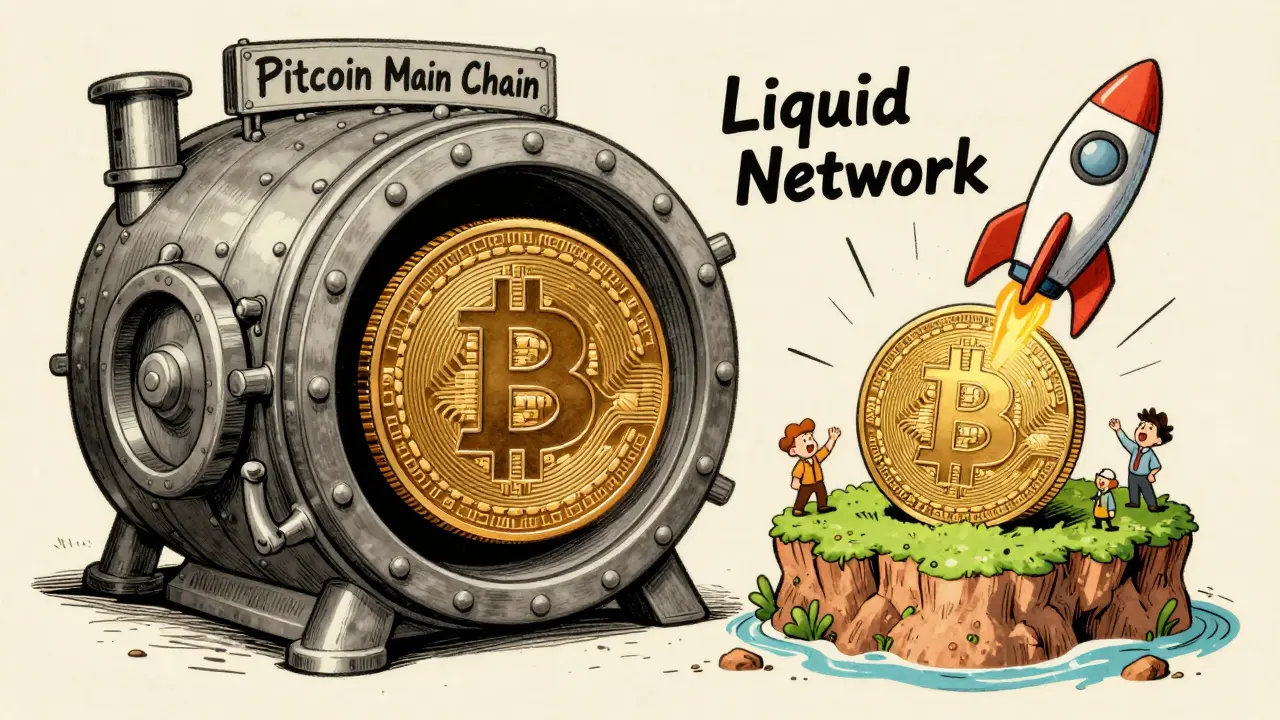
Imagine locking your Bitcoin in a vault on the main chain, then instantly getting an equivalent amount of tokens on another blockchain - and later, unlocking your original Bitcoin by destroying those tokens. That’s the two-way peg in action. It’s not magic. It’s cryptography. And it’s one of the most important, yet misunderstood, tools for expanding Bitcoin’s capabilities without touching its core protocol.
What Exactly Is a Two-Way Peg?
A two-way peg (2WP) is a system that lets you move assets back and forth between Bitcoin and a sidechain - without giving up Bitcoin’s security. Unlike one-way pegs, where you burn BTC to create tokens on another chain (like XCP back in 2014), a two-way peg locks your Bitcoin temporarily. You don’t lose it. It’s just held in escrow until you decide to bring it back. Here’s how it works in simple steps:- You send BTC to a special Bitcoin address controlled by a smart contract on the sidechain.
- That BTC gets locked under a Bitcoin script - meaning no one can spend it unless the sidechain proves it’s safe to unlock.
- After 100-500 Bitcoin blocks confirm the lock (to prevent double-spends), the sidechain mints an equal amount of its own tokens.
- When you want your BTC back, you burn those sidechain tokens.
- The sidechain submits a cryptographic proof that the tokens were destroyed, and the Bitcoin script releases your original BTC.
This isn’t just theory. It’s been built. The Liquid Network, launched by Blockstream in 2018, uses this exact mechanism. So does Rootstock (RSK), which has processed over 20,000 peg-in and peg-out transactions monthly since 2018.
Why Do We Need Sidechains and Two-Way Pegs?
Bitcoin’s design prioritizes security and decentralization - but that comes at a cost. It’s slow. It’s expensive. And it can’t run complex smart contracts like Ethereum can. That’s where sidechains come in. Sidechains are separate blockchains that run alongside Bitcoin. They can have faster blocks, lower fees, and support smart contracts - all while being anchored to Bitcoin’s security. But without a two-way peg, they’re useless. Why would anyone move their BTC to a sidechain if they can’t get it back? The two-way peg solves that. It lets you use Bitcoin’s value on a more flexible chain - say, to trade tokens, issue assets, or run DeFi apps - then return to Bitcoin when you’re done. It’s like borrowing your car to drive on a highway, then returning it to your garage when you’re done.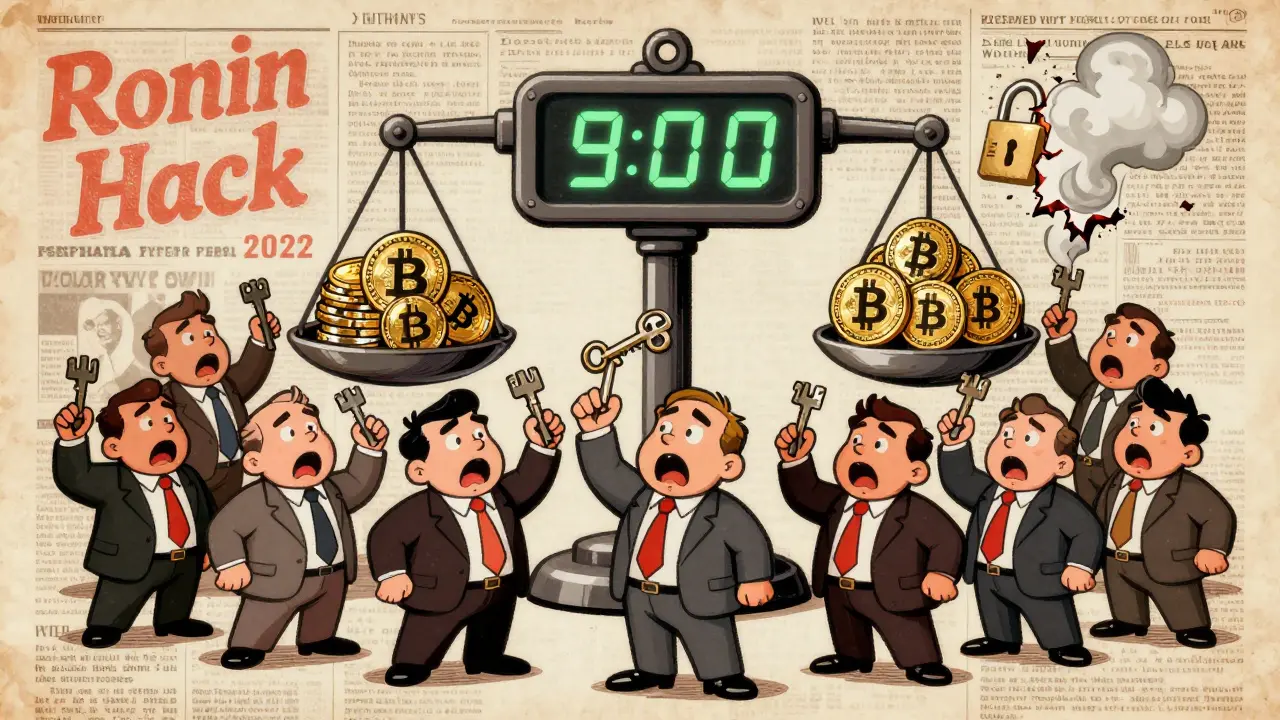
How Security Works - and Where It Breaks
The beauty of the two-way peg is that it doesn’t trust any single party. It relies on cryptographic proofs and Bitcoin’s consensus. But here’s the catch: the sidechain’s verification system must be flawless. In the Liquid Network, a federation of 15 trusted parties signs off on peg-in and peg-out requests. That’s secure - as long as no more than 5 of them are compromised. But in 2022, the Ronin Network sidechain lost $625 million because its validator nodes were hacked. The two-way peg didn’t fail. The people managing it did. That’s the Achilles’ heel: centralized control. If a sidechain uses a small group of validators to confirm pegs, it becomes a single point of failure. Bitcoin’s strength is that it doesn’t need trust. Sidechains with two-way pegs often do. Enter BitVM. Announced in February 2024, BitVM 2.0 is a breakthrough. It allows complex verification logic - like proving a token was destroyed - to be executed off-chain, using Bitcoin’s own rules. No trusted validators needed. Just math. Early tests show peg-in times dropping from hours to under 10 minutes. If it works at scale, it could make two-way pegs truly trustless.Real-World Use Cases - Who’s Actually Using This?
Most people think sidechains are for traders. But the real adoption is happening behind the scenes. - JPMorgan’s Onyx uses a Bitcoin-based sidechain with a two-way peg to settle institutional trades in minutes instead of days. They don’t move BTC. They move tokenized USD, but the peg mechanism is the same. - Microsoft Azure offers sidechain-as-a-service for enterprise clients who want to issue private assets with Bitcoin’s security. - Blockstream’s Liquid Network handles over $1 billion in monthly volume, mostly from exchanges and market makers moving BTC between wallets without paying high Bitcoin fees. On the retail side, adoption is slow. Reddit users report peg-in times averaging 47 minutes, with nearly a third waiting over two hours. Fees? Around $22.50 per transaction. That’s expensive compared to Layer 2 solutions like Lightning. And then there’s the regulatory mess. In July 2023, the SEC said pegged assets could be classified as securities if used in DeFi. Circle paused USDC pegging to Ethereum sidechains because of it. That scared off a lot of potential users.
Why Two-Way Pegs Are Still Relevant - Even With New Tech
You’ve heard of Cosmos IBC, zero-knowledge bridges, and atomic swaps. They’re faster. They’re cheaper. Some say they’ll make two-way pegs obsolete by 2026. But here’s what those alternatives don’t have: Bitcoin’s security. Cosmos IBC connects chains that trust each other. Zero-knowledge bridges rely on new cryptographic assumptions. Atomic swaps require both chains to be active and liquid. A two-way peg, when done right, doesn’t need trust. It doesn’t need new cryptography. It uses Bitcoin’s 15-year-old, battle-tested consensus. That’s priceless. Even if adoption is low - only 3 major sidechains use it with Bitcoin - it’s the only mechanism that lets you move Bitcoin’s value without changing Bitcoin itself. That’s why companies like JPMorgan and Microsoft are betting on it. They don’t want to risk their assets on unproven tech.The Future: Can Two-Way Pegs Survive?
The road ahead is rocky. The Drivechain BIP-300 proposal, which would let miners vote on sidechain rules, has only 12.7% support. Miners aren’t interested in managing sidechains. They want to mine Bitcoin. But BitVM changes everything. If it works, two-way pegs become fully decentralized. No federations. No validators. Just Bitcoin’s rules, extended. Gartner predicts 37% annual growth in two-way peg adoption through 2027. Forrester says it’s dead by 2026. Who’s right? The answer isn’t in the hype. It’s in the code. If BitVM 2.0 gets deployed and proves secure, two-way pegs become the backbone of Bitcoin’s future - not just for payments, but for DeFi, NFTs, and enterprise finance. If it fails? Then sidechains will remain niche tools for experts and institutions. Right now, the technology sits at a fork. One path leads to trustless, secure interoperability. The other leads to obsolescence. Bitcoin didn’t evolve by changing its core. It evolved by building on top of it. Two-way pegs are the most honest way to do that. The question isn’t whether they’re useful. It’s whether we can make them safe enough to trust.Right now, only one thing is certain: without secure two-way pegs, Bitcoin will stay locked in its own box - unable to do anything beyond sending money.

Madhavi Shyam
December 17, 2025 AT 02:032WP is essentially a trust-minimized cross-chain bridge anchored to Bitcoin’s UTXO set. The cryptographic proofs are ZK-SNARK-adjacent but use Bitcoin script, which is why it’s not as scalable as Layer 2s. Federation models are the bottleneck-not the peg itself.
Mark Cook
December 17, 2025 AT 22:57lol so now Bitcoin needs to be ‘extended’? 😂 Next they’ll say we need to add AI mining rewards. BTC is supposed to be simple. This is just DeFi creep.
Jack Daniels
December 19, 2025 AT 11:48I’ve been watching this for years. Every time someone says ‘trustless’, I check the validator list. Always 15 people. Always. It’s not trustless. It’s just hiding the trust behind a fancy name.
Bradley Cassidy
December 20, 2025 AT 08:34man i just read this whole thing and my brain is buzzing like a bee in a jar 😅 the way bitvm2.0 lets you verify token destruction using bitcoin’s own rules? that’s like teaching a turtle to do calculus… but it works?! i’m lowkey obsessed. the liquid network is basically the OG crypto taxi service-$22.50 to zip your btc across the multiverse. kinda wild when you think about it.
Craig Nikonov
December 21, 2025 AT 19:02BitVM? More like BitLiar. The whole ‘trustless’ narrative is a smokescreen. Miners won’t adopt Drivechain because they’re paid in BTC, not sidechain tokens. And JPMorgan? They’re using this to bypass Fed regulation. The SEC isn’t scared of DeFi-they’re scared of Bitcoin becoming a settlement layer for Wall Street. This isn’t innovation. It’s financial colonization.
Cheyenne Cotter
December 22, 2025 AT 09:07Let’s be real-the peg-in time is 47 minutes on average? That’s not ‘instant’. That’s a glorified batch process. And $22.50 per peg? That’s more than a Lightning invoice. Why not just use a centralized exchange if you’re going to pay that much? The whole system feels like a solution looking for a problem. Sidechains are cool in theory, but the friction is too high for real adoption. Plus, the regulatory uncertainty makes it a minefield. If Circle paused USDC pegging, you know it’s not safe.
Emma Sherwood
December 23, 2025 AT 23:16Hey everyone-just wanted to say this is actually one of the clearest explanations of two-way pegs I’ve seen. I’m new to sidechains but this made it click. The car analogy? Perfect. I used to think Bitcoin was stuck, but now I see it’s like a powerful engine that can power other vehicles without leaving the garage. And BitVM? If it works, it’s the missing puzzle piece. We’re not trying to replace Bitcoin-we’re giving it wings. Keep sharing stuff like this. 💪
Patricia Amarante
December 25, 2025 AT 05:34BitVM sounds like magic, but I’m skeptical. If it’s so great, why isn’t it live yet? And why are we still relying on federations? I’ve seen too many ‘revolutionary’ crypto ideas die on the vine. I’m not against innovation, but I’m tired of hype.
Timothy Slazyk
December 25, 2025 AT 17:52The real question isn’t whether two-way pegs work-it’s whether we’re willing to accept that Bitcoin’s value lies not in its ability to do everything, but in its refusal to do too much. Sidechains are like adding accessories to a classic car. You can put on leather seats, a stereo, even a GPS-but if you start welding the chassis, you lose what made it special. Bitcoin’s strength is its minimalism. We don’t need it to be a Swiss Army knife. We need it to be a hammer. And if we keep trying to turn it into a smartphone, we’ll end up with a broken hammer and a useless phone.
Donna Goines
December 26, 2025 AT 00:40They say BitVM is trustless. But who wrote the code? Who audits it? Who controls the dev wallet? The same people who ran the Ronin hack? No thanks. This is just a new way for elites to move money while pretending it’s decentralized. They’ll call it ‘permissionless’ until the government shuts it down. And then what? You think your BTC is safe? It’s already in a vault. This just adds more locks… and more keys in the hands of a few.
Shruti Sinha
December 27, 2025 AT 23:22Interesting read. Liquid Network’s volume is impressive, but the fee structure is still prohibitive for retail. Also, peg-in confirmation time is too long for daily use. Lightning is still king for speed and cost.
Tom Joyner
December 28, 2025 AT 03:54BitVM? How quaint. The real breakthrough is ZK-rollups on Ethereum, which have already proven scalability, security, and composability. Bitcoin’s sidechain experiment is a nostalgic footnote-like a vinyl collector trying to convince everyone cassette tapes are the future.
Abby Daguindal
December 29, 2025 AT 23:58Why are we even talking about this? Bitcoin was never meant for DeFi. It’s digital gold. Period. If you want smart contracts, go use Ethereum. Stop trying to turn BTC into a Swiss Army knife. You’re just making it heavier and slower. And now you’re inviting regulators into the kitchen. Great move.
Kelsey Stephens
December 30, 2025 AT 21:09Thank you for writing this. I’ve been confused about how sidechains interact with Bitcoin for months. You made it feel human. I’m not a dev, but I get it now. And BitVM? If it’s real, it could change everything. I’m rooting for it. Let’s hope the devs don’t mess it up.
SeTSUnA Kevin
December 30, 2025 AT 22:41BitVM 2.0 is not a breakthrough. It’s a rebranding of the original Drivechain concept with more buzzwords. The math is sound, but the incentive alignment is broken. Miners have no economic reason to validate sidechain proofs. This is a solution in search of a stakeholder. It will fail.