
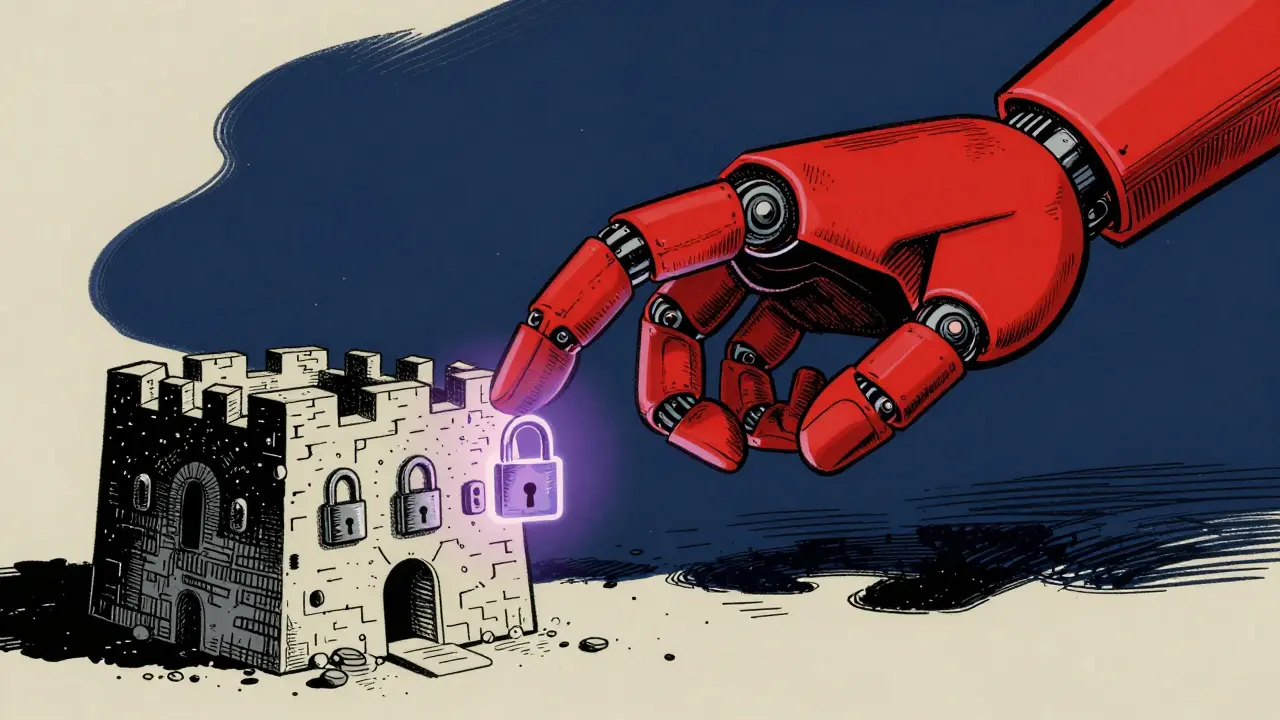
You're encrypting data today assuming it's safe forever. But in 2026, that assumption could cost you everything. Experts warn that quantum computers may break today's encryption within years-not decades. Your blockchain transactions, financial records, and sensitive communications aren't future-proof yet.
Quantum-resistant algorithms, also called post-quantum cryptography (PQC), solve this problem by designing math puzzles even quantum machines can't crack easily. Unlike flashy "quantum cryptography" marketing hype, these tools run on your existing servers without special hardware.
Why Quantum Computers Threaten Blockchain Security
Current blockchain security relies on two mathematical giants: RSA encryption (used by most websites) and ECC elliptic-curve cryptography. These protect digital signatures and private keys today. But in 1994, mathematician Peter Shor proved quantum computers could solve their core math problems exponentially faster using Shor's algorithm. Once sufficiently powerful quantum hardware exists-which many believe will happen before 2031-today's "unbreakable" encryption becomes transparent.
Dr. Michele Mosca's 2025 study calculated a 1-in-7 chance that critical public-key systems fail by 2026. That means some of your encrypted data could already be targeted by nation-state actors practicing "harvest now, decrypt later" attacks. Imagine storing patient health records today only to see them breached tomorrow when quantum tech matures.
What Are Quantum-Resistant Algorithms?
PQC isn't science fiction. The U.S. National Institute of Standards and Technology (NIST) finalized four standardized quantum-resistant algorithms in July 2022. These replace vulnerable public-key systems while maintaining compatibility with existing software stacks:
| Algorithm | Type | Key Feature | Ideal Use Case |
|---|---|---|---|
| Cryptals-Kyber | Encryption | Small keys (967 bytes) | Securing internet traffic |
| Cryptals-Dilithium | Digital Signature | Balanced performance | Blockchain identity verification |
| Falcon | Digital Signature | Smallest signatures (1KB) | Bandwidth-constrained IoT devices |
| Sphincs+ | Digital Signature | Backup math foundation | High-security government systems |
All four algorithms resist both classical and quantum attacks. Crucially, they don't require new infrastructure-they function on standard CPUs. This makes them practical alternatives to quantum key distribution (QKD) systems demanding fiber-optic networks.

NIST Standards vs Real-World Implementation
While NIST provides frameworks, adoption faces three hurdles. First, migrating billions of blockchain wallets demands updating every node, wallet app, and exchange interface simultaneously. Second, legacy systems built around RSA/ECC certificates often resist hybrid approaches during transition periods.
Third, developers must choose between single-algorithm deployments versus layering multiple cryptographic schemes-a tactic known as "crypto-agility." IBM recommends a phased approach: inventory all cryptography assets, test hybrid configurations, then incrementally replace vulnerable components over 3-5 years.
For example, a blockchain firm might temporarily combine traditional ECC with Dilithium signatures until full PQC migration completes. This maintains interoperability while preparing for eventual pure-PQC operation.

Harvester Attacks: Today's Risk Factor
The most immediate danger comes from adversaries hoarding encrypted data today to decrypt later. Consider cryptocurrency exchanges: if hackers intercept withdrawal requests transmitted via outdated TLS versions, those same messages could expose seed phrases once quantum decryption becomes feasible.
Defense requires prioritizing long-term secrets. Healthcare providers protecting genomic databases face higher urgency than temporary social media chats. Financial institutions must audit stored blockchain transaction logs dating back five+ years immediately, as re-encryption delays increase exposure windows.
Migration Roadmap Checklist
- Inventory Phase: Identify all blockchain nodes, smart contracts, and API endpoints using vulnerable cryptography. Focus especially on cold wallets holding multi-year assets.
- Hybrid Testing: Deploy dual-signature mechanisms combining ECDSA with Falcon/Dilithium in non-production environments. Measure latency impacts.
- Protocol Upgrades: Replace TLS handshake protocols with Kyber-based key exchange across validator networks.
- Certificate Rotation: Retire RSA certificates before expiration cycles end naturally, avoiding emergency patches.
- Verification Protocol: Implement automated scans detecting residual weak cryptography annually.
Do blockchains need complete rewrites to adopt PQC?
Not necessarily. Most Layer-2 scaling solutions can integrate PQC through protocol upgrades rather than chain forks. Core consensus layers typically require coordinated hard forks after achieving developer consensus.
Which quantum-resistant algorithm works best for Bitcoin?
Falcon offers ideal signature size constraints for Bitcoin's transaction volume. However, ongoing research explores BLS signatures combined with lattice-based methods for superior space efficiency.
Can existing wallets support PQC migrations?
Hardware wallet manufacturers are rolling out firmware updates supporting Dilithium/Kyber. Software wallets require code modifications, often achievable through plugin architectures.
When should organizations begin transitioning?
Immediate preparation advised due to harvest-now-decrypt-later risks. Full migration realistically takes 3-5 years depending on infrastructure complexity and regulatory deadlines.
Are there costs associated with adopting PQC?
Initial testing incurs modest expenses (~$5k-$20k), but operational overhead remains low since PQC runs on existing servers. Long-term savings outweigh breaches potentially costing millions.

Shaira Vargas
March 30, 2026 AT 00:14I am freaking out thinking about what happens if my money vanishes into thin air next year honestly. The idea that someone could just grab all my private info scares me to death every single day. Everyone says it is far away but experts say soon so I dont know what to believe anymore. Maybe I should stop keeping things online entirely but then how do I live normally? It feels like we are waiting for a bomb to go off without knowing the exact time. Please tell me there is something concrete we can do to protect ourselves now. The thought of hospitals getting hacked makes me feel terrible just imagining it happening.
Wade Berlin
March 31, 2026 AT 20:14calm down before you give yourself a heart attack over crypto theory
Samson Abraham
March 31, 2026 AT 22:34The transition period requires planning regardless of fear
Colin Finch
April 2, 2026 AT 07:59This shift is just another chapter in our collective evolution towards digital safety. We weave through these challenges because survival demands adaptation rather than stagnation. The algorithms mentioned here represent a bridge to a safer horizon for everyone. Let us embrace the change instead of fearing the unknown machinery ahead.
Liam Robertson
April 3, 2026 AT 18:14We can handle this if we just start early. Many companies are already preparing for the switch so it is not that hard. Just follow the NIST guidelines and you will be fine. Keep your head up and upgrade your software slowly. Everything works out in the end.
Sean Carr
April 4, 2026 AT 18:07Hybrid deployment keeps you safe while full migration happens. Inventory your assets first then test environments carefully.
Alex Lo
April 5, 2026 AT 17:58We really need to talk about this stuff because everyone is ignoring it and my own business feels left behind already. You think the news is hype but i think its real and the timing matters a lot for preparation. They say the machines come soon and then everything opens up like a window for bad actors. I worry about my bank accounts mostly and also the wallet things are tricky to fix completely. We shouldnt wait until 2026 to act now because delays cost money and trust forever. Its better to be safe than sorry always and prevention is cheaper than recovery after a breach. Plus the hardware runs just fine today too so why ignore the easy wins we have. Why would anyone delay on such big issues when the tools are already standardized by NIST. Maybe the costs are low enough for small guys if they just plan the rollout correctly over time. I heard some firms test hybrid modes already so it is not pure speculation or theoretical magic. That sounds smart for keeping old systems safe during the transition period while upgrading parts. So please just start checking your stuff now before the problem becomes a disaster for everyone. It is not too late to fix the foundations but the clock is ticking faster than we like. We need to prioritize critical secrets over temporary chat logs because value differs by industry sector. Healthcare needs stronger protection than social media apps simply due to the sensitivity of data involved. Just take action on the roadmap steps listed above and you will feel more secure in the long run. Stop worrying about tomorrow and start auditing today so you know exactly where you stand.
Elizabeth Akers
April 7, 2026 AT 04:16good points about taking action early
just follow the steps laid out
Jay Starr
April 8, 2026 AT 19:21I see the headlines everywhere but I still feel paralyzed by the complexity of it all. Is there really a way to verify if we are protected already?
Matt Bridger
April 10, 2026 AT 16:15Audit cycles detect weak crypto annually as recommended in the checklist
Lisa Miller
April 12, 2026 AT 04:27Thank you for putting this information out for us all to read. It is important that we stay informed and proactive with our digital habits. I appreciate the detailed breakdown of the different algorithms and their uses. We can definitely get through this transition if we work together. Just remember to keep patience as changes happen over a few years. Stay positive and let us support each other in learning the new standards. Your efforts help educate many people who might otherwise ignore the threat.
Joy Crawford
April 12, 2026 AT 15:19sad we are doomed again 😢😢
Beverly Menezes
April 13, 2026 AT 03:03let us work together to make this easier for everyone
Ronald Siggy
April 13, 2026 AT 22:12Taking control of your security infrastructure is essential for any organization now. Prioritize inventory and testing phases to avoid scrambling later.
joshua kutcher
April 14, 2026 AT 00:26It is understandable that people feel overwhelmed by the technical nature of cryptography updates. We all want to feel safe without needing a degree in math. Taking small steps helps reduce the anxiety associated with major changes. I hope everyone finds resources that explain the process simply. Remember that hybrid options exist to bridge the gap nicely.
Ashley Stump
April 15, 2026 AT 05:07Its a scam to sell fear and push upgrades.
athalia georgina
April 16, 2026 AT 16:45wtf did the nist mean by finalizing in 2022? u r late telling us now
Justin Smith
April 18, 2026 AT 08:58NIST selection occurred in July 2022 per public records available online.
Justin Garcia
April 19, 2026 AT 01:41Why trust government standards when private solutions could be better?
Tiffany Selchow
April 20, 2026 AT 01:39Our domestic standards are superior to anything foreign nations offer anyway.
Cara Boyer
April 21, 2026 AT 07:31government is lying about quantum dates 😲
Addy Stearns
April 22, 2026 AT 16:38In truth the passage of time reveals vulnerabilities that were hidden in plain sight all along. We must consider the philosophical implications of privacy shifting from mathematical hardness to hardware constraints. As the world moves toward a post quantum era we question the nature of trust itself. These algorithms represent not just tools but symbols of human ingenuity facing inevitable obsolescence of current models. The conversation extends beyond code into the realm of societal stability and global commerce. History teaches us that rapid technological shifts demand careful stewardship of information integrity. We stand at a precipice where the rules of engagement change fundamentally for decades to come.
Leah Lara
April 23, 2026 AT 04:15read it
Callis MacEwan
April 23, 2026 AT 07:20This is just post quantum noise designed to confuse developers about legacy protocol deprecation schedules.