

The landscape of digital finance in Iran has shifted dramatically. If you are trying to move money, save value against inflation, or simply access global markets from within the Islamic Republic, you know that the rules change faster than most people can adapt. The Central Bank of Iran (CBI) has tightened its grip significantly, blocking payment gateways and cracking down on advertising. Yet, despite these hurdles, millions of Iranians continue to use cryptocurrency. How do they do it? It isn't magic; it is a combination of technical adaptation, community knowledge, and careful risk management.
This guide breaks down the current reality of using crypto in Iran as of mid-2026. We will look at why these restrictions exist, the tools people are actually using to navigate them, and the specific risks you need to watch out for. This is not legal advice, but rather an observation of how the market functions on the ground.
Understanding the Regulatory Landscape
To navigate the system, you first need to understand what you are up against. The Iranian government’s approach to cryptocurrency is hybrid. On one hand, they encourage mining because it generates hard currency revenue for the state. On the other hand, they strictly prohibit domestic payments in crypto to prevent capital flight and maintain control over the rial.
In early 2025, the CBI blocked all cryptocurrency-to-rial payment gateways on Iranian websites. While some exchanges were later unblocked, they operate under strict government-controlled APIs that require full user data access. This means using official local exchanges often involves significant privacy trade-offs. Additionally, the ban on crypto advertising has pushed much of the activity underground, into Telegram groups and private forums.
The primary driver for users is economic survival. With inflation exceeding 40% annually and the rial losing value rapidly, many citizens view crypto not as an investment, but as a necessary hedge. According to estimates, roughly 1.4% of Iran's GDP flows through cryptocurrency channels. For many, this is the only way to preserve purchasing power.
The Shift to Decentralized Solutions
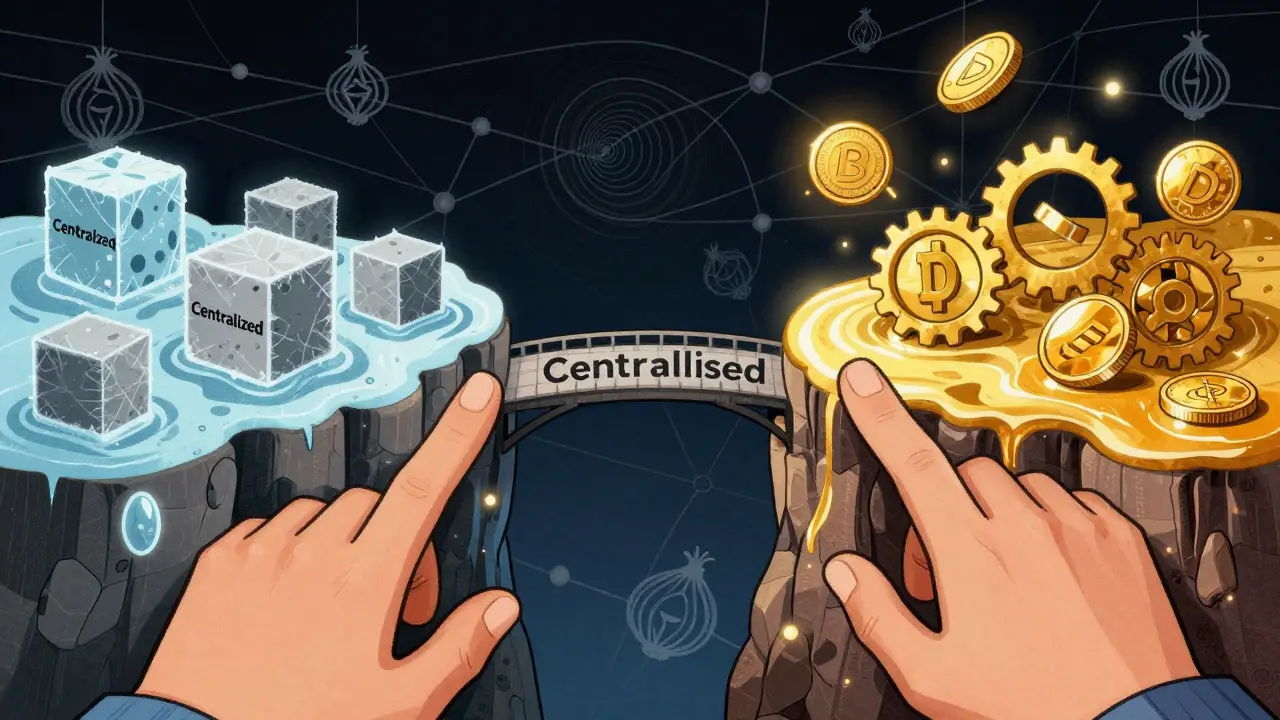
Centralized exchanges have become risky targets. In July 2025, Tether froze dozens of Iranian-linked wallets, disrupting liquidity for over a million users. This event was a turning point. Users realized that relying on centralized stablecoins like USDT carried too much counterparty risk.
DAI is a decentralized stablecoin pegged to the US dollar, governed by MakerDAO. Following the Tether freeze, there was a massive migration to DAI. Why? Because DAI is not controlled by a single company that can freeze your funds based on sanctions lists. Instead, it operates on smart contracts.
Most users moved their DAI transactions to the Polygon is a Layer 2 scaling solution for Ethereum that offers high speed and low transaction fees. network. Polygon offers near-instant finality (about 0.001 seconds) and transaction fees averaging just $0.0002. Compare this to Ethereum's mainnet, where fees can exceed $1.75 per transaction. For someone sending small amounts to pay for groceries or services, Polygon makes crypto practical. Within 28 days of the Tether freeze, DAI usage among Iranian users jumped from 3% to 67% of all stablecoin transactions.
Navigating Internet Censorship
You cannot access foreign exchanges without bypassing internet restrictions. The Iranian government employs sophisticated throttling techniques that target known exchange IP ranges. Simple VPNs often fail.
VPNs are Virtual Private Networks that encrypt your internet traffic and mask your location. According to analysis from TRM Labs, about 78% of Iranian crypto users rely on encrypted tunneling protocols. Services like NordVPN, ExpressVPN, and Surfshark dominate the market, accounting for 63% of usage. However, even these are not foolproof. Connection stability averages around 68%, meaning nearly one in three attempts to connect to international platforms may fail due to throttling.
For those seeking higher anonymity, the Tor Browser is a free software for enabling anonymous communication by directing internet traffic through a worldwide volunteer network. remains a popular choice, especially when combined with non-custodial wallets. Many users report using Tor to access decentralized exchanges (DEXs) directly, avoiding the need to log into a centralized platform altogether.
The Rise of Peer-to-Peer (P2P) Trading
With local exchanges like Nobitex facing reduced volume and strict trading hours (10 AM to 8 PM), peer-to-peer trading has become the backbone of the Iranian crypto economy. By September 2025, P2P transactions accounted for 52% of all crypto activity in the country.
Most of this happens on Telegram. There are thousands of dedicated groups where users post buy/sell orders. These platforms operate with minimal oversight. You find a seller, agree on a rate, and transfer funds via bank card or cash, while the crypto is sent directly between wallets.
This method is fast and avoids KYC (Know Your Customer) requirements entirely. However, it carries trust risks. Scams happen. To mitigate this, experienced users stick to established groups with reputational systems or use escrow bots. One widely cited method involves using Telegram bots to convert USDT to DAI on Polygon, then transferring to a MetaMask wallet. This process takes about seven minutes and costs less than $0.50 in fees.

Tools and Infrastructure
If you are new to this ecosystem, the learning curve is steep. Users report spending 17 to 22 hours just mastering the basics of secure circumvention. Here is the essential toolkit:
- Encrypted Messaging: Telegram is used by 89% of users for coordination and trading.
- Non-Custodial Wallets: MetaMask is a software cryptocurrency wallet used to interact with the Ethereum blockchain and other compatible networks. is the standard, used by 76% of advanced users. It gives you full control over your private keys.
- Reliable VPN: Expect to spend around $7.80 monthly on a service that works consistently.
- Local Knowledge Sources: Platforms like CoinJan and Aparat (Iranian YouTube alternative) host tutorials and real-time updates on which methods are currently working.
Technical support is decentralized. If you get stuck, you won't call a help desk. You will post in a Telegram group. Response times average 3.2 hours for basic issues, but complex problems can take nearly two days to resolve.
Risks and Pitfalls
Freedom comes with responsibility. The most common failure point is transaction failure during internet shutdowns. NetBlocks recorded 17 such incidents in Q3 2025 alone. Always ensure your transactions confirm before assuming they are complete.
Another major risk is smart contract vulnerability. While Polygon is cheaper, its security budget is smaller than Ethereum's. Stick to audited bridges and well-known tokens. Never send funds to unverified addresses found in random chats.
Finally, be aware of the tax implications. The August 2025 Law on Taxation of Speculation and Profiteering introduced a 15% capital gains tax. While enforcement is difficult underground, large transactions still carry scrutiny. Most users keep individual transaction values below $2,450 to avoid triggering reporting thresholds.
Is it illegal to own cryptocurrency in Iran?
Owning cryptocurrency is not explicitly illegal for individuals in Iran. However, using it for commercial payments is prohibited. The government focuses on blocking payment gateways and regulating exchanges rather than prosecuting individual holders. Mining is legal but heavily regulated with high energy tariffs.
Why did users switch from USDT to DAI?
In July 2025, Tether (the issuer of USDT) froze numerous Iranian-linked wallets due to sanctions compliance. This left many users unable to access their funds. DAI, being a decentralized stablecoin, does not have a central authority that can freeze accounts, making it a safer option for preserving value in sanctioned regions.
Which VPNs work best in Iran?
NordVPN, ExpressVPN, and Surfshark are the most commonly used services, holding 63% of the market share among Iranian crypto users. They offer obfuscation features that help bypass deep packet inspection. However, no VPN is 100% reliable due to constant government throttling efforts.
What is the safest way to trade crypto in Iran?
What is the safest way to trade crypto in Iran?
Peer-to-peer (P2P) trading via Telegram is currently the most dominant method, accounting for over half of all transactions. Using non-custodial wallets like MetaMask and decentralized exchanges on the Polygon network reduces reliance on centralized entities that may freeze assets. Always verify counterparties and use small test transactions first.
Does the Digital Rial replace crypto?
No. The Digital Rial pilot on Kish Island has seen very low adoption, with fewer than 12,400 active users. It requires national ID linkage and cannot be transferred internationally. Most citizens prefer crypto for its privacy, borderless nature, and ability to act as a hedge against inflation.
