
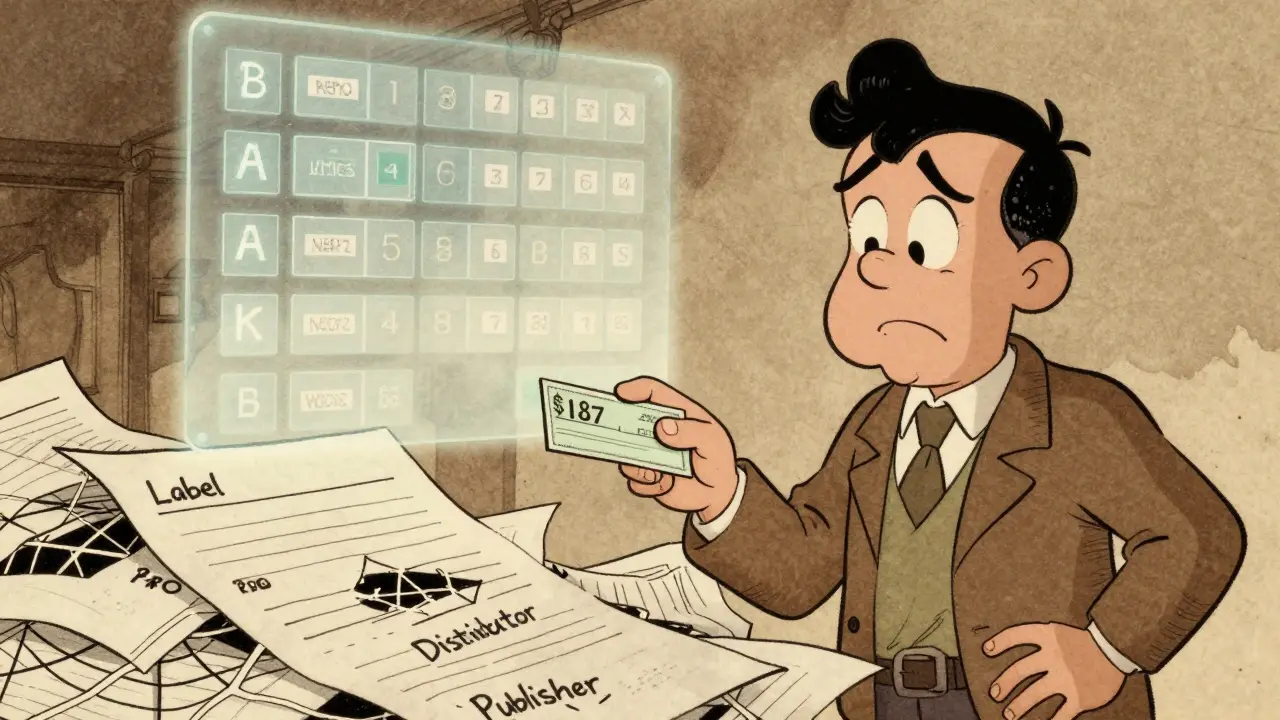
Imagine you release a song. A week later, it’s used in a TikTok video that gets 5 million views. Two years later, you finally get paid - $1.87. That’s not a story. That’s the music rights management system most artists live with today. The delays, the middlemen, the opacity - it’s broken. But blockchain is fixing it, one smart contract at a time.
What Blockchain Does for Music Rights That Old Systems Can’t
Traditional music rights management is like trying to track who owns a piece of paper that’s been copied, folded, and passed through 20 hands. Who wrote the beat? Who sampled the hook? Who licensed it for a commercial? Nobody really knows. Records are scattered across labels, publishers, PROs (Performance Rights Organizations), and sometimes lost in filing cabinets. Blockchain changes that by creating a single, public, unchangeable ledger. Every time a song is created, sampled, licensed, or streamed, that action is recorded as a block on the chain. No one can delete it. No one can alter it. And everyone can see it. This isn’t just about transparency - it’s about ownership. When an artist uploads a track to a blockchain-based platform, they attach metadata: the names of all contributors, their shares, the date of creation, and the license terms. That data is locked in. No more disputes over who owns 12% of a chorus. The ledger says it. The code enforces it.Smart Contracts: The Auto-Pilot for Royalties
Here’s where it gets real. Smart contracts are self-executing programs stored on the blockchain. They don’t need a human to say, “Pay this person.” They just do it. Let’s say a song is played on Spotify. Instead of waiting for Spotify to send a report to a distributor, who sends it to a publisher, who sends it to a PRO, who finally cuts a check - the smart contract detects the play in real time. It checks the ledger: 50% to the main artist, 20% to the producer, 15% to the lyricist, 10% to the sample clearance holder, 5% to the studio engineer. Instantly, the money flows. No delays. No deductions. No bureaucracy. Artists in Nigeria, Brazil, or rural Canada now get paid the same way as artists in Los Angeles - in minutes, not months. And the amount? It’s exact. No more “we rounded down because of processing fees.” The blockchain doesn’t round. It pays what’s owed.NFTs Aren’t Just Digital Art - They’re Ownership Tokens
NFTs (Non-Fungible Tokens) are often misunderstood as just JPEGs of apes. But in music, they’re something else: proof of ownership and participation. An artist can release a song as an NFT with built-in royalty splits. Buy the NFT? You don’t just own a file - you own a piece of the rights. Maybe you get 1% of future streaming royalties. Maybe you get early access to live shows. Maybe you vote on the next single. This turns fans from passive listeners into stakeholders. Platforms like Royal and Audius let artists tokenize their music. Fans can buy fractions of songs. When those songs get played, the money flows directly to the NFT holders. No label. No distributor. Just code and consent. This isn’t speculation. In 2024, the band 3OH!3 released a track as an NFT. Within 48 hours, fans bought enough shares to collectively earn over $12,000 in royalties - all automated, all transparent.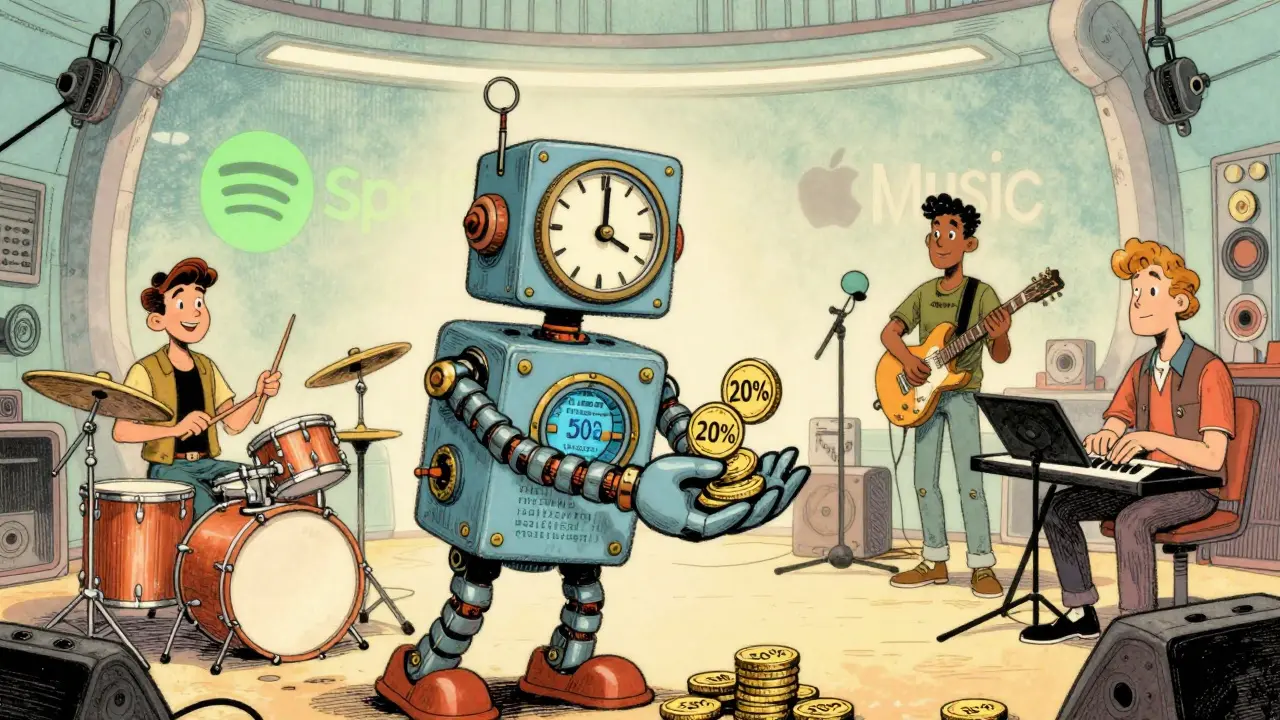
The Real Problems Blockchain Can’t Solve Alone
Don’t get it twisted. Blockchain isn’t magic. It’s only as good as the data you put in. If someone uploads a song they didn’t write and claims 100% ownership, the blockchain will record it. It doesn’t know the difference between a legal claim and a lie. That’s a human problem. And right now, there’s no automated way for a blockchain to detect plagiarism or unauthorized sampling. Also, copyright law isn’t global. A song licensed under U.S. law might be illegal to stream in Germany. Blockchain doesn’t rewrite laws. It just records them. So if the legal framework doesn’t catch up, you end up with a fancy ledger full of conflicts. And then there’s adoption. Big labels still control 70% of global music revenue. They’re slow to change. Streaming platforms like Spotify and Apple Music still use legacy systems. Until they integrate with blockchain protocols, most artists will still be stuck in the old pipeline.Who’s Already Doing This Right?
A few companies are proving it works. Sound.xyz is a platform where artists mint music as NFTs with embedded royalty splits. Fans buy tracks directly, and artists keep 85-90% of revenue, compared to 10-15% on Spotify. Audius is a decentralized music streaming service built on blockchain. It doesn’t charge artists to upload. It doesn’t take a cut. It pays out royalties in real time using its own token, $AUDIO. Dot Blockchain Music partners with labels to record every usage of a track on-chain. They’ve tracked over 200 million streams and paid out royalties within hours - not years. These aren’t startups playing with tech. They’re replacing broken systems with working ones.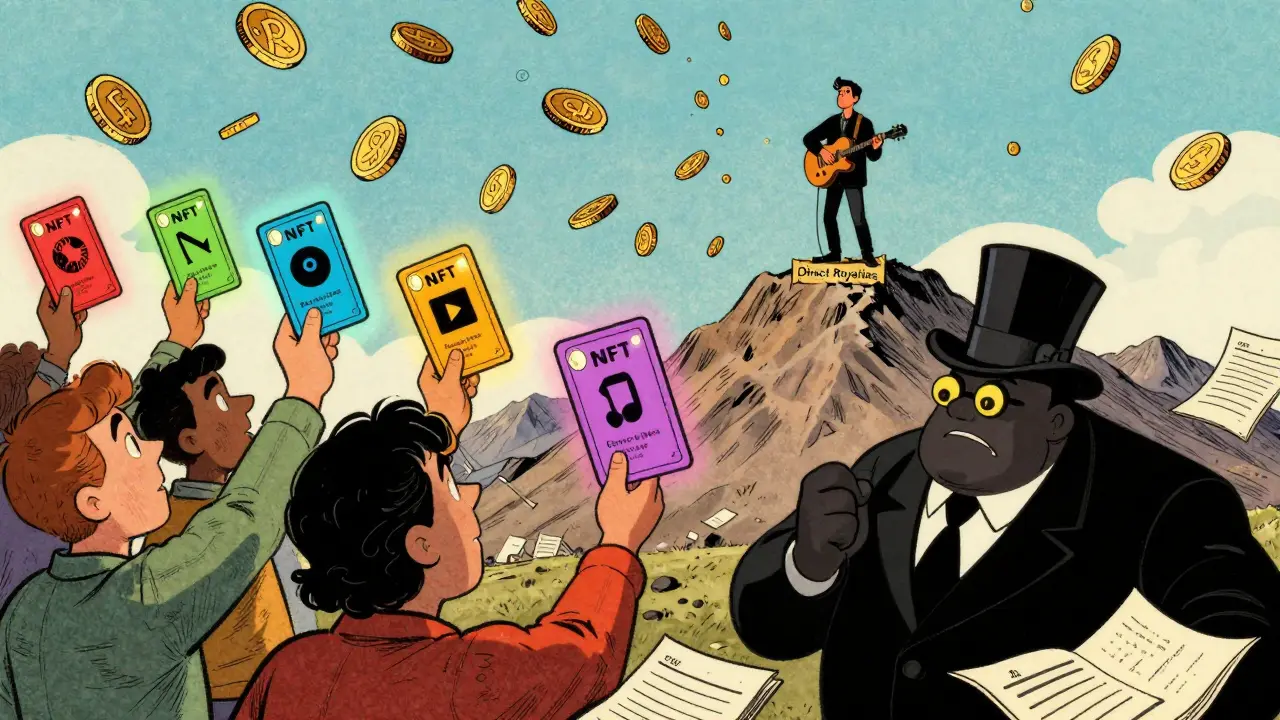
What This Means for Fans, Artists, and the Industry
For fans: You’re no longer just consuming music. You’re investing in it. When you buy a track from an artist you love, you’re not just getting a file - you’re getting a stake in their success. For artists: You get control. No more signing away rights for a $5,000 advance. You can release music directly. You can set your own terms. You can pay your collaborators fairly - and instantly. For the industry: This forces a reset. Labels that add value - marketing, touring, creative direction - will thrive. Labels that just sit on contracts and take 80% of revenue? They’ll fade out. The old model was built on asymmetry: artists need the label. The label doesn’t need the artist. Blockchain flips that. Now, the artist can go direct. And the label has to earn its place.What’s Next? The Road Ahead
The next five years will be about standardization. Right now, every blockchain music platform uses its own format. One uses Ethereum. Another uses Solana. One tracks metadata in JSON. Another uses IPFS. That’s a mess. The industry needs open standards - like how HTTP unified the web. If all platforms can talk to each other, artists can move their rights freely. Fans can buy music anywhere. Labels can integrate without rebuilding everything. Legal systems need to catch up too. Some countries already recognize blockchain records as legal evidence. Others don’t. Until there’s global alignment, disputes will still end up in court - just with better evidence. And adoption? It’s coming. Younger artists are already skipping labels. Gen Z musicians are minting tracks before they even finish recording. They know the old system doesn’t work. They’re building new ones. Blockchain won’t fix everything. But it fixes the biggest problem: trust. No more wondering if you got paid fairly. No more guessing who owns what. The ledger knows. And it never lies.Can blockchain really eliminate music industry middlemen?
Yes - but only if artists and platforms choose to use it. Blockchain removes the need for intermediaries who only handle paperwork and delays. Labels, distributors, and PROs still add value in marketing, legal, and promotion - but they no longer control access to payments. Artists can pay collaborators directly via smart contracts, and fans can buy music without going through a streaming platform’s fee structure. The middlemen don’t disappear - they evolve or get replaced.
Do I need cryptocurrency to use blockchain music platforms?
Not always. Many platforms now let you pay with credit cards or PayPal. But if you want to receive royalties or own NFTs, you’ll need a crypto wallet - like MetaMask or Phantom. These wallets hold your digital rights and let you receive payments in crypto or stablecoins. You don’t need to trade Bitcoin. Most artists convert their earnings to USD automatically through integrated services.
What happens if I upload a song with a sample I didn’t clear?
The blockchain will record your claim - but that doesn’t make it legal. If the original rights holder finds out, they can still sue you. Blockchain doesn’t replace copyright law. It just makes it easier to prove who owns what. If you sample without permission, you’re still infringing - and the ledger will be used as evidence against you. Always clear samples before uploading.
Can small independent artists benefit from this?
Absolutely. In fact, they benefit the most. Traditional systems favor artists with label backing who can navigate complex royalty collection. Independent artists often get lost in the cracks. With blockchain, an artist in Winnipeg can upload a track, set royalty splits with their drummer and producer, and start earning from day one - no application, no waiting, no minimum thresholds. It levels the playing field.
Is blockchain music rights management secure?
The blockchain itself is nearly impossible to hack - that’s the point. But your wallet? Your login? Those are weak points. If someone steals your private key, they can transfer your NFTs or claim your royalties. Always use hardware wallets, enable two-factor authentication, and never share your recovery phrase. Security isn’t built into the blockchain - it’s your responsibility.

Robert Mills
February 2, 2026 AT 09:32Jerry Ogah
February 3, 2026 AT 20:49Andrea Demontis
February 4, 2026 AT 10:06Joseph Pietrasik
February 4, 2026 AT 21:28Raju Bhagat
February 6, 2026 AT 06:17laurence watson
February 8, 2026 AT 00:25Pamela Mainama
February 8, 2026 AT 13:50Christopher Michael
February 9, 2026 AT 21:22Parth Makwana
February 11, 2026 AT 05:45Brandon Vaidyanathan
February 12, 2026 AT 07:06Gareth Fitzjohn
February 12, 2026 AT 21:35Katie Teresi
February 14, 2026 AT 02:48Moray Wallace
February 14, 2026 AT 04:25Dylan Morrison
February 14, 2026 AT 12:15William Hanson
February 15, 2026 AT 01:33Lori Quarles
February 16, 2026 AT 02:12Jeremy Dayde
February 16, 2026 AT 18:23Akhil Mathew
February 18, 2026 AT 14:07Tom Sheppard
February 20, 2026 AT 13:17