

Imagine walking into a crowded room and trying to tell everyone the time. If you shout it once, only those near you hear. If you walk up to each person individually, it takes forever. Now, imagine telling five people, who then each tell five more people, who tell five more. Within seconds, the whole room knows. This is not just efficient; it is resilient. If one person leaves or lies, the message still spreads through the others. This exact mechanism powers the backbone of Bitcoin, Ethereum, and thousands of other blockchain networks. It is called the Gossip Protocol, which is a decentralized peer-to-peer communication technique that uses random, periodic exchanges to propagate information across large distributed systems.
You might wonder why blockchains don't just use a central server to broadcast updates. The answer lies in the core promise of blockchain: decentralization. There is no boss, no central authority, and no single point of failure. To keep millions of nodes synchronized without a conductor, these networks rely on chaos managed by math. The gossip protocol turns this chaotic potential into a reliable, self-healing network.
The Origins: From Epidemics to Code
The concept didn't start with crypto bros or Bitcoin miners. It started in 1987, long before blockchain existed. A group of computer scientists, including Alan Demers and Doug Terry, published a paper titled "Epidemic Algorithms for Replicated Database Maintenance." They looked at how diseases spread through populations and realized that nature had already solved the problem of distributing information efficiently across large groups.
In an epidemic, one infected person passes the virus to a few others. Those new cases pass it to more people. Eventually, the entire population is exposed, but no single person had to infect everyone directly. The researchers applied this logic to database replication. Instead of a master server pushing updates to every client (which creates a bottleneck), each node randomly selects peers to share its data with. This approach ensures that even if half the network goes offline, the remaining nodes can still sync up when they reconnect.
This biological inspiration gives the protocol its name. Just like rumors spread through social circles, data spreads through network connections. It is simple, robust, and surprisingly effective for systems that need to scale to millions of participants.
How the Mechanism Actually Works
To understand how your wallet stays updated with the latest transactions, you need to look at the cycle. The gossip protocol operates in fixed time intervals, often referred to as rounds. Let's say a round happens every second. Here is what occurs during that second:
- Selection: Each node picks a small, random subset of other nodes from its known list. It doesn't contact everyone; that would crash the network. It might pick three or five peers.
- Exchange: The node sends its current state-such as recent transactions or blocks-to those peers. Simultaneously, it receives their states.
- Merging: The node compares the new information with what it already has. If it receives a newer version of a transaction or a block it missed, it adds it to its local ledger. Older duplicates are discarded.
- Propagation: In the next round, the node repeats the process, potentially sharing the newly acquired information with different peers.
This process continues until the information reaches a high probability of being present on all nodes. Because the selection is random, there is no guarantee that Node A talks to Node B in any specific order. However, over logarithmic time relative to the network size, the information saturates the system. This is known as eventual consistency. You might see a transaction on your screen a second before it appears on a node in another continent, but given enough time, they will match.
Key Parameters That Control the Flow
The effectiveness of the gossip protocol depends heavily on two main settings: fanout and timing. These parameters determine how fast information spreads versus how much bandwidth it consumes.
| Parameter | Description | Impact on Network |
|---|---|---|
| Fanout | The number of peers a node contacts per round | Higher fanout speeds up propagation but increases bandwidth usage |
| Cycle Timing | The frequency of gossip rounds (e.g., every 0.5s vs 2s) | Shorter cycles reduce latency but increase CPU load |
| Tombstones | Markers for invalidated data | Prevents stale data from resurfacing after network partitions |
If the fanout is too low, information moves slowly, causing delays in transaction confirmation. If it is too high, the network drowns in traffic, slowing down everything else. Developers must find the sweet spot. For example, Bitcoin typically uses a fanout of around 4 to 6 nodes per announcement, while Ethereum may adjust this based on network congestion. The cycle timing also matters. In a high-frequency trading environment within a blockchain context, faster cycles are crucial. In a supply chain tracking system where data changes rarely, slower cycles save resources.
Another critical concept is the "tombstone." When data needs to be deleted or invalidated, you can't just remove it because other nodes might have already received it. Instead, you send a tombstone-a marker that says, "Ignore this key." This ensures that if a node re-syncs later, it knows the data is obsolete rather than treating it as new.

Why Blockchains Love Gossip Protocols
The advantages of this approach align perfectly with the goals of decentralized finance and blockchain technology. First, it is incredibly fault-tolerant. In traditional client-server models, if the server crashes, the service stops. In a gossip network, if 30% of nodes go offline, the remaining 70% continue to exchange data. When the offline nodes return, they quickly catch up by gossiping with active peers. There is no single point of failure.
Second, it scales logarithmically. This means that as the network grows from 1,000 nodes to 1 million nodes, the time it takes for information to spread does not grow linearly. It grows much slower. This scalability is essential for public blockchains that aim for global adoption. Without gossip protocols, adding more users would exponentially increase the burden on the network infrastructure.
Third, it is simple to implement. Nodes do not need complex routing tables or knowledge of the entire network topology. They only need to know a few neighbors. This simplicity reduces bugs and makes it easier for new developers to build compatible clients. It also allows for dynamic membership. Nodes can join or leave the network at any time without disrupting the overall flow of information.
The Trade-Offs: Latency and Complexity
Despite its benefits, the gossip protocol is not perfect. The biggest drawback is latency. Because information hops from node to node, there is always a delay between when a transaction is created and when it is visible to the entire network. This is why you sometimes see "pending" transactions in your wallet. The network is still gossiping about it. For applications requiring real-time consistency, such as high-frequency stock trading, this delay can be problematic.
Debugging is another challenge. Since the path of information is probabilistic, tracing why a specific node missed a update can be difficult. Was it a network partition? Did the node fail to respond to a ping? Or was it simply unlucky in its random selections? This randomness makes testing and monitoring more complex than deterministic systems.
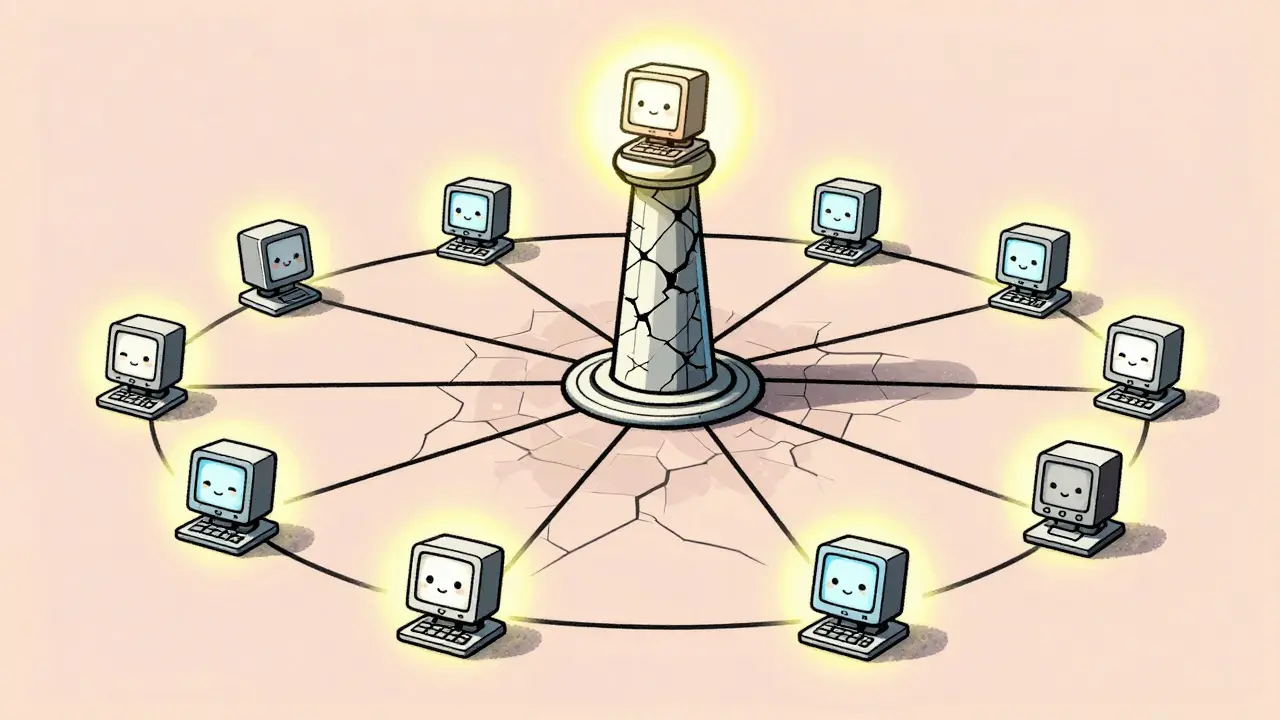
Additionally, gossip protocols can be vulnerable to certain attacks. Malicious actors can flood the network with fake gossip messages, wasting bandwidth and CPU resources. This is known as a Sybil attack, where an attacker creates many fake identities to dominate the gossip pool. To mitigate this, blockchains combine gossip protocols with proof-of-work or proof-of-stake mechanisms, ensuring that only valid, verified data is propagated widely.
Real-World Applications in Major Blockchains
You can see the gossip protocol in action in almost every major cryptocurrency. In Bitcoin, when a miner solves a block, they broadcast it to their immediate peers using a gossip-style announcement. Those peers verify the block and forward it to their peers. Within minutes, the entire network acknowledges the new block. This ensures that double-spending attempts are quickly rejected because the majority of nodes agree on the latest state.
Ethereum uses a similar approach but with more complexity due to its smart contract functionality. Ethereum nodes gossip not just about transactions and blocks, but also about state roots and receipts. This allows light clients, which don't store the full blockchain, to verify transactions by requesting specific proofs from full nodes via gossip channels.
Beyond cryptocurrencies, gossip protocols are used in distributed databases like Apache Cassandra and Riak. These systems use gossip to maintain cluster membership and detect failures. If a node stops responding to gossip pings, other nodes mark it as dead and redirect queries elsewhere. This same principle applies to blockchain nodes, ensuring that the network remains healthy and responsive.
Future Directions: Optimizing for Scale
As blockchains grow larger, the limitations of basic gossip protocols become more apparent. Researchers are developing advanced variants to address these issues. One promising area is topic-based gossip, where nodes only subscribe to specific types of data. For example, a node interested only in NFT transactions might ignore DeFi swaps, reducing unnecessary traffic.
Another development is geographic-aware gossip. By prioritizing peers in nearby regions, networks can reduce latency for local users while still maintaining global consistency. This is particularly useful for layer-2 solutions that require fast finality. Additionally, integration with sharding techniques requires modified gossip protocols that can handle cross-shard communication efficiently, ensuring that data flows correctly between different segments of the network.
The fundamental principles established in 1987 remain relevant today. The gossip protocol proves that sometimes, the most robust solutions are inspired by the simplest natural processes. By embracing randomness and redundancy, blockchain networks achieve a level of resilience that centralized systems struggle to match.
What is the difference between gossip protocol and broadcasting?
Broadcasting typically involves sending a message to all nodes simultaneously or through a structured tree, which can overwhelm the network. Gossip protocol uses random, limited exchanges between subsets of nodes, making it more scalable and resilient to failures, though slightly slower.
Why is eventual consistency acceptable in blockchain?
Blockchain relies on consensus mechanisms like Proof of Work or Proof of Stake to resolve conflicts. Eventual consistency means that while nodes may temporarily disagree, the consensus algorithm ensures they converge on the same truth over time, preventing double-spending and fraud.
How does fanout affect network performance?
Fanout determines how many peers a node contacts per round. Higher fanout speeds up information spread but increases bandwidth and CPU usage. Lower fanout saves resources but slows down propagation. Finding the right balance is crucial for network health.
Can gossip protocols be hacked?
Yes, through Sybil attacks where attackers create fake nodes to dominate gossip pools, or eclipse attacks where they isolate a victim node. However, blockchains mitigate these risks by combining gossip with economic incentives and cryptographic verification.
Is gossip protocol used outside of blockchain?
Absolutely. It is widely used in distributed databases like Cassandra, cloud computing services for health checks, and even in IoT networks for device coordination. Any system needing robust, scalable communication without a central server benefits from gossip protocols.
