
Flash Loan Profit Calculator
Flash loans are one of the most mind-bending innovations in decentralized finance. They let you borrow millions of dollars in crypto-without putting up a single dollar as collateral. No credit check. No lock-up. No waiting. But there’s a catch: you have to pay it all back-plus a fee-before the transaction ends. And that window? It’s less than 15 seconds.
How a Flash Loan Actually Works
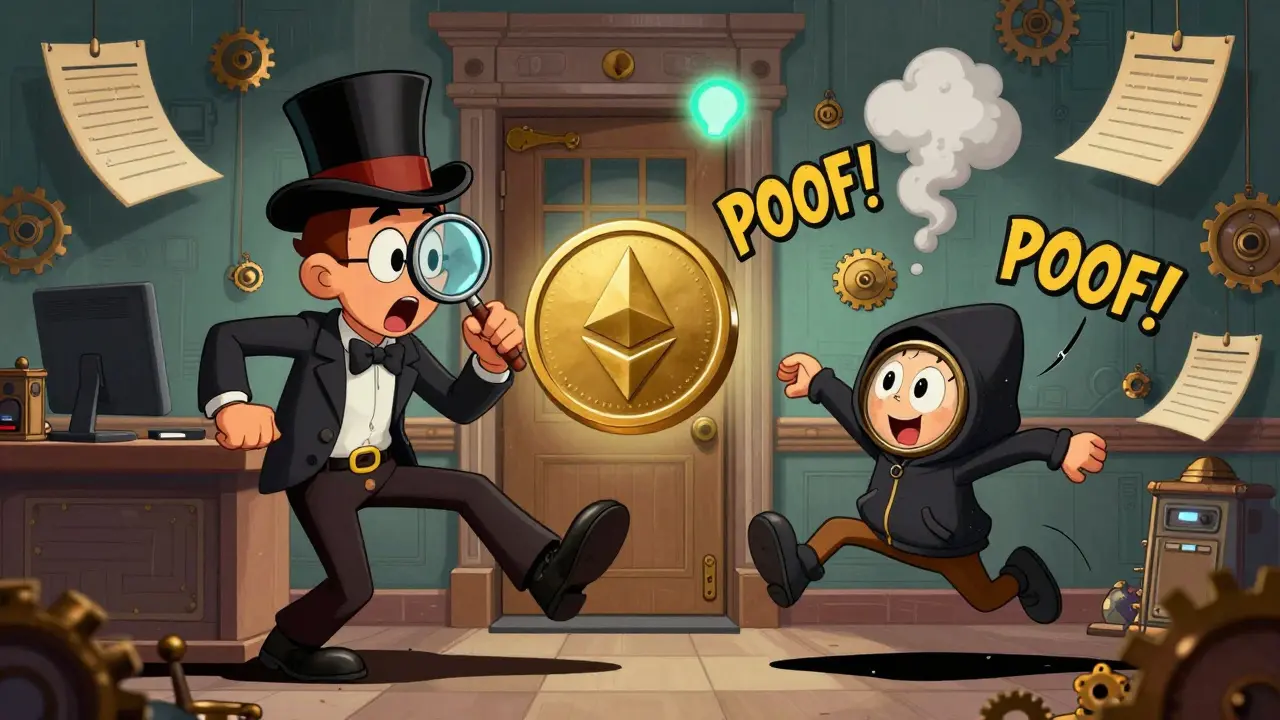
Think of a flash loan like a magic trick. You walk into a bank, ask for $1 million, walk out with it, and then walk right back in and hand it back-before the teller even finishes typing your name. The bank never loses money because the whole thing happens in one instant. If you don’t return it, the transaction vanishes like it never happened. In DeFi, this magic is powered by smart contracts on blockchains like Ethereum. When you request a flash loan from a protocol like Aave or Uniswap, the protocol doesn’t send you cash. It sends you a digital IOU-tokens you can use immediately, but only inside the same blockchain transaction. Here’s the step-by-step:- You trigger a flash loan from a DeFi protocol (like Aave).
- The protocol transfers the borrowed assets (say, 1,000 ETH) directly to your smart contract.
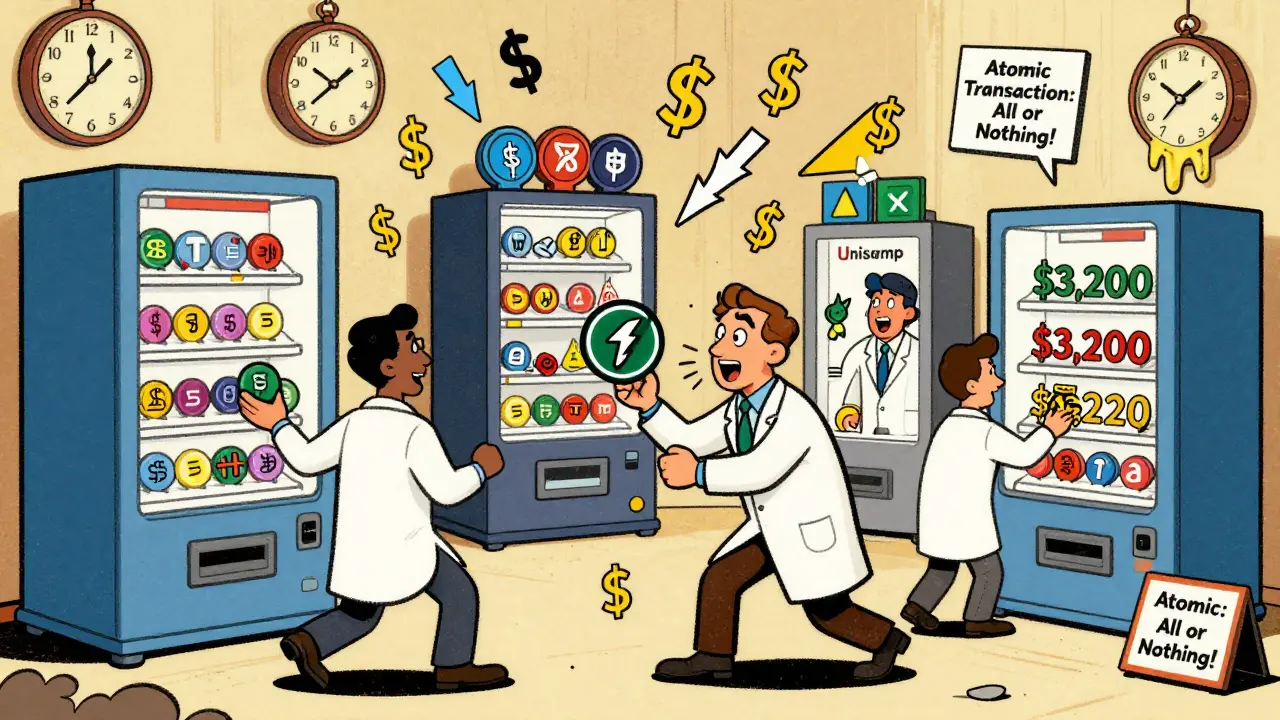
- While that transaction is still open, your contract executes a series of actions: swapping tokens on Uniswap, buying low on one exchange and selling high on another, or liquidating an undercollateralized position on Compound.
- Before the transaction closes, your contract must return the borrowed amount plus a fee (0.09% on Aave, 0.3% on Uniswap).
- If the repayment fails-even by one wei-the entire transaction is rolled back. No one loses anything. The loan never happened.
This is possible because of atomicity-a core feature of blockchain transactions. Either everything succeeds, or everything fails. No in-between.
Why Would Anyone Lend Without Collateral?
It seems crazy. Why would a DeFi protocol lend you $5 million with zero security? The answer: because they don’t actually risk anything. Unlike traditional loans, where the lender worries about default, flash loans are designed so default is impossible. If you don’t repay, the whole transaction is canceled. The protocol never loses tokens. The only cost to them is the gas fee they pay to process the transaction-and even that gets reimbursed when you pay the fee. In fact, flash loans are profitable for lenders. Aave charges a 0.09% fee on every flash loan. That might sound tiny, but with billions flowing through daily, it adds up. In Q3 2023, Aave processed 62% of all flash loan volume, earning millions in fees from a system that requires zero capital reserves.What Are Flash Loans Used For?
Flash loans aren’t for buying a house or paying bills. They’re for high-speed, capital-efficient DeFi strategies that can’t happen anywhere else.- Arbitrage: Buy ETH for $3,200 on Uniswap, sell it for $3,220 on Sushiswap-all in one transaction. Profit: $20,000 on a $1 million loan.
- Collateral swapping: Borrow DAI, use it to repay a loan on Compound, then swap your collateral from ETH to WBTC to avoid liquidation.
- Protocol liquidations: When someone’s position is undercollateralized, you can use a flash loan to buy their collateral at a discount and pocket the difference.
- Self-liquidation: Some traders use flash loans to trigger their own liquidations strategically, to reset their position with better terms.
One user on Reddit borrowed $2.3 million via flash loan in August 2023, executed an arbitrage between two DEXs, and walked away with $14,200 in profit after fees and gas. That’s a 0.6% return in under 3 seconds.
Flash Loans vs. Traditional DeFi Loans
| Feature | Flash Loan | Standard DeFi Loan |
|---|---|---|
| Collateral Required | 0% | 110-150% |
| Loan Duration | Seconds | Days to months |
| Repayment Deadline | Within same transaction | Fixed schedule |
| Interest Rate | 0.09-0.3% | 2-15% APR |
| Use Case | Arbitrage, liquidations | Holding, leverage, borrowing for long-term use |
| Technical Skill Needed | Advanced (Solidity, smart contracts) | Basic (wallet, UI) |
Standard DeFi loans require you to lock up more value than you borrow. If ETH drops 20%, your position might get liquidated. Flash loans skip all that. But they also skip the flexibility. You can’t hold ETH from a flash loan for a week. You have to use it and return it-immediately.
The Risks: It’s Not All Profit
Flash loans are powerful-but dangerous. In 2022, attackers used flash loans to exploit vulnerabilities in DeFi protocols and stole over $327 million, according to Chainalysis. These aren’t random hacks. They’re targeted attacks that use the loan to manipulate prices, drain liquidity pools, or trick oracles into reporting fake values. One famous example: in October 2020, Harvest Finance lost $30 million because a flash loan attack flooded their system with fake token prices. The oracle thought the token was worth more than it was, so the attacker borrowed against inflated collateral, drained the vault, and disappeared. Even legitimate users get burned. A GitHub user lost $850 trying to deploy a flash loan contract because they didn’t understand slippage limits or reentrancy guards. The learning curve is steep. OpenZeppelin found that 63% of open-source flash loan contracts have critical security flaws.
Who Uses Flash Loans Today?
Most flash loan users fall into two groups:- Sophisticated retail traders: These are developers or crypto-native traders who write their own contracts or use pre-built tools. They make up 63% of flash loan volume, with average transaction sizes around $1.2 million.
- Institutional players: Quant trading firms like Alameda Research and GSR use flash loans for high-frequency arbitrage across exchanges. They now account for 37% of volume, up from under 10% in 2021.
Regular users? Almost none. You can’t use a flash loan on MetaMask like a regular loan. You need to interact directly with smart contracts. That means coding, testing, and understanding gas fees. CoinGecko’s 2023 survey found only 22% of novice users succeeded in their first attempt.
What’s Changing in 2025?
Flash loans aren’t standing still. Aave’s V3 protocol, launched in 2022, added circuit breakers and time-locked fees to slow down attack patterns. The Ethereum Shanghai upgrade in April 2023 cut gas costs for complex operations by 15%, making flash loans cheaper to execute. Uniswap Labs updated its flash swap system in July 2023 to introduce tiered fees based on liquidity depth-rewarding users who use less volatile pools. And the next frontier? Cross-chain flash loans. Right now, flash loans only work within one blockchain. But protocols are testing ways to move assets between Ethereum, Polygon, and Arbitrum in a single atomic transaction. Regulators are watching. The SEC has flagged flash loans as potential tools for market manipulation. The Financial Stability Board warned in late 2022 that they could spread shocks rapidly across DeFi. But for now, they’re still legal-and thriving.Can You Use Flash Loans as a Beginner?
Technically, yes. But practically? Not without serious preparation. If you’re new to DeFi, here’s what you need before even thinking about a flash loan:- Basic Solidity programming skills
- Understanding of how AMMs like Uniswap work
- Experience with wallet interactions and gas estimation
- Knowledge of common attack vectors (reentrancy, oracle manipulation, MEV)
Finematics estimates it takes 40-60 hours of study to safely deploy a basic flash loan contract. Most people who try without this background lose money-fast.
Instead of jumping in, start by using platforms like Aave’s UI to simulate arbitrage trades with real funds. Or study open-source flash loan contracts on GitHub. Learn how they handle repayment, price checks, and error handling.
Flash loans are not a get-rich-quick tool. They’re a high-risk, high-skill lever for those who already understand DeFi’s inner workings. For everyone else, they’re a fascinating glimpse into the future of finance-where money moves at the speed of code.
Can you get a flash loan without a smart contract?
No. Flash loans require interaction with a smart contract that executes the entire loan and repayment in one transaction. You can’t request one through a regular wallet like MetaMask. You need to write or deploy code, or use a platform that abstracts the complexity-for example, some DeFi dashboards offer flash loan templates. But even then, you’re still relying on a contract behind the scenes.
What happens if I can’t repay a flash loan?
Nothing happens-because the loan never happened. If your contract fails to repay the borrowed amount plus fee before the transaction ends, the entire transaction is reverted. The protocol takes back the tokens. Your wallet isn’t charged. No debt is created. It’s like hitting undo on a purchase that never completed.
Are flash loans legal?
Yes, as of 2025, flash loans are legal in most jurisdictions. They’re treated as automated smart contract executions, not traditional loans. However, regulators like the SEC are scrutinizing their use in market manipulation. Using flash loans to artificially inflate prices or trigger liquidations for profit may violate securities laws in some regions, especially if done at scale or with insider information.
How much does a flash loan cost?
The fee is typically 0.09% on Aave and 0.3% on Uniswap. But that’s just the protocol fee. You also pay gas fees to execute the transaction on Ethereum. Gas can range from $0.50 to $5, depending on network congestion. For a $1 million loan, you’d pay about $900 in protocol fees and $2-$4 in gas. Total cost: less than $1,000.
Can flash loans be used on blockchains other than Ethereum?
Yes. While Ethereum hosts the majority of flash loans, protocols on Polygon, BNB Chain, and Avalanche also support them. However, cross-chain flash loans-where you borrow on one chain and repay on another-are still experimental. Most flash loans today are confined to a single blockchain due to the complexity of ensuring atomicity across networks.
Do flash loans contribute to DeFi security?
Surprisingly, yes. While they’re used in attacks, they also expose weaknesses in DeFi protocols. Security researchers use flash loans to stress-test systems. When a protocol survives a flash loan attack, it becomes more resilient. As Paradigm’s Chief Scientist put it, flash loans test DeFi’s economic security more rigorously than any other tool. Many of the fixes in Aave, Uniswap, and Compound today came from lessons learned during flash loan exploits.

Joe West
December 4, 2025 AT 12:09Flash loans are wild because they turn finance into a real-time video game. One move, one second, all or nothing. It’s not magic-it’s code that’s better at math than any human.
And yeah, the fees are tiny, but the gas? That’s where you get wrecked if you’re not careful.
Cristal Consulting
December 4, 2025 AT 19:05Biggest mistake beginners make? Thinking this is a shortcut to riches.
It’s not. It’s a scalpel. Use it wrong and you cut yourself.
Regina Jestrow
December 5, 2025 AT 02:40I tried this once. Not even a full loan-just a $50k dry run. My contract had a typo in the repayment check. Transaction reverted. I lost $18 in gas. Felt like I’d been slapped by a robot.
But I learned more in 12 seconds than I did in three months of reading whitepapers.
That’s the real value: brutal, instant feedback.
You don’t learn DeFi by watching YouTube tutorials.
You learn it by watching your wallet vanish in 7.3 seconds.
And then you go back and fix it.
And again.
And again.
Until you stop being the guy who gets exploited.
And become the guy who builds the exploit-proof contract.
Flash loans are the ultimate crash course.
And yes, it’s terrifying.
But that’s why they work.
There’s no room for guesswork.
Either you know what you’re doing-or you lose everything.
And that’s the beauty of it.
sonia sifflet
December 5, 2025 AT 07:52Everyone talks about arbitrage like it’s easy. Try running a flash loan on a chain with 150 gwei gas. Your $20k profit becomes a $3k loss after fees. And don’t even get me started on MEV bots stealing your sandwich before you even finish the swap.
You think you’re the shark? You’re the minnow.
Stanley Wong
December 7, 2025 AT 04:06I used to think flash loans were just for whales and quants but then I saw a guy on Twitter use one to swap his ETH for WBTC just to avoid a liquidation on Compound
He didn’t even make money
He just didn’t want to lose his position
And that’s when it hit me
This isn’t about profit
This is about control
It’s the only way in DeFi where you can force the system to bend to your timing
Not the other way around
It’s like having a pause button on your own financial disaster
And that’s kind of beautiful in a messed up way
Even if you’re just trying to save yourself
Not make a killing
Just survive
And that’s more powerful than any arbitrage
Chris Mitchell
December 8, 2025 AT 23:02Flash loans don’t create value. They redistribute it. And the ones who profit are the ones who already know where the value is hiding.
It’s not a tool for the new. It’s a weapon for the prepared.
Scott Sơn
December 10, 2025 AT 07:50Imagine walking into a bank, grabbing $10M, flipping it on Binance, and walking out with $200k profit before the teller even says ‘Welcome!’
Then the bank says ‘Thanks for playing!’
And you just… disappeared.
That’s not finance.
That’s heist movie meets blockchain.
And honestly? I’m glad I’m not the one writing the code that makes this possible.
One typo and you’re the villain in the next DeFi documentary.
Nina Meretoile
December 11, 2025 AT 07:59Flash loans are like a mirror for DeFi’s soul.
They show us who’s building securely and who’s just slapping code together.
Every exploit? A lesson.
Every safe protocol? A victory.
They’re not just a tool-they’re a stress test for the entire ecosystem.
And honestly? I’m grateful for them.
Because without them, we’d still be trusting bad contracts that leak millions.
Flash loans don’t break DeFi.
They make it stronger.
Even if it hurts to watch.
Kenneth Ljungström
December 12, 2025 AT 00:29Just wanna say big up to the devs who build safe flash loan systems 🙌
You’re the unsung heroes keeping this whole thing from collapsing.
And to everyone trying this for the first time?
Start small. Test on Sepolia. Don’t rush.
We’ve all been there.
And we all lost gas money to learn.
You got this 💪
Brooke Schmalbach
December 13, 2025 AT 18:45Let’s be real: 90% of flash loan users are just MEV bots disguised as ‘traders.’
They’re not making arbitrage profits.
They’re front-running your trades, draining liquidity pools, and calling it ‘innovation.’
And the protocols? They’re happy to take their 0.09% fee while the whole system gets gamed.
It’s not DeFi.
It’s a casino rigged by algorithms.
rita linda
December 14, 2025 AT 20:09Flash loans are the pinnacle of crypto’s pathological obsession with leverage.
No collateral? No accountability? No oversight?
It’s not financial innovation.
It’s financial nihilism.
And the fact that people celebrate this as ‘freedom’ is why we’re doomed.
This isn’t the future of finance.
This is the last gasp of a system built on illusions.
michael cuevas
December 16, 2025 AT 02:11So you spent 60 hours learning Solidity just to lose $20 in gas
And now you’re a ‘DeFi expert’
Congrats
You’re officially part of the cult
Now go write a blog post about how ‘this is the future’
And don’t forget to tag #DeFiIsTheFuture
And #FlashLoansAreMagic
And #IJustMadeMyFirstTransaction
And also
How’s your credit score?
Shane Budge
December 16, 2025 AT 17:24How many flash loans have you executed? Just curious.
Richard T
December 18, 2025 AT 16:11Shane, I’ve done 14. Three profitable. Eleven taught me more than any course ever could.
Mostly I use them to test new protocols-see how they react under pressure.
It’s like stress-testing a bridge before you let cars drive on it.
And yeah, I lost money.
But now I know which contracts are safe.
That’s worth more than any profit.
jonathan dunlow
December 18, 2025 AT 16:47People don’t realize flash loans are the reason DeFi didn’t die in 2022.
Every major exploit? Someone used a flash loan to find it.
Every fix? Born from someone getting burned.
It’s not a feature.
It’s the immune system of DeFi.
And if regulators shut this down?
We’re back to banks.
And nobody wants that.
So yeah, it’s risky.
But it’s also the only thing keeping this ecosystem alive.
Don’t hate the tool.
Learn how to use it right.
Barb Pooley
December 20, 2025 AT 07:39Flash loans are just a distraction.
Real wealth is in holding ETH.
Everything else is casino math.
And if you think you can outsmart the bots?
Good luck with that.
They’re running on AWS clusters with 1000x your computing power.
You’re using your laptop at 2am.
Wake up.
This isn’t a game.
It’s a slaughterhouse.
And you’re the cow.
Mariam Almatrook
December 21, 2025 AT 12:41It is profoundly disconcerting to observe the normalization of uncollateralized financial instruments within a decentralized ecosystem predicated upon algorithmic trust.
One must question whether the aesthetic allure of atomic transactions supersedes the foundational tenets of economic prudence.
Are we engineering financial liberation-or merely constructing a more efficient mechanism for systemic collapse?
The fee structure, while ostensibly trivial, masks a deeper parasitism: the protocol extracts value not through capital allocation, but through transactional velocity.
It is not innovation.
It is optimization for extraction.
And the participants? They are not traders.
They are data points in a predictive model designed to maximize gas revenue.
One must wonder: when the next black swan event occurs, who bears the cost?
Not the protocol.
Not the whales.
But the retail user who believed the myth of ‘no risk.’
And so, the question remains-
Is this finance?
Or is it merely the illusion of finance, rendered in bytecode?
nicholas forbes
December 22, 2025 AT 10:01I respect the ambition behind flash loans.
But I also know my limits.
I’m not coding smart contracts.
I’m not running arbitrage bots.
And that’s okay.
I use Aave to lend and borrow like a normal person.
And I sleep at night.
There’s no shame in that.
DeFi doesn’t need everyone to be a hacker.
It just needs some of us to be sane.