
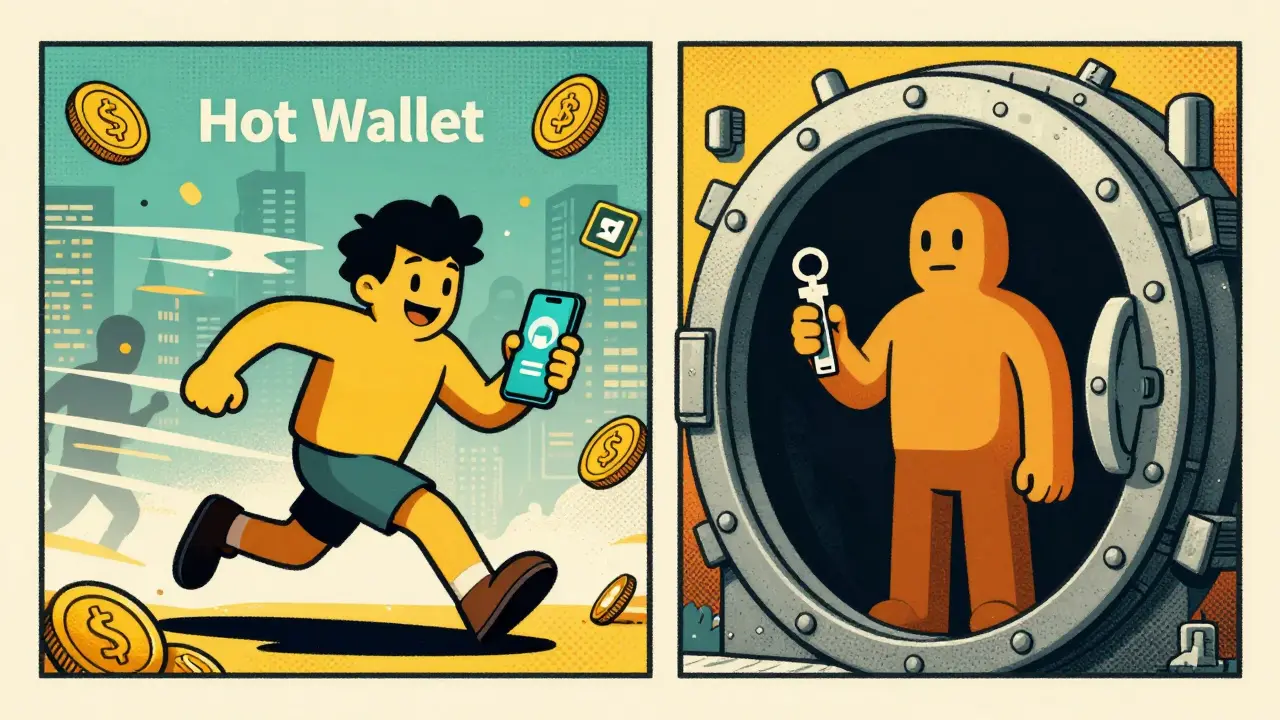
You don't actually store cryptocurrency in your wallet. That sounds like a trick question, but it’s the most important thing to understand before you buy anything. Your Bitcoin, Ethereum, or Solana lives on the blockchain-a public ledger visible to everyone. What you hold in your "wallet" are private keys, which are essentially cryptographic passwords that prove you own those assets. If someone steals your private key, they steal your money. There is no customer service call to reverse it.
This reality makes the choice between a hot wallet and a cold wallet not just about convenience-it’s about survival. A hot wallet is connected to the internet, making it fast but vulnerable. A cold wallet is offline, making it secure but slower. In 2026, with hackers stealing billions annually, knowing which one protects your specific amount of crypto is the difference between sleeping well and losing everything.
The Core Difference: Online Convenience vs. Offline Security
Think of a hot wallet like cash in your pocket. It’s easy to spend at a coffee shop, but if you get pickpocketed, it’s gone. A cold wallet is like a safety deposit box at a bank. You have to go through steps to access it, but it’s incredibly hard for thieves to break into.
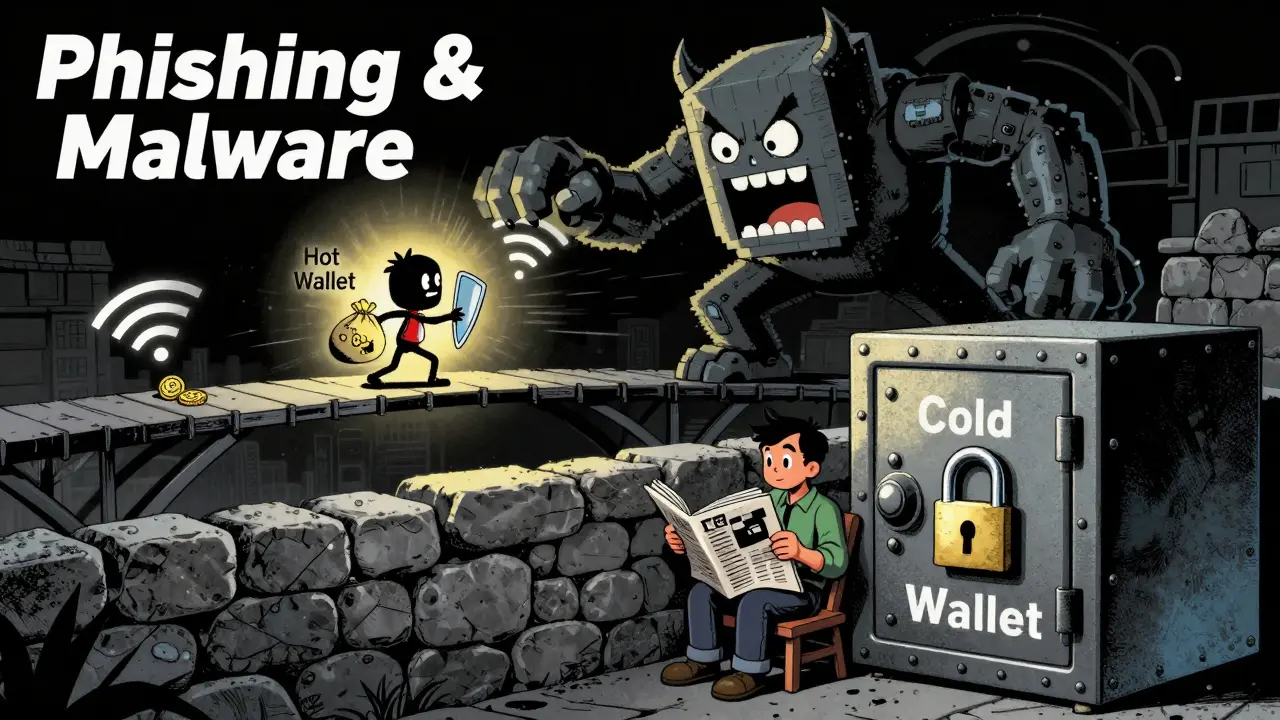
Hot wallets are software-based applications. They exist as mobile apps (like Trust Wallet or Exodus), browser extensions (like MetaMask), or built directly into exchanges (like Coinbase). Because they are always connected to the internet, they can sign transactions instantly. This connectivity is their superpower and their fatal flaw. Every time you connect to the web, you expose your private keys to potential malware, phishing sites, and network attacks.
Cold wallets, also known as hardware wallets, are physical devices. They look like USB drives but contain specialized chips designed to generate and store private keys completely offline. When you want to send crypto, you plug the device in, confirm the transaction on its small screen, and the signature is created inside the device. The private key never leaves the hardware. This "air-gapped" architecture means that even if your computer is infected with the worst virus in the world, your funds remain safe because the hacker cannot reach the keys.
Security Breakdown: Why Cold Wallets Win for Big Holdings
If your primary goal is security, the data is clear. According to TRM Labs' October 2023 report, hackers stole $7.04 billion in cryptocurrency during 2022-2023. Nearly 70% of these breaches involved compromised private keys or seed phrases. Most of these compromises happened in hot environments where keys were exposed to the internet.
BitGo’s 2024 penetration testing, which simulated 10,000 attack scenarios, found that cold wallets demonstrated 99.7% effectiveness against remote attacks. Hot wallets managed only 62.3%. The reason is simple: cold wallets eliminate the attack surface. Kaspersky’s 2024 blockchain security study showed that air-gapped transaction signing prevents 98.7% of malware-based attacks. Since 2018, there have been no documented cases of a properly secured hardware wallet being compromised remotely. The keys simply aren't there for the hacker to grab.
However, "properly secured" is doing a lot of heavy lifting. Cold wallets face different risks. BitGo’s 2024 custody report noted a 3.7% annual loss rate for hardware wallets due to physical loss or damage. If you lose your device and haven’t backed up your recovery seed phrase, your money is gone forever. Similarly, Reddit users documented 17 physical theft cases of hardware wallets in early 2025 alone. Security researcher Jonathan Levin warned that hardware wallets create a false sense of security if users ignore firmware updates; 68% of compromised Ledger devices in 2024 ran outdated software.
Convenience and Speed: Where Hot Wallets Shine
While cold wallets are safer, they are annoying to use for daily tasks. Sending a transaction from a cold wallet takes 45-90 seconds because you must physically press buttons on the device to verify details. For active traders, this friction is unacceptable.
Hot wallets process transactions in 2-5 seconds. They are essential for interacting with Decentralized Finance (DeFi) platforms. DappRadar’s Q1 2025 data shows that users make an average of 12.7 DeFi transactions per week using hot wallets, compared to just 0.8 for cold wallets. MetaMask, the most popular browser extension, connects to over 12,800 decentralized applications. Trying to swap tokens, provide liquidity, or mint NFTs using a hardware wallet requires plugging it in, connecting the app, confirming on the screen, and waiting. Do that ten times a day, and you’ll likely move your funds back to a hot wallet.
Hot wallets also offer instant liquidity access. If you need to pay for something quickly or react to a market swing, having your funds in a hot wallet like Coinbase Wallet or Trust Wallet allows immediate action. They support 5,000+ cryptocurrencies across 100+ networks, often with better user interfaces than hardware companion apps.
| Feature | Hot Wallet | Cold Wallet |
|---|---|---|
| Connectivity | Always Online | Offline (Air-Gapped) |
| Security Level | Moderate (Vulnerable to Phishing/Malware) | High (Immune to Remote Hacks) |
| Transaction Speed | Fast (2-5 seconds) | Slow (45-90 seconds) |
| Cost | Free | $50 - $250+ |
| Best For | Daily Trading, DeFi, Small Amounts | Long-Term Holding, Large Sums |
| Risk Profile | Hacking, Phishing, Seed Theft | Physical Loss, Device Damage, User Error |
Which One Should You Choose? The 5% Rule
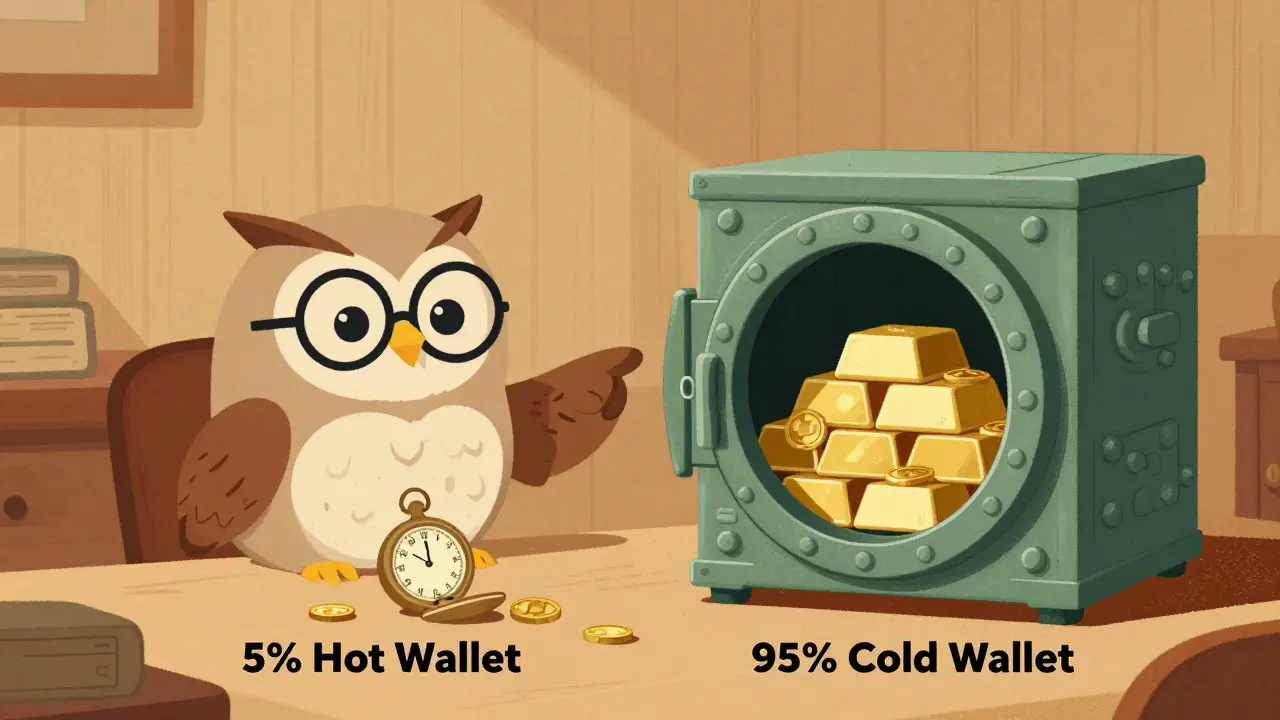
You don’t have to choose just one. The standard advice from industry experts, including Litecoin creator Charlie Lee and UC Berkeley cryptography professor Dr. David Wagner, is to use both. The strategy is often called the "5% Rule."
Keep 95% of your cryptocurrency in a cold wallet. This is your savings account, your retirement fund, your long-term investment. It sits offline, untouched by daily internet threats. Only keep 5% in a hot wallet. This is your spending money-funds you actively trade, use for DeFi yields, or need for quick transactions.
Dr. Wagner explicitly stated in his February 2025 Black Hat conference presentation that any amount exceeding $5,000 should never reside in hot storage for more than 72 hours. NerdWallet’s 2024 security survey supported this, finding that users who kept holdings over $10,000 in hot wallets suffered 43% higher compromise rates.
If you are new to crypto and only have a few hundred dollars, a reputable hot wallet like Trust Wallet or the Coinbase Wallet app is sufficient. The hassle of buying a hardware device isn't worth it yet. However, as soon as your portfolio grows beyond what you would comfortably lose in a robbery, invest in a cold wallet. Popular options in 2026 include the Ledger Nano X ($149), Trezor Model T ($219), and Ellipal Titan 2.0 ($149.99). These devices feature secure elements certified to high standards (like Ledger's CC EAL6+ chip) to prevent physical tampering.
Common Pitfalls and How to Avoid Them
Even with the right tools, human error is the biggest risk. Here is how people lose money despite using "secure" methods:
- Phishing Links: Chainalysis reports that phishing accounted for 38% of breaches in 2024. Users click fake links in Discord or Telegram, enter their seed phrase into a malicious site, and lose everything. Never type your seed phrase anywhere except when setting up your device. No legitimate support agent will ever ask for it.
- Skipping Backups: Ledger reported that 68% of users skip backup verification steps during first-time setup. If your device breaks and you didn't write down your 12-24 word recovery phrase, your crypto is gone. Write it down on paper, not digitally. Store it in a fireproof container.
- Outdated Firmware: As mentioned, 68% of compromised Ledger devices in 2024 had outdated software. Always check for firmware updates before making large transactions. Updates patch known vulnerabilities.
- Clipboard Hijacking: Security researcher Zachary Fallows documented that clipboard hijacking affects 18% of Windows-based hot wallets. Malware copies your address to the clipboard and replaces it with the hacker's address when you paste. Always double-check the last four characters of the recipient address before sending.
Future Trends: Hybrid Solutions
The line between hot and cold is blurring. In May 2025, Coinbase announced their "Vault" service, which combines cold storage security with hot wallet accessibility using multi-signature technology. This requires two-of-three signatures (user device, cold storage, institutional custodian) to move funds, offering a middle ground for users who want ease without sacrificing all security.
MetaMask introduced "Phishing Shield" in April 2025, which blocks 98.7% of known malicious sites, significantly improving hot wallet safety. Meanwhile, Ledger launched a "Recovery" service allowing secure seed phrase backup through global partners, addressing the fear of physical loss. By 2027, experts predict air-gapped mobile wallets using NFC technology will dominate, merging the convenience of phones with the security of hardware devices.
Is a hot wallet safe for large amounts of crypto?
No. While hot wallets are convenient, they are vulnerable to online attacks. Experts recommend keeping less than 5% of your total portfolio in a hot wallet. For holdings over $5,000-$10,000, you should use a cold wallet to minimize risk.
What happens if I lose my cold wallet device?
If you have your recovery seed phrase (the 12-24 words generated during setup), you can recover your funds on a new device. If you lost both the device and the seed phrase, your crypto is permanently inaccessible. Never store the seed phrase digitally.
Do I need a cold wallet if I only trade occasionally?
If you are trading frequently or using DeFi apps, a hot wallet is more practical for your active funds. However, if you plan to hold coins for months or years without moving them, a cold wallet is cheaper and safer in the long run.
Are hardware wallets immune to hacking?
They are immune to remote hacking because they are offline. However, they are not immune to user error, physical theft, or supply chain attacks (buying a tampered device). Always buy directly from the manufacturer and keep firmware updated.
Which is better: Ledger or Trezor?
Both are top-tier choices. Ledger uses a proprietary Secure Element chip (similar to credit cards) for added hardware security. Trezor uses open-source code, allowing the community to audit every line. Ledger has a larger market share and broader coin support, while Trezor is preferred by privacy advocates. Either is far safer than a hot wallet.

Carol @minaszilda
June 29, 2026 AT 14:32It is fascinating how we project physical ownership onto digital ledgers. The concept of 'holding' crypto is a linguistic artifact from the fiat era, yet it persists because it comforts our need for tangible control. We must remember that security is not a product but a practice. A cold wallet does not protect you; your discipline in protecting the seed phrase does. I often tell newcomers that the device is merely a tool for generating signatures, not a vault for value. The value remains on-chain, immutable and indifferent to your hardware choices.
Jay Sharma
June 30, 2026 AT 22:31They want you to think Ledger is safe until they pull the rug again. The whole ecosystem is compromised by design. Backdoor keys are standard procedure for these hardware manufacturers who have ties to intelligence agencies. You are playing checkers while they play 4D chess with your private keys. Trust no one, trust nothing, especially not Silicon Valley tech bros selling plastic fobs.
Rebecca Shoniker
July 2, 2026 AT 16:43The statistical analysis presented here is superficial at best. One must consider the systemic risk vectors inherent in centralized exchanges versus decentralized autonomous storage solutions. The dichotomy between hot and cold wallets is a false binary when one considers multi-signature multisig setups with time-locked transactions. Furthermore, the reliance on single-point-of-failure recovery phrases ignores the human element's propensity for error under duress. It is imperative to diversify custody mechanisms across multiple jurisdictions and technological stacks to mitigate correlated failure risks.
ELNORA JEFFERSON
July 3, 2026 AT 15:40I just use my phone. If I get hacked, I get hacked. Life is too short to worry about every little thing. This article is way too long and complicated for what it is. Just buy some coins and hope for the best. I am tired of reading all this technical jargon that nobody actually understands or follows anyway.
Trent Erman1
July 3, 2026 AT 18:58Hey everyone! Great discussion here. I always say that education is the best defense against theft. Make sure you verify your firmware updates regularly because that small step can save you millions. Also, never share your seed phrase with anyone, ever. It sounds obvious but people still do it. Stay safe out there and keep learning!
John Curry
July 5, 2026 AT 02:14There is a profound irony in seeking absolute security in a system built on probabilistic consensus. We build fortresses of code only to leave the gate open via social engineering. The cold wallet is a symbol of our desire for permanence in an ephemeral digital landscape. Yet, as long as humans are involved, vulnerability remains constant. Perhaps the real question is not which wallet is safer, but whether we should be holding these assets at all in such a volatile environment.
Fiona Ellis
July 6, 2026 AT 13:13I find it absolutely preposterous that anyone would suggest keeping more than 5% in a hot wallet without proper insurance protocols. Have you considered the implications of smart contract vulnerabilities interacting with your connected wallet? It is reckless. I personally use a combination of air-gapped devices and multisig setups managed through a DAO structure. Anything less is negligence. Please educate yourself before risking your capital on such flimsy advice. 📉🔒
Abby Martin
July 7, 2026 AT 16:19Let me tell you something. Most of you are doing it wrong. You think buying a Trezor makes you secure? No. It makes you complacent. I have seen too many people lose their keys because they wrote them down on paper and then burned the house down. Or worse, took a photo of it. Basic hygiene matters. Stop acting like geniuses when you are just gambling addicts with a ledger. Get your act together or don't bother entering this space.
Carl Hanzel
July 8, 2026 AT 04:12This entire premise is flawed. Cold wallets are not safer; they are just slower. In a world where speed is money, locking up your assets is financial suicide. I lost opportunities last week because I couldn't plug in my device fast enough. The market doesn't care about your security theater. Hot wallets are the future because convenience wins every time. Anyone saying otherwise is either old or stupid.
Trent Erman1
July 8, 2026 AT 18:30@Carl Hanzel I understand the frustration with speed, but losing everything to a hack is far worse than missing a trade. Security should always come first. Maybe try using a hot wallet for small amounts and keep the bulk in cold storage. That way you get both speed and safety. Don't let fear drive your decisions, but don't ignore risk either. Balance is key!
ross harris
July 9, 2026 AT 03:13The narrative of 'security vs convenience' is a capitalist trap designed to sell you hardware. Your private key is just math. Math doesn't care about your feelings or your USB dongle. The real danger is the psychological attachment to ownership. When you stop caring about the number going up, you become invisible to the predators. Detachment is the ultimate firewall. Embrace the void.
Melissa L
July 10, 2026 AT 08:15i just got a ledger and im so confused lol. why do i need to write down words? cant i just save it in my notes app? seems like a lot of hassle for just storing bitcoin. hope i dont lose the paper.
Rebecca Shoniker
July 11, 2026 AT 18:02@Melissa L Your approach demonstrates a fundamental misunderstanding of cryptographic principles. Storing seed phrases digitally exposes them to malware, cloud sync vulnerabilities, and remote access attacks. The physical medium is not a hurdle; it is a necessary barrier against automated exploitation. Ignoring this basic tenet of information security will inevitably lead to catastrophic loss of funds. Please rectify your procedures immediately.
Robert Hundley
July 11, 2026 AT 22:29Yo guys! Love this thread. Remember to stay positive and keep stacking sats. Whether you use hot or cold, the most important thing is that you are participating in the revolution. Let's keep supporting each other and spreading the word. Crypto is for everyone! Keep smiling and keep holding! :)
Emma Rémond
July 13, 2026 AT 00:05The discourse surrounding retail wallet adoption is painfully naive. Institutional-grade custody involves geographically distributed shards, quantum-resistant encryption, and rigorous audit trails. Expecting individual users to replicate this level of sophistication with a $150 USB stick is absurd. The average user lacks the operational security (OPSEC) required to manage even basic private keys securely. It is a fool's errand. True security requires professional management, not DIY hardware toys.
Scott Miller
July 14, 2026 AT 19:57Stop making excuses! If you are worried about hacks, then you are not serious about investing. Real winners take risks and reap rewards. Locking your money away in a cold wallet is for cowards who are afraid of volatility. Get in the game, trade hard, and don't look back. Fear is the enemy of profit. Wake up and start trading!
Carol @minaszilda
July 16, 2026 AT 04:42@Scott Miller Aggression rarely yields wisdom in financial matters. Risk management is not cowardice; it is sustainability. Those who burn out quickly rarely contribute to the long-term health of the ecosystem. We should encourage prudent behavior rather than glorifying recklessness. A calm mind makes better decisions than a frantic one.
Maurice Flynn
July 16, 2026 AT 22:27I find peace in the simplicity of the solution. Keep most offline, spend little online. It aligns with natural rhythms of conservation and action. There is no need for complexity. The technology serves us, not the other way around. Breathe deep, secure your keys, and let the market flow around you. Simplicity is the ultimate sophistication.
nancy jarecki
July 17, 2026 AT 11:04This article is barely worth reading. It repeats the same basic info that has been known since 2013. If you need to read this to understand wallets, you are not ready for crypto. The jargon is oversimplified to the point of insult. I expect better analysis from this platform. Typical low-effort content farm material.
Sajjad Ghorbani Moghaddam
July 18, 2026 AT 09:51Hey folks, just wanted to add that community support is huge here. If you are new, ask questions. We all started somewhere. Don't let the haters get you down. Learning about security takes time, but it is worth it. Let's help each other stay safe and grow together. You are not alone in this journey.
Mélanie Boulay
July 19, 2026 AT 16:05I have found that taking the time to properly set up my hardware wallet, including verifying the seed phrase character by character and storing it in a fireproof safe, provides a sense of stability that outweighs the initial inconvenience. While some may argue that the process is tedious, the peace of mind derived from knowing that one's assets are protected against remote cyber threats is invaluable. It is important to remember that security is an ongoing process, not a one-time event, and regular maintenance of one's digital hygiene is essential for long-term success in the cryptocurrency space.
Carl Belgrave
July 21, 2026 AT 04:41Listen up. American innovation created Bitcoin. We should be proud of our dominance in this space. Foreign entities trying to regulate this are weak. Use US-made hardware if you can. Support domestic industry. Don't let globalists dictate your financial freedom. Stand strong and keep your crypto sovereign. America first in crypto too.
Rob Morton
July 23, 2026 AT 01:26What interests me most is the evolution of hybrid models. How do you think the integration of NFC technology will change user behavior over the next five years? Will it bridge the gap sufficiently to make cold wallets viable for daily transactions? I am curious about the potential impact on DeFi participation rates among conservative investors who prioritize security above all else.
Daniel J. Cox
July 24, 2026 AT 20:12Just chilling here watching the drama unfold. Everyone has their opinion. I bought a Trezor, wrote down my seeds, put them in a box, and forgot about it. Works for me. No need to overthink it. :) Enjoy the ride.