Most decentralized exchanges on Avalanche are fighting for the same thing: retail users swapping tokens quickly. Platforms like Trader Joe dominate because they have deep liquidity and familiar interfaces. But what if you aren’t a retail user? What if you’re moving large amounts of capital and terrified of slippage eating your profits?
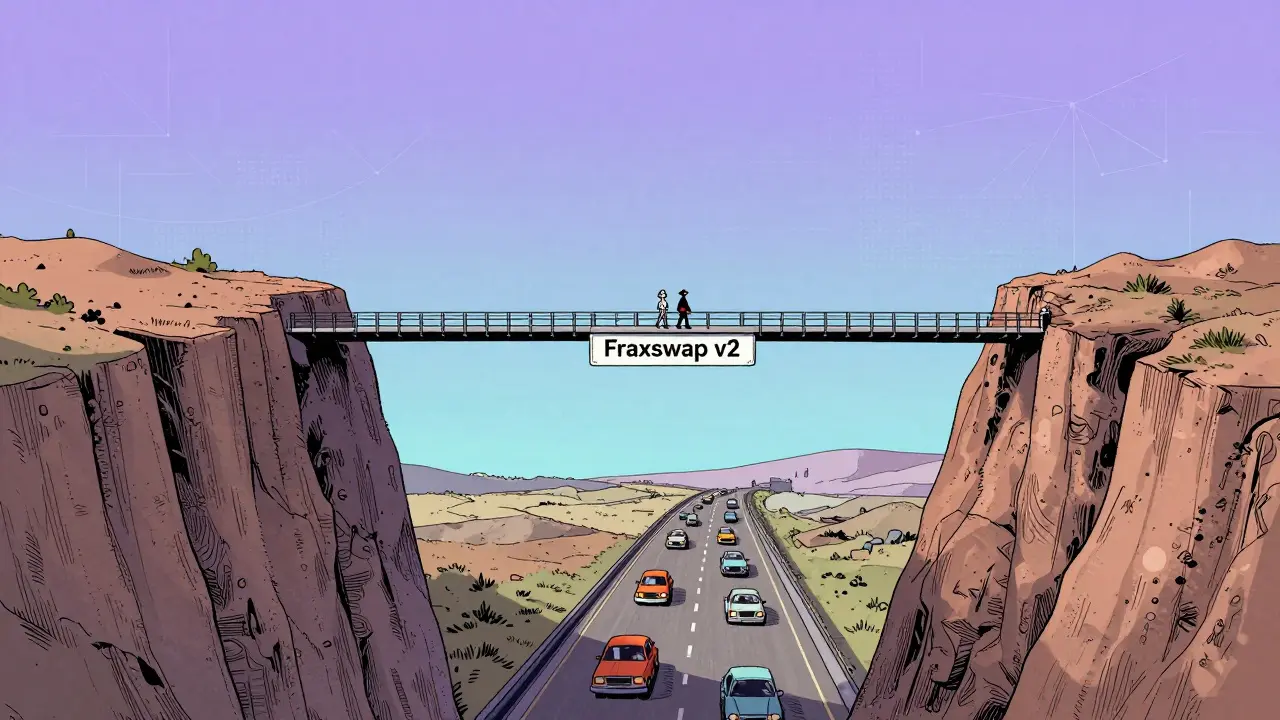
Fraxswap v2 is a decentralized automated market maker (AMM) built on the Avalanche blockchain that features proprietary Time-Weighted Average Market Maker (TWAMM) technology. It doesn’t try to be the fastest or the most popular. Instead, it solves a specific problem: executing large orders without crashing the price. If you’ve ever tried to sell $50,000 worth of a token on a thin pool and watched the price drop by 10% in seconds, you know why this matters.
What Makes Fraxswap v2 Different?
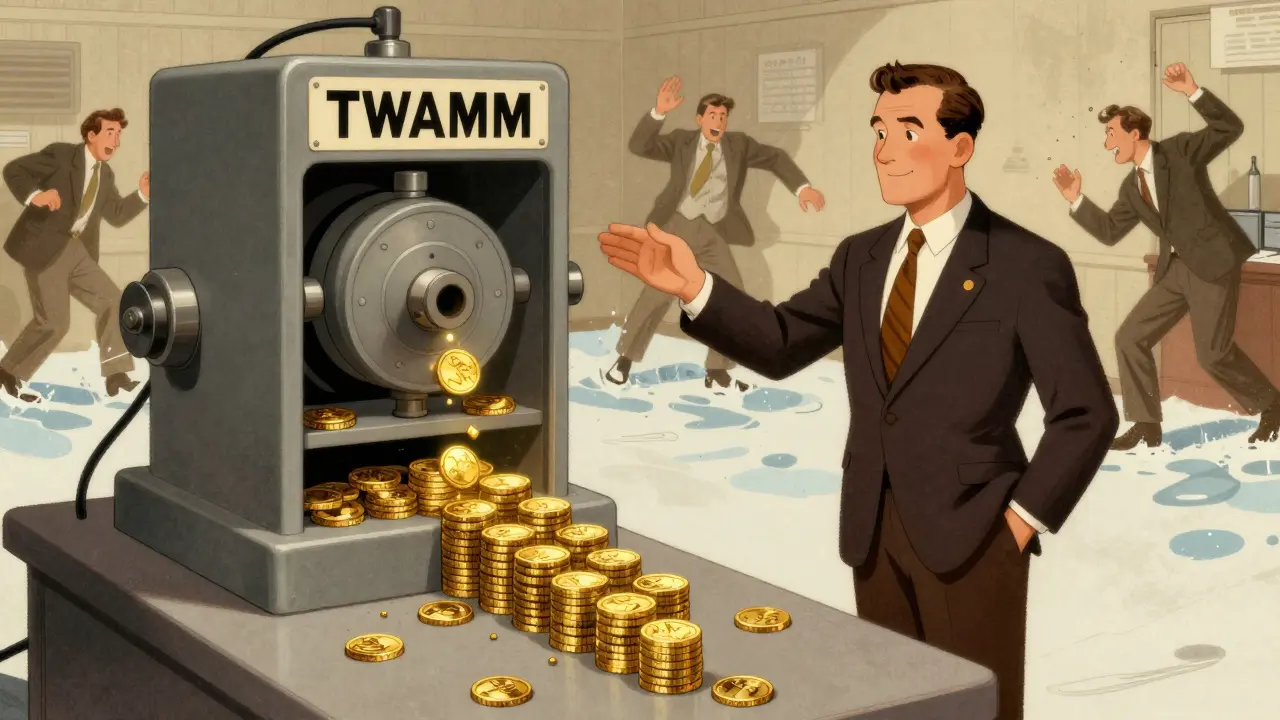
The core engine of Fraxswap v2 uses the standard xy=k constant product formula, which you’ll find in almost every AMM from Uniswap to SushiSwap. This ensures basic fairness in pricing based on liquidity depth. However, the real innovation lies in its Time-Weighted Average Market Maker (TWAMM) functionality.
TWAMM allows users to place virtual long-term orders that execute incrementally over time. Instead of hitting the market all at once, your order is split into smaller chunks. This mechanism reduces front-running risks and minimizes slippage for large trades. According to CoinMarketCap’s February 2026 assessment, this is a proprietary feature not found in other major AMMs like Uniswap. For institutional players or whales looking to enter or exit positions on Avalanche, this is a game-changer.
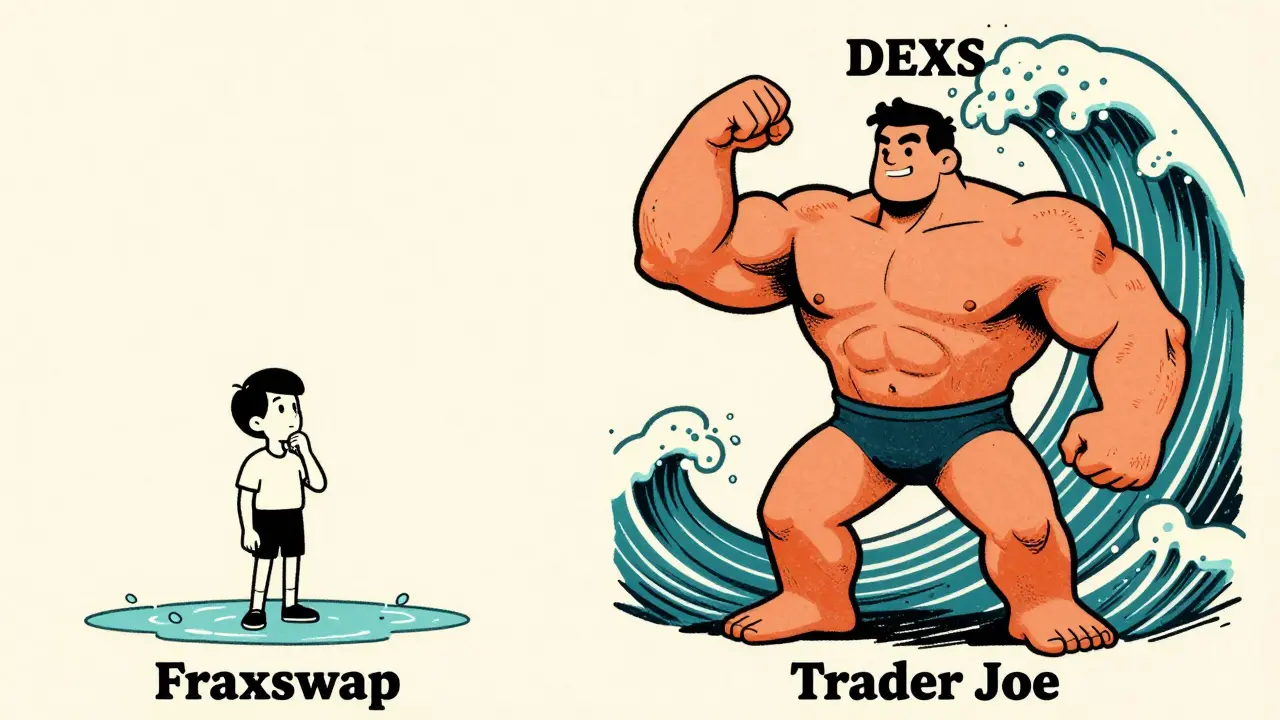
However, there’s a catch. This sophistication comes with trade-offs. While the tech is impressive, the platform lacks the raw volume that powers mainstream exchanges. As of early 2026, Fraxswap v2 reported a 24-hour trading volume of approximately $9,623 on CoinMarketCap. Compare that to Trader Joe, which handles over $87 million daily. The difference isn’t just numbers; it’s about who uses the platform.
Performance and Fees on Avalanche
One of the biggest advantages of using Fraxswap v2 is the underlying network. By operating on Avalanche’s C-Chain (Contract Chain), users benefit from transaction finality under two seconds. More importantly, fees remain incredibly low.
In January 2026, CoinCodex reported that transaction fees on Avalanche averaged between $0.01 and $0.05 depending on congestion. Even during peak times, this is a fraction of what you’d pay on Ethereum, where gas fees can swing from $1.50 to $15 or more. For high-frequency traders or those using TWAMM to break down orders into many small transactions, these low costs make the strategy viable.
Despite these technical benefits, Fraxswap v2 ranks #265 among all global cryptocurrency exchanges according to CoinCodex data from February 2026. This ranking reflects its niche status. It’s not built for mass adoption; it’s built for specific use cases where precision matters more than speed.
| Feature | Fraxswap v2 | Trader Joe | Pangolin |
|---|---|---|---|
| Primary Advantage | TWAMM Order Execution | High Liquidity & Volume | Established User Base |
| 24h Volume (Feb 2026) | ~$9,623 | ~$87.3 Million | ~$15 Million* |
| Avg. Transaction Fee | $0.01 - $0.05 | $0.01 - $0.05 | $0.01 - $0.05 |
| Concentrated Liquidity | No | Yes | No |
| Best For | Large Orders / Low Slippage | Retail Trading / High Volume | General DeFi Access |
User Experience and Accessibility
If you’ve used Uniswap before, Fraxswap v2 will feel familiar. The interface is clean and straightforward, requiring no special software beyond a standard Web3 wallet. You can connect wallets like MetaMask, Trust Wallet, or Core Wallet directly. Once connected, you simply switch your network to Avalanche’s C-Chain, and you’re ready to trade.
CoinMarketCap noted that experienced DeFi users can become proficient within 15-20 minutes. However, beginners might struggle with two things: identifying legitimate liquidity pools and understanding TWAMM parameters. Avalanche has seen a surge in scam tokens, so caution is essential when adding custom pairs. Additionally, setting up a TWAMM order requires deciding on duration and step size, which adds a layer of complexity compared to simple instant swaps.
Support resources are limited but functional. The primary hub is the Frax Finance Discord server, which had approximately 45,000 members as of February 2026. Response times for technical queries average 12-24 hours. Documentation is hosted on GitHub, updated as recently as January 15, 2026. While adequate for experts, CoinCodex described the docs as challenging for newcomers due to gaps in Avalanche-specific implementation details.
Liquidity Challenges and Market Reality
Let’s address the elephant in the room: liquidity. Fraxswap v2 has very little of it compared to competitors. With only $9,623 in daily volume, it represents roughly 0.011% of Trader Joe’s volume. This means that for standard retail trades-swapping small amounts of AVAX for USDC or other stablecoins-you’ll likely face worse prices here than on established platforms.
Why? Because thin liquidity leads to higher slippage on immediate swaps. The TWAMM feature mitigates this for large orders by spreading them out, but it doesn’t help if you need funds instantly. Furthermore, the lack of concentrated liquidity positions (a feature introduced by Uniswap V3) means liquidity providers on Fraxswap v2 must spread their capital across the entire price range, making capital efficiency lower.
This limitation keeps Fraxswap v2 from competing in the general retail space. It’s not trying to win the popularity contest. Instead, it serves a specialized audience: sophisticated traders and institutions who prioritize execution quality over convenience. Anonymous traders interviewed by CoinMarketCap confirmed that TWAMM is primarily used by those executing large institutional-sized trades who value discretion and minimal market impact.
Future Outlook: Can It Grow?
The broader context for Fraxswap v2 is tied to Avalanche’s growth. In December 2025, the Avalanche blockchain processed 1.2 billion transactions, showing robust network activity. Institutional interest is also rising, with AVAX prices increasing 11.9% in early 2026 amid growing social engagement. Filings for AVAX ETFs by firms like VanEck and Bitwise suggest that traditional finance is paying attention.
If institutional participation in Avalanche DeFi grows, demand for sophisticated trading infrastructure like TWAMM could increase. Analysts note that unless Fraxswap v2 achieves at least $1 million in daily volume-a 100x increase from current levels-it risks remaining a niche tool. Currently, development focus appears directed toward Frax Finance’s Ethereum implementation, with no major Avalanche-specific roadmap items announced in early 2026.
Long-term viability depends on whether the DeFi community values specialized execution tools enough to provide the necessary liquidity. Without deeper pools, the TWAMM advantage remains theoretical for many users. However, for those who understand its purpose, Fraxswap v2 offers a unique solution that no other Avalanche DEX currently matches.
Is Fraxswap v2 safe to use?
Fraxswap v2 is a fully decentralized protocol operating on-chain, meaning there is no central entity holding your funds. However, safety depends on smart contract audits and user behavior. Always verify contract addresses and be cautious of scam tokens listed on the platform. The protocol itself has not reported major security breaches, but as with any DeFi platform, you should never invest more than you can afford to lose.
What is TWAMM and how does it work?
TWAMM stands for Time-Weighted Average Market Maker. It allows users to place large orders that execute gradually over a set period. Instead of buying or selling everything at once, the system breaks the order into smaller chunks. This reduces slippage and prevents front-running bots from exploiting your trade, resulting in a better average price for large transactions.
Why is Fraxswap v2 volume so low compared to Trader Joe?
Fraxswap v2 targets a niche market focused on large-order execution rather than high-frequency retail trading. Most users prefer platforms with deeper liquidity for quick swaps, which drives volume to Trader Joe. Fraxswap’s specialized TWAMM feature appeals to fewer users, resulting in lower overall trading activity but potentially better execution for specific large trades.
Can I use MetaMask with Fraxswap v2 on Avalanche?
Yes. Fraxswap v2 supports all major Web3 wallets compatible with Avalanche, including MetaMask, Trust Wallet, and Core Wallet. You simply need to add the Avalanche C-Chain network to your wallet settings before connecting to the exchange interface.
Does Fraxswap v2 charge higher fees than other DEXs?
No. Since Fraxswap v2 operates on the Avalanche network, transaction fees are determined by network congestion, typically ranging from $0.01 to $0.05. These fees are comparable to other Avalanche-based DEXs like Trader Joe and Pangolin, and significantly lower than Ethereum-based exchanges.
