
Most people think all decentralized exchanges are the same-you connect a wallet, swap a token, and pay a fee. But if you're hunting for a way to earn better yields on the Avalanche network, you've probably stumbled upon FlairDex. This platform isn't just another clone; it's trying to be the native liquidity layer for the entire ecosystem by combining the best parts of two industry giants: Uniswap and Curve Finance.
The Core Mechanics: How FlairDex Actually Works
At its heart, FlairDex is a decentralized exchange (DEX) and automated market maker (AMM) that launched in December 2022. Instead of sticking to one way of swapping, it uses a dual-swap mechanism. This is a big deal because it handles different types of assets differently to save you money.
If you're swapping stablecoins, it uses a Stable Automated Market Maker (sAMM). This minimizes "slippage"-that annoying price change that happens between the time you click 'swap' and when the trade executes. For more volatile assets, it switches to a volatile AMM (vAMM), which is the standard model used by platforms like Uniswap. By splitting these paths, the platform ensures you aren't paying a premium for a trade that should be simple.
The biggest draw here is the cost. While many platforms charge a flat fee, FlairDex review data shows they've aggressively undercut the competition. They charge just 0.02% for stable swaps and 0.2% for volatile ones. For someone moving large amounts of capital, that tiny percentage difference adds up to significant savings over a month of trading.
Understanding the ve(3,3) Governance Model
If you've spent any time in DeFi, you know that governance tokens are often useless. You hold them, you vote on something boring, and that's it. FlairDex tries to fix this by implementing a ve(3,3) system. This is a complex but rewarding way to manage a protocol.
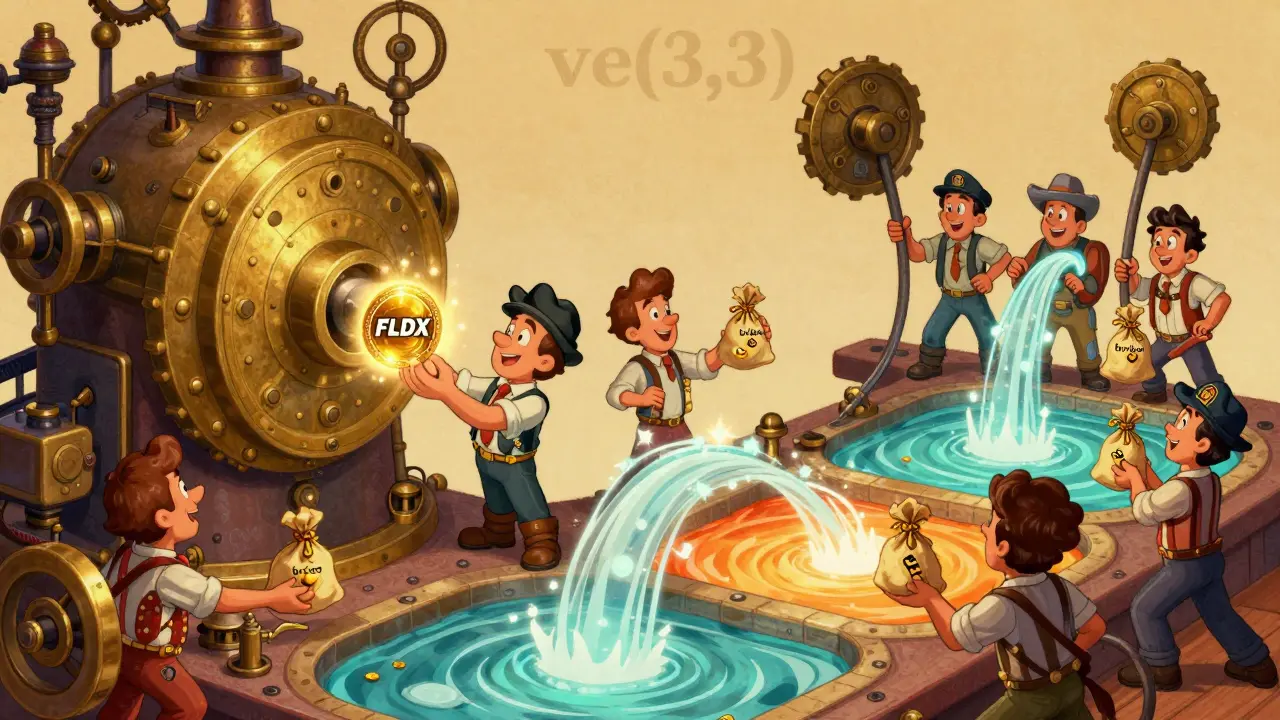
Here is how the loop works: you take your FLDX tokens and lock them into the protocol. In exchange, you get veFLDX. This isn't just a badge of honor; it gives you actual power. You can vote on which liquidity pools should get more token emissions. If a pool gets more emissions, more people provide liquidity there, making the pool deeper and trades more efficient.
But there's a twist: the "bribe" mechanism. Other projects or individual users can pay bribes to veFLDX holders to convince them to vote for a specific pool. Essentially, if you hold locked tokens, you can get paid just for voting the way others want you to. It turns governance into a revenue stream, which is a far more interesting proposition than traditional voting.
| Swap Type | FlairDex Fee | Typical DEX Fee | Benefit |
|---|---|---|---|
| Stablecoins (sAMM) | 0.02% | 0.04% - 0.1% | Ultra-low slippage cost |
| Volatile Assets (vAMM) | 0.2% | 0.3% | Competitive mid-tier pricing |
The Avalanche Advantage
Choosing Avalanche as its foundation was a strategic move. Compared to the Ethereum mainnet, Avalanche offers faster finality and significantly lower gas fees. This means you can actually interact with the ve(3,3) governance or adjust your liquidity positions without spending $50 in gas for a single transaction.
In the local Avalanche neighborhood, FlairDex is competing with established names like Trader Joe and Pangolin Exchange. While those platforms have more brand recognition, FlairDex is betting that its superior fee structure and the "bribe" economy will lure liquidity providers away from the old guard.
What's Missing? The Risks and Red Flags
No review is honest if it only talks about the perks. There are some glaring gaps with FlairDex. The most obvious is the accessibility of the FLDX token. As of late 2025, it hasn't hit the major centralized exchanges yet. While there's talk about KuCoin or OKX, the lack of a primary listing makes it harder for a regular person to buy in without navigating a DEX themselves.
Then there's the "battle-tested" factor. Launched in late 2022, it doesn't have a decade of security audits and stress tests behind it. In DeFi, newness often equals risk. The ve(3,3) model is also a bit of a psychological game; if the incentives aren't balanced correctly, the token price can become volatile as people unlock and dump their tokens.
We also see a lack of public data. It's hard to find real-time Total Value Locked (TVL) figures or detailed volume stats that are verified by a third party. This information scarcity is a red flag for institutional investors who need hard data before moving millions of dollars into a pool.

Looking Ahead: Perpetuals and Beyond
The roadmap for FlairDex suggests they aren't satisfied with just being a swap shop. They are planning to launch perpetual trading. For those who aren't in the loop, perpetuals are a type of derivative contract that allows you to trade with leverage-essentially betting on whether a price will go up or down without actually owning the asset.
If they pull this off, it changes the game. It moves the platform from a simple liquidity tool to a full-scale trading hub. Combining the low fees of their spot market with the high-margin potential of perpetuals could make the FLDX token much more valuable, as more fees would flow back into the protocol and its veFLDX holders.
Quick Start Checklist for New Users
- Wallet Setup: Ensure you have an Avalanche-compatible wallet (like Core or MetaMask).
- Funding: Load up on AVAX for gas fees and the assets you intend to swap.
- Liquidity Strategy: Decide if you want the steady, low-risk returns of stable pools or the higher-risk, higher-reward volatile pools.
- Governance: If you plan to hold FLDX, research the locking periods for veFLDX to ensure you don't lock your funds for longer than you can afford.
- Verify Pools: Check the current emissions and bribes for the pool you're entering to maximize your yield.
Is FlairDex safe to use?
Like all decentralized exchanges, the risk depends on the smart contract security. While it leverages proven models like those from Uniswap and Curve, it is newer and less "battle-tested" than the industry giants. Always use a separate wallet for DeFi interactions to mitigate risk.
What is the difference between sAMM and vAMM on FlairDex?
sAMM (Stable Automated Market Maker) is designed for tokens that maintain a similar price, like USDC and USDT, offering extremely low fees (0.02%) and minimal slippage. vAMM (Volatile Automated Market Maker) is for assets with fluctuating prices, such as AVAX or FLDX, with a slightly higher fee of 0.2%.
How do I earn money from bribes on FlairDex?
You must lock your FLDX tokens to receive veFLDX. This gives you voting power. Other projects pay "bribes" to veFLDX holders to encourage them to vote for specific liquidity pools. You earn these bribes by casting your vote for the pool the briber wants.
Where can I buy the FLDX token?
As of now, FLDX is primarily available on the FlairDex platform itself and other smaller decentralized exchanges on Avalanche. It is not yet listed on major centralized exchanges like Binance, though listings on platforms like OKX or KuCoin are anticipated.
Does FlairDex support leverage trading?
Not currently. However, the development roadmap includes the launch of perpetual trading functionality, which will allow users to trade with leverage in the future.

Robert Smith
April 28, 2026 AT 14:25Looks interesting 🚀
Noel Mandotah
April 28, 2026 AT 21:29Oh wow, another ve(3,3) fork. How original. Truly a masterpiece of innovation.
Nitin Gupta
April 30, 2026 AT 01:45The sAMM and vAMM split is actually a very efficient way to handle liquidity and reduce slippage for the users. It helps in maintaining a stable environment for the traders especially when dealing with pegged assets.
Felix Eduardo Velasquez
April 30, 2026 AT 13:26The concept of bribes in governance is essentially a market for influence. While it creates a revenue stream, we must consider if this optimizes for the health of the protocol or simply for the short-term greed of the token holders. The tension between long-term stability and immediate incentive is where the real risk lies in these models.
Livvy Cooper
May 2, 2026 AT 12:31Just sounds like more gambling with fancy names. Who cares about bribes.
Wayne Gillis
May 2, 2026 AT 17:53I WANT IN!! 🤑 Where do I sign up? This sounds like a money printer!! 💸🔥🚀
edie rosa
May 2, 2026 AT 19:43Typical DeFi nonsense. The lack of transparency on TVL is a massive red flag that everyone is just ignoring because they're blinded by the promise of high yields. It's honestly pathetic how people fall for this every single time without demanding a real audit first.
Michael Repak
May 3, 2026 AT 07:44I really think the Avalanche choice was smart!!! The speed is just way better than Ethereum!!! Love to see it!!!
Emily A
May 4, 2026 AT 13:10The absence of centralized exchange listings is a critical oversight in their go-to-market strategy. Liquidity is the lifeblood of any DEX, and restricting access to only on-chain swaps limits their growth potential significantly.
Aaron Zeiler
May 5, 2026 AT 06:09if you are doing the ve(3,3) thing just make sure you check the lock periods carefully cause you dont want your money stuck during a crash
Arti Jain
May 6, 2026 AT 08:30Utterly amateur. The lack of verified data is an insult to serious investors.
Janis Naglis
May 7, 2026 AT 22:52This is such a great opportunity for liquidity providers!!! The synergistic effect of the sAMM model combined with the ve(3,3) emission logic is absolutely top-tier!!! I'm so hyped to see the perpetuals launch!!! 🌟✨
Carli Bates
May 9, 2026 AT 05:17imagine thinking a bribe is actually governance lol we really just live in a giant simulation of greed now
Gabby Puche
May 9, 2026 AT 23:54Totally agree with the optimistic view! This is going to be huge for the Avax community 🌈💖
Ryan Nakielny
May 11, 2026 AT 02:23Wow, a protocol that pays you to vote. How very democratic of them. I'm sure this won't lead to any weird manipulation at all.
Kristi Swartz
May 11, 2026 AT 10:32it is common knowledge that high yields usually mean high risk and this is no exception
Alex Mazonowicz
May 12, 2026 AT 16:33Keep pushing forward!!! The roadmap looks promising!!! 🚀🚀🚀
Tracy McBurney
May 14, 2026 AT 03:08The author claims this isn't just another clone, yet it literally just staples Uniswap and Curve together. It's an architecturalFrankenstein that lacks any real unique value proposition beyond slightly lower fees, which can be changed by any competitor in five minutes.
Gabrielle Danis
May 14, 2026 AT 16:10For those who are new to this, remember that the sAMM is only for assets that are meant to stay at the same price. If you put a volatile token in there, you will experience significant impermanent loss.
Lynne Teperman
May 16, 2026 AT 11:16this vibe is totally wild and the whole bribe thing is just spicy finance
Harvey Alford
May 16, 2026 AT 18:40I'm losing money on my current pool. Help me.
Kathleen Warren
May 17, 2026 AT 23:50It's okay to feel nervous about the lack of data. Just start with a small amount and learn as you go. We are all learning this together.
Rachel S
May 19, 2026 AT 01:49The implementation of perpetuals would be a monumental shift for the platform! 😱 It would effectively transform the utility of FLDX from a mere governance token into a productive asset with real yield from trading fees! This is a high-stakes move, but if executed correctly, the growth could be exponential! ✨
Lloyd I
May 20, 2026 AT 05:26Let's all try to help each other understand the locking periods so nobody gets caught in a trap! We can do this together!
AP Fisher
May 21, 2026 AT 13:12I don't really get the bribe part. Is it like a real bribe or just a reward for clicking a button? It sounds weird but also kind of cool if it makes money.