
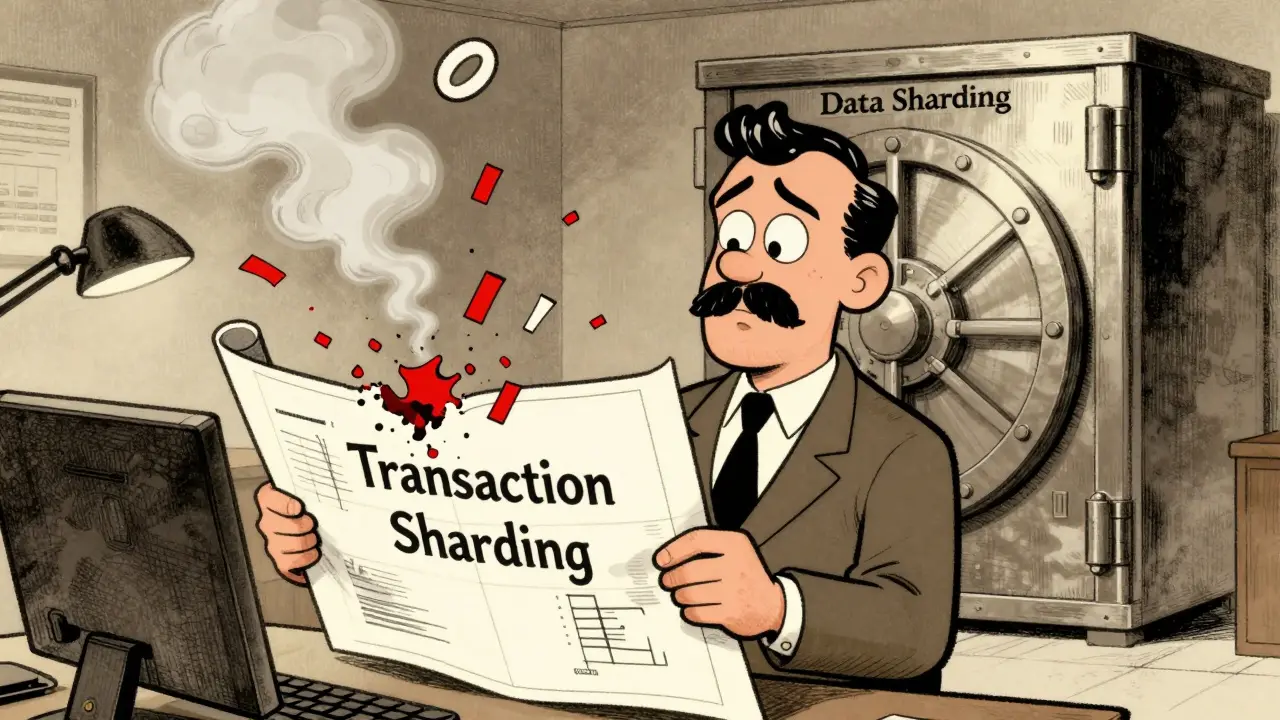
You’ve probably seen the term "transaction sharding" tossed around in tech forums or blockchain whitepapers. It sounds impressive, right? Like a magic bullet for scaling your system. But here’s the hard truth that most vendors won’t tell you upfront: **transaction sharding** isn’t a real technical concept. It’s a misnomer. A marketing buzzword. And if you’re building architecture based on it, you’re likely setting yourself up for failure.
The reality is simpler, though perhaps less glamorous. We have Data Sharding, which is a proven method of splitting large databases into smaller, manageable chunks to improve performance and scalability. That’s it. There is no separate mechanism called "transaction sharding." Transactions are just operations that happen *on top* of sharded data. Understanding this distinction is the difference between a scalable system and a fragmented mess.
The Myth of Transaction Sharding
Let’s clear the air immediately. When engineers or marketers say "transaction sharding," they usually mean one of two things:
- Distributed Transactions: Handling a single business logic operation (like a bank transfer) that touches data across multiple shards.
- Parallel Processing: Running many independent transactions simultaneously on different shards to increase throughput.
Neither of these is "sharding transactions." You cannot shard a transaction itself because a transaction is an atomic unit of work-it either succeeds completely or fails completely. You can’t split an atom.
Dr. Andy Pavlo, a database professor at Carnegie Mellon University, put it bluntly in his 2022 SIGMOD keynote: "The term transaction sharding is a misnomer; transactions aren't sharded, data is." He’s not alone. Baron Schwartz, CEO of Percona, reviewed over 200 production database implementations and never found a system that actually "shards transactions." What he found were systems that sharded data and then struggled with the complexity of coordinating transactions across those shards.
Why does this confusion persist? Because vendors want to sell solutions to the hardest problem in distributed systems: consistency. By calling it "transaction sharding," they imply they’ve solved the coordination headache. They haven’t. They’ve just renamed it.
What Data Sharding Actually Is
Data Sharding is the horizontal partitioning of a database where data is divided into distinct subsets (shards) and stored on separate servers.
Think of it like organizing a massive library. Instead of putting every book in one giant room (which becomes impossible to navigate), you split books by genre. Fiction goes to Room A, History to Room B, Science to Room C. Each room is a "shard." If someone wants a mystery novel, they go directly to Room A. They don’t search the whole building.
This approach gained traction during the Web 2.0 boom (around 2005-2007) when companies like Google realized their single-database architectures couldn’t handle the exploding volume of user data. Google’s Bigtable paper (Chang et al., 2006) laid the groundwork for modern sharding strategies.
Today, data sharding is standard practice in major systems:
- MongoDB 6.0+: Uses automatic chunk migration to balance data across shards.
- Apache Cassandra 4.1: Employs consistent hashing to distribute data evenly.
- Vitess 14.0: Provides MySQL-compatible sharding with sophisticated routing.
The goal is always the same: horizontal scalability. You add more servers (shards) to handle more data and more queries, rather than buying a bigger, more expensive server (vertical scaling).
How Data Sharding Works: The Strategies
You can’t just randomly throw data onto servers. You need a strategy. Here are the three main ways to shard data, each with trade-offs:
| Strategy | How It Works | Pros | Cons |
|---|---|---|---|
| Range-Based | Splits data by value ranges (e.g., IDs 1-1000 on Shard A, 1001-2000 on Shard B) | Easy to understand; supports range queries efficiently | Prone to "hotspots" if data isn’t uniformly distributed (e.g., new users all get high IDs) |
| Hash-Based | Applies a hash function (like MurmurHash3) to the shard key to determine placement | Excellent even distribution; minimizes hotspots | Range queries become expensive; requires rehashing if shards are added/removed |
| Directory-Based | Uses a central lookup service to map keys to shards | Flexible; easy to rebalance without moving data | Single point of failure risk; adds latency for lookups |
Most modern systems use a hybrid approach. For example, Twitter shards user timelines by user ID (range-based) but uses consistent hashing (hash-based) for tweet storage to ensure even load distribution.

The Real Challenge: Cross-Shard Transactions
This is where the "transaction sharding" myth comes from. When your data is split across shards, what happens if a single transaction needs to update data on two different shards?
Imagine an e-commerce order. The product inventory might be on Shard A, but the customer’s payment info is on Shard B. To complete the order, you must deduct inventory *and* charge the card. Both must succeed, or both must fail.
In a non-sharded database, this is trivial. In a sharded environment, it’s complex. You’re now dealing with distributed transactions.
Here’s why this matters:
- Latency Penalty: According to Percona’s March 2023 benchmark, cross-shard transactions in MongoDB 6.0 take 3-5x longer than single-shard transactions. Why? Because the database has to coordinate between nodes, waiting for acknowledgments from multiple places.
- Complexity: You often need protocols like Two-Phase Commit (2PC) or the Saga pattern to ensure consistency. These add significant code complexity and operational overhead.
- Failure Modes: If Shard A commits but Shard B crashes before confirming, you’re left in a limbo state. Resolving this requires robust retry mechanisms and idempotency checks.
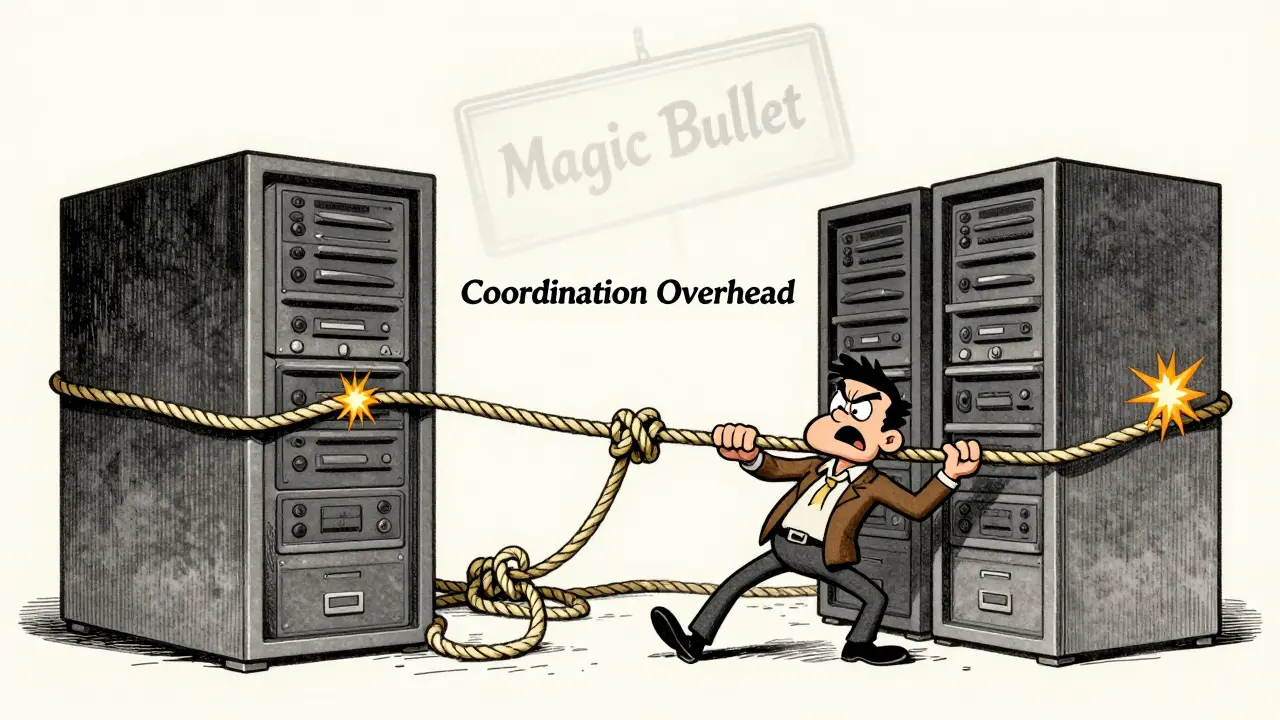
A fintech startup shared a painful lesson on Medium in 2022: they tried to implement "transaction sharding" (meaning they assumed cross-shard transactions would be as fast as local ones). They didn’t account for the coordination overhead. Result? Reconciliation errors cost them $50,000 in lost funds and weeks of debugging.
Blockchain Context: Where the Confusion Peaks
If you’re reading this in the context of blockchain, the terminology gets even murkier. Blockchain projects often talk about "sharding" to solve scalability issues (low TPS - transactions per second).
In Ethereum, for example, sharding refers to splitting the network’s state and computation across multiple committees. This is technically state sharding (a form of data sharding) and execution sharding (parallel processing of transactions).
But notice: they don’t call it "transaction sharding." They acknowledge that transactions themselves aren’t being chopped up. Instead, the *network capacity* to process transactions is being increased by parallelizing work across shards.
Projects like Solana or Avalanche use similar concepts but under different names (e.g., "pipeline processing" or "blockstorm"). The core principle remains: you shard the data/state and the processing power, not the transaction atom.
Be wary of any blockchain whitepaper that claims "transaction sharding" as a unique innovation. It’s likely just repackaged parallel execution or state partitioning.
When Should You Use Data Sharding?
Sharding isn’t free. It adds immense complexity. Before you shard, ask yourself:
- Is my dataset too big for one server? If you’re under 10TB, you probably don’t need sharding yet. Replication might suffice.
- Are write volumes overwhelming me? Sharding shines when you have high write throughput. Reads can often be handled by read replicas.
- Can I design around cross-shard joins? If your app relies heavily on joining tables that will end up on different shards, sharding will hurt performance. Consider denormalization or application-level joins.
According to Gartner’s 2023 report, 78% of Fortune 500 companies use some form of data sharding. But 65% of those use hybrid approaches, combining sharding with caching and replication to mitigate cross-shard issues.
Best Practices for Implementation
If you decide to shard, follow these rules to avoid common pitfalls:
- Choose Your Shard Key Wisely: This is the most critical decision. Pick a high-cardinality attribute that’s frequently queried (e.g., user_id, region_code). Avoid low-cardinality keys like "gender" or "status"-you’ll create uneven shards.
- Start Simple: Begin with a single shard. Add more only when metrics show you’re hitting limits. Premature sharding is a common mistake.
- Monitor Hotspots: Use tools like Prometheus or Datadog to track query patterns. If one shard is consistently busier, you may need to adjust your sharding strategy or rebalance data.
- Plan for Rebalancing: As data grows, shards become uneven. Ensure your database supports automatic rebalancing (like MongoDB’s chunk migration) or build a manual process.
- Test Cross-Shard Transactions Early: Don’t wait until production. Simulate cross-shard scenarios in staging. Measure the latency impact. If it’s unacceptable, redesign your schema to keep related data on the same shard.
Amazon DynamoDB Global Tables, for instance, achieve 200-300ms latency between US and EU regions by using geo-sharding. But they also rely on eventual consistency for cross-region writes to maintain speed. Strong consistency comes at a cost.
The Future: Hiding the Complexity
The industry is moving toward abstracting away sharding complexity. Google Spanner’s "Oscars" project aims to make sharding transparent to developers. AWS Aurora Serverless v2 introduced auto-sharding in 2022, letting the cloud provider manage shard distribution dynamically.
Gartner predicts that by 2025, 40% of new sharding implementations will use machine learning for dynamic rebalancing. The goal? Let AI decide where data lives based on access patterns, freeing developers to focus on business logic.
Until then, understanding the fundamentals-especially the difference between sharding data and coordinating transactions-is essential. Don’t let marketing terms fool you. Build solid, well-understood architectures.
Is transaction sharding a real thing?
No. "Transaction sharding" is a misnomer. Transactions are atomic units of work and cannot be split. What people usually mean is either distributed transactions (coordinating across shards) or parallel transaction processing (running many transactions simultaneously on different shards). The data is sharded, not the transactions.
What is the best sharding strategy for beginners?
Hash-based sharding is generally recommended for beginners because it provides even data distribution and minimizes hotspots. However, it makes range queries difficult. If your app relies heavily on range queries (e.g., time-series data), consider range-based sharding instead, but be prepared to handle potential imbalances.
How do I handle cross-shard transactions?
Cross-shard transactions require distributed transaction protocols like Two-Phase Commit (2PC) or the Saga pattern. Be aware that these introduce significant latency (3-5x slower than single-shard transactions). Best practice is to design your schema to minimize cross-shard dependencies by keeping related data on the same shard (colocation).
Does blockchain use transaction sharding?
Blockchain networks like Ethereum use state sharding and execution sharding to increase throughput, but they do not "shard transactions." Transactions remain atomic. The network processes more transactions in parallel by dividing the state and computational workload across multiple nodes or committees.
When should I start sharding my database?
You should consider sharding when your dataset exceeds the capacity of a single server (typically >10TB) or when write throughput overwhelms your primary node. Start with replication first. Only shard when vertical scaling and replication are no longer sufficient. Premature sharding adds unnecessary complexity.

mark valmart
May 31, 2026 AT 18:55man i really appreciate this breakdown because it cuts through all the noise. honestly seeing people get tripped up by marketing buzzwords is so common in our field and it feels good to have someone clarify the basics like this. thanks for keeping it real.
Crystal Davis
June 1, 2026 AT 21:34this article is painfully obvious to anyone who has actually read a single paper on distributed systems since 2006. you are explaining basic concepts as if they are groundbreaking revelations when in fact every senior engineer knows that transactions are atomic by definition. the idea that 'transaction sharding' exists as a term is laughable because it violates the ACID properties at a fundamental level. furthermore your comparison of data sharding strategies is superficial and ignores the nuances of consistent hashing algorithms which vary significantly between implementations. you fail to mention that range-based sharding can be optimized with virtual nodes to mitigate hotspots which contradicts your simplified view. additionally citing pavlo is lazy journalism because he has been saying this for years and yet vendors continue to use the term incorrectly not because they don't know but because it sells. your analysis lacks depth and fails to address the actual engineering challenges of cross-shard consistency beyond just naming protocols like 2PC which are notoriously difficult to implement correctly without deadlocks. if you want to write about sharding you should probably understand that the real issue isn't terminology but the lack of robust failure recovery mechanisms in most modern ORMs. this post is essentially a repost of stackoverflow answers from a decade ago packaged with bold fonts for engagement metrics. do better next time or stick to writing blog posts about css frameworks where accuracy doesn't matter.
Christina Pearce
June 3, 2026 AT 21:22i think it's really helpful to see these distinctions laid out clearly especially for those of us who are newer to database architecture. i've always found the blockchain section particularly confusing because everyone uses different terms for similar concepts so having a clear explanation of state versus execution sharding is super valuable. i wonder if there are any other areas in tech where marketing terms create similar confusion?
Barclay Chantel
June 4, 2026 AT 19:01how quaint that one must write an entire essay to explain that one cannot divide an atom. it seems the general populace has forgotten the rudiments of computer science in favor of chasing shiny new acronyms. truly a sad state of affairs for an industry that claims to value precision. one would think that after decades of formal methods and rigorous testing we would have moved past such elementary misconceptions but alas here we are reading about 'magic bullets' and 'marketing buzzwords' as if they were novel discoveries. perhaps if engineers spent less time attending conferences and more time reading textbooks we might avoid such pedestrian errors in the first place.
Miss Masquer
June 6, 2026 AT 01:31it is fascinating to consider how language shapes our understanding of technology in such profound ways and i find myself reflecting on the cultural implications of these terminological choices within the broader context of global software development practices which often struggle to bridge the gap between theoretical computer science and practical implementation realities in diverse organizational structures across different continents and industries where communication styles vary significantly and technical jargon can sometimes serve as a barrier to entry for junior developers who are eager to learn but may feel overwhelmed by the sheer volume of conflicting information available online today which makes resources like this article incredibly important for fostering a more inclusive and accurate dialogue about system design principles that ultimately affect millions of users worldwide through their daily interactions with digital platforms that rely on these underlying architectural decisions made by teams who may not always have the luxury of perfect information or unlimited resources to experiment with different approaches before committing to a specific strategy that will define the scalability and reliability of their product for years to come.
Joshua Alcover
June 7, 2026 AT 11:15the epistemological framework underlying the dichotomy between data partitioning and transactional atomicity necessitates a rigorous ontological examination of the semantic boundaries defining computational operations within distributed ledger technologies wherein the purported 'sharding' of transactions represents a categorical error in logical classification that fails to account for the inherent indivisibility of atomic units of work as defined by the axiomatic foundations of relational algebra and concurrent processing paradigms which mandate strict adherence to isolation levels and consistency models that preclude any notion of fractional transaction execution thereby rendering the colloquial usage of 'transaction sharding' not merely imprecise but fundamentally incoherent within the established lexicon of high-performance computing architectures and enterprise-grade database management systems that prioritize deterministic outcomes over probabilistic approximations of state transitions across heterogeneous node clusters operating under varying network latency conditions and fault tolerance requirements.
Diana Morris
June 8, 2026 AT 20:57stop wasting time arguing about words and start building scalable systems now because the market waits for no one and if you dont shard your data correctly you will lose customers to competitors who did it right yesterday so get moving and optimize your queries today
Dianne Wright
June 10, 2026 AT 19:04i feel so drained reading all these comments because nobody seems to understand that the real pain is in the debugging phase when everything breaks at 3am and you have to figure out why your saga pattern failed silently while the rest of the world sleeps peacefully unaware of the chaos unfolding in your production environment which leaves me emotionally exhausted and questioning my career choices every single day
trisya hazriyana
June 12, 2026 AT 08:08oh sure let's pretend that hash-based sharding is the silver bullet for all distribution problems when we all know that rehashing costs are astronomical and that directory-based approaches introduce latency bottlenecks that kill performance metrics so why bother pretending otherwise when the reality is that most startups fail before they even reach the scale where sharding matters anyway so maybe focus on business logic instead of premature optimization because that's what actually drives revenue not fancy database architectures that look good on whiteboards but crumble under real-world load tests
Debbie Lewis
June 12, 2026 AT 16:46just watching this unfold from the sidelines. interesting points all around but i think the key takeaway is simply to measure twice and cut once before implementing any major architectural changes.
Eric Grosso
June 13, 2026 AT 22:04hey guys i was wondering if anyone has tried using vitess for mysql sharding cause i heard its pretty cool but im not sure if its worth the learning curve compared to just sticking with standard replication setups for smaller datasets like mine which are only like 5tb so far but growing fast so maybe i should jump in now?
Edith Mair
June 14, 2026 AT 02:18you need to stop making excuses for poor schema design and start addressing the root cause of your cross-shard join issues because if you cant collocate your data properly then you have bigger problems than just terminology disputes and frankly it shows a lack of discipline in your planning phase which is unacceptable in professional environments where reliability is paramount.
Sam Dashti
June 14, 2026 AT 17:26it's like trying to herd cats through a sieve while riding a unicycle on a tightrope during a hurricane you know? the whole concept of splitting things up sounds great in theory until you realize that glueing them back together requires more duct tape than you thought possible and suddenly your beautiful clean codebase looks like a spaghetti monster had a baby with a tangled ball of yarn left out in the rain for a week so yeah maybe keep it simple folks unless you enjoy living on the edge of madness which some of us do but most people just want their app to load without crashing every five seconds.
Joe Clements
June 15, 2026 AT 16:24i totally get where everyone is coming from on this topic and it's really nice to see such a detailed discussion happening here. i hope we can all learn from each other's experiences and build better systems together in the future.