
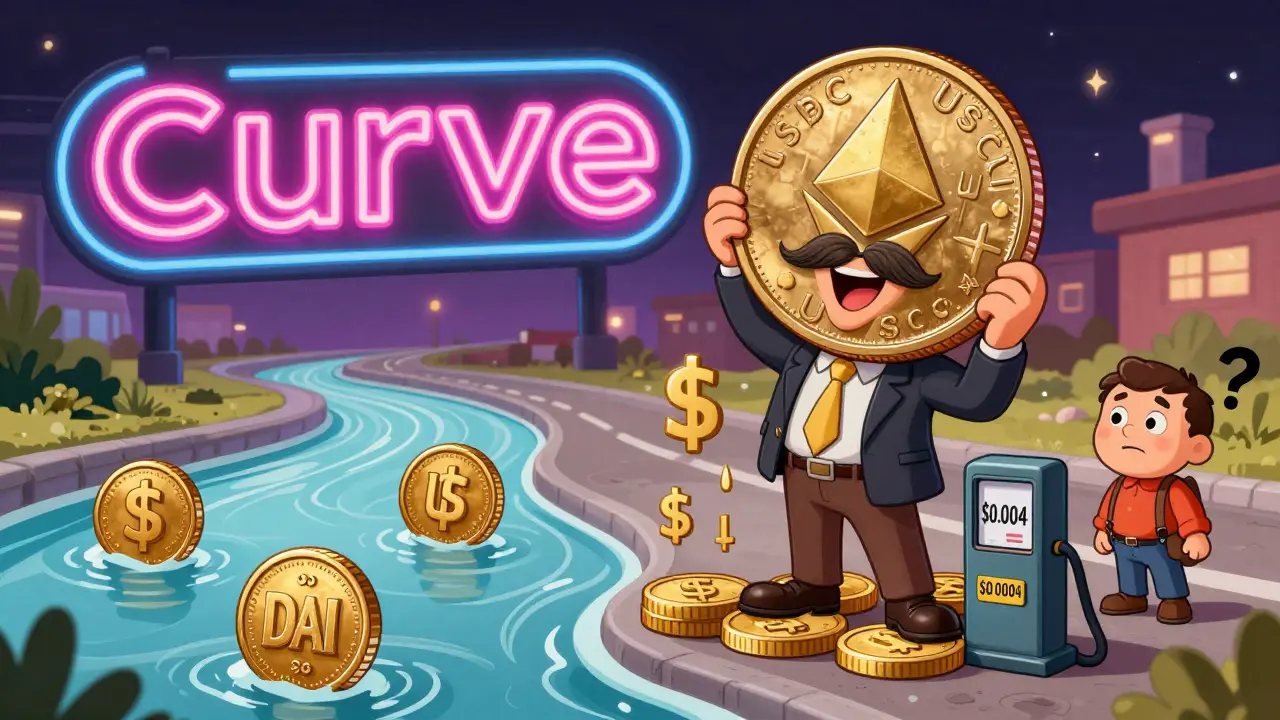
When you're trading stablecoins like USDC, DAI, or USDT, slippage and gas fees can eat into your profits faster than you think. On Ethereum mainnet, a simple swap might cost you $1.27 in gas and lose you 0.3% in price slippage. But on Curve (Optimism), the same trade costs $0.0004 in gas and slippage drops to just 0.04%. That’s not a typo. That’s the real difference this platform makes for stablecoin traders.
Curve isn’t a traditional exchange you sign up for with an email. It’s a decentralized protocol built on Optimism, a Layer-2 blockchain that rides on top of Ethereum. Its entire design is built around one goal: making stablecoin swaps as smooth and cheap as possible. And it works. As of January 2025, Curve (Optimism) handled $427 million in daily trading volume-38% of Curve’s total cross-chain volume-and processed over 18,400 transactions per day with settlement times under 2 seconds. That’s faster than most centralized exchanges.
How Curve (Optimism) Works
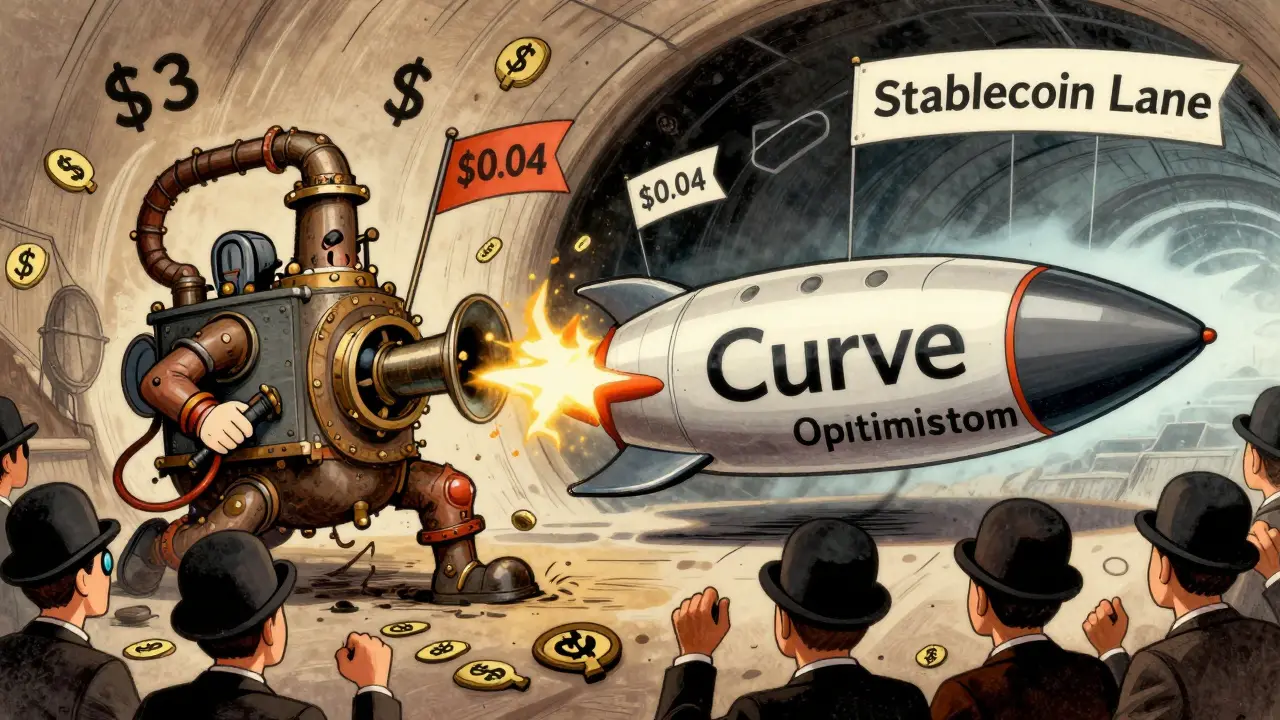
Curve’s secret sauce is its Adaptive Curve AMM algorithm. Unlike Uniswap, which uses a constant product formula (x * y = k) that works fine for volatile assets but falls apart with stablecoins, Curve’s algorithm adjusts dynamically based on real-time liquidity and volatility. For stablecoin pairs like USDC/USDT, it creates a nearly flat price curve. This means your $1,000 swap barely moves the price. On Uniswap, that same swap might cost you $3 in slippage. On Curve, it’s less than $0.40.
It runs on Optimism’s optimistic rollup. That means transactions happen off-chain, get batched, and are submitted to Ethereum as one compressed proof. The result? Gas fees are 99.7% lower than on Ethereum mainnet. A typical swap costs 0.00001 ETH-about 1/500th of what you’d pay on Ethereum. Withdrawals back to Ethereum take 7 days due to Optimism’s fraud-proof security system, but that’s a fair trade for the savings.
Why Curve (Optimism) Dominates Stablecoin Trading
Here’s the data: Curve controls 67.3% of all stablecoin swaps across DeFi, according to DeFi Llama’s February 2025 report. That’s more than all other DEXs combined. Why? Because no one else focuses so narrowly on this niche.
Curve (Optimism) supports 12 stablecoin pools-USDC/DAI/USDT/FRAX, etc.-and each one is deeply liquid. The TVL in these pools alone hit $842 million in January 2025. Compare that to Uniswap, which has over 15,000 pools but only 12% market share in stablecoin swaps. Uniswap is great for swapping random tokens. Curve is the only choice if you’re moving between USD-pegged assets.
Trading fees are 0.04%, versus Uniswap’s 0.3% and Balancer’s 0.5-1.0%. For a $10,000 trade, that’s $4 vs. $30. That’s $26 saved per trade. Do that 10 times a week, and you’re saving $13,520 a year. That’s why professional arbitrageurs and DeFi yield farmers live on Curve (Optimism).
What You Can’t Do on Curve (Optimism)
Don’t go to Curve if you want to swap Solana, Dogecoin, or NFTs. It doesn’t support volatile assets well. The algorithm is optimized for price stability, so if you try to swap USDC for ETH, the slippage jumps to 1.5% or more. It’s designed to fail there.
You also won’t find lending, borrowing, or yield farming built into the interface. Curve is a swap-only tool. If you want to earn interest on your stablecoins, you’ll need to use Aave or Compound separately. Curve’s only reward system is through its CRV token and veCRV voting mechanism.
CRV Token and veCRV Locking: The Double-Edged Sword
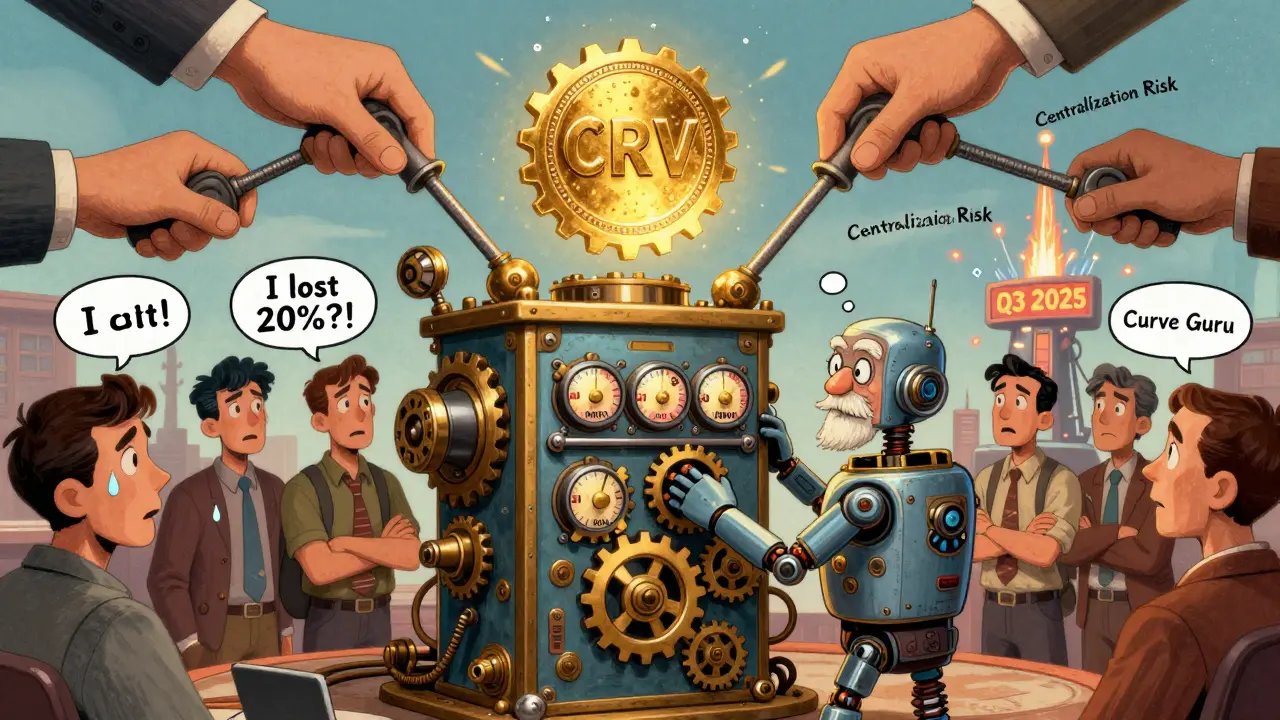
To earn trading fees and governance rights, you need to lock your CRV tokens as veCRV. Locking means you can’t move your CRV for a set period-up to four years. The longer you lock, the more voting power and fee rewards you get. It’s a clever incentive system, but it’s confusing.
Over 62% of CRV voting power is held by just 15 entities, according to governance data from November 2024. That’s centralization. And it’s why Diogo Monica of Anchor Protocol warned that Curve’s model creates "centralization risks."
For users, the learning curve is steep. A Koinly survey found that 37% of new users choose the wrong lock duration and lose up to 20% in potential rewards. Reddit users report spending hours figuring out how to maximize their veCRV. One user, CryptoSwapper2023, said it saved them $2,300 in gas last month-but admitted they "almost gave up after the first week."
Performance and Security
Curve (Optimism) has processed over 412,000 unique wallet interactions monthly as of January 2025. Settlement time is 2 seconds. Transaction throughput is 18,400 per day. These numbers are better than Ethereum mainnet by a factor of 7x.
Security comes from two layers: Optimism’s 7-day challenge window for fraud proofs, and Curve’s own multi-sig governance requiring 4-of-7 signers to approve changes. No single entity can change the protocol. That’s solid.
But there’s a catch: if you bridge funds from Ethereum to Optimism, you’re locked for 7 days if you want to withdraw back. That’s a risk if you need liquidity fast. And while Curve’s code has never been hacked, the entire DeFi ecosystem is only as secure as its bridges. Wormhole and LayerZero integrations have been exploited before.
Who Should Use Curve (Optimism)?
You should use Curve (Optimism) if:
- You trade stablecoins daily (USDC, DAI, USDT, FRAX)
- You’re tired of paying $1+ in gas fees per swap
- You’re comfortable with MetaMask and connecting wallets
- You don’t mind a 7-day wait to move funds back to Ethereum
- You’re willing to spend 8-12 hours learning veCRV mechanics
You should avoid Curve (Optimism) if:
- You want to trade Bitcoin, Ethereum, or altcoins
- You need instant withdrawals
- You’re new to DeFi and don’t understand LP tokens or impermanent loss
- You expect a simple app like Coinbase or Binance
Getting Started
Here’s the quick path:
- Install MetaMask or Ledger and fund it with ETH (for gas).
- Go to curve.fi and switch network to Optimism.
- Use the official Optimism bridge to move USDC or DAI from Ethereum to Optimism (takes 1-2 hours).
- Go to the Swap tab, pick your stablecoin pair, and trade.
- If you want to earn more, lock CRV as veCRV-but read the docs first.
Documentation is rated 4.3/5 by EthDocs, but most tutorials assume you already know what a liquidity pool is. The Discord community (45,000+ members) responds to 82% of questions within 24 hours. But if you ask about veCRV, expect a 72-hour wait.
Market Outlook and Future Plans
Curve’s total TVL across all chains is over $4 billion. Optimism alone holds $842 million. Gartner predicts Curve’s TVL will hit $6.2 billion by 2026, with Optimism making up 35% of that growth.
The big update coming in Q3 2025 is "Curve Warp"-a new cross-chain settlement layer that aims to cut bridging times from hours to minutes. If it works, it could make Curve (Optimism) the default hub for stablecoin flows across all Layer-2 chains.
CRV’s price is volatile. It’s down 98% from its $60.50 peak in 2020, but it’s holding steady at $0.8596 as of January 2025. Mitrade forecasts it could hit $1.20 by mid-2025. Changelly’s long-term projection? $7.11 by 2030. Bernstein analysts warn regulatory pressure could cap growth at 15% annually through 2030.
One thing’s clear: Curve isn’t trying to be everything. It’s the best tool for one job-and it does it better than anyone else.
Is Curve (Optimism) safe to use?
Yes, but with caveats. Curve itself has never been hacked. It runs on Optimism, which uses Ethereum’s security with a 7-day fraud-proof window. The protocol’s multi-sig governance (4-of-7 signers) prevents unilateral changes. However, you’re trusting third-party bridges like Wormhole and LayerZero, which have been exploited in the past. Always use the official Curve bridge and never send funds directly from a centralized exchange.
Can I earn rewards on Curve (Optimism)?
Yes, but only through veCRV. By locking your CRV tokens for up to four years, you earn a share of trading fees and gain voting power. The longer you lock, the higher your rewards. But if you lock too short or too long, you can lose up to 20% of potential earnings. There’s no simple way to earn rewards without understanding the veCRV system.
How is Curve (Optimism) different from Uniswap?
Curve is built for stablecoins; Uniswap is built for everything. Curve’s algorithm keeps slippage under 0.04% for stablecoin pairs, while Uniswap averages 0.3%. Curve’s fees are 0.04% vs. Uniswap’s 0.3%. But Uniswap supports over 15,000 token pairs; Curve only supports 12 stablecoin pools. Use Curve for USDC/DAI swaps. Use Uniswap for ETH/SOL or meme coins.
Do I need to lock CRV to use Curve (Optimism)?
No. You can swap stablecoins without locking any CRV. But if you want to earn trading fee rewards or vote on protocol changes, you must lock CRV as veCRV. Most active users lock some amount, but casual traders can swap without it.
What’s the minimum amount to start using Curve (Optimism)?
You need about $50-$100 worth of stablecoins to make it worth the gas and time. Swapping $10 on Curve saves you $0.03 in fees-barely noticeable. But if you’re swapping $10,000 daily, the savings add up fast. Most serious users start with $500+ to maximize the benefits of low fees and veCRV rewards.
Is Curve (Optimism) regulated?
Curve itself is decentralized and unregulated. But the CRV token has been classified as a security in some jurisdictions by the SEC as of October 2024. That doesn’t affect users directly, but it could limit future listings on centralized exchanges. Always check your local regulations before trading.
What happens if Optimism goes down?
If Optimism halts, your funds aren’t lost. They’re locked in the Optimism bridge contract. You can still withdraw them back to Ethereum mainnet after the 7-day challenge period. Optimism is backed by Ethereum’s security, so downtime is rare. The last major outage was in 2023 and lasted under 4 hours.
Can I use Curve (Optimism) on mobile?
Yes, through MetaMask or Trust Wallet mobile apps. The interface works the same as desktop. You’ll need to switch networks to Optimism manually. The website is mobile-optimized, but complex actions like veCRV locking are easier on desktop with a larger screen.
What’s the future of Curve (Optimism)?
The roadmap includes "Curve Warp," launching in Q3 2025, which aims to reduce cross-chain bridging from hours to minutes. If successful, Curve could become the central hub for stablecoin movement across all Layer-2 networks. Gartner predicts it will process over 50% of all stablecoin swaps on Layer-2 by 2026. Its narrow focus is its strength-and its biggest risk if DeFi shifts away from stablecoins.
Is Curve (Optimism) better than other Layer-2 DEXs?
For stablecoins, yes. No other DEX on any Layer-2 matches Curve’s slippage, fees, or liquidity depth for USD-pegged assets. Protocols like Solidly and Synthetix offer alternatives, but they have less than 15% market share combined. For anything else-volatility, NFTs, lending-other DEXs are better. Curve is a specialist, not a generalist.

Felicia Eriksson
February 21, 2026 AT 12:24Jeff French
February 22, 2026 AT 11:28Elana Vorspan
February 22, 2026 AT 20:19Phillip Marson
February 24, 2026 AT 01:22Tracy Whetsel
February 24, 2026 AT 07:04Patrick Streeb
February 24, 2026 AT 10:57Ifeanyi Uche
February 24, 2026 AT 20:05aaron marp
February 25, 2026 AT 12:53Brian Lemke
February 27, 2026 AT 07:08Deborah Robinson
February 28, 2026 AT 14:19Arya Dev
March 1, 2026 AT 21:22Leslie Cox
March 3, 2026 AT 11:25Danny Kim
March 5, 2026 AT 08:07Andrew Hadder
March 5, 2026 AT 12:12