
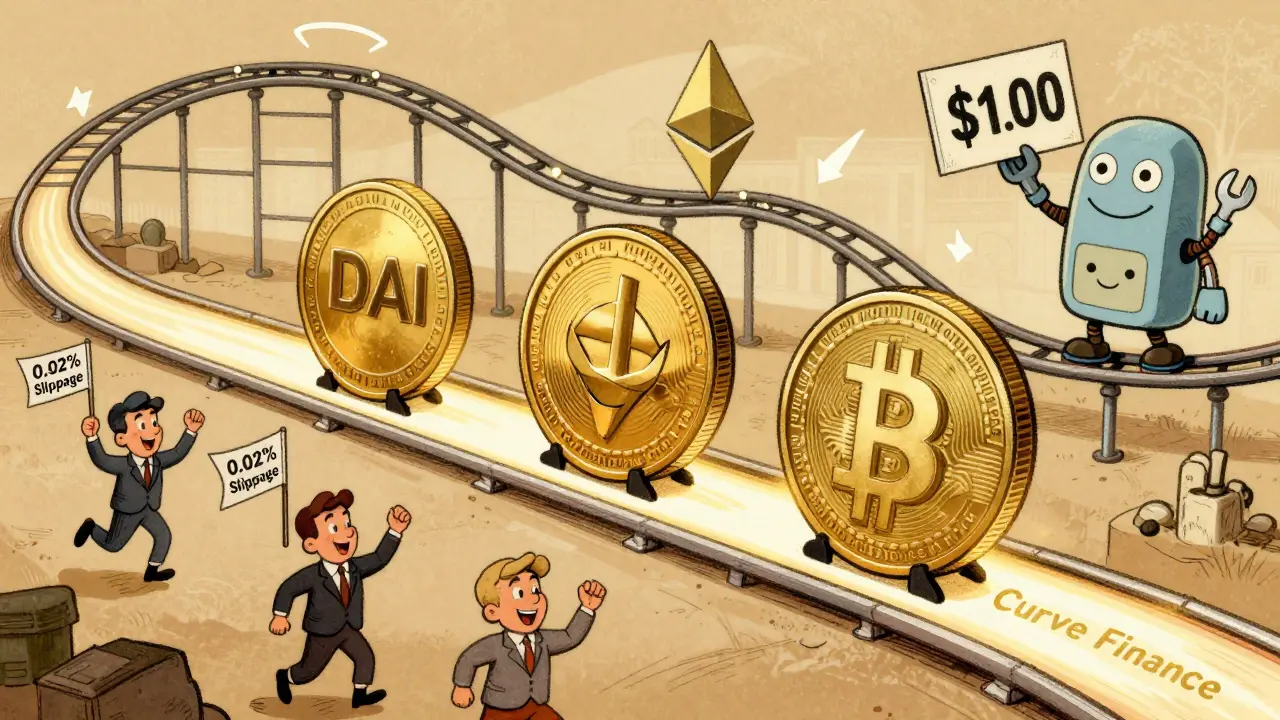
When you need to swap DAI for USDC or USDT for wBTC without losing 1% to slippage, most traders don’t head to Uniswap or SushiSwap. They go to Curve Finance. Launched in 2020, Curve isn’t just another decentralized exchange-it’s the most efficient, low-cost swap engine built specifically for stablecoins and similarly priced assets on Ethereum. By 2025, it processed $35 billion in trades in just one quarter, and its Total Value Locked (TVL) sits at $1.8 billion. If you’re trading stablecoins in DeFi, Curve is the tool you’re already using-even if you didn’t know it.
Why Curve Exists: The Stablecoin Problem
General-purpose DEXs like Uniswap were designed to swap wildly different assets: ETH for DOT, BTC for SOL. But when you’re trading DAI for USDC-two coins both pegged to $1-those platforms struggle. The price difference is tiny, but the AMM math they use creates huge slippage and high fees. Imagine trying to trade a $1 bill for a €1 coin at a regular exchange: you’d get ripped off because the system isn’t built for near-identical values. That’s exactly what happened on Uniswap before Curve came along. Curve fixed this with a custom bonding curve algorithm. Instead of using the constant product formula (x * y = k), Curve uses a stableswap invariant that flattens the price curve when assets are close in value. This means when you swap 10,000 DAI for USDC, you get almost exactly 10,000 USDC-no 0.5% loss, no surprise slippage. The math is complex, but the result is simple: lower fees, faster trades, and almost zero impermanent loss for liquidity providers.How Curve Works: More Than Just a Swap Tool
Curve isn’t just a swap interface. It’s a liquidity hub. Every stablecoin pool on Curve-DAI/USDC/USDT, FRAX/DAI/USDT, even renBTC/wBTC-is funded by users who deposit assets and earn rewards. In return for providing liquidity, you get two things: a share of trading fees and CRV tokens. CRV is Curve’s governance token, and holding it lets you vote on protocol changes, set incentive weights, and even influence which pools get boosted rewards. In 2024, Curve launched crvUSD, its own over-collateralized stablecoin. Unlike UST or other algorithmic stablecoins that collapsed, crvUSD uses a unique system called PegKeepers. These are automated bots that buy or sell crvUSD to keep its price at $1. If the price drops below $1, PegKeepers buy it using collateral from the pool. If it rises above $1, they mint and sell more. It’s like a decentralized central bank, and it’s already circulating over $120 million as of early 2026. crvUSD isn’t just a token-it’s a tool. You can use it as collateral on Aave, swap it in Curve pools, or even borrow against it. This integration makes Curve more than a DEX-it’s becoming the backbone of DeFi’s stablecoin economy.Curve vs. Other DEXs: What Makes It Different
| Feature | Curve Finance | Uniswap V3 | SushiSwap |
|---|---|---|---|
| Best for | Stablecoins & similar assets | Volatility pairs (ETH/BTC, etc.) | General swaps, yield farming |
| Slippage on $10K DAI→USDC | 0.02%-0.05% | 0.3%-1.2% | 0.2%-0.8% |
| Trading fees | 0.01%-0.04% | 0.05%-0.3% | 0.2% |
| Impermanent loss risk | Very low for stable pairs | High for stable pairs | High for stable pairs |
| Native stablecoin | crvUSD ($120M+ circulating) | No | No |
| Multi-chain support | Ethereum, Arbitrum, Optimism, Polygon, Avalanche, Fantom | Mainly Ethereum | Mainly Ethereum |
| Integration with DeFi | Aave, Compound, Yearn, Elixir, 1inch, DeBank | Basic | Some |
Curve wins on stablecoin swaps because it’s built for them. Uniswap is better if you’re trading ETH for a new memecoin. SushiSwap is good for yield farming with high APRs. But if you’re moving between stablecoins-whether you’re a trader, a DeFi farmer, or a liquidity provider-Curve is the only choice that makes sense.
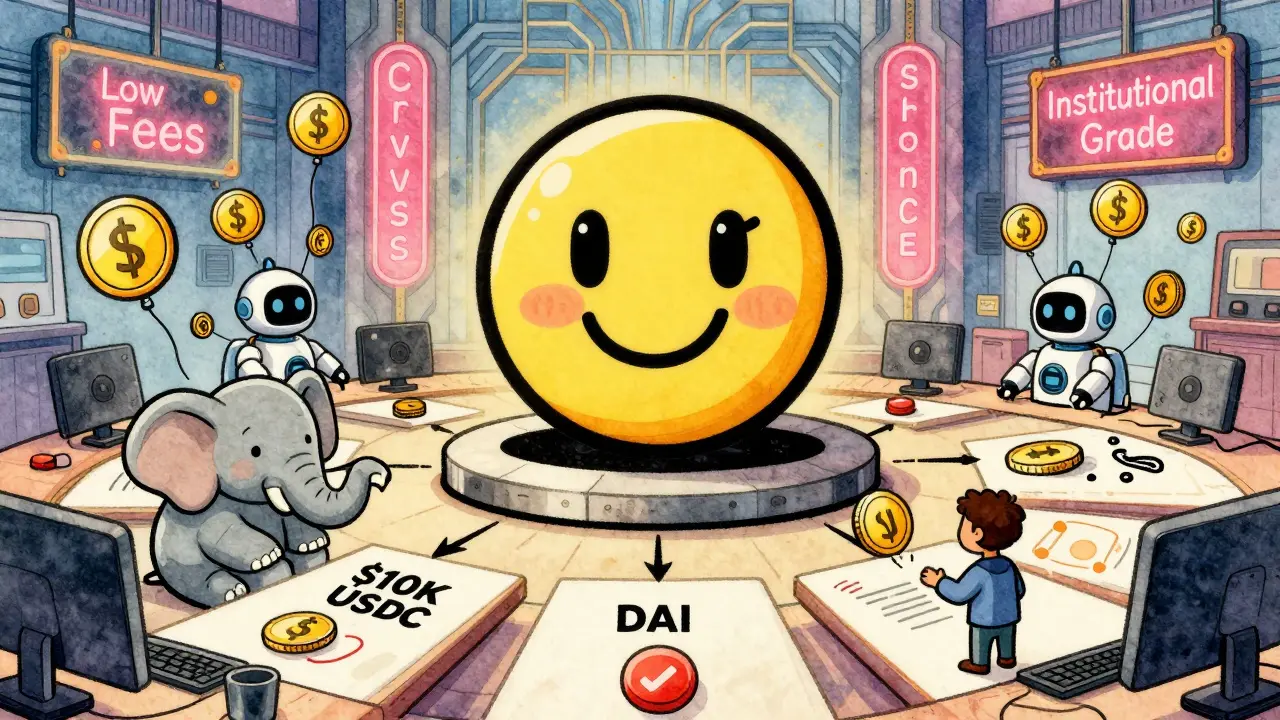
Who Uses Curve? Traders, Liquidity Providers, and Institutions
Curve’s user base isn’t casual. It’s dominated by three groups:- DeFi farmers who deposit stablecoins into Curve pools to earn CRV rewards and trading fees. Some strategies combine Curve liquidity with Aave lending to earn double yields.
- Traders who need to move large amounts of stablecoins without slippage-think hedge funds, market makers, or crypto businesses paying suppliers in USDC.
- Institutions like BlackRock, which partnered with Curve in late 2024 to bring its tokenized fund BUIDL into DeFi. This was a major signal: Curve is now trusted by traditional finance.
Even aggregators like 1inch and Paraswap route stablecoin trades through Curve because it’s the cheapest and most reliable option. If you’ve ever swapped stablecoins on a wallet like MetaMask and didn’t notice a difference, you probably used Curve behind the scenes.
Curve’s New UI: Less Scary, More Powerful
A year ago, Curve’s interface was a nightmare for beginners. Dozens of pools, confusing gauges, complex CRV voting-no clear guidance. In early 2025, Curve rolled out a full UI overhaul. The new dashboard is clean, intuitive, and packed with tools:- Real-time slippage estimates before you trade
- One-click deposit into top-performing pools
- Portfolio tracker showing your CRV earnings, fees, and exposure
- Simple governance interface: vote on which pools get boosted rewards
It’s still DeFi-there’s no way around gas fees or wallet connections-but now, even someone who’s never used a DEX can swap USDT for DAI in under a minute. The platform also added a “DeFi Health Score” that warns you if your liquidity position is at risk due to volatility or low rewards.
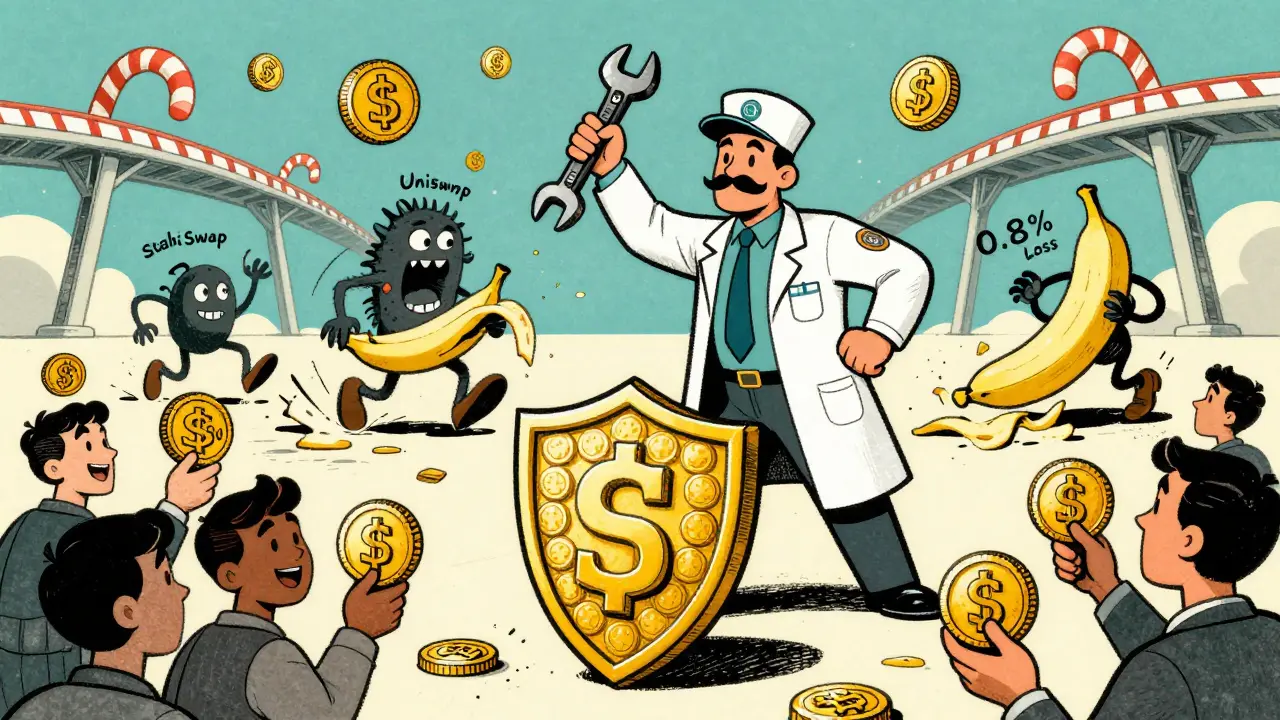
The Risks: What Could Go Wrong?
Curve isn’t risk-free. Even though it’s one of the most audited protocols in DeFi, you still face:- Smart contract risk: No code is perfect. A bug in the PegKeepers or bonding curve could cause instability (though no major exploit has occurred).
- Impermanent loss: Still possible if you deposit assets that diverge in value (like wBTC and ETH in a pool), but minimized for stablecoin-only pools.
- CRV token volatility: Your rewards are paid in CRV, which can drop 30% in a week. Some users lock CRV to avoid this.
- Gas fees: On Ethereum, trading can cost $5-$15. But Curve works on Arbitrum and Polygon, where fees are under $0.10.
Most users mitigate these risks by using Curve only for stablecoin swaps, keeping their main holdings in cold wallets, and avoiding high-risk pools with volatile assets.
What’s Next for Curve?
Curve isn’t standing still. By the end of 2026, it plans to:- Launch a unified lending interface that combines borrowing, collateral management, and stablecoin swaps in one screen.
- Expand cross-chain support with deeper integrations to LayerZero and Wormhole, allowing direct swaps between stablecoins on different chains.
- Introduce dynamic CRV distribution based on real-time liquidity demand, not fixed schedules.
- Begin testing cross-denomination stablecoin swaps-like EUR-stable to USD-stable-something no other protocol has solved reliably.
Founder Michael Egorov believes the future of DeFi isn’t about swapping ETH for tokens-it’s about moving real-world value digitally. And Curve is the only platform built to handle that.
Final Verdict: Is Curve Right for You?
If you’re trading stablecoins, Curve is the best DEX on Ethereum. Period. Lower fees, near-zero slippage, deep liquidity, and institutional backing make it unmatched for this use case.If you’re trading volatile assets, skip it. Use Uniswap or PancakeSwap instead.
If you’re a beginner, start small. Swap $100 of USDC for DAI on Polygon to get used to the flow. Learn how to stake CRV. Then scale up.
Curve isn’t flashy. It doesn’t have memes or celebrity endorsements. But it works. And in DeFi, that’s worth more than anything else.
Is Curve a centralized exchange?
No, Curve is a decentralized exchange (DEX). You trade directly from your wallet-no KYC, no deposits to a company. All transactions are handled by smart contracts on Ethereum and other blockchains.
Can I trade ETH or Bitcoin on Curve?
You can only trade wrapped versions like wETH or wBTC, and only in pools paired with stablecoins. Curve doesn’t support direct ETH/BTC or ETH/DOGE swaps. For those, use Uniswap or another general-purpose DEX.
How do I earn CRV tokens?
You earn CRV by providing liquidity to Curve pools. For example, depositing equal amounts of DAI, USDC, and USDT into the 3pool earns you trading fees plus CRV rewards. You can also vote on governance to boost rewards for specific pools.
Is Curve safe to use?
Curve is one of the most audited and battle-tested protocols in DeFi. It’s been live since 2020 with no major exploits. However, all DeFi carries smart contract risk. Always use small amounts first, avoid risky pools, and never invest more than you can afford to lose.
Do I need to pay gas fees on Curve?
Yes, every transaction on Ethereum costs gas. But Curve is available on cheaper chains like Arbitrum and Polygon, where fees are under $0.10. Always switch networks in your wallet before trading to save money.
What’s the difference between crvUSD and USDC?
USDC is a centralized stablecoin backed by cash and bonds. crvUSD is a decentralized, over-collateralized stablecoin created by Curve. It’s backed by crypto assets and stabilized by automated bots (PegKeepers). crvUSD is designed to be used within DeFi, while USDC is used everywhere.
Can I use Curve on my phone?
Yes, through wallet apps like MetaMask, Rainbow, or Trust Wallet. Connect your wallet to curve.fi in your mobile browser. The interface works fine on phones, though desktop is better for managing complex positions.
Curve isn’t trying to be everything. It’s trying to be the best at one thing: moving stablecoins without losing value. And in a world where every DeFi protocol is chasing hype, that’s the most powerful strategy of all.

Gavin Francis
January 27, 2026 AT 11:47Crystal Underwood
January 28, 2026 AT 05:47Brandon Vaidyanathan
January 29, 2026 AT 20:14Gareth Fitzjohn
January 31, 2026 AT 18:49Dahlia Nurcahya
February 1, 2026 AT 14:31Christopher Michael
February 2, 2026 AT 00:57Rico Romano
February 3, 2026 AT 13:26Meenal Sharma
February 4, 2026 AT 02:00Gary Gately
February 4, 2026 AT 15:16Gurpreet Singh
February 5, 2026 AT 17:58Will Pimblett
February 5, 2026 AT 21:54Brianne Hurley
February 6, 2026 AT 22:31Freddy Wiryadi
February 8, 2026 AT 18:33Dylan Morrison
February 9, 2026 AT 23:03Parth Makwana
February 11, 2026 AT 01:07Elle M
February 12, 2026 AT 11:38Wayne mutunga
February 12, 2026 AT 17:49William Hanson
February 14, 2026 AT 15:34Freddy Wiryadi
February 16, 2026 AT 12:13