
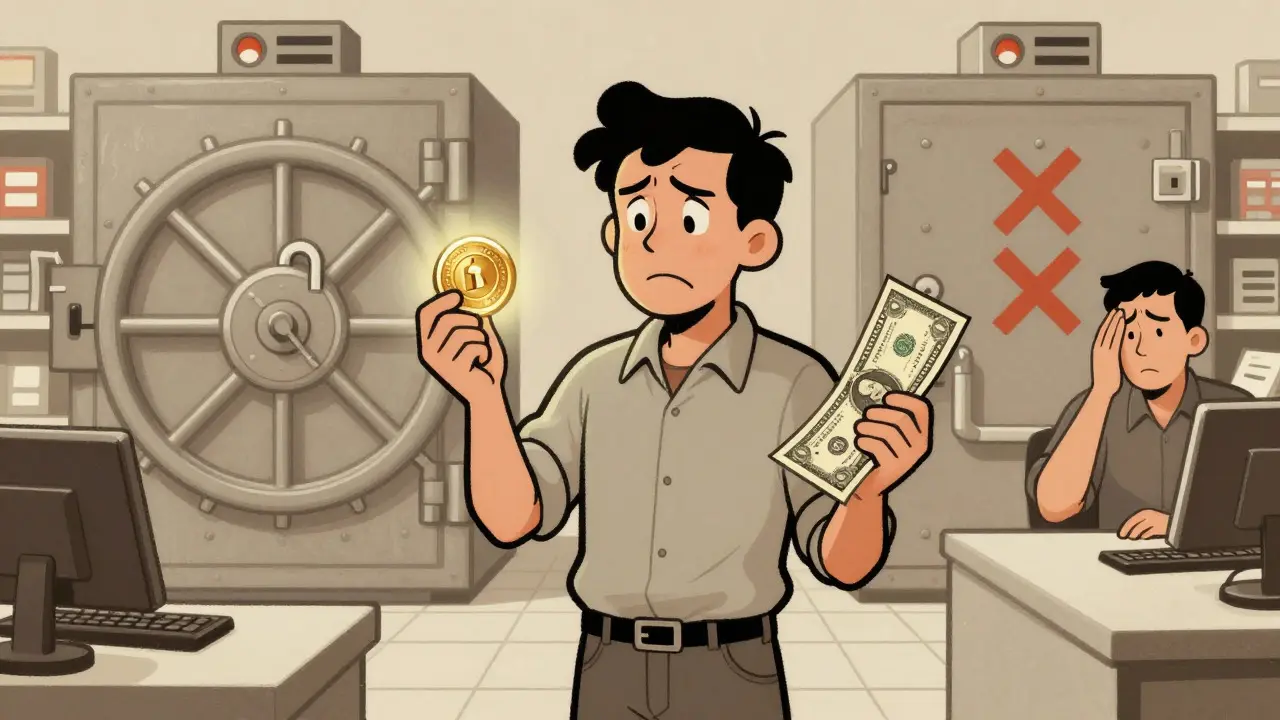
Living in a dollarized economy should make digital finance easier, right? Not necessarily. In Ecuador, a country that has used the US dollar as its official currency since 2000, the path for Cryptocurrency users is blocked by strict banking controls and regulatory silence. You can buy Bitcoin or Ethereum, but you can't pay your grocery bill with it. This creates a frustrating "gray area" where the law doesn't ban you from holding coins, but the financial system actively fights against you using them.
If you are an expat, a local resident, or someone sending money to family in Quito or Guayaquil, understanding these cryptocurrency restrictions is vital to avoid frozen bank accounts or high fees. The situation isn't just about legality; it's about practicality. With only 2.73% of the population owning crypto (compared to the Latin American average of 10.9%), the barriers are real and tangible. Here is what you need to know to navigate this complex landscape in 2026.
The Legal Gray Area: Banned or Allowed?
First, let’s clear up the confusion. Is crypto illegal in Ecuador? Technically, no. But is it legal tender? Absolutely not. On August 12, 2024, the Central Bank of Ecuador (BCE) issued a statement declaring that cryptocurrencies are neither legal tender nor authorized means of payment. This stance is rooted in Article 94 of the Organic Monetary and Financial Code, which protects the US dollar's status as the sole official currency.
However, the BCE admits it has "no power to ban" private transactions. So, if you swap tokens peer-to-peer (P2P) on a platform like Binance or OKX, you aren't breaking the law. But if you try to use a credit card at a local shop to buy crypto, you're likely stepping into trouble. The Superintendency of Banks maintains a list of unauthorized entities, which includes most major international exchanges. This means banks are legally mandated to refuse crypto-related transfers unless a future law explicitly licenses them. For now, that license doesn't exist.
- Holding Crypto: Legal. No tax penalty just for owning.
- Buying/Selling: Legal, but difficult via formal banking channels.
- Paying with Crypto: Not accepted as legal tender. Merchants can refuse.
- Mining: Not expressly banned, but economically unviable due to costs.
Why Banks Block Your Transactions
You might wonder why your bank freezes your account when you transfer funds to an exchange. It’s not personal; it’s compliance. The Monetary and Financial Policy and Regulation Board (JPRM) has issued resolutions excluding crypto from authorized payment methods. Consequently, card acquirers flag crypto exchanges as "high-risk." If you try to charge $500 on your debit card to buy Bitcoin, the transaction often gets flagged and reversed within 24 hours.
User reports from communities like r/CryptoEcuador highlight this pain point. One user noted having three bank accounts frozen in a single year, totaling $850 in lost funds. The issue stems from the lack of a domestic licensed exchange. Without a local entity to vouch for the transaction, banks treat every crypto purchase as potential fraud or money laundering. This forces most users to rely on cash-based P2P trades or offshore Over-the-Counter (OTC) desks, which come with their own set of risks and premiums.
Tax Implications: What the SRI Wants From You
Even if buying crypto is a headache, selling it brings another challenge: taxes. The Internal Revenue Service (SRI) treats realized crypto gains as Ecuador-source income. There is no special "crypto capital gains tax" rate; instead, it falls under standard progressive income tax brackets.
| Entity Type | Max Tax Rate on Gains | Filing Requirement |
|---|---|---|
| Individuals | Up to 35% | Annual Income Tax Return |
| Companies/Firms | 25% | Corporate Tax Return |
Keep in mind, this applies to *realized* gains. If you buy Bitcoin and hold it, you owe nothing until you sell or swap it for another asset. However, documentation is key. Since there is no official government guidance on how to report specific crypto transactions, keeping detailed records of entry prices, exit prices, and dates is essential. Failure to report can lead to audits, especially given the SRI's increasing focus on digital assets.
The Practical Reality: Mining and Adoption Barriers
Want to start mining Bitcoin in Ecuador? Think twice. While not prohibited, the economics don’t add up. Electricity tariffs average $0.145/kWh, which is 23% above the Latin American average. Add frequent grid outages in the Andean region (averaging 14.7 hours per month) and 35% import duties on computing equipment, and profitability vanishes. Total estimated hash rate from Ecuadorian miners is negligible, representing less than 0.0001% of global capacity.
Adoption remains low for similar reasons. Only 50% of adults have bank accounts, yet the financial system blocks crypto transactions for those who do. This paradox leaves the unbanked without access to formal crypto services, while the banked face friction. The BCE’s attempt to introduce "Dinero Electronico," a retail CBDC pegged to the dollar, has also failed to gain traction, with only 0.5% adoption as of 2023. This suggests that even state-backed digital payments struggle to overcome local infrastructure hurdles, let alone decentralized cryptocurrencies.
How Users Actually Trade: P2P and OTC Desks
So, how do people actually get their hands on crypto in Ecuador? They go around the banks. The primary method is Peer-to-Peer (P2P) trading on platforms like Binance, OKX, or Mercado Bitcoin. These platforms allow users to trade directly with other individuals, often settling in USD cash or stablecoins like USDT.
However, this route requires caution. Premiums on cash transactions average 8-12% above global prices. A survey of 500 users found that 23% reported fraud attempts. To mitigate risk, experienced traders recommend:
- Using established P2P platforms with escrow protection.
- Verifying counterparty reputation scores before large trades.
- Meeting in safe, public locations for cash handoffs.
- Avoiding direct wire transfers to unknown parties.
For larger amounts, Over-the-Counter (OTC) desks are common, particularly in cities like Guayaquil and Quito. These informal brokers charge fees of 5-7% but offer liquidity and speed. Just remember, because they operate outside the formal banking system, consumer protection is minimal. If the desk disappears with your money, good luck getting it back.

Comparison with Neighboring Countries
Ecuador’s approach stands out as one of the most restrictive in Latin America. Let’s compare it with regional neighbors to see where it fits in the broader context.
| Country | Legal Status | Payment Acceptance | Key Regulation |
|---|---|---|---|
| Ecuador | Gray Area (Not Legal Tender) | No | BCE Statement 2024 |
| Paraguay | Legal | Yes | 2022 Law (AML Compliance) |
| Mexico | Virtual Assets | Limited | 2018 Fintech Law |
| Peru | Regulated VASPs | Limited | UIF Registration (2025) |
While Paraguay allows crypto payments and Mexico has a licensing framework, Ecuador offers no formal pathway for crypto businesses. This lack of clarity pushes activity underground. Experts argue that this increases risk for consumers rather than reducing it. A regulated market would provide consumer protections, standardized reporting, and clearer tax guidelines, none of which currently exist in Ecuador.
Future Outlook: Will Things Change?
As of 2026, the outlook remains cautious. The BCE continues to explore a dollar-pegged CBDC, but no launch date is confirmed. Meanwhile, pressure is mounting from fintech startups. A May 2024 survey by ECLAC found that 78% of Ecuadorian fintechs would develop crypto services if a regulatory framework existed. Analysts predict that by 2026, the market could grow to $300 million annually if barriers are reduced, but without policy changes, it may remain stagnant at current levels.
For now, the safest advice is to stay informed, keep records, and use trusted P2P platforms. The days of easy, frictionless crypto adoption in Ecuador are still ahead, but the journey there will require navigating a maze of banking blocks and regulatory ambiguity.
Is it illegal to buy cryptocurrency in Ecuador?
No, it is not illegal to buy, hold, or sell cryptocurrency. However, it is not legal tender, and banks are encouraged to block related transactions. The main risk is administrative friction with banks rather than criminal prosecution.
What is the tax rate on crypto gains in Ecuador?
Realized crypto gains are taxed as ordinary income. Individuals face progressive rates up to 35%, while companies pay a flat 25%. Unrealized gains (holding) are not taxed until sold or swapped.
Can I pay for groceries with Bitcoin in Ecuador?
Generally, no. While some niche merchants may accept it voluntarily, it is not an authorized means of payment under national law. Most businesses prefer cash or card payments in USD.
Which platforms work best for P2P trading in Ecuador?
Binance, OKX, and Mercado Bitcoin are commonly used for P2P trading. Users typically settle trades in USD cash or USDT. Always verify counterparty reputation and use platform escrow for safety.
Will Ecuador adopt a Central Bank Digital Currency (CBDC)?
The Central Bank of Ecuador has been exploring a dollar-pegged CBDC since 2022, but as of 2026, no launch date has been confirmed. It aims to modernize small payments without replacing the US dollar.
