
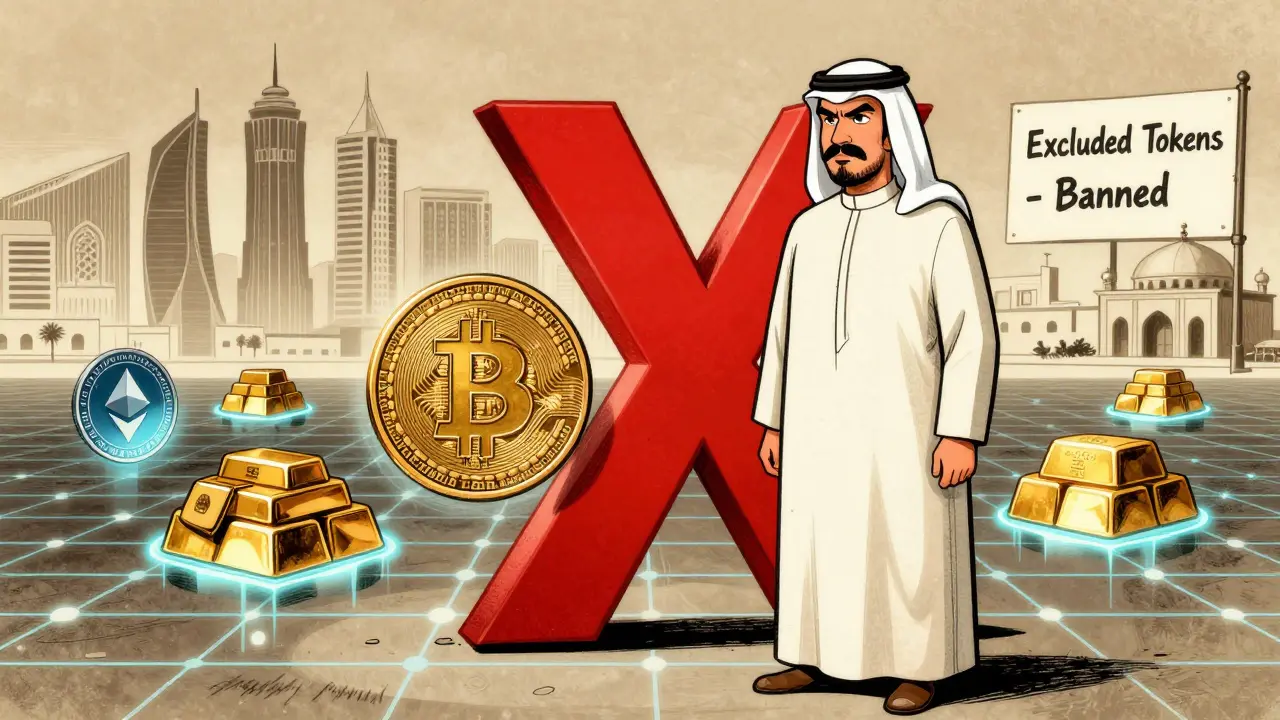
If you live in Qatar and you’re wondering whether you can buy Bitcoin, trade Ethereum, or use a crypto wallet, the answer is simple: no. Not legally, not through local banks, and not via any licensed service inside the country. Since September 2024, Qatar has drawn a sharp line between two types of digital assets - one that’s completely banned, and one that’s tightly controlled but allowed. For most people, this means crypto as they know it - Bitcoin, Dogecoin, stablecoins - is off-limits. But there’s a twist: you can still invest in digital versions of real things like property, gold, or company shares. It’s not a free-for-all. It’s not even close. It’s a system built to keep speculation out and control in.
What’s Completely Banned in Qatar
The Qatar Financial Centre Regulatory Authority (QFCRA) made it crystal clear in 2024: cryptocurrencies are Excluded Tokens. That’s the official term. And it means Bitcoin, Ethereum, Solana, Tether, USD Coin - any digital asset that acts like money - is illegal to trade, hold, or exchange within Qatar’s jurisdiction. This isn’t a gray area. Banks can’t offer crypto services. Exchanges can’t operate here. Wallet providers can’t set up shop. Even peer-to-peer trading carries legal risk.
The ban isn’t new. It started in 2018 when the Central Bank of Qatar told all local banks to stop dealing with crypto. By 2020, the QFCRA shut down all virtual asset services inside the Qatar Financial Centre. The 2024 rules didn’t lift any of that. They just added more structure - and made the ban even more official. The government’s reasoning? Money laundering, terrorist financing, and financial instability. Qatar doesn’t want its economy exposed to the wild price swings of unbacked digital currencies. They’ve seen what happens in other markets. They’re not taking the chance.
What’s Actually Allowed - And How It Works
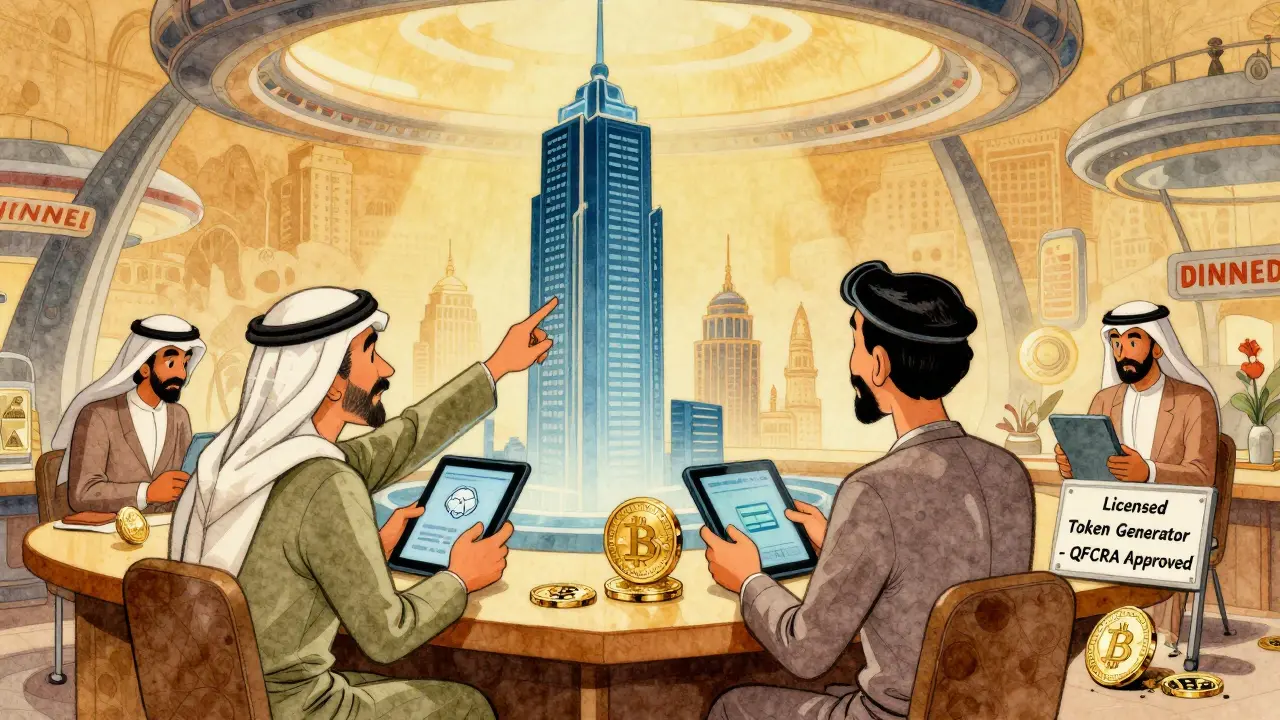
Here’s where things get interesting. While Bitcoin is banned, you can legally invest in tokenized real estate, corporate bonds, commodities like gold or oil, and even sukuk (Islamic bonds). These aren’t speculative coins. They’re digital certificates tied to real assets. Think of it like owning a share of a building in Doha - except instead of a paper deed, you hold a token on a blockchain.
The process isn’t simple. To turn a physical asset into a digital token, you need three steps:
- Validation - A licensed validator confirms you legally own the asset (like a house or a share of a company).
- Request - The asset owner formally asks for it to be tokenized.
- Generation - A licensed token generator creates the digital token on government-approved infrastructure.
You can’t just mint your own token. You can’t buy one from an offshore exchange. You have to go through a licensed provider operating under QFCRA rules. These providers are carefully vetted. They’re held accountable. And they’re the only legal way to access this kind of investment in Qatar.
Why This Dual System Exists
Qatar isn’t against technology. It’s against risk. The country wants to use blockchain - but only in ways that protect its economy. Tokenizing real estate makes sense. It’s a way to open up investment in Qatar’s massive property market to more people, including foreign investors. It can make buying and selling assets faster, cheaper, and more transparent.
But letting people trade Bitcoin? That’s gambling with the financial system. The QFCRA doesn’t want Qatari citizens losing savings to crypto pumps and dumps. They don’t want unregulated platforms draining capital out of the country. And they definitely don’t want their banks dragged into laundering schemes. The 2024 framework is a smart compromise: let innovation happen, but only where there’s real value behind it.
This approach sets Qatar apart from neighbors like the UAE or Saudi Arabia, which have built crypto exchanges and allowed retail trading. Qatar chose control over convenience. It’s a conservative move - but one that aligns with its long-term economic strategy: stability, sovereignty, and long-term asset growth.
What Happens If You Try to Use Crypto Anyway
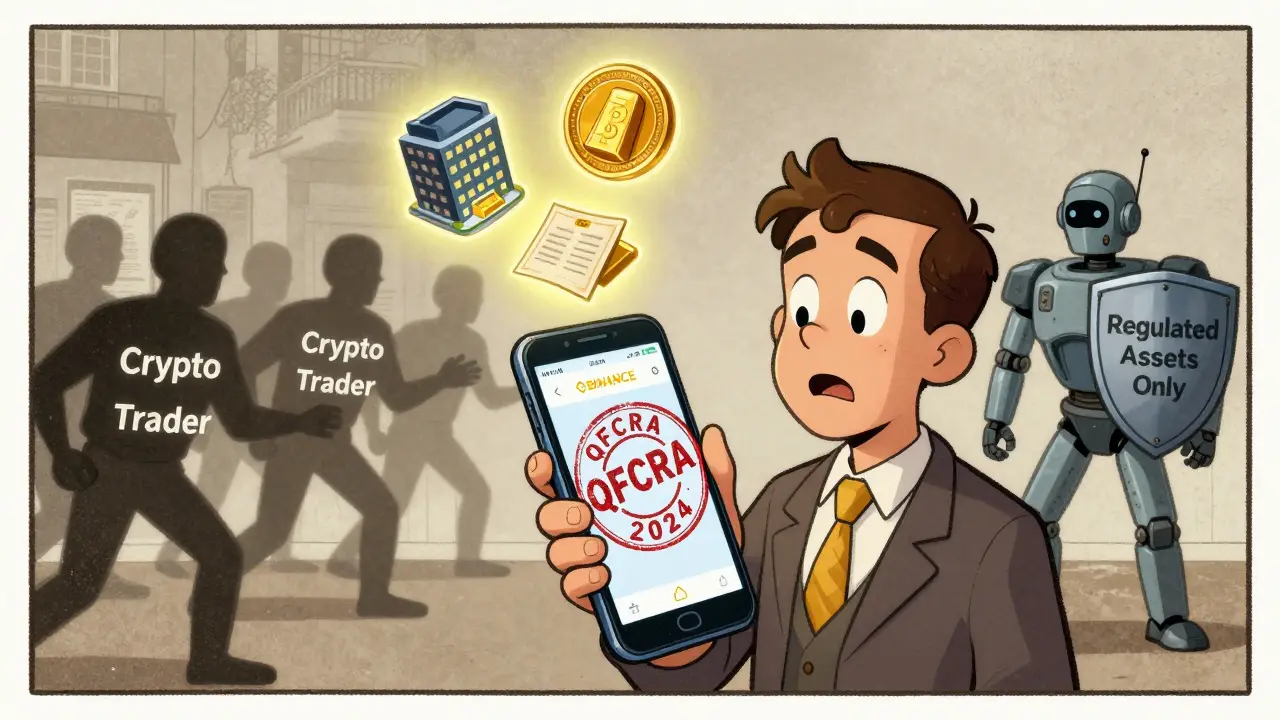
There’s no public record of individuals being fined or jailed for holding crypto privately. But that doesn’t mean it’s safe. The law is vague on personal use - but the rules for institutions are crystal clear. If you work for a bank, a financial firm, or even a startup in the QFC, using crypto could cost you your job - or worse. The Anti-Money Laundering Law No. 20 of 2019 defines "funds" broadly to include any asset transferred digitally. That means even if you bought Bitcoin on Binance from your phone, you could still be investigated if authorities suspect illegal activity.
Most residents who use crypto do so through offshore platforms. But that’s not risk-free. If you’re caught, you could face scrutiny from Qatar’s financial intelligence unit. Your bank accounts could be flagged. Your travel could be restricted. And if you’re using crypto to send money out of the country, you’re walking into serious legal territory.
Who Benefits From the New Rules
The biggest winners are institutional investors and high-net-worth individuals who want exposure to Qatar’s real economy. A family in Doha can now buy a digital share of a commercial building in West Bay - with lower fees, faster settlement, and clear ownership records. A foreign investor can purchase tokenized oil reserves without needing to physically hold them. These are legitimate, regulated investments.
Businesses that offer tokenization services are also growing. Legal firms, asset managers, and fintech startups are rushing to become licensed token generators or validators. The QFC is actively encouraging this growth as part of Qatar’s Third Financial Sector Strategic Plan. The goal? To make Qatar a regional hub for secure, asset-backed digital finance - not crypto speculation.
What’s Next for Crypto in Qatar
Don’t expect the ban on Bitcoin or Ethereum to lift anytime soon. The 2024 framework explicitly labeled these as "Excluded Tokens" - a legal term that’s hard to reverse. Any future changes will likely expand the types of assets that can be tokenized - maybe carbon credits, intellectual property, or even art. But cryptocurrencies? They’re not on the table.
Qatar is also exploring its own central bank digital currency (CBDC), but even that’s not considered a cryptocurrency under the new rules. It’s a government-backed digital riyal - a tool for monetary policy, not trading. That’s another sign: Qatar wants digital money, but only if it’s fully controlled by the state.
For residents, the message is clear: if you want to invest in digital assets, stick to the legal path. Use licensed providers. Focus on real-world value. Avoid anything that looks like a coin or token you can buy on an app. The rules are strict, but they’re also designed to protect you - not punish you.
Bottom Line: Crypto Isn’t Dead in Qatar - But It’s Not What You Think
Qatar didn’t ban blockchain. It banned speculation. You can’t trade crypto here - but you can own a piece of a skyscraper, a gold bar, or a share in a Qatari company - all as digital tokens. The system is complex, tightly regulated, and not built for the average person looking to get rich quick. But for those who want secure, transparent, long-term investment, it’s one of the most sophisticated frameworks in the region.
If you’re a resident, your best move isn’t to look for loopholes. It’s to learn about licensed tokenization providers. Ask your bank if they offer tokenized assets. Talk to a financial advisor who understands the QFCRA rules. The future of finance in Qatar isn’t in Bitcoin. It’s in the digital representation of things that actually matter.
Is it illegal to own Bitcoin in Qatar?
Owning Bitcoin privately isn’t explicitly criminalized, but all services that support it - trading, exchanges, wallets - are banned. Using Bitcoin carries legal risk, especially if linked to financial institutions or cross-border transfers. The government treats it as an "Excluded Token," meaning it has no legal recognition and is not protected under financial regulations.
Can I use Binance or Coinbase in Qatar?
No. Binance, Coinbase, Kraken, and all other crypto exchanges are blocked from operating legally in Qatar. While you might still access them via VPN, doing so violates Qatar’s financial regulations. Your bank may flag your transactions, and you could face scrutiny from financial authorities if large amounts are moved.
Can I invest in tokenized real estate in Qatar?
Yes. Under the Digital Assets Regulations 2024, you can legally invest in tokenized real estate, bonds, commodities, and shares through licensed providers. These tokens represent actual ownership in physical assets and are subject to strict validation and generation processes. This is the only legal way to invest in digital assets in Qatar.
Are stablecoins like USDT allowed in Qatar?
No. Stablecoins, including USDT and USDC, are classified as "Excluded Tokens" under Qatar’s 2024 regulations. They’re treated as currency substitutes and are completely banned from use, trading, or custody within Qatar’s jurisdiction - even if they’re pegged to the US dollar.
Can I mine cryptocurrency in Qatar?
Mining cryptocurrency is not explicitly banned, but it’s highly discouraged and carries significant risk. The government views mining as a form of crypto activity that supports excluded tokens. High electricity usage from mining could also attract attention from regulators. There are no legal protections or licenses for crypto mining in Qatar.
What happens if I get caught using crypto illegally?
There’s no public record of individual prosecutions, but violations of financial regulations can lead to bank account freezes, investigations by the Financial Intelligence Unit, or even criminal charges if linked to money laundering. Businesses caught offering crypto services face heavy fines and license revocation. The risk isn’t zero - it’s just not always enforced publicly.
Is there a Qatari cryptocurrency?
No public cryptocurrency exists, but Qatar is exploring a central bank digital currency (CBDC) - a digital version of the Qatari riyal. Unlike Bitcoin, this would be fully controlled by the Central Bank of Qatar and used for official transactions, not trading. It’s not classified as a cryptocurrency under current rules.
Can foreigners invest in tokenized assets in Qatar?
Yes. Foreign investors can legally invest in tokenized real estate, commodities, and corporate assets through licensed providers in the Qatar Financial Centre. The framework is designed to attract international capital, provided all tokenization steps are followed and providers are QFCRA-approved.

Shaun Beckford
January 18, 2026 AT 00:50Qatar’s crypto ban is peak control-freak energy. They’re not stopping innovation-they’re just making sure only the elite get to play with blockchain while the rest of us get to stare at our Binance apps like sad puppies. Tokenized real estate? Cute. Meanwhile, I’m over here trying to buy DOGE and getting a cease-and-desist from my bank. The hypocrisy is thicker than a Qatari gold bar.
Deb Svanefelt
January 18, 2026 AT 08:15This is actually one of the most thoughtful crypto frameworks I’ve seen. Most countries either go full libertarian or full prohibition. Qatar found a middle path: allow blockchain for real economic value, block it for gambling. Tokenizing property or sukuk isn’t just legal-it’s a smart way to modernize without inviting chaos. The real win? Protecting ordinary people from rug pulls disguised as ‘investments.’
Pat G
January 19, 2026 AT 18:19Of course the U.S. and EU are screaming about ‘financial freedom’-but they’re the ones who let crypto scams drain millions from retirees. Qatar’s being responsible. If you want to gamble, go to Vegas. Don’t drag your crypto addiction into my country’s economy. This isn’t oppression-it’s protection.
Tony Loneman
January 20, 2026 AT 16:04They’re not banning crypto-they’re banning the idea that money can be decentralized. This is just the first step before they start tokenizing your thoughts. Next thing you know, your emotional state will be a regulated asset class. Welcome to the Qatari Panopticon. 🤖
kristina tina
January 22, 2026 AT 03:12For anyone who thinks this is anti-tech-nope. This is pro-smart-tech. Tokenizing assets isn’t just legal, it’s revolutionary. Imagine buying a share of a skyscraper in Doha with a tap on your phone. No lawyers, no title deeds, no waiting weeks. This is finance 3.0-and Qatar’s leading it. Meanwhile, the rest of the world is still arguing about whether Dogecoin is a meme or a currency.
Pramod Sharma
January 24, 2026 AT 00:15Smart move. Real assets > speculative coins. Simple.
Patricia Chakeres
January 25, 2026 AT 05:53Of course they banned Bitcoin. They’re terrified of financial independence. This is a dictatorship in disguise. They want you to depend on their ‘licensed’ tokenized assets so they can track every cent you own. CBDC next. Then biometric ID. Then you’ll need government permission to buy bread. 🤡
Katherine Melgarejo
January 26, 2026 AT 08:05So… you can own a piece of a building via blockchain but not a piece of Bitcoin? Cool. I guess in Qatar, money has to have a physical address to be real. Meanwhile, I’m over here buying NFTs of cats in space. We’re all just trying to survive capitalism, right?
Hannah Campbell
January 27, 2026 AT 20:22Qatar’s crypto policy is basically ‘We’re rich so we get to decide what your dreams are worth’ 🤡
Ashlea Zirk
January 29, 2026 AT 05:58The regulatory clarity here is admirable. Many jurisdictions struggle with ambiguity, but Qatar has drawn a clear boundary: innovation with accountability, not speculation without oversight. The tokenization framework, while complex, ensures transparency, reduces fraud, and aligns with Islamic finance principles. For institutional investors, this is a model worth studying-not mocking.
Bryan Muñoz
January 30, 2026 AT 13:08They’re not banning crypto… they’re banning freedom. And don’t tell me it’s ‘for your own good’-I’ve seen what happens when governments control money. Next they’ll ban cash. Then barter. Then thoughts. The Qatari CBDC is the first step. We’re already in the Matrix. 💀
Bharat Kunduri
January 30, 2026 AT 13:49lol qatar thinks they’re so smart but their system is just a walled garden. why not just let people trade? if you want to be safe then don’t invest. but don’t stop others from trying. also i typed this on my phone and i’m tired so sorry for the typos
Dustin Secrest
February 1, 2026 AT 04:06There’s a philosophical elegance here. Money has always been a social contract. Qatar is simply redefining the contract to exclude speculative abstraction and anchor value in tangible, verifiable assets. It’s not anti-liberty-it’s anti-illusion. Bitcoin is a story. Tokenized real estate is a deed.
Kelly Post
February 2, 2026 AT 16:09If you’re a resident and you’re confused about what’s allowed-don’t panic. Start by asking your bank if they offer tokenized assets. Talk to a financial advisor who knows the QFCRA rules. The system isn’t designed to confuse you-it’s designed to protect you from scams. Take the time to learn. The future of finance here isn’t wild coins-it’s smart, secure, real-world-backed assets.
Lauren Bontje
February 2, 2026 AT 18:23Let me guess-Qatar’s elite are all buying Bitcoin on VPNs while telling everyone else to ‘play by the rules.’ Classic. They want control, not safety. This isn’t financial wisdom-it’s authoritarianism with a nice UI. The fact that they’re building a CBDC proves it: they don’t want decentralized money. They want total control. And they’re using ‘stability’ as a cover.
Stephanie BASILIEN
February 4, 2026 AT 09:30While the regulatory architecture appears rigid, it is, in fact, a sophisticated calibration of risk aversion, cultural values, and long-term economic sovereignty. The exclusion of unbacked tokens reflects not hostility toward innovation, but a prioritization of systemic integrity over speculative velocity. One might even argue that this represents a higher form of financial maturity.
Rod Petrik
February 4, 2026 AT 12:07They banned crypto but still let you buy gold tokens? That’s the same thing. Gold is just a shiny rock. Bitcoin is digital scarcity. They’re scared of real decentralization. And the CBDC? That’s the real enemy. They’re not protecting you-they’re preparing to freeze your account if you think differently. They’re watching. Always watching. 👁️
Telleen Anderson-Lozano
February 6, 2026 AT 06:10I think this is a really balanced approach, honestly. On one hand, I get why people want to trade Bitcoin-it’s exciting, it’s rebellious, it’s like digital gold. But on the other hand, I’ve seen friends lose everything to crypto scams. So… I get why Qatar’s doing this. It’s not about control-it’s about making sure people don’t get crushed. And honestly? The tokenized real estate thing sounds kind of cool. Like, imagine owning a piece of a building in Doha without the paperwork nightmare. That’s actually kind of revolutionary. I just hope they make the system easy to use for regular people too.
Haley Hebert
February 7, 2026 AT 15:44Hey, if you’re new to this whole tokenized asset thing-don’t feel overwhelmed. Start small. Ask your bank if they offer any QFCRA-approved options. Maybe a tokenized gold fund or a share in a local property project. It’s not flashy like Bitcoin, but it’s real. And honestly? It’s way less stressful. I used to stress over crypto prices every day. Now I just check my tokenized portfolio once a month. Peace of mind? Priceless. 💛
Jason Zhang
February 8, 2026 AT 09:38Qatar’s system is just capitalism with training wheels. They let you invest-but only in things they approve of. Meanwhile, the people who actually built blockchain? They’re stuck outside the gates. This isn’t innovation. It’s corporate feudalism with a blockchain logo.
CHISOM UCHE
February 10, 2026 AT 01:36Tokenization as a tool for financial inclusion in emerging markets is fascinating. In Nigeria, we struggle with access to formal investment channels. Qatar’s model-while restrictive-demonstrates how blockchain can be harnessed for institutional-grade transparency. The key is licensing, not prohibition. The real lesson? Regulation doesn’t have to stifle innovation-it can channel it.
Chris Evans
February 10, 2026 AT 15:42Let’s deconstruct the metaphysics of value here. Bitcoin is a decentralized ledger of trustless consensus. Tokenized real estate is a centralized ledger of state-sanctioned ownership. One is anarchic potential. The other is institutional permanence. Qatar chose the latter-not because it’s better, but because it’s controllable. The real question isn’t ‘What’s banned?’ It’s: ‘What kind of society are we building when we decide that only state-approved assets can hold value?’ The answer is… not a free one.