
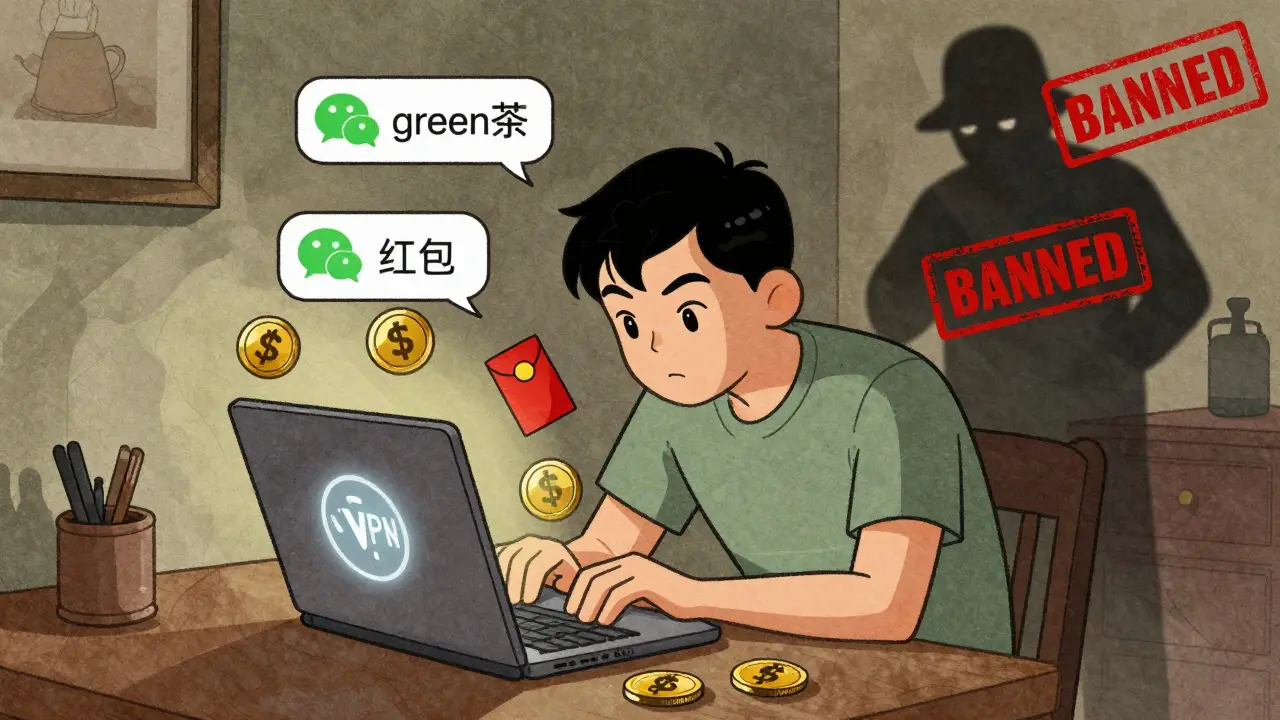
China officially banned cryptocurrency in 2021. No exchanges. No mining. No trading. Yet, 59 million Chinese people are still using crypto today. That’s more than the entire population of Canada. How is that possible?
They Didn’t Stop Using It - They Just Went Dark
The Chinese government didn’t just warn people away from Bitcoin. They shut down every exchange operating inside the country. They blocked websites. They fined banks that even looked the other way. By September 2021, owning or trading crypto was illegal. At least, that’s what the law says. But laws don’t stop people who have a reason to use something. For many Chinese, crypto isn’t about speculation - it’s about survival. Sending money to family abroad? Traditional banks charge 5-7% in fees and take days. Using USDT (Tether) on a peer-to-peer platform? 15 minutes. Less than 1% in fees. That’s why stablecoins now make up nearly 40% of all crypto transactions in China, up from just 22% in 2024.How Do They Do It? The Underground Network
You won’t find a crypto app on the official Chinese app stores. But if you know where to look, you’ll find them. Apps like CryptoBridge and Silk Road Wallet aren’t on Google Play or Apple’s App Store. They’re on third-party Android stores, downloaded over 8.7 million times in the first half of 2025. Users install them manually, often through QR codes shared in WeChat groups. Most Chinese crypto users access offshore exchanges like Binance, Bybit, or OKX through VPNs. About 78% use them, according to Chainalysis. It’s not perfect - connections drop, servers get blocked - but it works. And when the internet gets too hot, they switch to P2P trading. Peer-to-peer trading is the backbone of China’s crypto underground. Instead of using an exchange, buyers and sellers connect directly. They use WeChat or QQ to negotiate. Escrow services hold the money until both sides confirm the trade. Around 63% of all crypto transactions in China happen this way. And 45% of those P2P trades are done through encrypted WeChat groups that use coded language - “green tea” for Bitcoin, “red packet” for USDT - to avoid detection.The e-CNY Paradox
While cracking down on Bitcoin and Ethereum, China is pushing its own digital currency: the e-CNY, or digital yuan. The People’s Bank of China has rolled out over 260 million individual wallets and 15.5 million corporate ones. By mid-2025, civil servants in pilot cities like Shanghai and Shenzhen are getting paid in e-CNY. You can use it to pay for subway rides, phone bills, even hospital fees. It’s a clear signal: the government wants control. The e-CNY is fully traceable. Every transaction is logged. No anonymity. No privacy. And that’s the point. But here’s the irony: the more the government pushes the e-CNY, the more people turn to crypto. Why? Because crypto is the only way to move money outside China’s surveillance system. The e-CNY locks you in. Bitcoin lets you escape.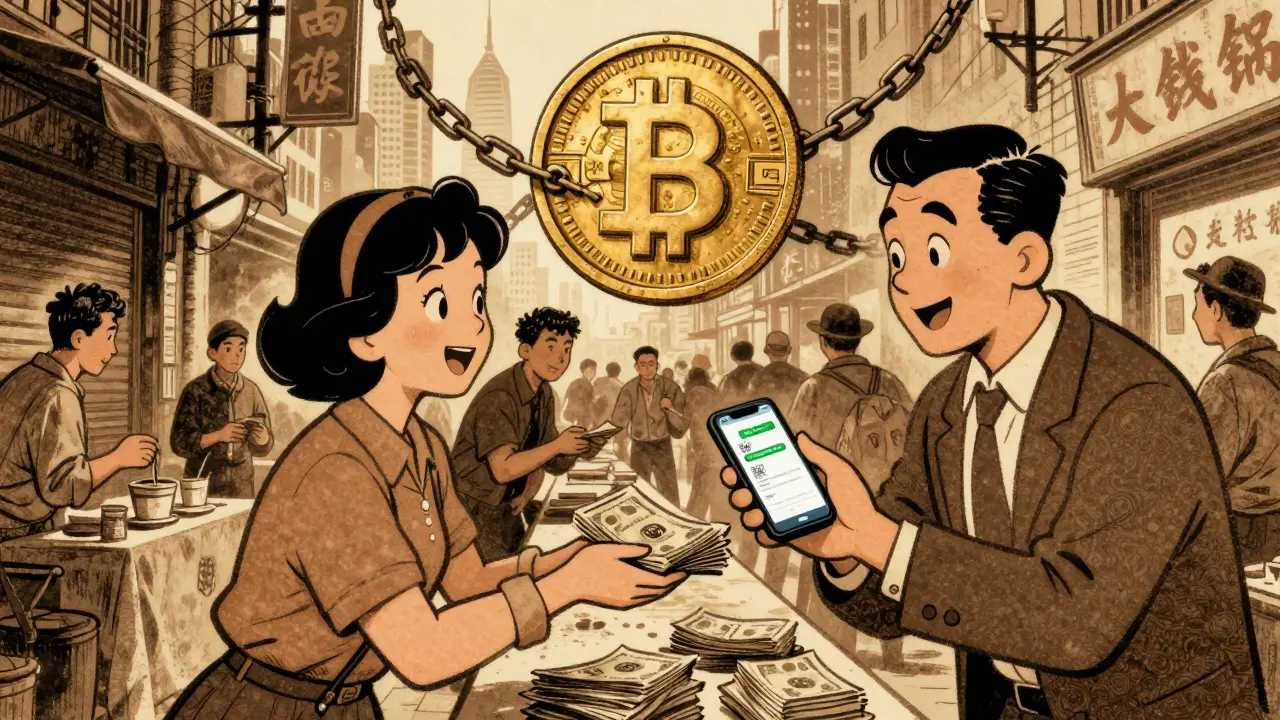
Who’s Using It? Young, Tech-Savvy, and Fed Up
It’s not the elderly. It’s not the middle class sitting on savings. It’s young people - mostly men under 35. Nearly 38% of Chinese crypto users are between 25 and 34. That’s higher than anywhere else in the world. Meanwhile, users over 45 make up just 12.8% of the market, compared to 22% globally. And while 89% of users are male, that gap is shrinking. More women are joining, especially those working in tech or with family abroad. They’re not gambling. They’re protecting value. Sending money home. Avoiding inflation. One user on Zhihu, China’s version of Reddit, wrote: “I use USDT to pay my daughter’s tuition in Australia. The bank wanted $1,200 in fees. I paid $15 in crypto. It arrived in 12 minutes.” That’s the real story.The Risks Are Real - But People Keep Going
It’s not safe. In April 2025, a Reddit survey from r/CryptoChina found that 68% of users had their bank accounts frozen because of crypto activity. The average loss? 23,500 yuan - about $3,250. Some lost everything. Scams are rampant. The China Cybersecurity Association reported $165 million lost to crypto fraud in just the first quarter of 2025. Fake P2P platforms. Fake wallet apps. Fake “guaranteed returns.” Yet 82% of users said they kept trading. And 45% increased their investment compared to 2024. Why? Because the alternatives are worse. Capital controls limit how much money you can take out of China. The yuan is losing value. Inflation is creeping up. And the government doesn’t trust its own financial system. So people trust code instead.

Rishav Ranjan
December 22, 2025 AT 04:27Wow. So what?
Naman Modi
December 22, 2025 AT 19:24China bans crypto? Big deal. People always find a way. 😏
Shubham Singh
December 23, 2025 AT 17:16One must admire the sheer audacity of a population that treats state prohibition as a mere technical glitch. The e-CNY is not a currency-it is a surveillance ledger with a user interface. Meanwhile, USDT operates like a silent protest in code. The state fears what it cannot control. And so, it tries to ban it. How quaint.
Dustin Bright
December 24, 2025 AT 12:27Bro. My cousin in Shenzhen uses crypto to send money to his mom in rural Henan. She doesn’t even know what blockchain is. She just gets the cash. 🤝
Sheila Ayu
December 25, 2025 AT 12:16Wait-so you’re telling me people are using WECHAT to trade Bitcoin? And they call it ‘green tea’?!?!?!!? That’s not underground-that’s a TikTok trend with a blockchain twist!!
And don’t even get me started on ‘red packet’ for USDT-next they’ll be calling Dogecoin ‘dumpling money’ and calling Ethereum ‘dragon fruit’!!
Who wrote this article? A marketing intern who binge-watched Netflix’s ‘Dark’ and then tried to write a Forbes op-ed after three Red Bulls??
Also, 59 million people? That’s more than the entire population of Canada??? So… what? They’re all just sitting around typing ‘green tea’ into WeChat at 3 a.m.???
And the fact that 89% are male? That’s not a crypto stat-that’s a Tinder profile statistic. Who’s even left to do the laundry??
Also-did you mention inflation? Yes. Did you mention how the yuan’s losing value? Yes. But did you mention that the Chinese government is literally printing more money to fund its own infrastructure projects? Yes. But you didn’t say that crypto is just a symptom, not the disease.
And what about the 68% whose bank accounts got frozen? Where’s their story? Where’s the human cost? You turned this into a tech fantasy novel with bullet points.
And Hong Kong? Ohhhhh, Hong Kong!! The ‘crypto hub’?? That’s like saying ‘the back alley behind the gas station is the new Michelin-starred restaurant’ because someone sold a burrito there.
And Bernstein’s ‘65% chance’? That’s not a prediction-that’s a fortune cookie. Who even is Bernstein? Is that a hedge fund or a guy who sells yoga mats on Amazon?
And the final line-‘one USDT at a time’? That’s not poetic. That’s a bad Instagram caption.
Also-why is no one talking about how this entire underground economy relies on people risking jail time, bank freezes, and family shame to send money to their sister in Canada???
So… yeah. Cool story. But where’s the soul?
Helen Pieracacos
December 25, 2025 AT 20:06Wow. So the government bans crypto… and people use it anyway. Groundbreaking. 🙄
Ashley Lewis
December 26, 2025 AT 12:27It is not surprising that a nation with such rigid control over its populace would witness such a desperate, unregulated response. The fact that citizens must resort to encrypted slang and VPN tunnels to perform basic financial transactions speaks not to innovation, but to systemic failure. This is not resistance. It is survival in a digital police state.
vaibhav pushilkar
December 27, 2025 AT 09:09Actually, the P2P model in China is brilliant. No middlemen, no fees, no delays. It’s like the original internet-peer-to-peer, decentralized, human. The government can block websites, but they can’t block trust between two people.
Lloyd Yang
December 28, 2025 AT 21:46Let me tell you something-this isn’t just about money. It’s about dignity. Imagine being told you can’t send your daughter’s tuition abroad without paying a 7% fee and waiting a week. Then you find out you can do it in 12 minutes for $15 using a phone app no one’s supposed to know exists. That’s not crypto. That’s liberation. That’s a mother choosing her child’s future over a bureaucratic nightmare. And yeah, it’s risky. But so is trusting a bank that’s owned by a government that watches every penny you make. The e-CNY isn’t progress-it’s a leash. Crypto? It’s the only thing left that still lets you breathe.
And the women? Oh, they’re not just joining-they’re leading. Quietly. Smartly. They don’t need to shout about decentralization. They just need to pay the bills. And they’re doing it better than anyone else.
The real revolution isn’t in the code. It’s in the WeChat group where a 28-year-old nurse in Chengdu teaches her mom how to scan a QR code for ‘red packet’ so her brother in Toronto can get his rent money. No form. No ID. No permission. Just love, encrypted.
They’re not rebels. They’re realists. And the world needs to stop calling it ‘underground.’ It’s just… life. In 2025. In China.
And yeah-some people get caught. Some lose everything. But they still come back. Because what choice do they have? The system’s rigged. So they built their own.
And honestly? That’s the most human thing I’ve read all year.
Charles Freitas
December 30, 2025 AT 12:25Oh, so now it’s ‘human ingenuity’? Let me guess-the same ‘ingenuity’ that got 68% of these people their bank accounts frozen? The same ‘ingenuity’ that led to $165 million in scams? The same ‘ingenuity’ that makes people trust strangers on WeChat with their life savings? No. This isn’t innovation. It’s desperation dressed up as a TED Talk. You don’t get to romanticize financial chaos just because it’s convenient.
And let’s not pretend this isn’t a massive tax evasion scheme. The government’s not ‘failing’-they’re trying to stop people from laundering money, hiding assets, and dodging capital controls. And you? You’re cheering for it like it’s some kind of Robin Hood heist.
It’s not. It’s a mess. And it’s going to end badly.
Jacob Lawrenson
January 1, 2026 AT 03:29YESSSSSS!!! This is the future!!! 🚀🔥
Imagine: a world where your money doesn’t need permission to move. Where your sister in Canada gets cash in 12 minutes. No banks. No bureaucracy. Just you, your phone, and a little bit of courage.
China’s not breaking the rules-they’re rewriting them. And honestly? I’m jealous. We’re still arguing about whether crypto is ‘real money’ while they’re already using it to pay for college.
Also-green tea for BTC?? I’m buying that merch. 🫖💰
Sarah Glaser
January 1, 2026 AT 19:59There is a profound cultural paradox here: the world’s most centralized state is inadvertently fostering the world’s most decentralized financial underground. This is not merely evasion-it is the birth of a new social contract, forged not in legislation, but in necessity. The Chinese people, through quiet, collective action, have redefined sovereignty: not as control from above, but as autonomy from below. The e-CNY may be the instrument of the state, but USDT is the instrument of the people. And in that tension lies the future of global finance.
Grace Simmons
January 2, 2026 AT 22:23Let’s not glorify this. This is illegal activity by millions of people. You don’t get to call it ‘resilience’ when it’s breaking the law. The Chinese government has every right to control its financial system. This isn’t ‘freedom’-it’s a loophole. And loopholes get closed. Eventually.
And don’t act like the U.S. or EU are saints. We’ve got our own capital controls, our own surveillance, our own banks that charge 5% for wire transfers. But we don’t turn to black markets. We fix the system. Not bypass it.
Steve B
January 4, 2026 AT 12:09One wonders whether the persistence of crypto in China is not a triumph of technology, but a symptom of a deeper malaise-a society where trust in institutions has been so thoroughly eroded that citizens must turn to unregulated digital artifacts to preserve even the most basic human functions: familial care, economic dignity, intergenerational survival. The blockchain, in this context, is not a tool-it is a tombstone for the social contract.
SHEFFIN ANTONY
January 6, 2026 AT 00:16Wait-so you’re saying 59 million people are breaking the law… and you’re calling it ‘human ingenuity’??
That’s not genius. That’s a national emergency.
And ‘green tea’ for Bitcoin?? That’s not clever-that’s cringe.
Also, why is every single user under 35? Are the older generations just… sitting around waiting to die? Or did they figure out that crypto is a scam?
And the fact that 89% are male?? That’s not a crypto stat-that’s a dating app stat. Who’s raising the kids??
And Hong Kong?? Ohhh, so now it’s ‘Hong Kong’??
China’s not ‘softening.’ They’re just letting people get caught first. Then they’ll make an example of them.
And ‘Bernstein’s 65% chance’? That’s not analysis. That’s a casino bet.
This article reads like a Silicon Valley pitch deck written by someone who’s never met a Chinese person.
Craig Fraser
January 7, 2026 AT 13:52It’s amusing how Western commentators treat this as some kind of romantic rebellion. It’s not. It’s a dysfunctional financial system with a workaround. The government is not ‘paranoid.’ It’s protecting its monetary authority. The fact that people are risking jail time to avoid paying a 7% fee doesn’t make them heroes-it makes them reckless. And the idea that this is ‘the future’ is delusional. The future is regulation. Not chaos.
Lloyd Yang
January 7, 2026 AT 15:14You’re right-it’s not about freedom. It’s about function. But function is what freedom looks like when you’re locked out of the system. You call it ‘reckless.’ I call it resourceful. You call it ‘chaos.’ I call it community. You call it ‘breaking the law.’ I call it surviving a system that doesn’t serve you. The state can freeze accounts. But it can’t freeze love. And it can’t stop a mother from sending her daughter’s tuition in 12 minutes for $15. That’s not a loophole. That’s a lifeline.
And yeah-some people get scammed. Some lose everything. But they still come back. Because the alternative is worse. And if you’ve never had to choose between paying rent and sending money home, maybe you shouldn’t be the one judging.