
Did you try to log in to CROSS Exchange, only to find the site completely unresponsive?
If so, you are not imagining things. The platform is effectively dead.
In this review, we break down exactly what happened to this Azerbaijan-based centralized cryptocurrency exchange, why it disappeared from the market, and whether you can still recover any assets you might have left there. We also look at what went wrong with its native XEX token economy and where you should trade instead in 2026.
The Current Status of CROSS Exchange
As of early 2023, the website for CROSS Exchange (cross.exchange) became inaccessible. There were no prior announcements about maintenance, server upgrades, or a move to a new domain. Major tracking sites like Cryptowisser marked the platform as "dead" and moved it to their Exchange Graveyard list on March 23, 2023.
Since then, there has been zero credible public communication from the team. No press releases, no social media updates, and no regulatory filings appear in English-language sources through late 2024 and into 2026. In the world of crypto, silence usually means one thing: the operation has ceased.
For anyone looking to use CROSS Exchange today, the answer is simple: you cannot. There is no way to deposit funds, withdraw assets, or even check your balance if the site remains offline. If you had funds on the platform before it went dark, those assets are likely lost unless a legal entity emerges to handle refunds-which is highly unlikely given the lack of transparency surrounding the company.
What Was CROSS Exchange?
To understand why it failed, we need to look at what it was trying to be. Launched in November 2019, CROSS Exchange positioned itself as an entry-level spot trading platform based in Azerbaijan. At a time when major players like Binance and Kraken dominated the news, CROSS tried to attract users with low fees and aggressive incentives.
The core value proposition was straightforward:
- Low Trading Fees: A maximum fee of 0.10% per transaction, which was competitive compared to the industry average of 0.20-0.25% at the time.
- Fiat On-Ramps: Users could deposit via wire transfer or debit card, making it accessible for beginners who didn’t already hold cryptocurrency.
- Mobile Support: Dedicated apps for iOS and Android to trade on the go.
On paper, these features sounded reasonable. However, the real draw-and ultimately the trap-was its native token model.
The XEX Token and Trade Mining Model
CROSS Exchange issued a utility token called XEX. This wasn't just a governance token; it was central to how the exchange claimed to make money and keep users engaged. They offered three distinct trading modes:
- Standard Trading Mode: Traditional spot trading with fixed low fees.
- Reward Mode: Layered additional token-based incentives on top of standard trades.
- Trade Mining Mode: This was the headline feature. Users would "mine" XEX tokens by trading. The platform promised to rebate up to 80% of paid trading fees back to users in the form of XEX.
Let’s look at the math. If you paid a 0.10% fee, you could theoretically get 0.08% back in XEX. That sounds great, but it relies on two assumptions: that the XEX token retains its value, and that the exchange has enough revenue to sustain such high payouts indefinitely.
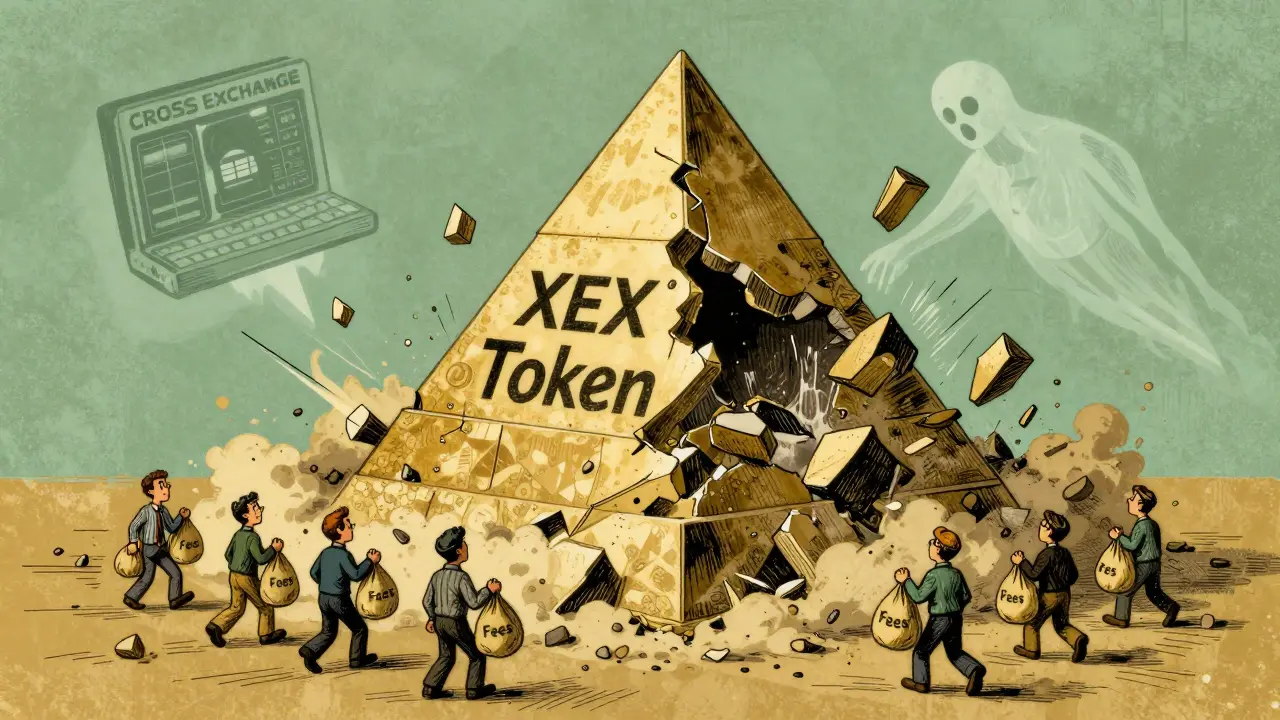
This model closely resembled FCoin, another exchange that collapsed in 2020 after its tokenomics proved unsustainable. Like FCoin, CROSS relied on constant user growth and trading volume to fund these rebates. When the hype faded or regulatory pressure increased, the incentive structure crumbled.
Security and Transparency Concerns
One of the biggest red flags for CROSS Exchange was its lack of transparency. While competitors like Kraken and Coinbase published regular proof-of-reserves audits and detailed security reports, CROSS offered vague marketing claims about "strong security" and "separate management of client assets."
Here is what was missing:
- No Named Leadership: Public records did not identify the CEO, founders, or the specific legal entity operating the exchange.
- No Regulatory Licenses: There is no evidence that CROSS held licenses from major financial authorities like the US SEC, UK FCA, or EU regulators under the MiCA regulation.
- No Security Audits: No third-party penetration tests or cybersecurity ratings were publicly available.
Operating out of Azerbaijan provided some regulatory flexibility, but it also meant users had very little legal recourse if something went wrong. In contrast, platforms licensed in the European Union must comply with strict consumer protection rules introduced by MiCA starting in 2024. CROSS never sought such authorization.
Fees and Withdrawal Costs
Before it shut down, CROSS advertised competitive withdrawal fees. For Bitcoin (BTC), the fee was 0.0005 BTC per withdrawal. At the time, this was slightly below the industry average of roughly 0.0006 BTC.
However, fiat deposits via credit cards often incurred hidden costs. Third-party payment processors typically charge between 1.0% and 4.0% for card transactions. While CROSS claimed to be beginner-friendly, these underlying costs meant that buying crypto with a debit card was rarely cheap.
| Feature | CROSS Exchange (Defunct) | Kraken (Active) | Coinbase (Active) |
|---|---|---|---|
| Status | Dead / Offline | Active & Regulated | Active & Publicly Traded |
| Jurisdiction | Azerbaijan | USA / Europe | USA |
| Max Spot Fee | 0.10% | 0.16% - 0.26% | Variable (often higher) |
| Regulatory Compliance | None known | High (Multiple Jurisdictions) | High (SEC Registered) |
| Native Token Rebates | Up to 80% (XEX) | N/A | N/A |
Why Did CROSS Exchange Fail?
Several factors contributed to the demise of CROSS Exchange:
Unsustainable Tokenomics: Giving away 80% of fees in a volatile token like XEX is not a long-term business model. As the token price likely dropped due to inflation from constant rewards, users stopped trading, reducing the exchange's revenue.
Lack of Brand Trust: Without named founders or a transparent corporate structure, institutional investors and large retail traders avoided the platform. Liquidity dried up, making it harder to execute large orders without slippage.
Regulatory Pressure: As global regulations tightened, especially with the introduction of MiCA in Europe and increased scrutiny from the US SEC, offshore exchanges with opaque operations found it increasingly difficult to operate legally. Many chose to shut down rather than undergo costly compliance processes.
Competition: By 2023, established players like Kraken, Binance, and Coinbase had improved their interfaces and reduced fees significantly. CROSS’s unique selling points-low fees and trade mining-were no longer compelling enough to justify the risk of using an unknown platform.
Can You Recover Your Funds?
If you had assets on CROSS Exchange when it went offline, the outlook is grim. Because there is no known legal entity or customer support channel active since March 2023, there is no formal process for filing claims.
We recommend taking the following steps, though success is unlikely:
- Document Everything: Save screenshots of your account history, deposit confirmations, and any emails from the platform.
- Check Blockchain Transactions: If you deposited crypto directly to the exchange’s wallet addresses, you can track those transactions on a block explorer. This proves ownership but does not guarantee recovery.
- Contact Local Authorities: Since the exchange was based in Azerbaijan, you could theoretically report the issue to local financial regulators, though cross-border enforcement is complex and rare for individual small losses.
Do not trust any third-party services claiming they can recover your funds for a fee. These are almost certainly scams targeting desperate users.
Better Alternatives for 2026
Instead of risking your capital on defunct or obscure platforms, consider these well-established alternatives that offer similar benefits with far greater safety:
Kraken: Known for strong security and regulatory compliance. It offers over 700 cryptocurrencies and has never suffered a major hack since launching in 2011. Ideal for users who prioritize safety and transparency.
Coinbase: Best for beginners due to its user-friendly interface and easy fiat on-ramps. As a publicly traded company, it adheres to strict financial reporting standards.
Crypto.com: Offers a wide range of products including trading, staking, and a Visa card. It provides attractive cashback and staking rewards without relying on unsustainable trade-mining models.
Uniswap: For advanced users comfortable with decentralized finance (DeFi), Uniswap allows peer-to-peer trading without a central intermediary. While it carries smart contract risks, it eliminates counterparty risk associated with custodial exchanges.
Conclusion
CROSS Exchange serves as a cautionary tale in the crypto industry. Aggressive incentives like trade mining and high fee rebates may attract users initially, but they cannot compensate for a lack of transparency, regulatory compliance, and sustainable business practices.
The platform is currently inactive, and any remaining assets are likely unrecoverable. For your future trading needs, stick to regulated, reputable exchanges that publish regular audits and maintain clear lines of communication with their users. Your capital is worth protecting against the next "too good to be true" promise.
Is CROSS Exchange still operational in 2026?
No, CROSS Exchange is considered dead. Its website has been inaccessible since March 2023, and there have been no official communications or relaunch announcements since then.
What happened to my XEX tokens?
The XEX token is no longer actively traded or supported by the exchange. Most aggregators show it as inactive with negligible liquidity. Any XEX held in your personal wallet may have little to no market value.
Was CROSS Exchange regulated?
There is no public record of CROSS Exchange holding licenses from major financial regulators such as the SEC, FCA, or EU authorities under MiCA. It operated primarily out of Azerbaijan with minimal regulatory oversight.
How do I recover funds from CROSS Exchange?
Recovery is highly unlikely. There is no active customer support or legal entity to contact. Document your transactions and consult local authorities, but beware of scams promising fund recovery for a fee.
What is a safer alternative to CROSS Exchange?
Safer alternatives include Kraken, Coinbase, and Crypto.com. These platforms are regulated, publicly accountable, and have robust security measures and proof-of-reserves audits.
What was Trade Mining on CROSS Exchange?
Trade Mining was a feature where users received up to 80% of their trading fees back in XEX tokens. This model was unsustainable and similar to other failed exchanges like FCoin.
