
Cambodia Crypto Remittance Cost Calculator
Send Money to Cambodia: Legal vs Illegal Channels
See how much you'll pay using Cambodia's new crypto restrictions versus underground methods. Based on current 2025 regulations.
Cost Breakdown
Total Fee
$0.00
Processing Time
3-15 days
Risk Level:
Why This Matters
| Criteria | Legal Channel | Illegal Channel |
|---|---|---|
| Fee Structure | 6.8% remittance fee + $5 processing | 2-5% + hidden risks |
| Processing Time | 3-15 days | 24-72 hours |
| Regulatory Risk | Low (licensed platforms) | Very High (account freeze) |
| Transaction Limits | $5,000 daily limit | Unlimited |
| Legal Status | Compliant with NBC regulations | Illegal under Prakas B7-024-735 |
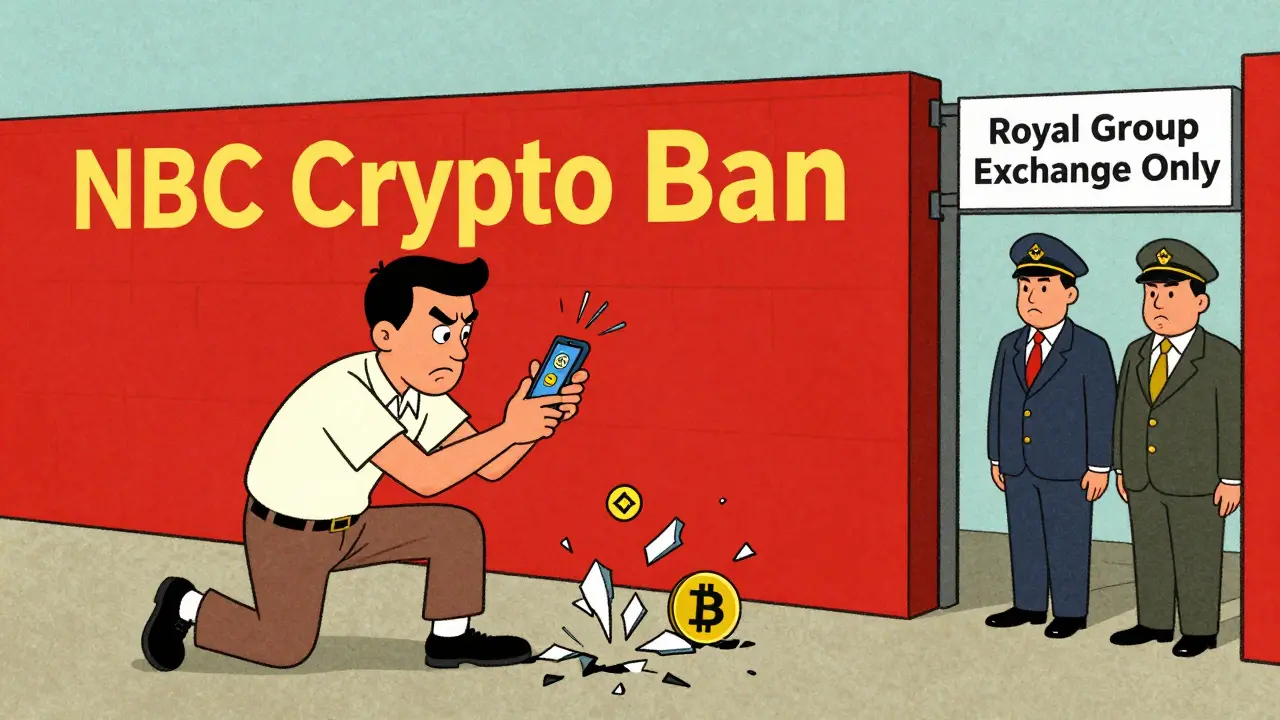
When you try to send Bitcoin to a friend in Cambodia, or cash out your crypto earnings into riel, you hit a wall. It’s not that crypto is illegal there-it’s that Cambodia banking restrictions on crypto transactions make it nearly impossible for regular people to use it legally. Since early 2025, the National Bank of Cambodia (NBC) has enforced a system that lets only two licensed platforms handle crypto, while blocking everything else. Banks can’t hold Bitcoin. You can’t use Binance or Coinbase. Even peer-to-peer trades can freeze your Wing Money account. This isn’t just a policy-it’s a full-scale financial firewall.
How Cambodia’s Crypto Ban Works in 2025
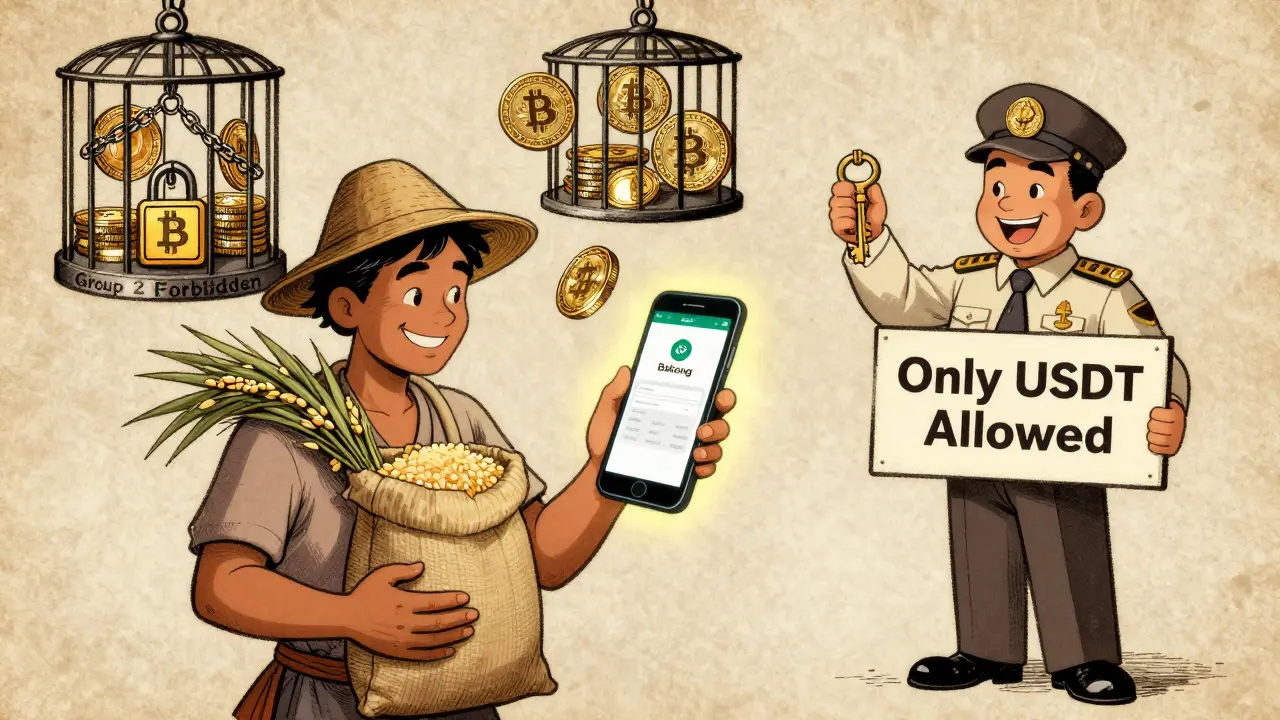
The rules changed dramatically in January 2025 with Prakas B7-024-735, a new regulation that splits crypto into two groups. Group 1 includes tokenized securities and stablecoins fully backed by real assets like the U.S. dollar. Group 2 covers everything else-Bitcoin, Ethereum, Solana, and other unbacked coins. Banks can only deal with Group 1, and even then, they need special approval. They’re not allowed to hold Group 2 assets on their books at all. That means no Cambodian bank can store Bitcoin in its digital vaults. Not even as a backup.
Only two companies have the green light to operate: Royal Group Exchange and platforms built on Bakong, the government’s own blockchain payment system. If you want to buy or sell crypto legally, you have to go through one of them. And even then, you need to submit your national ID, a utility bill, and wait up to 15 days just to get verified. Once approved, you’re capped at $5,000 in daily conversions between USDT and riel. For most people, that’s not enough to move money meaningfully.
Why the Government Blocked Binance, Coinbase, and Others
On December 3, 2024, Cambodia’s Telecommunication Regulator shut down access to 16 major offshore crypto exchanges-including Binance, Coinbase, and OKX. The official reason? They were operating without a license from the Securities and Exchange Regulator of Cambodia (SERC). But the real trigger was international pressure. In September 2024, the U.S. Treasury sanctioned Ly Yong Phat and his L.Y.P. Group for running human trafficking and online scam centers where victims were forced to run crypto fraud schemes. Many of those scams used unregulated crypto platforms to move money out of the country.
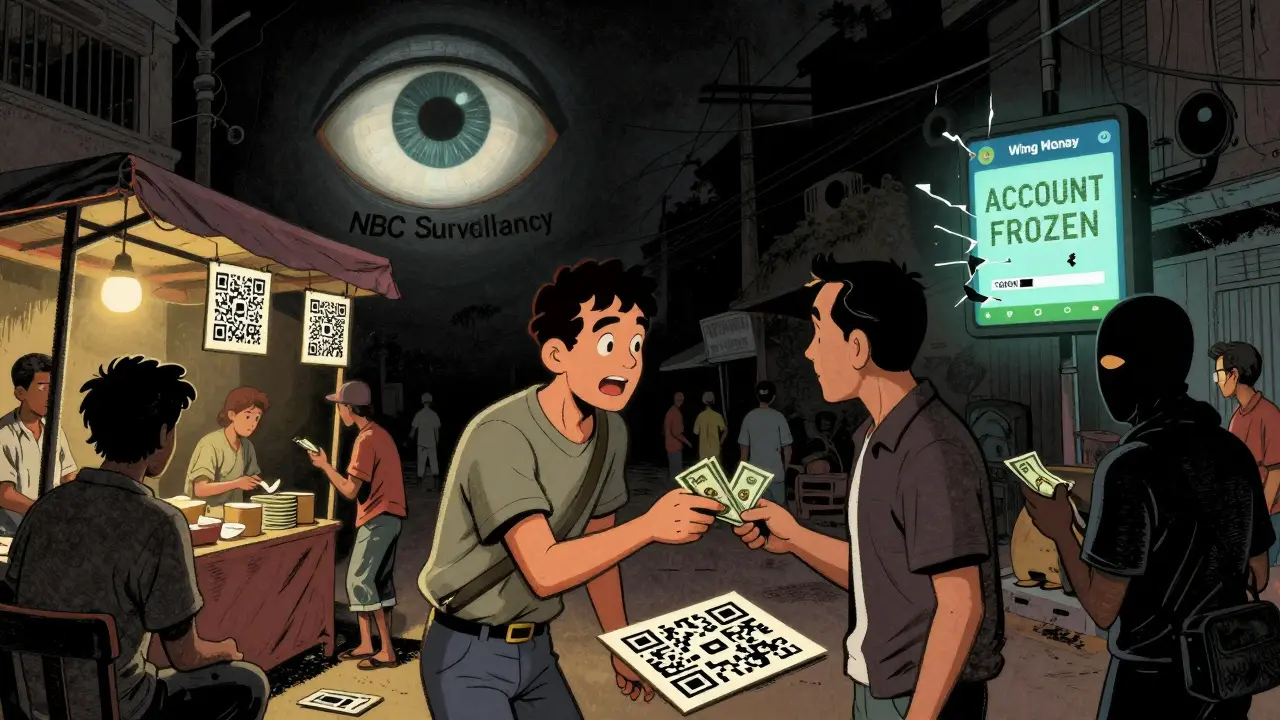
After that, the NBC didn’t just want to block bad actors-it wanted to control every single crypto transaction. So they cut off the open internet channels and forced everything through their own narrow pipeline. Now, if you try to use Binance P2P, your Wing Money account might get frozen for two weeks. No warning. No appeal. Just silence. Users on Reddit and Telegram report being flagged for doing three small $50 trades. The system doesn’t distinguish between a farmer selling rice for USDT and a scammer laundering cash.
The Bakong System: Cambodia’s Alternative to Crypto
Cambodia isn’t against digital money-it just wants its own version. Project Bakong, launched in 2020 with help from Japan, is a blockchain-based payment network that connects 62 banks and 8,600 merchants. As of late 2024, it’s used by 12.4 million people-65% of the adult population. You can pay for groceries, send money to family, or pay a taxi driver using your phone, all in riel or USD, with near-instant settlement.
But here’s the catch: Bakong doesn’t connect to public blockchains. It’s a closed loop. The government controls every transaction. There’s no way to send Bakong money to Bitcoin. No way to convert it to Ethereum. The NBC’s governor said plainly in November 2024: “Cambodia will not recognize private cryptocurrencies as legal tender until our Bakong CBDC achieves full stability.” In other words, they’re building a digital currency they can monitor, tax, and shut down at will.
Who’s Getting Hurt by These Rules
Over 68% of rural Cambodians don’t have access to traditional banking. For them, crypto was a lifeline-cheap remittances from Thailand or Malaysia, no middlemen, no 8% fees. Now, those corridors are blocked. The World Bank reports that remittance costs in Cambodia still sit at 6.8%, while neighboring Laos, which allows crypto remittances, charges just 4.2%. That’s $2.60 extra for every $100 sent home.
Small businesses are also stuck. AgriTech startup RiceX managed to raise $2 million in stablecoin funding in late 2024-but it took 10 days of paperwork, legal reviews, and NBC approvals. Meanwhile, a similar company in Vietnam could have done the same in 48 hours using a licensed crypto exchange. Cambodia’s restrictions are making it harder to attract foreign investment, not easier.
How This Compares to Neighboring Countries
Thailand lets banks hold up to 20% of their capital in crypto assets, including Bitcoin. Singapore allows retail investors to trade Bitcoin futures. Vietnam permits licensed banks to custody digital assets. Cambodia is the only country in Southeast Asia that outright bans banks from holding unbacked cryptocurrencies. Even Indonesia, which has cracked down hard on unlicensed exchanges, still allows licensed platforms to operate openly.
Cambodia’s 15% capital exposure limit for Group 1 assets is stricter than even the Basel Committee’s global recommendations. And while other countries are building bridges to crypto, Cambodia is building a moat. The result? Crypto adoption here has dropped from 4.7% of the population in 2021 to just 2.1% in 2024, according to Statista. That’s the lowest rate in the region.
The Hidden Costs of Control
The NBC claims these rules protect financial stability. They point to Cambodia’s low inflation-6.2%-compared to 15.3% in some regional neighbors. But there’s a dark side. Chainalysis data shows illicit crypto activity in Cambodia rose 37% in 2024. Why? Because the legal channels are too slow, too expensive, and too restrictive. People aren’t giving up crypto-they’re going underground.
And here’s the irony: South Korean exchanges processed $8.93 million in USDT transactions with Huione Guarantee, a company sanctioned by the U.S. Treasury for money laundering. That’s a 1,400x jump from 2023. The very people the NBC wants to stop are finding ways around the system-through sanctioned entities that slip through the cracks.
Bank staff are overwhelmed too. Getting approved as a Crypto Asset Service Provider takes 90 to 120 days. Banks must submit 47 documents, run stress tests simulating 80% crypto price crashes, and spend $350,000 to connect to Bakong. Staff need 120 hours of certified training. The NBC’s help desk handles only 17 queries a day across 58 banks. If you have a question, you wait three days for an answer.
What This Means for You
If you’re a Cambodian citizen trying to use crypto: your options are either Royal Group Exchange (slow, limited, verified) or nothing. Don’t expect to use Binance P2P without risking your bank account. If you’re an investor or entrepreneur: Cambodia is not a crypto-friendly market. The regulatory risk is too high. If you’re a remitter sending money home: you’re paying more and waiting longer than ever before.
The government’s goal-to prevent fraud, protect the riel, and control financial flows-is understandable. But the cost is real. Innovation is stifled. Financial inclusion is blocked. And the underground market is growing faster than the legal one.
Cambodia chose control over openness. But control doesn’t eliminate risk-it just hides it. And in the long run, hiding problems doesn’t solve them.

Noriko Robinson
December 6, 2025 AT 14:15The way Cambodia is handling crypto feels like locking the barn after the horse has already crossed three borders. I get wanting to stop scams, but now even farmers sending money home are punished. This isn't regulation-it's digital colonialism wrapped in bureaucracy.
Yzak victor
December 7, 2025 AT 22:47I’ve seen this play out in other countries where governments try to control tech instead of adapting to it. Cambodia’s Bakong system is neat, sure, but if you can’t connect it to the real crypto world, it’s just a fancy digital piggy bank with a lock on it.
Neal Schechter
December 9, 2025 AT 05:54As someone who’s worked with remittance startups in Southeast Asia, this is heartbreaking. The cost difference between Cambodia and Laos isn’t just numbers-it’s meals missed, school fees unpaid, medical bills left unpaid. People aren’t turning to underground crypto because they want to break the law. They’re doing it because the legal option is broken.
The NBC thinks they’re protecting the riel, but they’re really protecting their own control. And in the process, they’re leaving millions behind.
Meanwhile, Thailand lets banks hold crypto. Vietnam lets you trade. Even Indonesia, with all its red tape, still lets licensed platforms exist. Cambodia’s policy doesn’t make sense unless you assume the average citizen is a criminal.
It’s not about fraud anymore. It’s about power. And power doesn’t care if it crushes the little guy.
There’s a reason crypto adoption dropped to 2.1%. Not because people lost interest. Because they got scared, locked out, and tired of being treated like suspects.
And now the underground market is growing faster than the legal one. That’s not a win. That’s a warning sign painted in red.
The real question isn’t whether crypto is dangerous. It’s whether control without inclusion is sustainable.
They built a moat. But moats don’t stop crocodiles-they just make them hungrier.
Tisha Berg
December 10, 2025 AT 21:34It’s sad because so many Cambodians were using crypto to finally get out from under the old banking system. Now they’re stuck between a rock and a hard place-no access to real financial tools, and no way to send money without paying double.
nicholas forbes
December 11, 2025 AT 16:18Let me get this straight-Cambodia bans Bitcoin because of a few bad actors, but lets a US-sanctioned company launder $8.9M in USDT through South Korea? That’s not policy. That’s hypocrisy.
Kenneth Ljungström
December 12, 2025 AT 18:05It’s wild how some governments think blocking tech will stop innovation. It just pushes it underground. 😔
Cristal Consulting
December 12, 2025 AT 23:24They’re not stopping crime. They’re stopping hope.
Sandra Lee Beagan
December 13, 2025 AT 06:35The structural inefficiencies of Bakong’s closed-loop architecture create systemic friction that disincentivizes genuine adoption while inadvertently incentivizing illicit channels through arbitrage dynamics. The regulatory overreach is not only economically suboptimal-it’s anthropologically tone-deaf.
Nina Meretoile
December 13, 2025 AT 17:36It’s funny how we think control equals safety. But safety without access isn’t safety-it’s imprisonment. Crypto gave people in rural Cambodia a way to connect to the global economy. Now they’re being told, ‘You can’t have that, but here’s a government app that tracks every coffee you buy.’
They’re not afraid of Bitcoin. They’re afraid of losing control.
And the worst part? The people who suffer the most? They never got a seat at the table.
When you build a system that only works for the powerful, you don’t protect the economy. You just make it colder.
And cold economies don’t grow. They just freeze.
Maybe the real question isn’t why people use crypto. It’s why we keep building walls instead of bridges.
History doesn’t remember the people who built the walls. It remembers the ones who climbed them.
And Cambodia? They’re building a very tall wall.
Chloe Hayslett
December 14, 2025 AT 18:40So what? If you can’t play by the rules, don’t play. Crypto is for criminals and tech bros anyway. Let them go to Vietnam.
Jerry Perisho
December 15, 2025 AT 03:47USDT cap at $5k daily? That’s not a limit. That’s a joke. You can’t run a business on that. No wonder startups are fleeing to Thailand.
Vincent Cameron
December 15, 2025 AT 10:37Control is the illusion of order. The real order is chaos-hidden, decentralized, and unstoppable. You can ban Bitcoin but you can’t ban human ingenuity.
Krista Hewes
December 16, 2025 AT 13:18i just sent $50 to my cousin and my wing account got frozen for 2 weeks… no email no call just gone. this is not a bank its a prison.