

If you live in Chile, Colombia, Peru, or Argentina and want to buy Bitcoin or Ethereum without dealing with international banks, Buda might be the only exchange you actually need. Unlike global platforms that make you jump through hoops to deposit pesos, soles, or pesos, Buda was built from the ground up for South Americans. It’s not the biggest or flashiest crypto exchange out there-but for people in its home region, it’s often the most practical.
What Is Buda?
Buda started in 2015 as SurBTC, a small startup in Santiago, Chile. Its founders saw a problem: most crypto exchanges didn’t support local currencies. If you wanted to buy Bitcoin in Colombia, you had to use a risky peer-to-peer deal or wire money abroad. Buda changed that. Today, it’s the largest crypto exchange in Chile, Colombia, and Peru, handling over 65% of all exchange volume in Chile alone.
It’s not a global giant like Binance or Coinbase. It doesn’t offer hundreds of coins. But it does one thing extremely well: it lets you trade Bitcoin, Ethereum, and a few others directly in Chilean pesos (CLP), Colombian pesos (COP), Peruvian soles (PEN), or Argentine pesos (ARS). No USD conversion. No third-party payment processors. Just your local bank account and a few clicks.
Cryptocurrencies You Can Trade
Buda keeps things simple. You won’t find 500 altcoins here. The platform supports just six:
- Bitcoin (BTC)
- Ethereum (ETH)
- Litecoin (LTC)
- Bitcoin Cash (BCH)
- Tether (USDT)
- USDC
That’s it. But each one pairs directly with one of the four local currencies. So you can trade BTC/CLP, ETH/COP, LTC/PEN, and so on-20 trading pairs total. This focused approach means less confusion for new users and faster order matching because the platform doesn’t have to juggle hundreds of markets.
For most people in Latin America, this is enough. You don’t need Shiba Inu or Solana if you’re just trying to hedge against inflation or buy a little Bitcoin on the side. Buda gives you the core assets you actually use.
Trading Fees and Commissions
Fees on Buda are straightforward, but they vary depending on how much you trade.
Standard traders pay 0.5% per trade. That’s higher than Binance’s 0.1% or Coinbase’s 0.5% for small trades, but it’s not unusual for regional exchanges. The real catch? Volume discounts kick in fast. If you trade over $10,000 a month, your fee drops to 0.2%. And if you refer friends, you can earn 20% of their trading fees-some users report making $15-$20 a month just from referrals.
Withdrawal fees are clearly listed:
- Bitcoin: 0.00011 BTC
- Ethereum: 0.00053418 ETH (normal), 0.0006944 ETH (high priority)
- Litecoin: 0.00000001 LTC
- USDC: 1.38 USDC (normal), 2 USDC (high priority)
These are reasonable. No hidden fees. No surprise charges when you pull your money out.
Security: Cold Storage, KYC, and Chainalysis
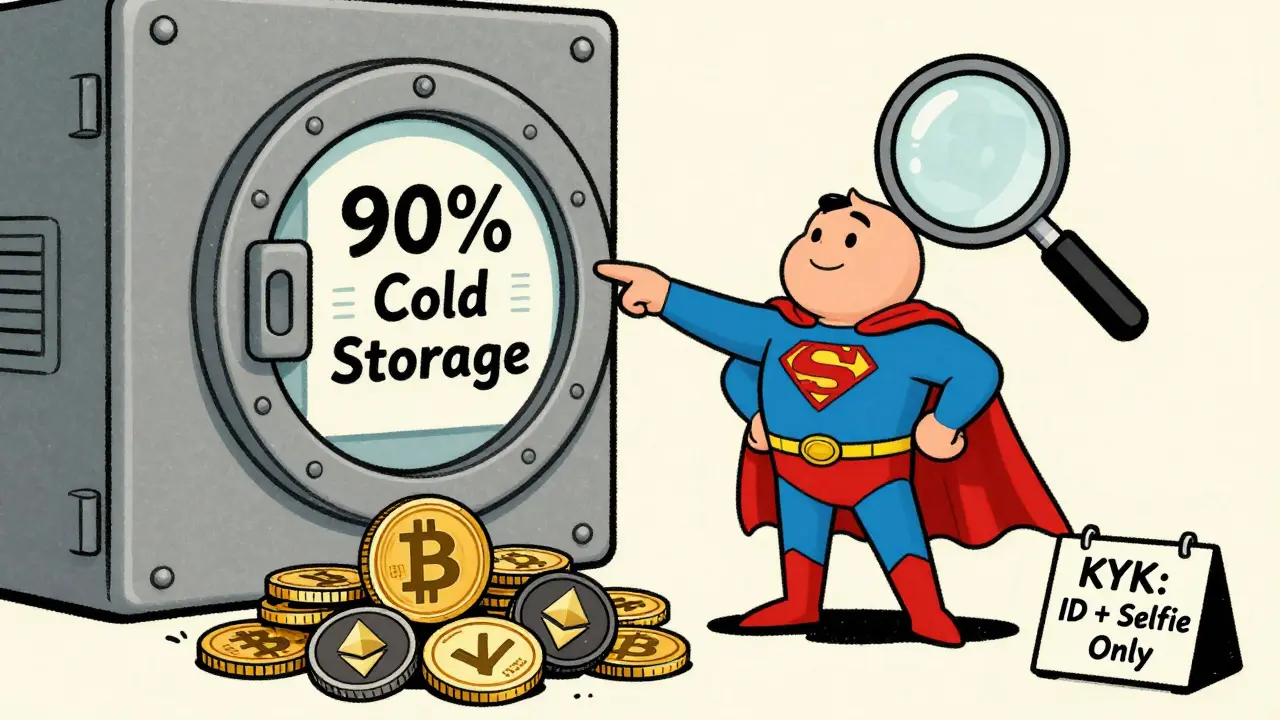
Buda takes security seriously. About 90% of user funds are stored in offline cold wallets. That’s on par with industry leaders like Coinbase (which holds 98% offline). It’s not perfect, but it’s solid.
The exchange uses Chainalysis to monitor transactions and block suspicious activity. That’s a big deal-it’s the same tool governments and banks use to track crypto crime. Buda also requires Dynamic Key authentication, which means logging in isn’t just a password. You need a second code that changes every time.
KYC is strict. You need to submit a government ID, a selfie with your ID, proof of address, and confirm your email. Once verified, you can trade up to $10,000 per month. That’s enough for most retail users but limits big investors. No one’s complaining, though. In countries where banking systems are unstable, knowing your money is locked down matters more than high limits.
One red flag? Buda shut down its Bug Bounty Program in 2023. That program used to pay up to $5,000 to hackers who found security flaws. Its removal raised eyebrows. The company says it moved to internal audits, but transparency dropped.

Platform and Mobile App
Buda’s web interface is built on TradingView, the same charting tool used by professional traders worldwide. That means advanced tools: candlestick charts, indicators, drawing tools, alerts. But it’s also intimidating if you’ve never traded before.
There’s no demo account. No tutorial. No help section. You’re thrown into the deep end. Users report it takes 3-5 trades before things click. That’s fine for experienced traders, but terrible for beginners.
The mobile apps (iOS and Android) are clean and fast. Deposits and withdrawals work smoothly. The design is simpler than the web version, which helps. But the same lack of guidance remains. If you’re new, you’ll need to find YouTube guides in Spanish. There are over 50,000 views on community-made tutorials-so they’re out there.
Bank Integration and Deposit Methods
This is where Buda shines. Unlike global exchanges, it connects directly with local banks. In Chile, you can deposit CLP via bank transfer with zero fees. In Colombia, COP deposits are free too. Credit card deposits? Those cost up to 3%. But that’s still better than paying $30 to send money through Western Union.
Withdrawals to your bank account take 1-2 business days. During market crashes, delays can stretch to 48 hours-especially in Argentina, where peso volatility causes system backups. But that’s rare. Most users report smooth, predictable processing.
January 2025 brought a big upgrade: integration with Chile’s Transbank system. Now, deposits are processed in minutes instead of hours. That’s a game-changer for day traders.
What Buda Doesn’t Offer
Buda isn’t trying to be everything. That’s intentional. But it means some traders will hit walls.
No margin trading. No futures. No staking. No copy trading. No lending. No NFT marketplace. If you want to leverage your Bitcoin or earn interest on your Ethereum, you’ll need another platform.
And while Binance is now offering peso-denominated trading in Colombia, Buda still has the edge in banking access and local support. But that gap is closing.
Customer Support
All support is in Spanish. No English option. That’s fine if you’re in Latin America, but it’s a dealbreaker for anyone outside.
Email responses take 12-24 hours on weekdays. Phone support is available in Chile for urgent issues. That’s unusual for a crypto exchange-and a big plus. Most platforms only offer chatbots.
There’s no 24/7 live chat. No ticket system. No knowledge base. It’s basic, but it works. Users say support is helpful when they finally get a reply.
Who Is Buda For?
Buda isn’t for everyone. If you’re in the U.S., Europe, or Asia, skip it. You’ll have better options.
But if you live in Chile, Colombia, Peru, or Argentina, and you want to:
- Buy Bitcoin with your local bank account
- Trade without international fees
- Keep your crypto secure with cold storage
- Use a platform that actually understands your currency and laws
Then Buda is probably your best choice. It’s not perfect. It’s not flashy. But it’s reliable, regulated, and built for your reality.
For retail traders with average trade sizes between $100 and $500, Buda delivers. It’s not the place to chase altcoins or leverage your portfolio. But it’s the place to get started-and stay started-in Latin America’s crypto market.
What’s Next for Buda?
Buda isn’t standing still. In late 2024, it added USDT trading pairs. In early 2025, it launched crypto-backed loans-though details are still thin. It’s also building infrastructure for third-party payment providers to use its rails, which could turn it into a payments hub, not just an exchange.
Analysts expect 15-20% annual growth through 2027. With Latin America’s crypto adoption still rising fast, Buda’s deep local roots give it a real shot at staying on top-even as Binance and others try to move in.
Is Buda safe to use?
Yes, Buda is considered one of the safest crypto exchanges in Latin America. It stores 90% of user funds in offline cold wallets, uses Chainalysis for transaction monitoring, and requires strict KYC verification. While it doesn’t have insurance like Coinbase’s $255 million policy, its security practices are strong and match industry standards. The shutdown of its Bug Bounty Program in 2023 is a concern, but internal audits have replaced it.
Can I use Buda if I’m not in Chile, Colombia, Peru, or Argentina?
No. Buda only accepts users from these four countries. It’s designed specifically for South American markets and integrates directly with local banks. If you’re outside this region, you won’t be able to create an account or deposit funds. Even if you try using a VPN, your bank transfer will be rejected.
Does Buda support fiat deposits without fees?
Yes, bank transfers in CLP, COP, PEN, and ARS are free. Credit card deposits cost up to 3%, which is common for crypto exchanges. Withdrawals to your bank account take 1-2 business days and are free for most users. There are no hidden fees on deposits or withdrawals within the supported currencies.
What cryptocurrencies can I trade on Buda?
You can trade six major cryptocurrencies: Bitcoin (BTC), Ethereum (ETH), Litecoin (LTC), Bitcoin Cash (BCH), Tether (USDT), and USDC. All pair directly with local currencies like CLP, COP, PEN, and ARS. There are no altcoins beyond these six.
Is there a mobile app for Buda?
Yes, Buda has official apps for both iOS and Android. The apps are simple, fast, and allow you to deposit, withdraw, and trade on the go. The interface is less complex than the web version, making it easier for beginners. However, there’s no demo account or educational content built in.
How long does KYC verification take on Buda?
KYC verification typically takes 24 to 72 hours. You’ll need to submit a government ID, a selfie holding your ID, proof of address, and confirm your email. Once verified, your monthly trading limit rises to $10,000. Delays can happen during high traffic or if documents are unclear.
Does Buda offer staking or earning interest on crypto?
No. Buda only offers spot trading. You cannot stake Bitcoin, earn interest on Ethereum, or use any yield-generating features. If you want passive income from crypto, you’ll need to use a different platform.
What are Buda’s trading fees?
Standard trading fees are 0.5% per trade. High-volume traders who move over $10,000 per month pay as low as 0.2%. Referrals can earn 20% of the fees from people they bring in. Withdrawal fees are fixed and transparent-for example, Bitcoin withdrawals cost 0.00011 BTC, and Ethereum costs between 0.00053418 and 0.0006944 ETH depending on priority.
Buda isn’t trying to beat Binance. It’s trying to serve people who’ve been ignored by global platforms. And in that, it’s winning.

Robert Kunze
March 20, 2026 AT 20:54Christopher Hoar
March 21, 2026 AT 01:19Sarah Zakareckis
March 21, 2026 AT 10:49Heather James
March 22, 2026 AT 18:29Angelica Stovall
March 24, 2026 AT 00:10Taylor Holloman.
March 24, 2026 AT 00:43Bryan Roth
March 24, 2026 AT 02:12shreya gupta
March 24, 2026 AT 20:53Derek Lynch
March 26, 2026 AT 07:14iam jacob
March 28, 2026 AT 06:12Jesse Pals
March 28, 2026 AT 20:27Diane Overwise
March 29, 2026 AT 04:54Ann Liu
March 31, 2026 AT 01:44Ross McLeod
March 31, 2026 AT 21:31rajan gupta
April 1, 2026 AT 02:12Billy Karna
April 2, 2026 AT 09:43Cheri Farnsworth
April 3, 2026 AT 08:10Gene Inoue
April 4, 2026 AT 00:59Ricky Fairlamb
April 5, 2026 AT 14:35Shreya Baid
April 7, 2026 AT 06:58Dionne van Diepenbeek
April 8, 2026 AT 09:11Derek Lynch
April 9, 2026 AT 10:30