
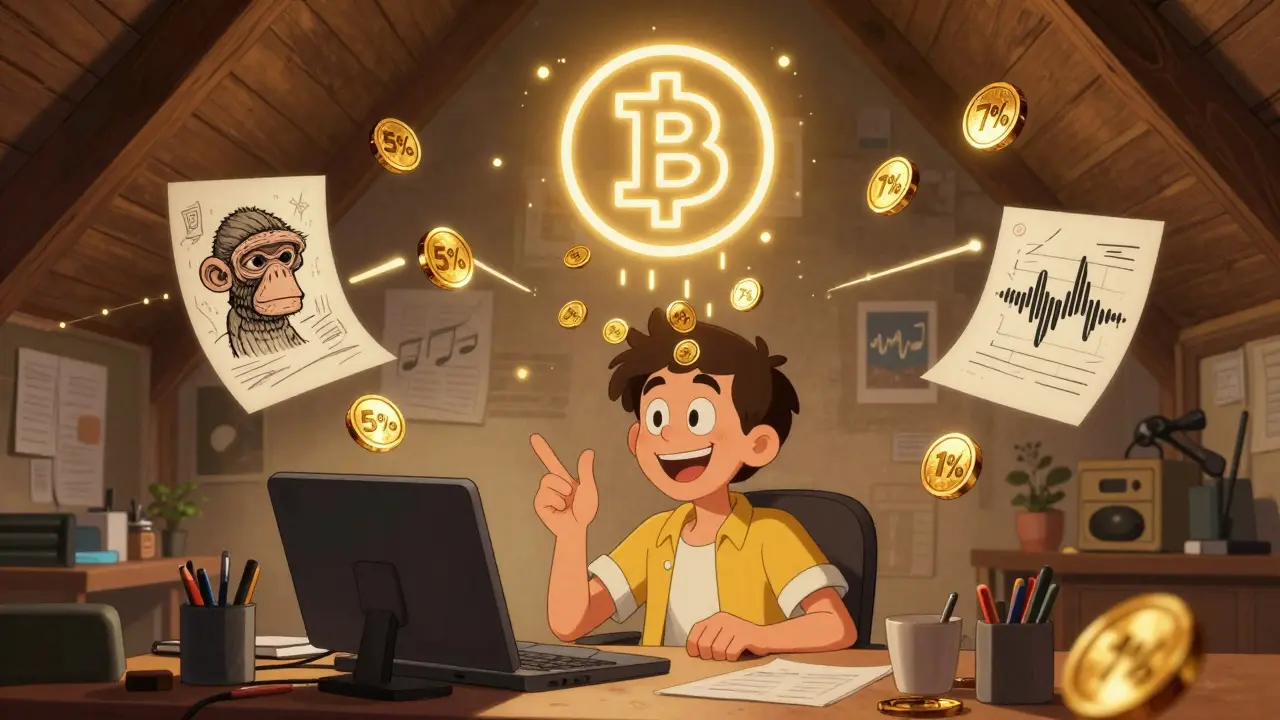
For decades, artists have faced a brutal truth: once they sell a piece of digital art, they rarely see another cent from it - even if that same piece sells for 10x, 100x, or more later. Galleries take cuts, auction houses keep profits, and copy-paste culture makes it easy for anyone to steal and redistribute work without paying a dime. But with NFTs, that’s changing - and fast.
What NFT Royalties Actually Do
NFT royalties are automatic payments built into the blockchain code of a digital artwork. When you mint an NFT, you can set a percentage - usually between 5% and 10% - that gets paid to you every time someone resells it. No paperwork. No middlemen. No waiting for a check. The moment the NFT changes hands, the money hits your wallet.
This isn’t theoretical. In 2022 alone, over $1.8 billion in royalties flowed back to creators on the Ethereum blockchain. That’s not a typo. That’s real money going straight to artists who made something people wanted to own.
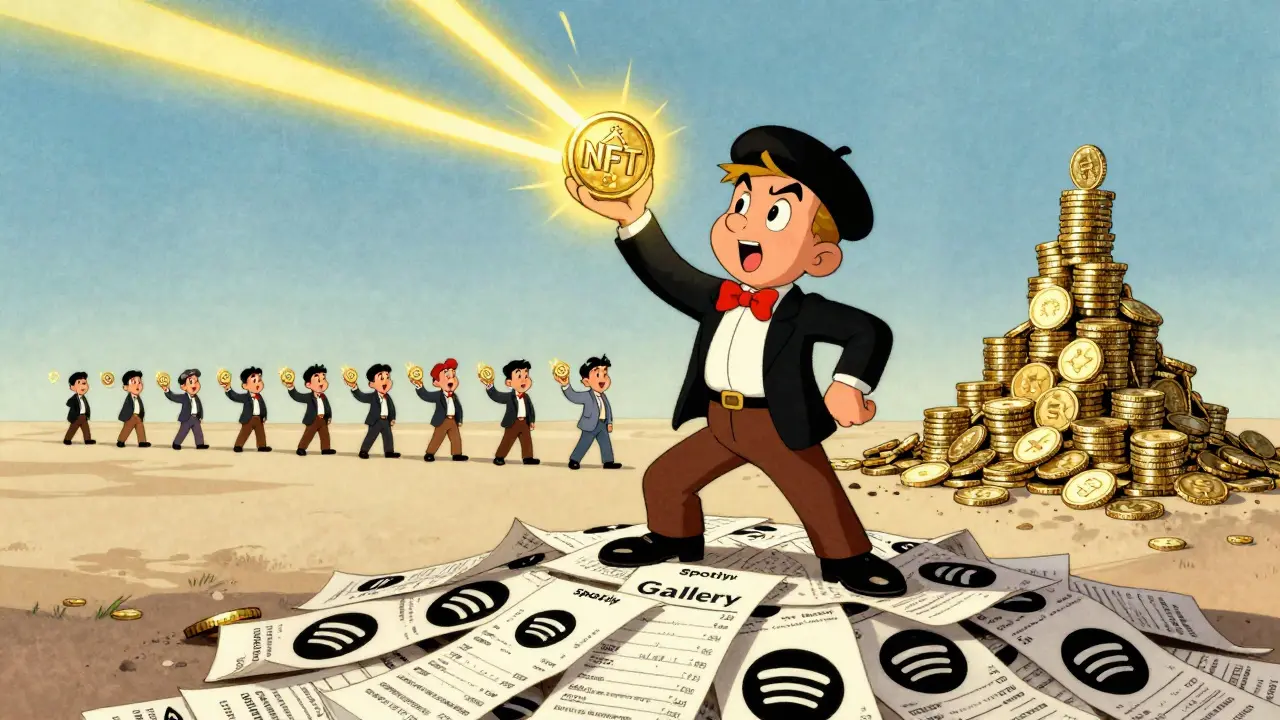
Take Yuga Labs, the team behind Bored Ape Yacht Club. They earned over $147 million in royalties from secondary sales. Or Jacques Greene, a musician who sold a 6-second audio loop as an NFT. He made $16,037 in royalties - nearly half what he earned from 7 million Spotify plays. That’s the power of owning the future value of your work.
Why This Beats Traditional Art Sales
In the real world, if a painter sells a canvas for $2,000, they get $2,000. If someone later flips it for $200,000? The artist gets nothing. The collector pockets the profit. The gallery took their cut. The auction house took theirs.
NFT royalties flip that model. Every time your art is resold - whether it’s a week later or five years from now - you get a cut. That means your work doesn’t just make money once. It keeps making money. Forever.
And it’s transparent. Anyone can look up the transaction history on the blockchain. You can see exactly how many times your NFT sold, for how much, and how much you earned each time. No hidden fees. No accounting errors. No delays.
Real Artists, Real Earnings
It’s not just big collections making bank. Independent artists are seeing life-changing results.
- A digital illustrator in Toronto set her royalty at 7% and now pulls in $3,000 a month just from resales - no new work needed.
- A game developer in Berlin earned $8,000 in royalties from a single character NFT sold over 120 times.
- A musician in Mexico City made more from one NFT album resale than from 18 months of streaming.
These aren’t outliers. They’re becoming common. Platforms like OpenSea, Blur, and Magic Eden have made it easy for anyone to set royalties during minting. You don’t need to code. You just pick a number, click ‘mint,’ and let the blockchain handle the rest.
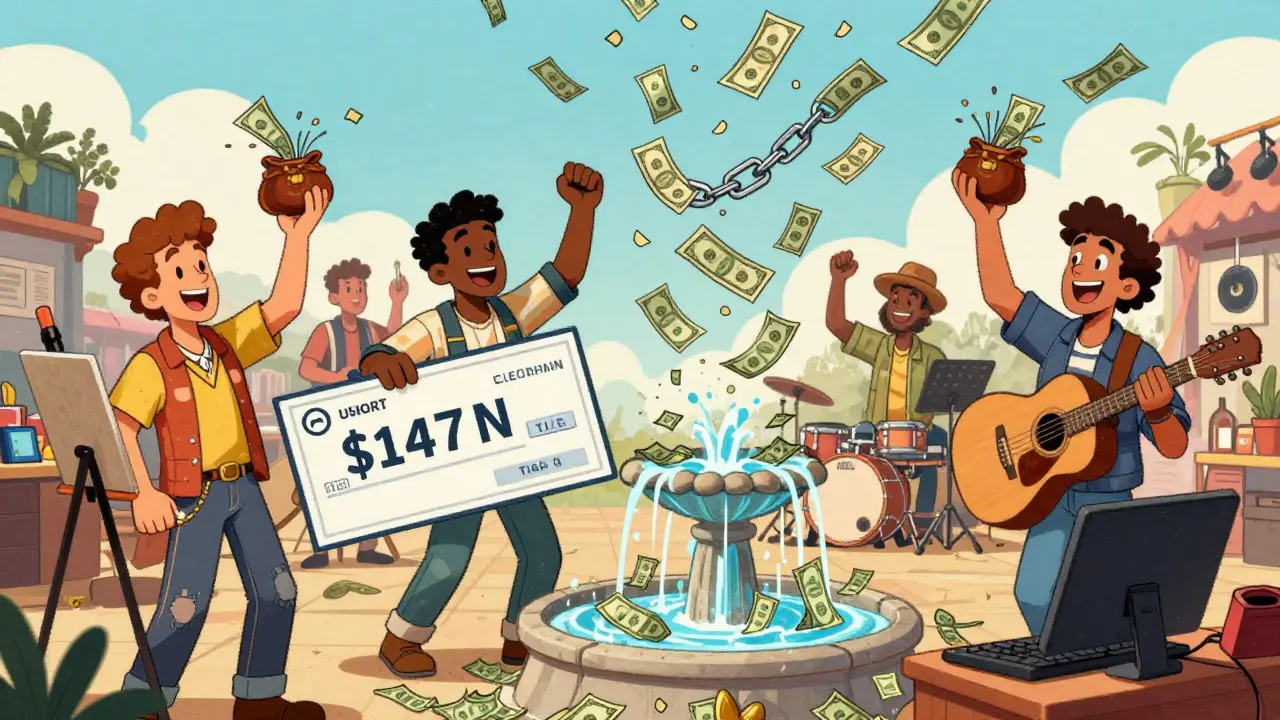
The Hidden Advantage: Creative Freedom
Most artists don’t just want money - they want to keep creating. Without royalties, many had to take day jobs, compromise their style, or chase trends just to pay rent. NFT royalties change that.
When you know your art will keep earning, you can take risks. Experiment with wilder concepts. Try new mediums. Make art that matters to you, not just what sells. That’s not just financial freedom - it’s artistic liberation.
One painter in Lisbon told a Reddit thread: “I used to delete half my work because I thought no one would care. Now I post everything. If it sells? Great. If it doesn’t? I still get royalties from the ones that do. I finally feel like I’m not begging for attention.”
Where It Gets Messy
It’s not all smooth sailing. Not all platforms enforce royalties. Magic Eden, for example, lets buyers opt out of paying them. That means if someone buys your NFT there and then resells it on a different marketplace that doesn’t honor royalties, you get nothing.
Then there’s the “NFT wrapping” loophole. Tech-savvy buyers can bundle your NFT into a new smart contract and sell it without triggering the royalty. It’s like putting a fake label on a designer bag and selling it as generic.
And some buyers hate high royalties. If you set yours at 15%, you might scare off collectors who see it as a tax on their investment. Most successful creators stick to 5-7%. That’s enough to matter, but not enough to turn people away.
There’s also no universal rule yet. One marketplace honors your royalty. Another doesn’t. Your NFT can be sold on three different platforms, and you get paid on only one. It’s a patchwork - and it’s frustrating.
How to Set It Up Right
If you’re an artist thinking about NFTs, here’s how to start:
- Choose a platform that enforces royalties (OpenSea, Foundation, SuperRare).
- During minting, set your royalty at 6%. That’s the sweet spot most buyers accept.
- Don’t mint everything at once. Test with one collection first.
- Join creator Discord groups. Ask how others set theirs. Learn what works.
- Track your sales. Use blockchain explorers like Etherscan to see where your royalties are going.
You don’t need to understand blockchain. You just need to know how to click “set royalty” and pick a number. The rest? The code does it for you.
The Bigger Picture
NFT royalties aren’t just about art. They’re about power. For the first time, creators have direct control over how their work is valued and compensated. No galleries. No record labels. No algorithms deciding if you’re “worth” anything.
This is how the internet was supposed to work - creators paid fairly, directly, and continuously. And it’s already happening.
As more platforms move toward enforcing royalties - and as regulators start recognizing them as legitimate income - this model will only get stronger. The future of digital creativity isn’t in streaming ads or sponsored posts. It’s in smart contracts that pay you every time someone loves your work enough to own it.
Do NFT royalties work on all marketplaces?
No. Some platforms like Magic Eden don’t enforce royalties by default, and buyers can bypass them using technical workarounds like "wrapping." Stick to platforms that actively enforce royalties - OpenSea, Foundation, and SuperRare are the most reliable.
Can I change my royalty percentage after minting?
Generally, no. Once an NFT is minted, the royalty percentage is locked into the smart contract. If you want to change it, you’d need to create a new collection. That’s why it’s critical to choose the right percentage before minting.
How much should I set my royalty at?
Most successful creators set royalties between 5% and 7%. Anything above 10% can deter buyers, especially investors looking to flip quickly. Below 5% might not make a meaningful difference. Test with your audience - ask in your community what feels fair.
Do I pay taxes on NFT royalties?
Yes. In most countries, including Canada and the U.S., NFT royalties are treated as income. You’ll need to report them on your tax return. Keep detailed records of every sale, the amount received, and the date. Many artists use crypto tax tools like Koinly or TokenTax to track this automatically.
Can I earn royalties from physical art sold as an NFT?
Yes - if the NFT represents ownership or rights to the physical piece. For example, if you sell a painting as an NFT with a clause that the buyer gets the physical artwork, you can still earn royalties on future NFT resales. The royalty applies to the digital token, not the physical object. But you’ll need clear terms in your smart contract or accompanying legal document.

Will Lum
February 10, 2026 AT 20:18Brittany Meadows
February 11, 2026 AT 09:32Christopher Wardle
February 12, 2026 AT 15:46Desiree Foo
February 12, 2026 AT 16:58Kaz Selbie
February 13, 2026 AT 01:45Robbi Hess
February 13, 2026 AT 13:36Keturah Hudson
February 13, 2026 AT 18:55Ace Crystal
February 15, 2026 AT 17:36SAKTHIVEL A
February 16, 2026 AT 04:44krista muzer
February 17, 2026 AT 16:18Tammy Chew
February 19, 2026 AT 03:59Lindsey Elliott
February 19, 2026 AT 04:01Santosh kumar
February 20, 2026 AT 17:10John Doyle
February 20, 2026 AT 17:43monique mannino
February 22, 2026 AT 13:42Holly Perkins
February 22, 2026 AT 17:37Claire Sannen
February 23, 2026 AT 05:19Elijah Young
February 23, 2026 AT 09:24Beth Trittschuh
February 24, 2026 AT 05:58Benjamin Andrew
February 26, 2026 AT 03:44Michelle Cochran
February 27, 2026 AT 21:23Sakshi Arora
February 28, 2026 AT 11:36